- 168 pages
- English
- ePUB (mobile friendly)
- Available on iOS & Android
eBook - ePub
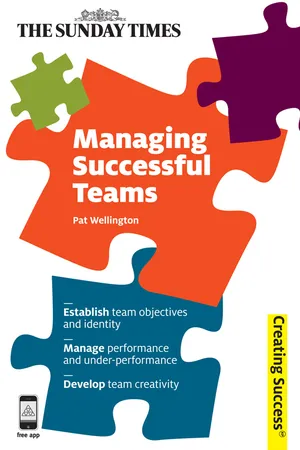
Managing Successful Teams
About this book
With the shift of emphasis from the West to emerging economies such as China, Brazil and India, organisations need to restructure to adapt to the new global economy. Teams and projects are increasingly being scattered all over the world, and a manager operating in this environment can't connect face to face with people in their team. Not only will managers need to adapt to develop their skills for new environments, they will have to work better, quicker and faster. Managing Successful Teams prepares you to meet the challenges of building and leading teams, showing you how to improve performance and achieve the best results. Offering valuable advice and instant strategies, it covers each aspect of managing teams in new cultural shifts, including developing team creativity and innovation, realigning the teams identity with your leadership style and effective team leadership. The only book on the market to incorporate emerging trends and shifts in business practice, Managing Successful Teams addresses the practical and realistic issues you face in your everyday working life.
Information
1
Setting the scene
Introduction
Your working role in life never stands still. You might start working as part of a work group, then become a member of a team and progress to becoming a team leader, possibly in a functional team. As your company grows and expands you could move into a self-managed team, or become a sponsor, or be asked to lead a virtual team. To cut to the chase: you need to develop a broad spectrum of knowledge and understanding, and have all your senses on high alert to develop your various roles, subtly change your style of management and behaviour according to the situation you find yourself in.
But what about the big picture? What is happening in the marketplace and why? How is this going to impact on our working lives?
Big picture
Even before the economic downturn, organisations have been in a state of change and restructuring often to survive, and then to compete on the global platform. This has involved either restructuring, de-layering, or corporate re-engineering, and the introduction of teams. This has allowed organisations to become either more specialised and/or more flexible in order to offer a product or service to the market, to be one step ahead and gain market share.
We have seen how manufacturers are returning to work-group teams, and how electronic communications enable teams to successfully operate even though their members are geographically widely dispersed. Organisations, whether private or public, have woken up to the fact that they do not need to control production in order to supply a service or product, and that in many cases vertical integration is inefficient since specialist providers can satisfy demands for ‘components’ more cheaply and to higher standards than in-house providers. ‘Outsourcing’, traditional for the materials and components inputs to many industries, is now becoming common for services and intangible inputs as well as physical components, consumables and sub-assemblies. At the same time, electronic communications have facilitated Just-in-Time manufacturing and inventory techniques, and forced organisations to recognise that one key to competitiveness is long-term and close relationships and teamwork with suppliers. In fact, the supplier is no longer a commercial slave to be whipped but a commercial colleague to be nurtured. Design and manufacturing teams are becoming more and more inter-enterprise, working alongside in-enterprise management teams.
The final step in this process was and is for organisations to ‘deconstruct’ themselves. Instead of being a monolithic structure, arranged in a pyramid with the chairman at the top and the workers at the bottom, with multiple layers of fossilised management systems in between, the whole edifice is dissolving into small independent work groups, each able to ‘sell’ some service or value to others. The idea is for teams to come together, involving individuals or groups from around (and outside) the enterprise, perform some activity, be it on a project or long-term production basis, and then dissolve, with the members re-forming into new teams to meet new challenges. Apart from a very small core of strategists and controllers, the ‘organisation’ in the ordinary sense of the word is on the verge of collapse, to be replaced with something resembling a shoal of fish or flock of migrating birds, splitting, re-forming and wheeling about to avoid dangers and to take advantage of current and short-lived sources of food. With the aid of electronic communications networks, many team members may work wherever they prefer to be, and the ‘office’ is becoming a pit stop rather than a residence, and ‘groupware’ is replacing the conference room.
Meanwhile, as the framework dissolves the teams live on, with key individuals perhaps being members of many teams simultaneously, providing personal and information links between them, and ensuring rapid flows of knowledge and ‘best practice’ from team to team. Teamwork has become the name of the game!
The pros and cons of teamwork
Any research on teams that we have undertaken in organisations has usually given us a positive feedback. Those organisations that have successfully implemented teams have found that communication has improved across the company, and there is a marked improvement in relationships and collaboration between departments, functions or teams. They have also found that they have managed to unlock hidden gems of knowledge and sharing of experiences between those in the teams. There have been ‘buy-in’ and a sense of ownership demonstrated by those who have undertaken a task or project. Another benefit has been improvements in the way resources are used, resulting in increased effectiveness, efficiency or productivity.
Well stop there. Isn’t this too good to be true? Yes, it is. There is a plethora of books and conference presentations talking about ‘why teams fail’. So let’s look at negative experiences as well, even for those companies that have ultimately successfully implemented teamwork company-wide.
The first stumbling block has been the amount of time it has taken to get teams up and running. Most teams will experience a drop in productivity to start off with while they get established, and this can affect morale. As a result, managers can then panic, as it is still common practice in most organisations in the West to focus on quarterly results. Even when organisations pilot the formation and use of a team there can be resentment from other parts of the workforce, or attempts to sabotage the initiative by senior personnel in the company who have not bought into the concept in the first place. It takes nerves of steel for the steering committee/senior management to stay convinced that implementing teams company-wide is the answer. In many instances it can take from three to five years for work teams to be fully and successfully implemented.
Another major stumbling block has been that the change in the role of managers to whom teams report (as distinct to team leaders) is radical and unexpectedly difficult. Manager as facilitator and manager as coach roles, even when anticipated and sometimes even trained for, often turn out to be deeply unsatisfactory to line managers.
There can also be resentment or ‘turf wars’ caused by decision-making abilities being transferred from a department to a team. For example, we worked on a customer care initiative with a London borough. One of the issues identified during the assignment was the fact that the one-stop call centre that had been created to offer a range of primary services had real difficulties initially getting even basic information. Individual departments would simply not provide information for the call centre to do its work properly. Staff in these departments saw the call centre as ‘new upstarts’, who might have good communication skills but could not possibly have the knowledge or intelligence to handle even basic, non-essential queries that related to the services they traditionally offered.
In reality many of the fundamental enquiries that people in these departments handled were an irritation and interrupted them undertaking the core parts of their workload. But at the same time they were clearly concerned as to how centralised the information or services from their department were going to be made, and the impact on their jobs. The approach often was, ‘If you don’t know what is going to happen it is better to resist.’
On balance, in spite of these negative experiences, I believe teamworking often provides an organisational effectiveness that usually exceeds that which is achieved by a traditional hierarchical chain of command. The flexibility and agility that are enabled by teams means companies can come to market with a new product or service not only to keep abreast of market trends but also to beat the competition. In addition, the emphasis on more people-centred companies where employees have the benefit of formal systems for their appraisal, the analysis of their training needs and assessment of the results achieved both personally and by the team, have all been part and parcel of how this has been achieved.
As we start to move through the book you will see that there is a considerable investment to be made – in planning, managerial time, training and opportunity cost to create a high performing team. The setting up of a team or teams within an organisation cannot happen without support from the top.
What support do teams need from the top?
How successful an organisation is at utilising teamwork effectively largely depends on the attitude, directives and policies that come from the management team. So what’s of importance?
- Too much hierarchy whether formal or informal can impede teamwork.
- Resources need to be sufficient for a team to function. This means right staffing levels, budget, equipment, and a way of accessing up-to-the-minute information.
- Encouragement of teams to work collaboratively rather than in competition with each other. It is important that these work groups set their goals in harmony with each other and that the goals are mutually supportive.
- Reward systems that recognise team performance as well as individual contributions.
- Teams need to have the authority to act upon their teams’ decisions.
Bearing all of this in mind, where do we go from here? For starters you need to understand the difference between a team and a work group and the various types of teams that might be developed within a company. So over and out to the next chapter.
2
Back to basics – the fundamentals of working in teams
Introduction
So we need to start from the basics. First, are teams always the answer? Do you really work in a team, or some other form of group? What is the definition of a team? Are there different types of teams and, if so, what are they? What are the considerations in structuring a team? What stages might a team go through in its development? What are the two critical roles that can make a difference between success and failure? What are the characteristics of a high performing team?
What is and what isn’t a team?
The creation of a team is not the answer in every situation that might arise within a company. If, for example, a group’s work is routine and unchallenging and wholly pre-programmed with no opportunity for feedback, developing a team will not make much difference to productivity.
In a food production line, if you take a bunch of staff doing a manual activity, for example, ensuring the washed lettuce leaves are evenly spread out across a conveyor belt or putting the stuffing in turkeys, there is little point in putting them in yellow jump suits and calling them the ‘leaf squad’, or ‘turkey finishers ...
Table of contents
- Cover
- Title page
- Imprint
- Dedication
- Table of contents
- Preface
- 1. Setting the scene
- 2. Back to basics – the fundamentals of working in teams
- 3. Setting up a new team
- 4. Managing the team once formed – motivation and performance management
- 5. Managing the team once formed – communication, meetings, influencing and projects
- 6. Taking over as manager of an established team
- 7. Problems in the team
- 8. Leading the virtual team
- 9. The future for teams
- References and recommended reading
- Full imprint
Trusted by 375,005 students
Access to over 1.5 million titles for a fair monthly price.
Study more efficiently using our study tools.
Frequently asked questions
Yes, you can cancel anytime from the Subscription tab in your account settings on the Perlego website. Your subscription will stay active until the end of your current billing period. Learn how to cancel your subscription
No, books cannot be downloaded as external files, such as PDFs, for use outside of Perlego. However, you can download books within the Perlego app for offline reading on mobile or tablet. Learn how to download books offline
Perlego offers two plans: Essential and Complete
- Essential is ideal for learners and professionals who enjoy exploring a wide range of subjects. Access the Essential Library with 800,000+ trusted titles and best-sellers across business, personal growth, and the humanities. Includes unlimited reading time and Standard Read Aloud voice.
- Complete: Perfect for advanced learners and researchers needing full, unrestricted access. Unlock 1.5M+ books across hundreds of subjects, including academic and specialized titles. The Complete Plan also includes advanced features like Premium Read Aloud and Research Assistant.
We are an online textbook subscription service, where you can get access to an entire online library for less than the price of a single book per month. With over 1.5 million books across 990+ topics, we’ve got you covered! Learn about our mission
Look out for the read-aloud symbol on your next book to see if you can listen to it. The read-aloud tool reads text aloud for you, highlighting the text as it is being read. You can pause it, speed it up and slow it down. Learn more about Read Aloud
Yes! You can use the Perlego app on both iOS and Android devices to read anytime, anywhere — even offline. Perfect for commutes or when you’re on the go.
Please note we cannot support devices running on iOS 13 and Android 7 or earlier. Learn more about using the app
Please note we cannot support devices running on iOS 13 and Android 7 or earlier. Learn more about using the app
Yes, you can access Managing Successful Teams by Pat Wellington in PDF and/or ePUB format, as well as other popular books in Business & Human Resource Management. We have over 1.5 million books available in our catalogue for you to explore.