The Complete Guide to Property Development for the Small Investor covers every stage of property development. Including both practical 'how-to' advice and important guidance on making a profit from property.
This new edition constitutes an essential handbook that is both comprehensive and user-friendly. Containing practical checklists and extensive details on useful addresses and websites, the book also provides updates on essential legislative changes that will have an impact on both new and experienced developers.
This fully revised and updated third edition includes vital new information on: changes to tax/VAT incentives; the impact of the credit crunch on the UK property market (and the potential opportunities if offers); the rise and fall (and potential rise again) of the buy-to-let market; and the latest rules and regulations affecting both landlords and tenants.
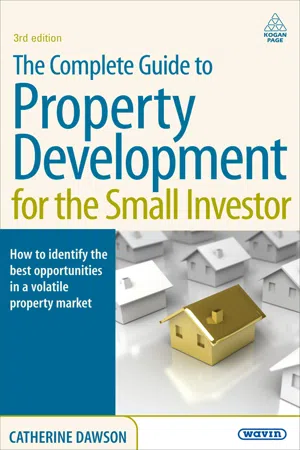
eBook - ePub
The Complete Guide to Property Development for the Small Investor
How to Identify the Best Opportunities in a Volatile Property Market
- 288 pages
- English
- ePUB (mobile friendly)
- Available on iOS & Android
eBook - ePub
The Complete Guide to Property Development for the Small Investor
How to Identify the Best Opportunities in a Volatile Property Market
About this book
Information
Stage One
Preparation
1 | Knowing how to invest successfully |
Many potential investors are asking whether, given current market conditions, it is the right time to invest in property development. This is because property prices are falling in many parts of the United Kingdom and people are beginning to worry about the ‘credit crunch’ and the effect this will have on their family finances.
To be able to answer this question it is important to understand the relationship between the UK economy and the housing market, consider short- and long-term trends and undertake a full assessment of market conditions. It is also important to consider possible benefits for investors of the current market position, especially in terms of the availability of bargain properties such as repossessions and failed buy-to-let investment properties. Once you have considered these issues you can then ask whether it is prudent to invest in property development at this time. These issues are discussed in this chapter.
The economy and housing market
If you are thinking about investing in property development you need to have a thorough understanding of current and future economic and market conditions, and understand how they relate to the housing market. As we have seen in the United States, when the economy expands, lenders tend to extend too much credit and consumers are happy to accept this credit, usually because they have confidence in the housing market. This results in many people taking out larger mortgages than they can realistically afford, and leads to much greater borrowing on credit cards and hire purchase agreements. However, when economic conditions worsen, excessive borrowing means that people are unable to meet their payments, confidence in the housing market slumps, property prices begin to fall and homes are repossessed.
The International Monetary Fund (IMF) believes that the UK housing market will follow the US market, but on a two-year time lag. Experts fear that many homeowners in the United Kingdom who have overstretched their borrowing will suffer as a similar credit crunch begins and inflation rises. Indeed, recent figures indicate that the number of repossessions in the United Kingdom reached 27,100 in 2007, up from 22,400 in 2006 according to the Council of Mortgage Lenders (CML), and experts fear that this figure will rise to more than 45,000 in 2008. This has prompted the UK Government to begin talks with mortgage lenders to try to avert the crises and deal more favourably with homeowners who find themselves in arrears and facing repossession.
The role of the media
Some experts, however, think that the media in particular are over-emphasizing the financial problems being faced by the United Kingdom and that, in doing so, they are making a bad economic situation worse. Financial crises are always big news and the media has had some spectacular financial stories to report recently, including problems with rogue traders and bank collapses. Some people believe that this type of scaremongering could lead to people reducing their spending and saving money, which means that less money is spent and large amounts of money are removed from the economy. This can help to increase the likelihood of a recession and a property market crash.
One view is that buyers are being manipulated by stories in the media that do not reflect reality. This is because the media need to tell a story, but they also need to entertain, which often leads to a concentration of personal stories that do not reflect what is happening in reality. For example, I was recently approached by a TV company who wanted to interview me about the experiences of property developers who had lost their properties through repossession, or lost out financially through poor development strategies. I said that I didn’t know of anyone that fitted this description. Our property company is doing very well and so are all the others that we are aware of. They were disappointed and said that this information would hardly make a good story. I pointed out that this reflected reality as I saw it. However, when the programme was screened it seemed to suggest that all property developers throughout the United Kingdom were suffering financially and that they were losing their properties through repossession. Two personal stories were reported to back up this assertion. Yet this does not reflect my reality – our company has been running successfully since 1996, and many of our competitors are also doing very well.
However, despite stories in the media not always reflecting reality, the media do have considerable influence on the public. Indeed, the Royal Institution of Chartered Surveyors (RICS) found in a recent survey that 23 out of 200 surveyors cited media gloom as having an impact on confidence in their local property market. If people are new to a particular market, such as property development, it is understandable that they will take note of the media when making investment decisions. However, you should balance this information with your own research. The economy in the United Kingdom is suffering, and there is potential for a property market crash, but this does not mean that property development is not still a viable investment opportunity, as long as careful decisions are made backed up by thorough personal research. Advice about how to do this is offered throughout this book.
Monitoring inflation
If you are thinking about investing in property development, it is important to monitor inflation and interest rates carefully to make the most of your investment. At this present time, the UK inflation rate is well above the Bank of England’s 2 per cent target and above average for the European Union as a whole. Inflation determines the real return on any investment that you make and can have a major impact on the value of your investment in the future.This is of particular importance when viewing property investment as a long-term strategy. Therefore, you need to make sure that if you decide to invest in property development, your plans are not at the mercy of inflation and any future rises that may occur. In the United Kingdom the Consumer Prices Index (CPI) measures changes in the prices of selected household goods and uses this to determine the rate of inflation. For more information about the CPI and for up-to-date figures, visit www.statistics.gov.uk.
When economic growth is strong more money chases fewer goods and services, which pushes up prices and leads to higher inflation, which is what we have seen over the past few years in the United Kingdom. When this occurs, interest rates are used to keep growth broadly in line with its long-run trend of around 2.5 per cent each year. This is one of the reasons why interest rates rose in 2006 and 2007. Higher interest rates tend to discourage borrowing and encourage saving, which should slow the economy. Lower rates encourage borrowing and should have the opposite effect. This is one reason why we have seen the recent cuts in interest rates. Movements in interest rates affect the overall level of demand in the economy and so can have a powerful influence on the inflation rate.
Although higher inflation rates tend to be good for borrowers and bad for investors, you need to consider this link between inflation and interest rates when making your investment. If you intend to take out a mortgage on a property, the real value of your mortgage could be reduced considerably in times of high inflation, so this could work in your favour, but only if interest rates are favourable. Therefore, if you have cash to invest it may not be prudent to invest all of it in property by buying outright when inflation is high. Instead, you could decide to borrow on the property, or you could look to other types of investment. When doing this you need to consider the trends and prospects of other types of investment. Other assets, such as shares, can produce better returns than the property market, but this type of investment is much more volatile. In general, bonds and high-interest savings accounts will not provide as good a return as property has done over the last 35 years, but, in general, they are much safer options. If you are interested in other types of investment, you should seek the advice of an independent financial advisor. Information about doing so is provided in Chapter 4.
Understanding short- and long-term trends
To gain a better understanding of the trends and prospects of the housing market it is useful to look at how the market has performed in the past. Two useful house price surveys are produced by the Halifax and the Nationwide Building Society. The Halifax House Price Index was first produced in 1983. It shows that since then house prices have increased by 8 per cent a year, while inflation has increased by 4.5 per cent a year. The Nationwide house price survey began in 1973 and in that time house prices have increased by an average of 9 per cent a year. This compares to an average rate of inflation of 7 per cent a year over the same period.
These figures show that house prices have beaten inflation over the last 25–35 years, and that therefore buying property has represented a good long-term investment. Where investors can lose out is when they view their investment as a short-term strategy during times of market uncertainly. For example, in the five years from 1990 to 1995 house prices fell by around 10 per cent. Short-term investors who spent large amounts of money on properties and then tried to sell them lost out considerably during this time because prices were falling so quickly. However, in the 13 years since 1995 house prices have more than trebled in many parts of the United Kingdom. This means that, during this period, short-term property development strategies did prove to be very lucrative. Even people who bought properties that...
Table of contents
- Cover
- Title page
- Imprint
- Table of contents
- Introduction
- Stage One: Preparation
- Stage Two: Progression
- Stage Three: Procurement
- Stage Four: Permission
- Stage Five: Perspiration
- Stage Six: Presentation
- Stage Seven: Preservation
- Useful addresses
- Useful websites
- Full Imprint
Trusted by 375,005 students
Access to over 1.5 million titles for a fair monthly price.
Study more efficiently using our study tools.
Frequently asked questions
Yes, you can cancel anytime from the Subscription tab in your account settings on the Perlego website. Your subscription will stay active until the end of your current billing period. Learn how to cancel your subscription
No, books cannot be downloaded as external files, such as PDFs, for use outside of Perlego. However, you can download books within the Perlego app for offline reading on mobile or tablet. Learn how to download books offline
Perlego offers two plans: Essential and Complete
- Essential is ideal for learners and professionals who enjoy exploring a wide range of subjects. Access the Essential Library with 800,000+ trusted titles and best-sellers across business, personal growth, and the humanities. Includes unlimited reading time and Standard Read Aloud voice.
- Complete: Perfect for advanced learners and researchers needing full, unrestricted access. Unlock 1.5M+ books across hundreds of subjects, including academic and specialized titles. The Complete Plan also includes advanced features like Premium Read Aloud and Research Assistant.
We are an online textbook subscription service, where you can get access to an entire online library for less than the price of a single book per month. With over 1.5 million books across 990+ topics, we’ve got you covered! Learn about our mission
Look out for the read-aloud symbol on your next book to see if you can listen to it. The read-aloud tool reads text aloud for you, highlighting the text as it is being read. You can pause it, speed it up and slow it down. Learn more about Read Aloud
Yes! You can use the Perlego app on both iOS and Android devices to read anytime, anywhere — even offline. Perfect for commutes or when you’re on the go.
Please note we cannot support devices running on iOS 13 and Android 7 or earlier. Learn more about using the app
Please note we cannot support devices running on iOS 13 and Android 7 or earlier. Learn more about using the app
Yes, you can access The Complete Guide to Property Development for the Small Investor by Catherine Dawson in PDF and/or ePUB format, as well as other popular books in Negocios y empresa & Propiedad inmobiliaria. We have over 1.5 million books available in our catalogue for you to explore.