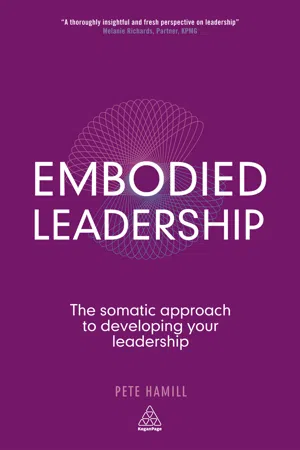
We don't need leaders who know about leadership - we need leaders who embody the capacity to lead in the midst of ambiguity and complexity. The concept of embodied leadership is derived from somatic coaching, a unique approach that brings the body forward as an advocate in creating a place for change and transformation. It brings together language, action, feeling and meaning and is based on the idea that the mind and body are inextricably linked: to develop one, you must cultivate the other.
Embodied Leadership deconstructs our thinking about the body using key discoveries in neuroscience to demonstrate the uses and benefits of a somatic approach, particularity in the area of emotional intelligence.There are practical exercises throughout to develop embodied leadership skills and personal development.
- 272 pages
- English
- ePUB (mobile friendly)
- Available on iOS & Android
eBook - ePub
About this book
Information
PART ONE
Setting the foundations
In the first part of this book, I will show how our ideas on leadership needed to be updated if they are to be effective. Our ideas on leadership, however, sit on top of some flawed ideas on what it is to be human, and it is ultimately these that we must address if we are to understand leadership differently.
My aim with these five chapters is that you can walk away understanding why some non-obvious and, perhaps a little weird, approaches to leadership development may actually be the ones that will be most effective. From that in Part Two, we will explore in more detail how this can work in practice.
01
What do we mean by leadership anyway?
Leadership… remains the most studied and least understood topic in all the social sciences. Like beauty, or love, we know it when we see it but cannot easily define or produce it on demand. WARREN BENNIS1
It feels important to begin by establishing some foundations about the concept of leadership itself, before going on to the main theme of this book, embodiment. While it would be ideal if we started with a common and agreed understanding of leadership, this may be too much to hope for, given Warren Bennis’s comment above. My aim therefore, is to at least begin by laying some groundwork so that you as the reader can start with an understanding of what I mean by leadership.
To begin with, it’s important to understand that when talking about leaders and leadership, people are often referring to subtly different things.
• The leaders: Sometimes we are speaking of the leaders, themselves, and the characteristics or traits of those individuals.
• The position: Regularly I hear people referring to leaders, when in fact they are referring to the people who hold certain positions of power and authority in organizations or society.
• The actions and behaviours: Some people prefer to speak about leadership, rather than leaders, and here they will often refer to the actions or behaviours of individuals that constitute leadership (or not).
• The results: And finally, others when referring to leaders and leadership, will be focused on results – leadership is about results and leaders are those who achieve those results.
One of the problems I see is that when people are speaking about leaders or leadership they are often speaking from one of these different perspectives, but without realizing it. An argument or debate can easily follow just because two people are speaking about the subject with different assumptions about leadership.
Each of these ways of looking at leadership sheds light on some aspects of the subject, and equally leaves some problematic aspects in the shadows. I will consider each of these perspectives in turn, look at the implications of viewing leadership in that way, and then begin to develop a more integrated view of this topic.
Leadership: the leaders
There are many books written on leadership, and if you distil their essence much of what they write is no different from that in older texts, such as Plato’s Republic in the West, or the Bhagavad Gita in the East. What these older books seek to do is describe an exemplary human being (the Bhagavad Gita is at times referred to as the ‘manual for mankind’), and in today’s world we look for many of these virtues under the label of leadership. In this way of looking at leadership, who we are defines our leadership.
In this viewpoint we are looking for exemplary human beings to lead us, and integrity and honesty become very important concepts. What sort of mood do leaders carry with them (moods are infectious in organizations2)? What presence and gravitas do they have? Are they benevolent or malevolent as leaders? Are they able to deal with complex and ambiguous situations? All of these are core pieces that we look for in leaders.
It’s also about the relationship the leader develops with their followers. What’s it like to be led by you? When you are with someone, do you feel that they are really present with you, or are they trying to get something from you? Do they have an agenda? We know from many sources (from psychology to neuroscience) that human beings need connection and belonging. For much of human evolution we were potentially something else’s dinner, and being excluded from the tribe was fatal. Whilst that is not necessarily true now, our entire evolutionary biology is wired for us to seek connection and belonging.
This is probably all fairly recognizable – we want leaders with integrity, who have the capacity to build relationships and bring people together. The virtues when described in this way bring back one of the oldest debates on leadership – are leaders born or made? Nature or nuture?3 Are some people just born good at this stuff, whilst others aren’t?
Nature versus nurture?
Over the past centuries, part of what has occurred has been an evolution and democratization of the concept of leadership. Many of the prior restrictions have been removed. Historically, leadership was the divine right of kings and emperors – and indeed in some parts of the world it still is. Over time there has been a movement from this to the ‘great man’ and ‘trait’ theories of leadership, which emphasized some traits that were born into a person and allowed that person to be a leader – and it was generally men (with a few notable exceptions) who were these leaders.
Today many of us live in a world where, at least theoretically, anyone can be a leader. Theoretically, anyone can become prime minister in the UK, and theoretically any US citizen can become president. China, although filled with legal complexity, inequality and Communist Party internal politics, is brimming with entrepreneurs leading small businesses and looking for opportunities. This is not to say that there is not inequality in our society – there is; women, for example, are less likely to achieve positions of leadership in many organizations – but leadership is now thought to be more available to more people.
Some people argue that there is a genetic component to leadership, and therefore some people will just be more natural leaders. A recent study on this showed that genes may account for 49 per cent of a person’s qualities of transformational or inspirational leadership.4 The study, based on surveys of hundreds of twins, showed that although a proportion may be affected by genetics, there was a vital importance in providing training to develop managers’ abilities to practise transformational leadership. So even if genes do have a say, a large proportion (around 51 per cent) comes down to development, and even with ‘good genes’ for leadership, the study’s authors conclude that development is required.
I am dubious that even 49 per cent of leadership can be put down to genetics. In coming to that statistic, the authors of the study admit some limitations.5 The research makes the assumption that environmental factors, such as what children learn from their parents, are all basically reducible to genetics – in other words, their parents’ influence over them doesn’t matter as everything will be passed on through genes anyway. This undermines their conclusions, from my perspective, and means that a figure as high as 49 per cent needs to be read sceptically.
Therefore, I am very cautious about the idea that genes are responsible for even this amount of our leadership capacity. The challenge is that our genes do not completely define us, as they were once thought to do – all genetics can really say is that someone has a propensity for something, rather than being an accurate predictor.6 There is also a (relatively) new scientific field of epigenetics, which looks at how our genes are switched on or not, depending on, amongst other things, environmental factors.7 Therefore the idea that our genes have fixed us in some way and dictate our leadership capacity is highly dubious.8
I am personally very reluctant to reduce everything back to genes in some form of genetic determinism for leadership. The majority of the evidence from science, psychology and the wider social sciences points to a wider range of factors being involved. In fact, today, a genetic basis for any talent or skill (from sports and music to leadership) is highly questionable. In his best-selling book Outliers, Malcolm Gladwell made these ideas famous. He looks at how most Canadian ice hockey stars are born at the start of the year:
in any elite group of hockey players – the very best of the best – 40 per cent of the players will have been born between January and March, 30 per cent between April and June, 20 per cent between July and September, and 10 per cent between October and December.9
On investigating this, we discover that the cut-off date for age-specific ice hockey for children is in January. Therefore a boy who is 10 at the start of January could be playing with another who turns 10 in December of the same year. This creates a development gap that is significant at this age. So what happens next? The boys who play better, who will probably be the older ones who are more physically mature, get more attention, more coaching and support. Over time they are selected for more competitive games, and get more opportunities to practise and learn the skills of ice hockey. There is no astrological or genetic determinism at work, simply factors of age, attention and opportunities to practise.
A study cited by Gladwell in the American Journal of Human Biology showed how, when Belgium changed its cut-off date for soccer from August to January, this changed the birth-month composition of elite players, so that within a couple of years there were almost no elite players born in December.10
A recent study published in the UK by the Institute for Fiscal Studies, showed how birth month impacts on schooling in the UK. Children there start primary school in the September after they turn four. A similar gap develops between those who turn four in August and those who turned four in the previous September, who are in the same school year. This development gap has a negative impact upon later exam results, university admissions and self-confidence of the younger children compared with those who are almost a year older.11
Geoff Colvin, a Senior Editor at Fortune magazine, in his book Talent is Overrated, goes further in arguing against a genetic basis for talent:
Some researchers now argue that specifically targeted innate abilities are simply fiction. That is, you are not a natural-born clarinet virtuoso or car salesman or bond trader or brain surgeon – because no one is. Not all researchers are prepared to accept that view, but the talent advocates have a surprisingly difficult time demonstrating that even those natural gifts they believe they can substantiate are particularly important in attaining great performance.12
So it seems that, although this is still an area of active scientific study, researc...
Table of contents
- Cover
- Praise for Embodied Leadership
- Title Page
- Imprint
- Dedication
- Contents
- Foreword
- Acknowledgements
- Introduction
- PART ONE Setting the foundations
- PART TWO Exploring the ideas in practice
- PART THREE The wider implications for leadership
- Index
- Full imprint
Trusted by 375,005 students
Access to over 1.5 million titles for a fair monthly price.
Study more efficiently using our study tools.
Frequently asked questions
Yes, you can cancel anytime from the Subscription tab in your account settings on the Perlego website. Your subscription will stay active until the end of your current billing period. Learn how to cancel your subscription
No, books cannot be downloaded as external files, such as PDFs, for use outside of Perlego. However, you can download books within the Perlego app for offline reading on mobile or tablet. Learn how to download books offline
Perlego offers two plans: Essential and Complete
- Essential is ideal for learners and professionals who enjoy exploring a wide range of subjects. Access the Essential Library with 800,000+ trusted titles and best-sellers across business, personal growth, and the humanities. Includes unlimited reading time and Standard Read Aloud voice.
- Complete: Perfect for advanced learners and researchers needing full, unrestricted access. Unlock 1.5M+ books across hundreds of subjects, including academic and specialized titles. The Complete Plan also includes advanced features like Premium Read Aloud and Research Assistant.
We are an online textbook subscription service, where you can get access to an entire online library for less than the price of a single book per month. With over 1.5 million books across 990+ topics, we’ve got you covered! Learn about our mission
Look out for the read-aloud symbol on your next book to see if you can listen to it. The read-aloud tool reads text aloud for you, highlighting the text as it is being read. You can pause it, speed it up and slow it down. Learn more about Read Aloud
Yes! You can use the Perlego app on both iOS and Android devices to read anytime, anywhere — even offline. Perfect for commutes or when you’re on the go.
Please note we cannot support devices running on iOS 13 and Android 7 or earlier. Learn more about using the app
Please note we cannot support devices running on iOS 13 and Android 7 or earlier. Learn more about using the app
Yes, you can access Embodied Leadership by Pete Hamill in PDF and/or ePUB format, as well as other popular books in Business & Management. We have over 1.5 million books available in our catalogue for you to explore.