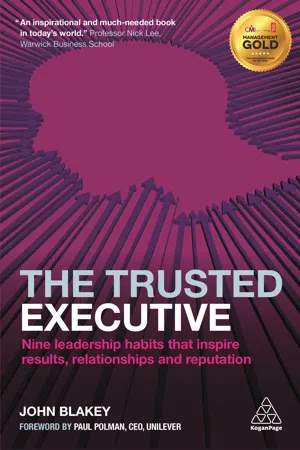
SHORTLISTED: CMI Management Book of the Year 2017 - Commuter's Read Category The Trusted Executive helps leaders create a strategy for building trust in a globalized, technology-enabled, diverse and increasingly sceptical world. Through innovative coaching exercises, self-assessment exercises, inspirational interviews with international CEOs and underpinned by rigorous academic research, The Trusted Executive gives leaders the tools to build trust through three key pillars: ability, integrity and benevolence. Underpinning these pillars lie nine habits of trustworthiness; habits that will enable executives to deliver outstanding results, inspiring relationships and a positive contribution to society. With tools for measuring and developing leadership trust and focused strategies for handling trust violations, The Trusted Executive takes account of the ever-changing, increasingly diverse and multi-generational work environment. An essential tool for leaders who want to create a positive long-term legacy.
eBook - ePub
The Trusted Executive
Nine Leadership Habits that Inspire Results, Relationships and Reputation
- English
- ePUB (mobile friendly)
- Available on iOS & Android
eBook - ePub
The Trusted Executive
Nine Leadership Habits that Inspire Results, Relationships and Reputation
About this book
Information
Part I
Trust lost and trust regained

01
A broken model
The blue pill vs the red pill
There is one and only one social responsibility of business – to use its resources and engage in activities designed to increase its profits so long as it stays within the rules of the game, which is to say, engages in open and free competition without deception or fraud.1
Such was the opinion of the economist Milton Friedman when interviewed for The New York Times back in September 1970.1 This quote is a great example of how truth is defined by the times and the culture in which we happen to live. Truth is not a fixed entity. I am sure that if I was a US businessman reading Milton Friedman’s article back in the 1970s it would seem an entirely reasonable conclusion being spoken by a highly eminent economist. Yet it is now history. The world has changed and it keeps changing.
Friedman’s quote reveals that we have lived in a business world that worshipped the concept of financial profit. This singular pursuit was fuelled by executive leaders who relied upon one central assumption: if I have a powerful enough intellect to work out the best answers and I have the authority to implement those answers then I will maximize the financial returns of this business. I will be successful in the eyes of the business owners. We worshipped profit and the temple of financial profit was supported by two sacred pillars – intellectual ability and authority (see Figure 1.1). I am not using the word ‘authority’ in the context of being an expert on a topic or even as the enforcer of agreed standards, policies and rules. I am using it in the context of a job title in a hierarchical organization, which grants an executive leader the authority to tell someone else what to do.

FIGURE 1.1 The temple of profit
This model had the benefit of being both simple and, for many years, largely effective in achieving the goal. We could regard it as a product of the industrial revolution – a highly mechanistic, scalable means of production. However, can you imagine if I had teleported a 1970s businessman into a 21st-century boardroom and placed him amongst his modern-day peers? What would he have made of their smart phones and their video-conferencing, their tie-less, smoke-free conversations on the rise of Generation Y, their strange habit of pouring their own coffees at the break? Not to mention that the lady sat at the table is not a minute-taking secretary but the CEO herself! That businessman would be as bewildered as I hope you were when you read the above quote from Milton Friedman.
In this chapter, I will explore the background to this model: who created it, why they created it and the purpose it has served. In particular, I will examine the underlying assumptions that this model makes about the trustworthiness of executive leaders and conclude that it is a model that remains deeply wired in the executive subconscious. While this model has served the world of business to a point, I will argue that it is reaching the limit of its effectiveness in a 21st-century environment where the converging trends of globalization, technology, media, Generation Y and diversity are exposing that authority has been used as a surrogate for trust. In other words, what held the traditional model together and enabled it to function was deference to authority. When this pillar is challenged by the diverse stakeholders of the modern business, the model starts to break down. What is revealed is that authority is what we use when we want to manage staff for the singular pursuit of financial profit on behalf of the owners of the business. Trust is what we must use if we want to lead a diverse group of stakeholders who all wish to have a say in the future purpose of business and who all wish to benefit from its activities. So let us explore more closely how and why the ’70s world of Milton Friedman differs from the world of tomorrow’s trusted executive.
Traditional measures of business success: Single bottom line
Traditionally, life was simple. The purpose of a commercial business was to maximize profits and this was the singular measure of success. Even in ‘third sector’ organizations such as charities and social enterprises, we have been trained to focus upon another version of profit, which we call ‘surplus’. Whatever we call it, profit has given us a barometer of success that has some advantages and some disadvantages. On the one hand, it is a readily understood concept in the business world and it is a consistent measure of the added financial value of our activities. On the other hand, it breeds a myopic fascination with one particular assessment of business contribution that can blind business leaders to the wider context in which they operate. If business continues to worship profit within a societal context that has decided it no longer worships profit then this will progressively undermine trust in business institutions and those who lead them.
Where does this idea of worshipping profit come from? It comes from Friedman’s 19th-century peers such as Adam Smith and other economists who ushered in the industrial revolution. It is 19th-century economics that still lies at the heart of the modern business system. Smith and his protagonists created a model of man in which ‘economic values guide choice, and choices are rational and utility maximizing… the goal of Smith’s economic man is to maximize the wealth of the firm and is based on contractual duties owed to owners’.2 A model of man in which the source of power is institutional authority and intellectual ability and the means of managing risk is through control not through high trust relationships. A model of man in which we are all no more than ‘self-interested actors rationally maximizing our own personal economic gain’.3 This mindset powered a period of unprecedented growth and innovation in the western world, yet we must be careful to remember that it was only ever a model; it was not the truth. Like all models it has its limitations. Despite those increasing limitations, it is highly likely that this model still remains the underlying assumption of your organizational world; an assumption so deeply wired into our collective consciousness that we have long forgotten its origin and its justification.
However, we have not forgotten its central implication which is that, as executive leaders, our job is to maximize profit on behalf of the owners of our enterprises. How could we forget this implication when these same owners monitor, control and reward us on a daily basis with this goal in mind? If you are an entrepreneur that owner may be a voice in your own head. If you are a charity then it is the voice of your trustees. If you are a global CEO it is the quarterly return you present to your shareholders. Whatever your form of governance, I guess that you will quickly identify this voice and recognize its impact on your leadership behaviours. As one of the global CEOs I interviewed put it:
However much you try to avoid it, the quarterly reporting matters and that drives a set of behaviours that are at odds with longer-term goals. You talk about driving the business for the long term but you act to deliver in the short term. Consequently, it appears as if you are lying.
The goal matters. What matters gets measured. And what gets measured gets done and so creates a deep groove in the organizational psyche.
CASE STUDY The case of Dodge brothers versus Ford Motor Company
The ideology of short-term shareholder profit as the sole purpose of business was enshrined in law via the legal dispute between the Dodge brothers and Ford Motor Company in 1919.4 Henry Ford, the founder of Ford Motor Company, sought to end special dividends for shareholders in order to make long-term investments in new plant and machinery, which would also increase the number of people employed by the company and reduce the cost of Ford cars to the consumer. Announcing his intention, he said:
My ambition is to employ still more men, to spread the benefits of this industrial system to the greatest possible number, to help them build up their lives and their homes. To do this we are putting the greatest share of our profits back in the business.
The Dodge brothers, John and Horace, owned 10 per cent of the company at the time and, on behalf of the m...
Table of contents
- Cover
- Praise for The Trusted Executive
- Dedication
- Title Page
- Contents
- Foreword by Paul Polman, CEO, Unilever
- Introduction: ‘You’re too nice, Blakey’
- PART I Trust lost and trust regained
- PART II The nine habits that inspire results, relationships and reputation
- PART III The wider context
- Afterword
- About the author
- Index
- Copyright
Trusted by 375,005 students
Access to over 1.5 million titles for a fair monthly price.
Study more efficiently using our study tools.
Frequently asked questions
Yes, you can cancel anytime from the Subscription tab in your account settings on the Perlego website. Your subscription will stay active until the end of your current billing period. Learn how to cancel your subscription
No, books cannot be downloaded as external files, such as PDFs, for use outside of Perlego. However, you can download books within the Perlego app for offline reading on mobile or tablet. Learn how to download books offline
Perlego offers two plans: Essential and Complete
- Essential is ideal for learners and professionals who enjoy exploring a wide range of subjects. Access the Essential Library with 800,000+ trusted titles and best-sellers across business, personal growth, and the humanities. Includes unlimited reading time and Standard Read Aloud voice.
- Complete: Perfect for advanced learners and researchers needing full, unrestricted access. Unlock 1.5M+ books across hundreds of subjects, including academic and specialized titles. The Complete Plan also includes advanced features like Premium Read Aloud and Research Assistant.
We are an online textbook subscription service, where you can get access to an entire online library for less than the price of a single book per month. With over 1.5 million books across 990+ topics, we’ve got you covered! Learn about our mission
Look out for the read-aloud symbol on your next book to see if you can listen to it. The read-aloud tool reads text aloud for you, highlighting the text as it is being read. You can pause it, speed it up and slow it down. Learn more about Read Aloud
Yes! You can use the Perlego app on both iOS and Android devices to read anytime, anywhere — even offline. Perfect for commutes or when you’re on the go.
Please note we cannot support devices running on iOS 13 and Android 7 or earlier. Learn more about using the app
Please note we cannot support devices running on iOS 13 and Android 7 or earlier. Learn more about using the app
Yes, you can access The Trusted Executive by John Blakey in PDF and/or ePUB format, as well as other popular books in Business & Management. We have over 1.5 million books available in our catalogue for you to explore.