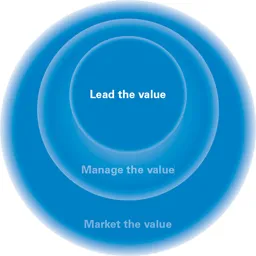
The consequences of a primary focus on shareholders over the last few decades has emphasized that that a new model of value creation is necessary. Today's economy demands organizations that create value, not only for shareholders but also for customers, employees, leaders and society. Businesses that face up to this challenge by focusing on all the stakeholders involved will be far more successful in the long term than those driven purely by seeking to deliver the maximum return on shareholder investment. Creating Lasting Value shows readers how to achieve lasting results by channeling efforts into three key areas. It demonstrates how to lead the value, manage the value, and market the value.
The successful organizations of the future will be those that can put these principles into practice: this book shows you how.
eBook - ePub
Creating Lasting Value
How to Lead, Manage and Market Your Stakeholder Value
- 288 pages
- English
- ePUB (mobile friendly)
- Available on iOS & Android
eBook - ePub
Creating Lasting Value
How to Lead, Manage and Market Your Stakeholder Value
About this book
Information
Wave 1: Lead the Value
04
Mobilize energy
The preceding chapters focused mainly on the foundations of value creation. Now it is time to discuss value creation in practice. We will do so with the help of the concrete steps presented in Chapter 2, which are required to make the waves of value roll. Let us commence with ‘Mobilize energy’ since there is no movement without energy. This chapter will first describe the two streams of energy in organizations. We will also indicate the various ways to create energy and give people a feeling of urgency or excitement. Next, we will look at the different sources that can be used to create energy. Mobilizing energy is required at various levels within an organization, from the workfloor to the boardroom. But how?
4.1 What happens here?
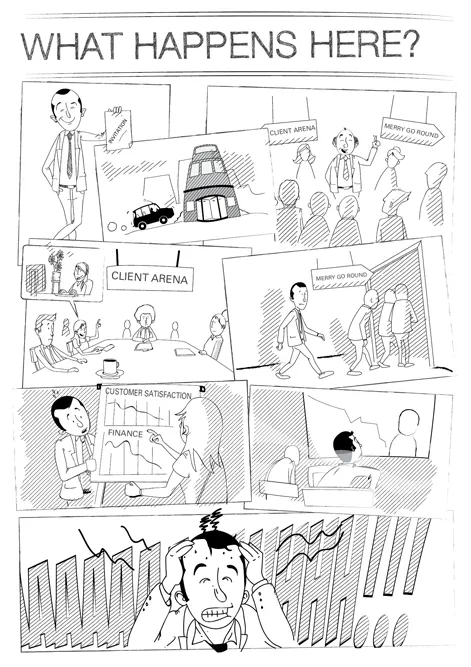
Imagine that you are manager in a large insurance company. Not just any manager. No, you have made it into the top 50 of the company. One day you are invited to a meeting; a strategy meeting. This is not that unusual as it happens more frequently now. You know it will be one of those days, a day spent sitting down. The new strategy has probably been defined and will now be presented by the big boss. In all likelihood, the message will once again be: ‘We have to change because the market demands that we do so. These will become our five priorities for the next two years. This also means that you will have to change.’ An alarming number of charts and those types of stories will be presented. You have to get through it until the end of the day. Grit your teeth a while longer. But oh well, it is also laid back and you can do a spot of networking in-between.
You drive to the establishment in your BMW X5. You enter and chat to your colleagues briefly. It is about to start. You are curious about what today’s programme actually involves. Sure enough, the big boss kicks it off but that only takes five minutes as he says: ‘Today we’re going to take a look together to see where we currently stand as an organization.’ The entire group is split into two subgroups. You are in the group that remains in the plenary hall. The other group is going to ‘do a merry-go-round’. This intrigues you, but first you look at what is going to happen in the plenary hall.
A table and some chairs have been placed in the middle of the hall. Positioned around them is a large ring of chairs, in a kind of U shape, but without tables. You have to sit in the outside ring as the chairs in the inner ring (at the table) are occupied by a number of employees. They are from the call centre and are accompanied by a number of salespeople. Hey, there is Martin, a salesperson from your department. The discussion leader seated at the table explains: ‘Welcome to this employee arena. I’m going to talk with the employees seated in the inner ring for the next 45 minutes and you will only listen. That may be difficult, but it is important that you listen attentively. Once the 45-minute period has finished you may ask questions and talk to people in the inner ring.’ The discussion gets off to a bit of an uncomfortable start. You notice that the employees find it somewhat scary, but the first comments arrive five minutes later and you are astonished that they had the courage to utter them. One of the call-centre employees reveals why she enjoys this work and the most wonderful thing she experienced in her job:
When I received a bouquet of flowers because I had personally ensured the money was credited to his account! I still have the card that accompanied it. It was quite a task. I personally had to go through six or so departments and was sent back and forth. But I told myself that they weren’t going to keep me down and that I would sort it out for that gentleman. After all, I saw on my screen that he had already called seven times about the same issue.
You think that this is an example of good service. How good of her! You can see that her eyes are really shining, by the way. ‘I received no recognition for this from my boss, incidentally. I was even told off for not meeting my production target and spending too much time on my telephone calls. You know, all numbers can be green here while the customer walks away screaming. But I can never really get my manager to discuss this since he is in meetings most of the time. The walls between departments are very high and everyone simply throws work over them. Perhaps they should organize things better during those management meetings seeing as they’re all sitting together at that moment.’ The arena discussion then shifts to the honesty of appraisals, the appreciation you receive for your work, the promises made by sellers that are impossible to keep, and several other topics. You discover that the workfloor has more passion than you imagined. You also notice that you can improve your leadership style….
Phew, the arena discussion has finished. You now find yourself in a smaller group and head off to do ‘the merry-go-round’. You enter the financial room first, which contains a large sign with two lines. One line depicts the organization’s turnover: stable for the past four years. The other represents costs over the same period. Boy oh boy, they have risen! You see high-denomination banknotes strewn across the ground. Are they genuine? They appear to be the increased costs for the past year. A discussion ensues in the group, led by the CFO. Were we actually aware of this? Yes, we were in fact, but everyone thought that it would improve. A bell rings, signalling us to move to the next room. The customer room also features a large sign with two charts once again. They look very stable. The customer satisfaction rating has been 6.3 over the past years. The number of customers who recommend your organization to others constitutes 3 per cent of the total. That was 4 per cent in previous years. A clothesline with letters attached to it has also been hung up. Letters of complaint. In the background you continue hearing a friendly voice, apparently from the organization’s call centre. The voice repeats: ‘One moment please, no member of staff is currently available.’ A short discussion about customers is also held in this room. When was the last time you actually spoke to a customer? The bell rings, telling you to move along. Twenty minutes in one of these rooms fly by pretty quickly. As you leave the room the last thing you hear from the loudspeaker is ‘One moment please, no member of staff is currently available.’ The third room, the employees’ room, is filled with festive smiles and streamers. It also contains a large foam sign featuring a number of statements from employees and some figures. Employee satisfaction is 7.5. Wow, that is high. Engagement with one’s own work is 7.8, while engagement with the organization is 6.2. Source: the employee survey conducted last year. This cannot be true, surely? Financially, we are performing poorly, customers are dissatisfied and everyone here is happy? There goes the bell again. Off to the following room, which looks completely different. A sign reading ‘cinema’ is hanging above the door. Great! But it looks more like a haunted house when you enter. It is pitch dark with scanty lighting and smoke in the air. The film begins. It is a customer speaking about his investment-based savings scheme in which most of the premium was spent on costs rather than investments. He invested €17,000 in savings but the value now is a mere €1,430. He is in his late thirties and speaks into the camera in a very polite and controlled manner. You can see, though, that he is extremely disappointed and angry. It makes you think of Kafka. It makes you think of the company you work for. Your stomach aches and you feel nauseous. The bell rings for lunch. You do not really have an appetite.
Without going into detail about what happened after lunch, how the day ended and what the follow-up steps were, let us pause and think about why your stomach aches. Do you perhaps feel a sense of urgency?
4.2 Urgency and excitement
We distinguish between two energy streams in the mobilization of energy. The first energy flow relates to urgency. A sense of urgency arises when people start perceiving threats, weaknesses, uneasy truths or brutal facts. Change is based on external necessity. When you experience a sense of urgency, you realize that something needs to be done differently because disaster will strike if the situation remains the same. Customers are leaving, losses are significant, the company’s image has been damaged and market share is dwindling faster than ever before. A sense of urgency is therefore always related to a clear, important and urgent issue, which is also perceived as such by the people concerned. You cannot avoid it; something clearly has to happen.
If a real sense of urgency exists, people identify risks in their external environment and actively seek opportunities for change. They then have the desire to intervene immediately and overcome threats. They then reserve time for important activities aimed at achieving progress rapidly. They then undertake to formulate a good vision and strategy. They then undertake to eliminate obstacles. The tempo is then maintained at a high level and short-term successes are attained and celebrated.
There is a drawback to creating a sense of urgency. It is initially negative and unpleasant. It gives you stomach ache, as was the case in the previous tale. The consequence is that you must not continue creating a sense of urgency indefinitely. This can ultimately foster feelings of alienation, causing people to drop out because they sense a lack of appreciation for their commitment and results. Be honest and imagine how you would feel if you have been working day and night since the start of a change process as team leader, investing all your energy into improvements and achieving actual improvements. However, you can only hear about aspects that are not going well. Be that as it may, there is also a great advantage to creating a sense of urgency, and that is its obligatory nature. You must take action, you must do something, otherwise it will go wrong.
Creating a sense of excitement has a completely different character. It is a sense of excitement that arises because people see opportunities and challenges. A sense of excitement ensures an inner motive and the desire to change, innovate or even conquer. The benefit of a sense of excitement is that it is positive. It is enjoyable to follow new paths, pursue your ideals and realize new opportunities. We will provide another example of this in section 4.4, which looks at Per Jorgenson from International Health Insurance (IHI). The disadvantage of a sense of excitement is that it can be obligation-free, especially within large organizations. In the corridors you may hear people saying: ‘That group is working on that customer-focus project and is so enthusiastic. I personally think it’s a bit exaggerated, but it’s nice to see them working like that.’ Such comments indicate appreciation, but not engagement, ownership or action.
Reason and feeling: a dualistic approach
How do you create such a sense of urgency or excitement? This is a question we now wish to address in greater detail. To do so, we will make grateful use of several guidelines provided by John Kotter in his book The Heart of Change (Kotter and Cohen, 2002). A sense of urgency or a sense of excitement can be created in various ways. The first way involves the rational side. This usually proceeds as follows: a survey is initiated, various documents and reports are studied, a comparison with the benchmark is made, and several conclusions are distilled from a detailed and thorough analysis. These conclusions do not lie. They cannot be ignored. The people to whom the results are presented are therefore expected to draw the conclusion themselves: ‘We must change.’ John Kotter calls this approach the Think-Analyse-Act method. Although it is exceedingly logical, thorough and reliable, this approach often fails (particularly ...
Table of contents
- Cover page
- Praise for Creating Lasting Value
- Title page
- Imprint
- Table of contents
- Acknowledgements
- Introduction and Summary
- The foundations of value creation
- Wave 1: Lead the Value
- Wave 2: Market the Value
- Wave 3: Market the Value
- Making even bigger waves
- Epilogue
- References
- Index
- Full imprint
Trusted by 375,005 students
Access to over 1.5 million titles for a fair monthly price.
Study more efficiently using our study tools.
Frequently asked questions
Yes, you can cancel anytime from the Subscription tab in your account settings on the Perlego website. Your subscription will stay active until the end of your current billing period. Learn how to cancel your subscription
No, books cannot be downloaded as external files, such as PDFs, for use outside of Perlego. However, you can download books within the Perlego app for offline reading on mobile or tablet. Learn how to download books offline
Perlego offers two plans: Essential and Complete
- Essential is ideal for learners and professionals who enjoy exploring a wide range of subjects. Access the Essential Library with 800,000+ trusted titles and best-sellers across business, personal growth, and the humanities. Includes unlimited reading time and Standard Read Aloud voice.
- Complete: Perfect for advanced learners and researchers needing full, unrestricted access. Unlock 1.5M+ books across hundreds of subjects, including academic and specialized titles. The Complete Plan also includes advanced features like Premium Read Aloud and Research Assistant.
We are an online textbook subscription service, where you can get access to an entire online library for less than the price of a single book per month. With over 1.5 million books across 990+ topics, we’ve got you covered! Learn about our mission
Look out for the read-aloud symbol on your next book to see if you can listen to it. The read-aloud tool reads text aloud for you, highlighting the text as it is being read. You can pause it, speed it up and slow it down. Learn more about Read Aloud
Yes! You can use the Perlego app on both iOS and Android devices to read anytime, anywhere — even offline. Perfect for commutes or when you’re on the go.
Please note we cannot support devices running on iOS 13 and Android 7 or earlier. Learn more about using the app
Please note we cannot support devices running on iOS 13 and Android 7 or earlier. Learn more about using the app
Yes, you can access Creating Lasting Value by Jeroen Geelhoed,Salem Samhoud,Nur Hamurcu in PDF and/or ePUB format, as well as other popular books in Negocios y empresa & Estrategia empresarial. We have over 1.5 million books available in our catalogue for you to explore.