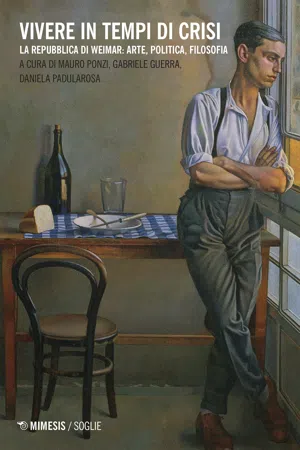
La Repubblica di Weimar (1919-1933) è stata un laboratorio politico e culturale in cui sono state formulate e sperimentate soluzioni artistiche, politiche e teoriche, che hanno fortemente influenzato i decenni successivi. Questo periodo storico è stato fondamentale per la Germania e per l'Europa perché ha rappresentato il periodo di modernizzazione della cultura e della politica che ha fornito le basi per le strutture istituzionali, i linguaggi e le sperimentazioni artistiche, riprese poi dopo il dodicennio nero del nazismo. I saggi raccolti in questo volume affrontano l'arte, la politica e la filosofia della Repubblica di Weimar nei loro rispettivi linguaggi, stilemi, teorie e prassi. Vivere in tempi di crisi non è facile e meno che mai è facile dare una risposta teorica e pratica alle cause di questa crisi, dai molteplici aspetti, e trovare il modo per uscirne. Questo stato di crisi permanente è forse l'elemento che conferisce agli studi pubblicati in questo volume un motivo di unità, un forte interesse storico, letterario e filosofico nel riproporre un tema dimenticato e forse anche un motivo di forte attualità.
eBook - ePub
Vivere in tempi di crisi
La Repubblica di Weimar: arte, politica, filosofia
- English
- ePUB (mobile friendly)
- Available on iOS & Android
eBook - ePub
Vivere in tempi di crisi
La Repubblica di Weimar: arte, politica, filosofia
About this book
Information
Subtopic
World HistoryIndex
HistoryBibliografia generale
Adorno Theodor W., Kierkegaard. La costruzione dell’estetico, Longanesi, Milano 1983.
Agamben Giorgio, L’avventura, Nottetempo, Roma 2015.
Amann Melanie, Angst für Deutschland: die Wahrheit über die AFD: wo sie herkommt, wer sie führt, wohin sie steuert, Droemer, München 2017.
Ankum Katharina von (Hg.), Women in the Metropolis: Gender and Modernity in Weimar Culture, University of California Press, Berkeley 1997.
Aragon Louis, Le paysan de Paris, Gallimard, Paris 1926.
Arendt Hannah, L’angelo della storia. Testi, lettere, documenti, trad. it. a cura di Corrado Badocco, Giuntina, Firenze 2017.
Ariès Philippe, Storia delle mentalità, in La nuova storia, a cura di Jacques Le Goff, Mondadori, Milano 1980, pp. 141-166.
Asholt Wolfgang - Fähnders Walter (Hgg.),“Die ganze Welt ist eine Manifestation”. Die europäische Avantgarde und ihre Manifeste, Wissenschaftliche Buchgesellschaft, Darmstadt 1997.
Aufricht Ernst Josef, Erzähle, damit du dein Recht erweist, Alexander-Verlag, München 1966.
Axel Fritz, Ödön von Horváth als Kritiker seiner Zeit, in Dieter Hildebrandt - Traugott Krischke (Hgg.), Über Ödön von Horváth, Suhrkamp, Frankfurt a.M. 1972.
Baader Johannes, 14 lettere di Cristo, trad. it. e cura di Simone Buttazzi, Area 51, San Lazzaro di Savena 2011.
Baeumler Alfred, Bachofen, der Mythologe der Romantik, in Der Mythus von Orient und Occident. Eine Metaphysik der alten Welt, aus den Werken von J.J. Bachofen mit einer Einleitung von Alfred Baeumler, hrsg. v. Manfred Schröter, C.H. Beck’sche Verlagsbuchhandlung, München 1956, pp. XXIII- CCXCIV.
– , Metafisica e storia. Lettera a Thomas Mann, trad. it. di Leonardo Pica Ciamarra, in “Archivio di Storia della Cultura”, XVIII (2005), pp. 363-381.
Baeumler Marianne - Brunträger Hubert - Kurzke Hermann, Thomas Mann und Alfred Baeumler. Eine Dokumentation, Königshausen und Neumann, Würzburg 1989.
Balistreri Antonio Giuseppe, La “Rivoluzione conservatrice” tedesca come concetto e come campo di controversia storiografica, in “Il Pensiero politico”, XXVIII (1995), pp. 210-236.
Ball Hugo, La fuga dal tempo. Fuga saeculi, trad. it. di Pierluigi Taino, Campanotto, Pasian di Prato (UD) 2006.
Barndt Kerstin, Sentiment und Sachlichkeit. Der Roman der Neuen Frau in der Weimarer Republik, Böhlau, Köln 2003.
Barth Ulrich, Protestantismus und Kultur. Systematische und werkbiographische Erwägungen zum Denken Paul Tillichs, in Christian Danz - Werner Schüßler (Hgg.), Paul Tillichs Theologie der Kultur. Aspekte-Probleme-Perspektiven, De Gruyter, Berlin-Boston 2011, pp. 13-37.
Bartsch Kurt, Ödon von Horváth, Metzler, Stuttgart-Weimar 2000.
– , Frühe Horváth-Aufführungen in Österreich nach 1945, in Klaus Kastberger (Hg.), Ödon von Horváth. Unendliche Dummheit-dumme Unendlichkeit, Paul Zsolnay, Wien 2001, pp. 140-154.
Bauman Zygmunt, Retrotopia, trad. it. di Marco Cupellaro, Laterza, Roma-Bari 2017.
– , Strangers at our door. Stranieri alle porte, trad. it. Marco Cupellaro, Laterza, Roma-Bari 2016.
Baur Detlev, Der Chor im Theater des 20. Jahrhunderts. Typologie des theatralen Mittels Chor, Niemeyer, Tübingen 1999.
Beaud Olivier, Les derniers jours de Weimar. Carl Schmitt face à l’avènement du nazisme, Descartes & Cie, Paris 1997.
Beaud Olivier - Pasquino Pascal, La controverse sur Le gardien de la constitution ...
Table of contents
- Introduzione Vivere in tempi di crisi
- Gian Enrico Rusconi Lezioni di Weimar
- Federico Lijoi La democrazia tra compromesso e decisione. Un dilemma etico per Weimar
- Hermann Wündrich L’artista funambolo
- Antonio Rostagno Il teatro di Alban Berg nella Repubblica di Weimar
- Matthias Warstat Tra classe e società: politica di strada rivoluzionaria e il teatro della Repubblica di Weimar
- Akira Ichikawa La Takarazuka-Revue e Due cravatte di Georg Kaiser. il lascito di Seiki Hori
- Flavia Arzeni Ödon von Horváth: Italienische Nacht. Attuale, sempre attuale…
- Giulia Iannucci “Das Babel der Welt”.
- Mauro Ponzi Laboratorio Weimar: arte e politica
- Giuseppe Di Giacomo Arte e politica nella Repubblica di Weimar
- Gabriele Guerra Demoni a Weimar. Una rilettura teofilosofica
- Daniela Padularosa Lo spirito e la macchina: Dada a Weimar
- Domenico Conte Tommy a Weimar.
- Wolfgang Müller-Funk La Repubblica di Weimar. monumento storico della ragion cinica
- Carlo Galli Schmitt nella crisi di Weimar
- Dario Gentili Sull’idea di rivoluzione.
- Massimo Palma L’intellettuale costituente. Hugo Preuss tra Schmitt e Brecht
- Bibliografia generale
Trusted by 375,005 students
Access to over 1.5 million titles for a fair monthly price.
Study more efficiently using our study tools.
Frequently asked questions
Yes, you can cancel anytime from the Subscription tab in your account settings on the Perlego website. Your subscription will stay active until the end of your current billing period. Learn how to cancel your subscription
No, books cannot be downloaded as external files, such as PDFs, for use outside of Perlego. However, you can download books within the Perlego app for offline reading on mobile or tablet. Learn how to download books offline
Perlego offers two plans: Essential and Complete
- Essential is ideal for learners and professionals who enjoy exploring a wide range of subjects. Access the Essential Library with 800,000+ trusted titles and best-sellers across business, personal growth, and the humanities. Includes unlimited reading time and Standard Read Aloud voice.
- Complete: Perfect for advanced learners and researchers needing full, unrestricted access. Unlock 1.5M+ books across hundreds of subjects, including academic and specialized titles. The Complete Plan also includes advanced features like Premium Read Aloud and Research Assistant.
We are an online textbook subscription service, where you can get access to an entire online library for less than the price of a single book per month. With over 1.5 million books across 990+ topics, we’ve got you covered! Learn about our mission
Look out for the read-aloud symbol on your next book to see if you can listen to it. The read-aloud tool reads text aloud for you, highlighting the text as it is being read. You can pause it, speed it up and slow it down. Learn more about Read Aloud
Yes! You can use the Perlego app on both iOS and Android devices to read anytime, anywhere — even offline. Perfect for commutes or when you’re on the go.
Please note we cannot support devices running on iOS 13 and Android 7 or earlier. Learn more about using the app
Please note we cannot support devices running on iOS 13 and Android 7 or earlier. Learn more about using the app
Yes, you can access Vivere in tempi di crisi by AA. VV., Mauro Ponzi, Gabriele Guerra, Daniela Padularosa in PDF and/or ePUB format, as well as other popular books in History & World History. We have over 1.5 million books available in our catalogue for you to explore.