"A powerful case for the persistent questioning and existential interruption that accompanies that pursuit of [happiness and revolution], and fuels it, and constitutes and ruptures its vagrant, open end."— Fred Moten, author of In the Break: The Aesthetics of the Black Radical Tradition
"It is hard today to escape the perception that financial violence and fascism are suffocating every possibility of happiness… There Is No Unhappy Revolution shows a possible way out from this despair."— Franco "Bifo" Berardi, author of Futurability: The Age of Impotence and the Horizon of Possibility.
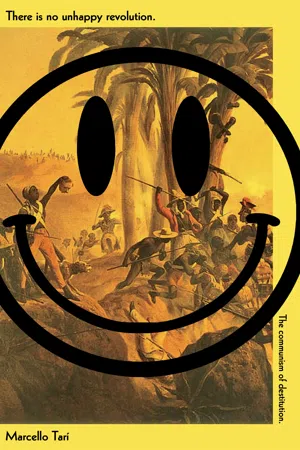
In a time of ongoing political, economic, and climate crisis can we afford our collective unhappiness any longer? There Is No Unhappy Revolution gives expression to the age of revolution unfolding before us. With equal parts sophistication and raw urgency, Marcello Tarì identifies the original moments as well as the powerful disruptive and creative content haunting our times like a specter.
The age of revolution is back, and with it, instability and uncertainty as major markers of our times. There is a renewed faith in popular rebellion as a means to enact sorely needed systemic change. At the heart of these dynamics rests a new theory of social change and societal well-being. Happiness is collective, not individual, as Marcello Tarì explains, and our collective desire for happiness is a revolutionary force that cannot and should not be contained.
One hundred years after the October Revolution, amidst our current civilizational crisis, is it still possible to think and build communism? Yes, Tarì responds, provided we radically rethink the tradition of revolutionary movements that have followed one century to another. Offering both a militant philosophy and a philosophy of militancy, he deftly confronts the different contemporary movements from the Argentinean insurrection of 2001 to Occupy Wall Street, the Spanish Indignados, the French movement against the labor law, and the Arab Spring, resurrecting and renewing a lineage of revolutionary thought, from Walter Benjamin to Giorgio Agamben, that promises to make life livable.
What happens next? At least no exploiter will suddenly pop up; and should something even worse happen, well now the tables have been cleared and you can see what might be wrong with free men and women, or what is not wrong with them yet.
—Ernst Bloch, Traces1
The first discussions of “destituent insurrection” in recent times were presented by militant researchers Colectivo Situaciones, in a book written in the wake of the Argentinian insurgency of Winter 2001, and concentrated in particular on two insurrectionary days, December 19 and 20, of that year.2
In their text, Colectivo Situaciones claims those two days in December represented a series of problems for those trying to read the insurgency in more-or-less traditional Marxist or anarchist terms. Even if they themselves remained strongly bound to those categories, faced with the facts of the Argentinian situation, they managed—with a visionary realism—to describe certain features that have today redefined the revolutionary question. Here, once more, we find that subject and object are not mere givens: “we intend to develop a style of thought constituted not by the preexistence of its object but by its interiority with respect to the phenomenon we are thinking about.”3
Colectivo Situaciones’s book has been translated and discussed in many languages, but their novel definition of the insurrection did not find particular resonance at the time. It found none whatsoever, to tell the truth. This was, in all likelihood, because it posed contradictions to the political grammar utilized by the Argentinian group’s “sympathetic readers”: principally made up of Italian-influenced post-operaists, and then Latin American neo-Marxists. In fact, Colectivo Situaciones soon abandoned this line of research and language, returning to more orthodox modes of expression and eventually bringing their project to an end.4
Unsurprisingly, the post-operaists did not grasp the crucial importance of destitution, preferring instead to continue to focus on the old category of counterpower. Others, at different latitudes, who perhaps might have grasped it, were either prejudiced or otherwise distracted. In reality, that book contained a range of inventive elements ahead of its time, even if other elements were destined to wane away—and not only those connected to traditional categories of left-wing political thought, but also the antiglobalization movement that was, quite rightly, fading out that same year.
Indeed, 2001—the Year of the Snake in Chinese astrology—signaled the end of the alter-globalization movements and the beginning of a new cycle of global civil war: the snake shed its skin. In rapid succession, we saw the events of the G8 in Genoa, the explosion of the Twin Towers in New York, the beginning of what became known as the “permanent and continuous war,” the implosion of Argentinian neoliberalism—the precursor of the “financial crisis,” concentrated in a single country—and, within that context, the appearance of a strange insurrectionary practice that announced the form of revolts to come. The following appeared in prompt succession: the uprising of the French banlieues in 2005, the Greek insurgency of 2008, and then a rapid crescendo that culminated in the burning of the world between 2010 and 2011. A new episode emerged in 2016, with the massively popular French revolt against the new labor law reforms.
One might propose that the Argentinian insurrection constituted a paradigm—an exemplum—of those struggles that commenced following the declaration of a “state of global crisis” in 2008.5 Frequently, in opposition to a certain form of mechanistic Marxist historicism, the form of struggle—a paradigm, in a quite precise sense—is revealed to the world before the so-called “objective” conditions have matured. It is as if there is a kind of practical prophecy, heralding a politics yet to come. It represents a call to arms that interrupts the continuum of the revolutionary tradition—better yet, a tradition that has become conformism. The left complains, every time in fact, new forms of struggle suddenly and noisily appear: “Now is not the moment, we need to wait for the ‘objective conditions’ to mature. The people won’t understand. This is a gift to reactionary forces: you’re merely provocateurs.” For the left, the objective conditions obviously never mature, while in a short period of time, these same conditions mature for governments in terms of counter-insurrection.
We are not saying anything particularly original, in writing that forms of struggle come before dynamics of power. Foucault claimed on more than one occasion, “resistance comes first,” thumping his fist on the table. Mario Tronti wrote in the 1960s that the principal factor is the struggle of the working class and not that of capitalist development.6 E. P. Thompson described the “making” of the English working class, demonstrating its autonomous origins—it was not simply a byproduct of capitalist industry—and that capital instead had to wage a social war against the class, beginning with a close study and then dismemberment of proletarian forms of life and struggle. In other words, we can say with a certain level of antihistoricist authority, new forms of struggle and resistance appear before certain forms of power, giving real meaning to the word reactionary. In this regard, the real question to confront has always been that of breaking apart the circularity discovered by operaismo between struggle and development, between resistance and the reconfiguration of power, which seems to necessarily tie the two together. The revolutionary question lies for the most part in bringing an end to this infernal cycle, and destituent power, perhaps, simply names this “bringing to an end.” In any case, we cannot apply the same mechanism in the opposite direction by attempting to claim that struggle automatically anticipates the future and, moreover, produces the conditions for its defeat. Common sense teaches us that things do not always go the same way. No one knows what a form of struggle can do, because no one knows what a form of life can do.
That a contextual form of struggle can reconfigure the general form of a conflict to come depends on something that has little to do with classical politics and even less with political economy. Forms of life, in their simplest outlines, generate, within and around themselves, forms of struggle. It is only when a form of life and a form of struggle coincide in time, becoming indistinguishable from each other, becoming one with each other, that we witness a revolutionary phenomenology in action. Whoever in our own times manages to grasp the fragments of a form of life that exist, relatively speaking, outside of government and capital and enter into a revolutionary becoming, manages to read a trend, to see not so much what is moving from today in a straight line towards tomorrow, but that which is coming towards us, in leaps and bounds, as a result of the short-circuiting of the past and the present. Conversely, those who grasp nothing whatsoever—for example, the contemporary urban uprisings in Europe and across the world—fail to understand them. They are obsessed with the future. They ignore—consciously or otherwise—the experiments in life that are taking place everywhere in recent years, from Rome to Athens, from Rennes to Barcelona, from New York to Chiomonte, from Cairo to San Cristóbal de las Casas, which in their turn represent a paradigm. The error that seems to repeat itself every time is that of a posteriori dividing forms from one another, giving a position of primacy to the form of “struggle” that should be bestowed upon that of “life.”
To say that the Argentinian insurrection is a paradigm does not mean insisting it is a “model” to be followed and reproduced everywhere, as in the era of Marxism-Leninism, when the Bolshevik Revolution and everything that happened in the USSR had to be painstakingly followed by Communist Parties and organizations across the world, on the basis of the belief that Marxism was a science on a par with meteorology or marine biology. Even less does it mean we must trust timeless “actions” meant to instill a certain consciousness in the oppressed masses. When one speaks of paradigms, without doubt, one refers to a certain regime of truth, but this does not mean a scientific or voluntarist truth so much as those truths that involve zones of existence that science fails to recognize as sources of truth. These are truths that the Invisible Committee says “are felt but cannot be demonstrated.” In other words, these are “ethical truths,” truths from within, which are no less strong than those of the outside. On the contrary, they are more powerful in relation to the world because they come from inside, from interiority, and jut out until they touch the limit of their own enunciation, which is always material. It is important, nonetheless, to specify that these truths are always contextual, determinate—they are neither moral truths (as is often the case with anarchism), nor universalisms (as happens with the left), nor relativist (as with the fanatics of deconstruction). Precisely because they are determinate, they are truths that move, and by moving they encounter other questions, other peoples, other friends of the truth who are transformed by it and in turn actualize and change it through use. “Logic goes right to the very depths. The truth is extremist,” wrote Henri Barbusse in 1920 in a letter to Antonio Gramsci’s L’Ordine Nuovo.7 A truth that does not go to the extreme is no use at all, other than—in the best of cases—as a form of self-consolation.
The Argentinian insurgency is paradigmatic because it illuminates the epoch not from a site of transcendence, looking down upon the world, but from the depths of its catastrophe—in itself a truth—and communicates from there. It becomes aware of its singularity through that of the event which is being expressed around it, first locally and then radiating a sense of existence and struggle everywhere around it, a strategy for life and a tactic for fighting, a form of life and a form of organization that builds through destituting and that we magically saw again, even if only in fragments, years later in places far from Buenos Aires. In Badiou’s words: “an insurrection can be purely singular and at the same time universal: purely singular, because it is a moment, the pure moment; and universal, because finally this moment is the expression of general and fundamental contradictions.”8
Above all, saying that the insurrection that takes place in a particular country, in a particular moment, constitutes a paradigm means avoiding reducing it to street-fighting techniques adopted during the uprising, and instead leads one to think about whether its quality—that it was destituent—might have something to do with a broader range of deep-rooted and far-reaching phenomena. This means reflecting on how it might be disseminated in every field of life, thereby redefining politics as well. Precisely due to its idiosyncrasy, the Argentinian insurrection renders intelligible a whole series of phenomena belonging to a single unity of which it is part and, at the same time, helped to create.
The appearance of a new paradigm, whether scientific, political or aesthetic, clearly signals a break with the recent past and a total dislocation of the terms in which a certain thing, event, or state of the world can be defined. In our own case, it represents a partial viewpoint because it is contextual but, through resonating with other places and times, illuminates a general form that is nonetheless never totalizing. The Argentinian destituent insurrection is not the origin point of all subsequent insurrections or their archetype; it is a particular image that, through communicating a priori all the other particular images that are part of the same insurrection, renders them intelligible along with a constellation of phenomena that define the contours of the epoch. Viewing ourselves through its lens means being able to grasp something more about the uprisings of the present and the tumult of the recent past, as much as the techniques of counter-insurrection and the thousands of maneuvers governments have enacted to block that which is coming.
As the Argentinian collective noted, a destituent insurrection of the kind they describe cannot be thought of in classical political terms, by measuring its effectiveness based on its immediate and surface-level political achievements—another right gained or one minister less—but instead has to be understood as the opening of a field of possibility. The Argentinian insurrectionary paradigm thus finds its point of no return in the temporal and subjective “deformation” that it impressed upon the world and not in any progressivist effect. In this sense, the surfacing of an insurrection has more to do with fantasy than with economic-political reasoning.
Benjamin writes that “fantasy” is something for which even its manifest appearances represent “a decomposition of the forms … from which its appearance derives.”9 An “authentic fantasy” is the process of dissolving what exists, even the forms that manifest themselves in the act of dissolution, a “purely negative” practice that is neither entirely destructive nor productive of further works. It is a pure destitution of the dominant forms that always and only arrives “from within, free and therefore painless,” thus without the stigmata of exteriority. Benjamin continues: “Furthermore, in deformation … it reveals the world to be caught in an infinite dissolution, but this also means: in eternal transience.” Authentic fantasy is, in this sense, perfectly an-archic and dovetails with the process of the ordering of the profane described in the well-known Theological-Political Fragment. Here a true, free happiness is when “all that is earthly seeks its downfall … nature is messianic by reason of its eternal and total passing away.”10
This is why insurrection, before it is an art, is borne of an exercise in fantasy. But since, as Benjamin continues, “fantasy is the foundation of every work of art” but is incapable of constructing it, insurrection defines itself and experiences its limits through becoming a form of art, a téchne in the true sense of the term, even if only in a second moment when the work of the imagination is complete. Only by remaining faithful to the auroral gesture of fantasy can this generation of forms avoid becoming a governmental structure. It is only the deforming, transient action of fantasy—which neither contains nor creates principles—that can effectively oppose the phantasmagoric productivity of government. All of this, in the end, can be summarized very simply: an insurrection is not made by pursuing and imagining productive forms of the future, but through a collective exercise in ...
Table of contents
Cover
Halftitle Page
Title Page
Copyright
Contents
Translator’s note
01. Preamble
02. The World or Nothing at All
03. Another Thought About War
04. Destituent Strike I: Justice vs. Law
05. Destituent Strike II: “No Future for Us”
06. Destituent Strike III: Revolt Against the Metropolis
07. Destituent Strike IV: The Nomos of the Commune
08. The Byt Front (Destituent Bolshevism)
09. Interruption I: “There Is No Unhappy Love”
10. Interruption II: To Save Tradition, We Must Interrupt It
11. Interruption III: Destitute Everything, Including the Revolution
12. Interruption IV: The Heroic Cessation: An Epic for the Revolution
13. The Destituent Insurrection
14. An Enchanting Horror
About the Author
About Common Notions
Become a Monthly Sustainer
More From Common Notions
More From Common Notions
More From Common Notions
Trusted by 375,005 students
Access to over 1.5 million titles for a fair monthly price.
Study more efficiently using our study tools.
Frequently asked questions
Yes, you can cancel anytime from the Subscription tab in your account settings on the Perlego website. Your subscription will stay active until the end of your current billing period. Learn how to cancel your subscription
No, books cannot be downloaded as external files, such as PDFs, for use outside of Perlego. However, you can download books within the Perlego app for offline reading on mobile or tablet. Learn how to download books offline
Perlego offers two plans: Essential and Complete
Essential is ideal for learners and professionals who enjoy exploring a wide range of subjects. Access the Essential Library with 800,000+ trusted titles and best-sellers across business, personal growth, and the humanities. Includes unlimited reading time and Standard Read Aloud voice.
Complete: Perfect for advanced learners and researchers needing full, unrestricted access. Unlock 1.5M+ books across hundreds of subjects, including academic and specialized titles. The Complete Plan also includes advanced features like Premium Read Aloud and Research Assistant.
Both plans are available with monthly, semester, or annual billing cycles.
We are an online textbook subscription service, where you can get access to an entire online library for less than the price of a single book per month. With over 1.5 million books across 990+ topics, we’ve got you covered! Learn about our mission
Look out for the read-aloud symbol on your next book to see if you can listen to it. The read-aloud tool reads text aloud for you, highlighting the text as it is being read. You can pause it, speed it up and slow it down. Learn more about Read Aloud
Yes! You can use the Perlego app on both iOS and Android devices to read anytime, anywhere — even offline. Perfect for commutes or when you’re on the go. Please note we cannot support devices running on iOS 13 and Android 7 or earlier. Learn more about using the app
Yes, you can access There Is No Unhappy Revolution by Marcello Tarì, Richard Braude, Gerardo Muñoz in PDF and/or ePUB format, as well as other popular books in Scienze sociali & Storia mondiale. We have over 1.5 million books available in our catalogue for you to explore.