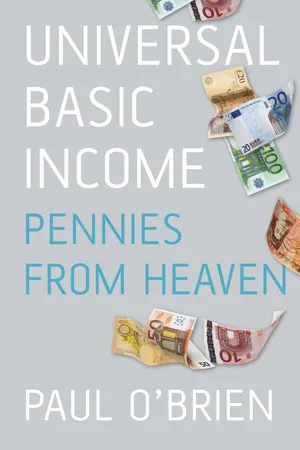
This book is about a radical idea: the idea that each of us deserves enough money on which to live - and that it should be paid independently of our personal means, and independently of whether we work, or even want to work. The concept of 'basic income' has been discussed internationally and has the potential to revolutionise the way that society functions. It would provide greater security for the young, for the self-employed and entrepreneurs as well as reshaping the social welfare system in its entirety. In this book, author and academic Dr Paul O'Brien explores the arguments for and against the idea and explains how this very real proposal might work in practise.
- 224 pages
- English
- ePUB (mobile friendly)
- Available on iOS & Android
eBook - ePub
About this book
Information
1
UNIVERSAL BASIC INCOME: AN OUTLINE OF THE IDEA
INTRODUCTION
The traditional situation of a job for life is rapidly being eroded. Already, machines are replacing workers at supermarket checkouts and in banks, making life more complicated for customers and enrolling them as temporary, unpaid employees of the organisation.
We face a future where, it is projected, there will be massive displacement of humans by robots of one kind or another. In the near future, there will be driverless vehicles on the roads,1 as there have been driverless trains for years. Jobs particularly under threat include those of cashiers, marketers, customer-service employees, factory workers, financial middle men (and women), journalists, lawyers, and phone workers.2
Medical diagnoses can increasingly be carried out over the Internet (either completely automatically or with a human professional online) and robots can do surgery. Higher education in its traditional form is threatened by the development of MOOCs (Massive Open Online Courses). Parents worry about how to anticipate the coming robot revolution in terms of their children’s education.3
The subjection of the human being to the machine – so effectively satirised in Charlie Chaplin’s film Modern Times – has been replaced by a new threat: the replacement of people by machines, as foreseen in modern films including the Terminator series.4
Even traditionally human-specific activities such as love and sex are being called in question by technology, with recent films such as Her and Ex Machina. In the future, the sexual partners of many people may be robots.5 Whether you think all that is comical, sad, exciting or horrifying, it’s difficult to see how such a future could be avoided, even if it were desirable to avoid it. There is too much money to be made.
Martin Ford projects that mechanisation will push people off the land where they traditionally made a living, and deprive them of the jobs they might otherwise obtain in the cities to which they migrate as a result. Machines threaten to make economic activity redundant at both the higher and lower ends of the scale.6 Ford describes how recessions eliminate routine jobs: then organisations realise that, in the wake of recovery, technological advances permit them to operate without rehiring the workers.7 While online activity is great for the corporations that prevail in the Internet, income for everyone else drops to the level of pocket change.8
Ford points out that the computer technology of today has roots in the taxpayer-funded, post-Second World War federal funding for research. It does not look as if this is leading to prosperity for the descendants of those taxpayers.9 While the stock market soared, Wall Street banks got rid of tens of thousands of jobs.10 Concerns about the effect of ‘immigration’ on jobs ignore the issue of ‘virtual immigration’ raised by electronic offshoring.11 Higher education is also under threat, with the growth of online education.12 Technology promises to shake up the area of healthcare as well.13 In Ford’s view, emerging industries will seldom be labour-intensive.14 (Ford supports the idea of a guaranteed UBI as a means of addressing the problems he outlines.)15
Where the money is going to come from to buy goods, if nobody has a job to earn it, is not something that owners of businesses, or indeed investors, seem to have thought through to any great extent. In this sense, capitalism is not a ‘rational’ system: it does not necessarily work in its own interest. Things that are good for individual capitalists (such as cutting back on the number of employees) may be bad for the system as a whole. The ‘invisible hand’ of the market that is supposed to ensure the best possible functioning of the system breaks down here (as it does elsewhere, for example in regard to pollution and resource depletion).
While new jobs will no doubt be created by the growth of new technology, they will tend to be at the higher end of the scale, with a growing income gap between those with high and low skills.16 The notion of UBI as a solution is now reaching the mainstream of political debate: in the context of discussions of the ‘robot revolution’, a Financial Times editorial called for ‘data-driven pilot projects’ to test the UBI idea in practice.17
The idea of a guaranteed basic income, citizen’s dividend, national dividend, or UBI, is fairly straightforward. It involves the state paying a certain amount of money to all, without means testing or work requirement.18 Those who argue for UBI usually want it to be enough for each person to live on, though basic income could exist in a partial form (as it already does in Alaska).19
In Ireland, for example, the government already pays a form of basic income to a sector of the population (in the form of child benefit, at €140 per month per child).20 UBI would extend this principle to everyone.21 For those who support UBI, it seems particularly important to defend any ‘universality’ that may already exist (for example in the form of child benefit or pensions) as they may form the foundation of a future UBI.
The goal of ‘full employment’ is a mirage. This is due to a number of factors, including the increased role of technology and the growing role of women in the workforce. (‘Full employment’ traditionally meant full male employment, with women remaining in the home.) Much of our current ‘employment’ is deficient in terms of the quality of the jobs available.22 A (vulnerable and insecure) sector of the workforce, sometimes described as the ‘precariat’, is emerging.23
Insecurity is rapidly becoming a permanent part of people’s everyday lives. Many workers in traditional jobs are unable to make ends meet. If someone is unfortunate enough to lose their job, they have to deal with an unwieldy welfare system that can have the effect of forcing them into poverty and subservience, despite the – often well-intentioned – efforts of those who administer the system.
The exaggerated importance attached to jobs and to ‘full employment’ means that the natural environment is, in a political sense, pushed to the sidelines: we are faced with the absurd choice between maximising job creation on the one hand, and preserving the future of the planet on the other. While deforestation and the overuse of fossil fuels threaten the future of human civilisation and indeed of the planet itself,24 the spectre of unemployment seems easy to fix in comparison – it is simply a matter of rethinking how we distribute wealth in the society.
It should be emphasised that full-time employment in the traditional sense for all adults is not feasible and would be an ecological nightmare if it were. (This is not to mention the social nightmare many people endure already, which consists in spending all day working and commuting and seldom seeing their family.) Instead, it seems obvious that we need to find ways of redistributing income that detaches it from work, and ways of redistributing necessary work so that people have more free time.
In the meantime, the current system contributes to multiple problems. Certain types of legitimate work are invisible and devalued, including the activities of carers and homemakers (whether male or female) because they do not easily fit into the formal economy. For many people, the balance between work and life is hopelessly out of kilter. The authoritarian response to the problem is Soviet-style ‘workfare’ of one kind or another:25 in other words, making income more dependent on work, rather than less.
Workfare, with its constant monitoring26 and compulsion, is dependent on an unquestioning adherence to a traditional work ethic that is rapidly being undermined by social and economic developments. Meanwhile, massive inequality in terms of wealth distribution27 threatens to destabilise society. In the United States, it was estimated in 2014 that the wealth owned by the top 0.1 per cent is almost the same as that owned by the bottom 90 per cent.28
The marginalisation of the ‘precariat’ means there is a potential bomb under industrial-corporate society, whose effects (xenophobia and possible new forms of fascism) are likely to make things even worse than they already are.
Guy Standing points out that the precariat are ‘floating, rudderless and potentially angry.’29 They are distinct from the proletariat in that they do not have the stability, or rootedness, of the latter.30 They lack a sense of identity based on work.31 They experience ‘the four As – anger, anomie, anxiety and alienation.’32 The precariat may regard trade unions negatively, as having looked after the interests of their own members to the disadvantage of the precariat.33 To take an example from Ireland, a ‘two-tier’ pay disparity has developed, whereby new entrants to the teaching profession are significantly disadvantaged vis-à-vis their older peers.34
The precariat are subject to ‘zero-hour contracts’ and vanishing pension provision. Social immobility becomes intensified. On a global scale, the danger is that the precariat, exasperated by the inaction of traditional politicians, may follow demagogues, potentially supporting candidates of the extreme Right. In the culture of ‘precarity’, the widespread and increasing use of state surveillance leads to a lessening of privacy and freedom. In the UK, doctors are told to police the ‘fitness for employment’ of patients in receipt of disability benefits, undermining the traditionally confidential physician–patient relationship. How to establish a society that takes account of the rise of the precariat is a central question of our time. Precariousness affects the children of the post-war generation much more than it does their parents.35
Indeed, we have entered a dangerous time of ever-increasing surveillance, anticipated in novels such as Orwell’s Nineteen Eighty-Four and Zamyatin’s We. Every move we make on the street is recorded and may be analysed in future. Every time we log on to the Internet, our every move is subject to being stored and sold on for commercial purposes. Privacy is an increasingly valuable, and increasingly disappearing, commodity. In the future, it is not too far fetched to imagine that people may have to pay large sums of money to retrieve their privacy or prevent it being taken away, if indeed that will be possible any more.
College education is being simultaneously ‘massified’ and downgraded, with crippling debts for students, and ‘internships’ for graduates instead of jobs.36 The ‘internship’ culture (unpaid work as an intended transition between education and employment), while it no doubt assists some people in getting valuable job experience or functions as a stepping stone to full-time employment, in other ways perpetuates a culture of underemployment and precarity.37
Machines threaten to make us free. Instead of seeing the prospect of freedom from coerced labour as something to be celebrated (as it might be in a rational society) we view it ...
Table of contents
- Cover
- Title
- Copyright
- Contents
- Acknowledgements
- Introduction
- 1. Universal Basic Income: An Outline of the Idea
- 2. A Brief History of Basic Income Proposals
- 3. Freedom, Justice and Solidarity: The Philosophical Basis of UBI
- 4. Political Issues: The Implications of UBI for Feminism and the Environment
- 5. Answering Some Objections
- 6. Implementation: Making UBI Happen
- Conclusion: Summing Up and Looking Forward
- Notes
- Bibliography
Trusted by 375,005 students
Access to over 1.5 million titles for a fair monthly price.
Study more efficiently using our study tools.
Frequently asked questions
Yes, you can cancel anytime from the Subscription tab in your account settings on the Perlego website. Your subscription will stay active until the end of your current billing period. Learn how to cancel your subscription
No, books cannot be downloaded as external files, such as PDFs, for use outside of Perlego. However, you can download books within the Perlego app for offline reading on mobile or tablet. Learn how to download books offline
We are an online textbook subscription service, where you can get access to an entire online library for less than the price of a single book per month. With over 1.5 million books across 990+ topics, we’ve got you covered! Learn about our mission
Look out for the read-aloud symbol on your next book to see if you can listen to it. The read-aloud tool reads text aloud for you, highlighting the text as it is being read. You can pause it, speed it up and slow it down. Learn more about Read Aloud
Yes! You can use the Perlego app on both iOS and Android devices to read anytime, anywhere — even offline. Perfect for commutes or when you’re on the go.
Please note we cannot support devices running on iOS 13 and Android 7 or earlier. Learn more about using the app
Please note we cannot support devices running on iOS 13 and Android 7 or earlier. Learn more about using the app
Yes, you can access Universal Basic Income by Paul O'Brien,Dr Paul O'Brien in PDF and/or ePUB format, as well as other popular books in History & Economic Theory. We have over 1.5 million books available in our catalogue for you to explore.