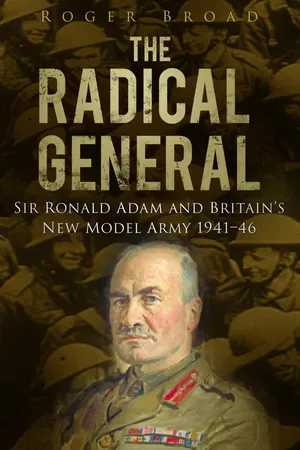
Britain's great battlefield generals of the Second World War like Montgomery and Slim would have failed had not General Sir Ronald Adam been appointed Adjutant-General in 1941. As the army's second most senior officer, he was responsible for providing the man- and womanpower for battle. He revolutionised recruitment practices and introduced scientific selection procedures to find the officers, NCOs and technicians that a modern army needed. Adam also recognised that soldiers needed to believe in the cause they were fighting for. This too led to controversy when the soldiers began to debate political issues about post-war Britain. Did Adam's espousal of such discussion groups lead to the Labour landslide in 1945? How did this career soldier of conventional background, when given the authority, come to tread on so many toes, kick so many shins and break up so much of the War Office's most revered items of mental and organisational furniture? This book reveals the true story of a Modern Major-General.
- 240 pages
- English
- ePUB (mobile friendly)
- Available on iOS & Android
eBook - ePub
About this book
Information
Topic
HistoriaSubtopic
Biografías históricas1
THE PUZZLE
After his release from a Japanese prison camp in 1945 the sci-fi-writer-to-be J.G. Ballard spent the holidays from his English boarding school with his grandparents. He recalled that, ‘They were obsessed with the iniquities of the post-war Labour government, which they genuinely believed to have carried out a military putsch to seize control of the country, using the postal votes of millions of overseas servicemen.’1
This was an extreme example of the sorrow, bewilderment and anger felt by many in Britain and abroad when Winston Churchill, the inspirer of resistance to tyranny, had on the morrow of victory in Europe been cast aside by the electorate with a landslide majority for the Labour Party. Against an unexpected and unwelcome reality many find reassurance in a scapegoat. The reality in this case was that the electorate did not believe that Churchill was the man to lead a peacetime government. As the wartime Coldstream Guards captain and later military historian Sir Michael Howard wrote, ‘However great our admiration for Winston Churchill, few of us saw any reason to be grateful to the Conservative Party for its management of national affairs during the 1930s.’2
Others closer to the centre of public affairs than Ballard’s grandparents also needed a scapegoat to explain this unpalatable truth. Some blamed the voting outcome on the Army Bureau of Current Affairs (ABCA), which had issued fortnightly discussion pamphlets for the troops. In fact, few of the 118 pamphlets issued were controversial. One was suppressed before publication; that on the Beveridge Report on social security was withdrawn in favour of a more closely supervised version. Nonetheless, the Royal Army Educational Corps (RAEC) was pursued for years by the gibe that its only battle honour had been the general election of 1945. This charge had a small element of truth, for there was Left-wing influence in the army’s educational service, although its extent is debatable.
Who was responsible for this? Apart from Sir James Grigg, the war minister – a very conservative figure – and parliamentary undersecretary Lord Croft – even more so – the soldier in overall charge of army education (among many other responsibilities) was Gen. Sir Ronald Forbes Adam, Bt, Adjutant-General (AG) to the Forces in 1941–46. In modern usage he was the army’s director of human resources. Did he, wittingly or unwittingly, orchestrate the Ballard grandparents’ ‘putsch’? If so, why and how?
Despite holding the second highest post in the British Army for five years at a crucial time, Adam is little known compared with Britain’s other generals of the Second World War. Those flamboyant in style – such as Montgomery, Slim and Alexander – are famous, as is Alanbrooke. Such others as Auchinleck, Browning, Horrocks, O’Connor, Leese, Paget and Hobart have featured in history books and memoirs. Other widely recognised names are Gort and Wavell, who suffered eclipse through personal misjudgement or military or political mischance. Percival is remembered for surrendering Singapore. Battles lost and won are stirring stuff and their outcome overtly affects history. Yet without competent organisation, adequate supplies of matériel, and enough men trained for warfare, all the battlefield generals’ plans and campaigns could have been the reverse of glorious. Without Adam’s achievements as AG in 1941–46 the British Army would have been in little better shape later in the war than the disasters from 1940 to mid-1942 showed it to be. Without him, many of those of battlefield renown would not have achieved success or gained acclaim. It is not that Adam’s role is forgotten; more overlooked: organisation and administration are usually regarded as boring stuff.
TWO PRE-WAR TASKS
On his appointment as AG in June 1941 Adam had been a soldier for nearly forty years, rising steadily if unspectacularly until, in 1938, he was appointed to the new post of Deputy Chief of the Imperial General Staff (DCIGS). Here, within the financial constraints and the policy vagaries of the time, he made a major contribution to getting the British Army ready for war. That it was still not ready enough was outside his control. Apart from this official task he took on the unofficial role of maintaining peace between the Chief of the Imperial General Staff (CIGS), Lord Gort, and the Secretary of State for War, Leslie Hore-Belisha, who barely spoke to each other. He then, for seven months in 1939–40, commanded III Corps of the British Expeditionary Force (BEF), held mainly in reserve. As the Allied forces in the north of France crumbled, Adam was ordered by Gort, now commander-in-chief (C-in-C) of the BEF, to establish a perimeter around Dunkirk, a move that – along with much courage, German errors and sheer luck – enabled 340,000 British and French soldiers to escape by sea. This reinforced Adam’s reputation for solid competence. Then for a year he commanded the land defence of north-east England against the expected invasion.
After a brief euphoria in the latter half of 1940, morale in the army slumped – much less so in the navy and air force, which had visible successes. This was not helped by the army’s selection of men for duties fitting their abilities being haphazard and inept; the picking out of men for training as officers was arguably even worse. The problems of creating a modern army of soldier-citizens, motivated and with high morale, had not been faced in the years of peace.
By the time Adam left Northern Command to become AG in June 1941 he had learnt much to convince him of the need for three major reforms. The first in time was putting the selection and training of officers on to a scientific basis, including the employment of psychiatrists and psychologists to help judge the quality of potential leaders. This upset conventional minds, political and military.
Next came another change that was deeply upsetting to traditionalists: initially bypassing the individual regiments and corps by sending recruits through the same basic training, during which their intellectual capacity, psychological balance, existing and potential skills, combatant temperament and leadership qualities could be judged, again using scientific methods. Only then were they posted to a regiment or a corps for further training that tried to reconcile the army’s needs, their abilities and, if possible, their wishes. Many of Adam’s fellow officers believed this undermined, in particular, the infantry’s regimental system.
Finally, apart from improving morale through better welfare provision for soldiers and their families, Adam believed that to motivate the citizen-warriors of a democratic state, they needed to understand the nature of the war and the enemy they were fighting. So talks and discussions on the war, on the aims of British policy and other current affairs became an integral part of army life. Faced with an enemy promoting a fascist ideology of dictatorship and intolerance, the Army Council (comprising Britain’s political and military leadership) agreed that Britain should promote its own ideology of democracy through its main weapons: open discussion and debate. But encouraging the common soldiery to think about and to discuss public affairs disturbed some. ‘Theirs not to reason why, theirs but to do and die’, was an attitude with many sympathisers almost a century after the Charge of the Light Brigade at the Battle of Balaclava in the Crimea. Yet the days of obedient cannon fodder were over.
With the War Office Selection Board (WOSB) Adam introduced science and objectivity in place of hunch and prejudice; in the General Service Corps (GSC), analysis and reason in place of tradition and sentiment; with ABCA, open discussion and debate into an organisation based on hierarchy and obedience. All three reforms ruffled feathers, but there can be no doubt that without them the British Army could not have made such a valuable contribution to final victory. Adam was fortunate in having solid support – particularly against Churchill in his more wayward moments – from Sir Alan Brooke, the CIGS from 1941 onwards, and from Grigg.
NOT THE SUMMIT
Was being AG during those dramatic years the summit of Adam’s achievements? In having direct command over men and matters it was, but it was far from being the sum of his life. After leaving the army in 1946 at the age of 60 he continued to show great energy and initiative. During the next decade he was chairman and director-general of the British Council and an executive board member and chairman of UNESCO. He chaired a Board of Trade enquiry into the linoleum industry; he also chaired the Library Association and was on the council of the Institute of Education at London University. He sat on the boards of Birkbeck College and the Tavistock Clinic, and was principal of the Working Men’s College. A leisure interest led to him being president of the Marylebone Cricket Club (MCC; the world-famous cricket club at Lord’s). Concern about international dangers took him to the presidency of the United Nations Association (UNA) and to co-operate on a book on nuclear disarmament. Not until he was 84 years old did he give up his public responsibilities. He lived another thirteen years, and died in Sussex in his 98th year, his mind and handwriting still clear, and taking a long daily walk.
Adam is the exception that proves the rule of the ‘Peter Principle’ that in a hierarchy an employee tends to rise to the level of his incompetence.3 His capacity for detail and hard work took him through a rising variety of staff jobs, made him an excellent DCIGS, a fine corps commander, an able general officer commanding (GOC) at Northern Command, and an outstanding adjutant-general. But the very qualities that suited him so well for these roles make it unlikely that he would have made a good CIGS or a theatre or army commander. He was a very good number two to the army, and there is nothing shameful or to be regretted about that. He rose to the level of his competence and flourished in it. The only occasion when he might have risked this achievement was in May 1940, when he was ordered to join a Franco-British force to try to break out southwards across the German thrust to the Channel. Events foiled this, and Adam was deprived of the one chance to prove or disprove his capacity in an important battle command.
Yet it remains a puzzle as to how a man of conventional enough background to achieve high army rank, who in a very conservative institution rose steadily with a reputation as a capable administrator with a shrewd diplomatic ability – ‘a safe pair of hands’ – should suddenly, when given the need, the opportunity and the authority, start to tread on official toes, kick not a few shins, and break up some of the War Office’s most elegant and revered Victorian furniture, with admirable effect. And, notwithstanding criticism from Churchill downwards, Adam succeeded in most of what he set out to achieve, even though his successors backtracked on his more imaginative reforms. The British Army and the British people were fortunate in having a man of such judgement as ‘Bill’ Adam at their service in so many roles, over so many years.
2
FROM INDIA TO INDIA
For several generations India was the birthplace of many British soldiers. During the Second World War they ranged from Terence ‘Spike’ Milligan, gunner and Goon, to Percy Hobart, armoured warfare expert and developer of ‘Hobart’s funnies’ for D-Day – amphibious and flail tanks, flame and mortar throwers, armoured bulldozers. Spike’s father was a quartermaster-sergeant, Hobart’s a senior official in the Indian Civil Service. Soldiers, administrators and judges were the formal core of the British Raj. The informal underpinning was provided by engineers, teachers, missionaries, doctors, the occasional journalist such as Rudyard Kipling, and businessmen.
Among the last was Frank Forbes Adam. Born in Scotland in 1846 and educated at Loretto, the then recently established Edinburgh independent school, he went out to India at the age of 26 as a merchant, a description he continued to apply to himself in later life. He prospered as a partner in Graham’s Trading Company, carrying on Britain’s imperial trade. In 1883 he married Rose Kemball, the daughter of a Bombay High Court judge. Later in the decade he reached the apex of the Indian west-coast business world as president of the Bank of Bombay and of the Bombay Chamber of Commerce, and membership of the Port Trust. He was also part of the formal structure of the Raj as a member of LegCo – the Legislative Council, the nominated body consulted by the governor about provincial matters. His prominence in the business community and his public service were recognised by his appointment in 1888 as a Companion of the Indian Empire and a knighthood in the same order two years later.
On 30 October 1886, at the cool hill station above Bombay, the Adams’ first child, Ronald Forbes, was born. Because of the high mortality rate among European children, it was common for the infants of the prosperous to be sent to Britain early on. Ronald went to England at 3 years old to the care of relatives. Fortunately, Frank Forbes Adam, unlike his contemporaries in government service, had some control over his own career, and this separation did not last long. In the following year, Sir Frank and Lady Adam returned to Britain with their second and third sons, Eric Forbes, born in 1888, and Colin Forbes, a year later. Where the Forbes name originated is uncertain, although it was initially used as a further given name. The family settled in Cheshire, at Hankelow Court, in the village of that name. The house is described by the architecture historian Sir Nikolaus Pevsner as a ‘brick, black and white house from 1870s, enlarged 1901’; in short, mock Tudor.1 Sir Frank began a second phase to his business career in Manchester, then the world centre for the textile trade. In 1896 the family’s fourth child, Hetty, was born.
The family’s return to Britain meant that the boys, apart from Ronald for a year, were spared the fate of many of their Indian-born contemporaries of being sent ‘home’ when very young to stay with relatives, at boarding school or even with foster parents, and not seeing their parents for years until rare home-leave brought them back to Britain. For mothers particularly this caused much anguish; for many children it caused lifelong psychological trauma. However, Ronald and his brothers did not escape boarding school at a young age. In the 1890s British schools, both private and state, were with few exceptions based on the precept ‘spare the rod and spoil the child’, certainly in spirit, frequently in practice. This applied at Ronald’s prep school in Sussex, Fonthill, which his brother Colin described as having been in Ronald’s time something of a ‘Dotheboys Hall’ (à la Nicholas Nickleby), although improved in his own days a few years later. Colin assigned his brother’s reticence and taciturnity to the treatment he received there.2 One attribute Ronald did acquire at Fonthill was the very precise and clear handwriting that he kept all his life. Once at Eton from September 1898 until December 1902 he was, according to a 1976 interview, ‘very happy’, and is recalled as saying, ‘I made up my mind pretty early that I would go into the army’.3 His brothers outshone Ronald academically. Both were King’s Scholars at Eton, and both went on to King’s College, Cambridge. Eric joined the Foreign Office, dying at 37, and Colin the Indian Civil Service until ill health forced a return to Britain a few years later. They were the family’s sprinters, with Ronald the long-distance runner, in achievement and longevity.4 Hetty lived to age 81, Colin to 93; Ronald outlived all his younger siblings. Considering that, in the view of the military historian Basil Liddell Hart, ‘the Army was the vocation of the sons who were not likely to shine in other professions’, Ronald did well.5
‘THE SHOP’
Ronald wanted to join the Royal Regiment of Artillery (RA), which meant entering ‘the Shop’, the nickname for the Royal Military Academy at Woolwich, where gunners and engineers trained. (Cavalry and infantry trained at the Royal Military College at Sandhurst.) To prepare for the entrance exam he was early in 1903 sent for six months to Adams and Millard, a British-run examinations ‘crammer’ in Freiburg, Germany. He mixed with very few Germans and learnt no German. But those months in Germany helped get him into the Shop as a ‘gentleman cadet’ at the age of ‘seventeen years, eleven months and three days’, as the records meticulously detail.6 His own recollection was of scraping in bottom or second to bottom in the entrance list; the Woolwich records are a little more generous: thirty-third out of thirty-nine. In Freiburg, Adam had gone to a fencing master who also taught him the sabre, with which German students fought duels (although Ronald never did). At the Shop new cadets had to provide a display for the seniors: ‘box or fence or sing or dance or do something […] a sort of initiation rite’. His swordplay helped establish his credentials with his seniors. Otherwise Woolwich provided a general education, regular riding school, general drill and gun drill. It was a strenuous course physically and – some assert – intellectually, and the position in which the cadets were placed at the end usually affected the rest of their careers.
But, according to the biographer of Noel Mason-Macfarlane (Adam’s future brother-in-law), there was an ‘undemanding mental climate’ at Woolwich. Mason-Mac’s more intellectual approach was looked upon as something of an oddit...
Table of contents
- Cover
- Title Page
- Contents
- Acknowledgements
- List of Illustrations
- Abbreviations
- Brief Chronology
- 1. The Puzzle
- 2. From India to India
- 3. The Somme and the Asiago
- 4. Rising Star
- 5. Stumbling to War
- 6. Return via Dunkirk
- 7. Guarding the North
- 8. Pegs and Holes
- 9. Officer-Like Qualities
- 10. Dynamite
- 11. The Humane Touch
- 12. Frictions
- 13. The Legacy
- 14. Cultural Diplomacy
- 15. Lifelong Learning
- 16. How Radical Was He?
- Notes
- Full Chronology
- Plate Section
- Copyright
Trusted by 375,005 students
Access to over 1.5 million titles for a fair monthly price.
Study more efficiently using our study tools.
Frequently asked questions
Yes, you can cancel anytime from the Subscription tab in your account settings on the Perlego website. Your subscription will stay active until the end of your current billing period. Learn how to cancel your subscription
No, books cannot be downloaded as external files, such as PDFs, for use outside of Perlego. However, you can download books within the Perlego app for offline reading on mobile or tablet. Learn how to download books offline
Perlego offers two plans: Essential and Complete
- Essential is ideal for learners and professionals who enjoy exploring a wide range of subjects. Access the Essential Library with 800,000+ trusted titles and best-sellers across business, personal growth, and the humanities. Includes unlimited reading time and Standard Read Aloud voice.
- Complete: Perfect for advanced learners and researchers needing full, unrestricted access. Unlock 1.5M+ books across hundreds of subjects, including academic and specialized titles. The Complete Plan also includes advanced features like Premium Read Aloud and Research Assistant.
We are an online textbook subscription service, where you can get access to an entire online library for less than the price of a single book per month. With over 1.5 million books across 990+ topics, we’ve got you covered! Learn about our mission
Look out for the read-aloud symbol on your next book to see if you can listen to it. The read-aloud tool reads text aloud for you, highlighting the text as it is being read. You can pause it, speed it up and slow it down. Learn more about Read Aloud
Yes! You can use the Perlego app on both iOS and Android devices to read anytime, anywhere — even offline. Perfect for commutes or when you’re on the go.
Please note we cannot support devices running on iOS 13 and Android 7 or earlier. Learn more about using the app
Please note we cannot support devices running on iOS 13 and Android 7 or earlier. Learn more about using the app
Yes, you can access The Radical General by Roger Broad in PDF and/or ePUB format, as well as other popular books in Historia & Biografías históricas. We have over 1.5 million books available in our catalogue for you to explore.