eBook - ePub
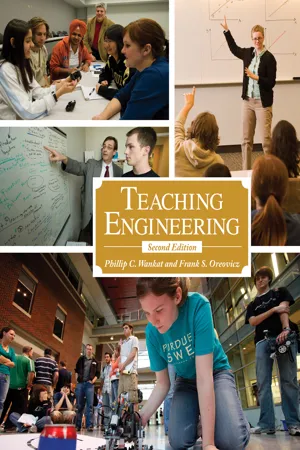
Teaching Engineering, Second Edition
- 482 pages
- English
- ePUB (mobile friendly)
- Available on iOS & Android
eBook - ePub
Teaching Engineering, Second Edition
About this book
The majority of professors have never had a formal course in education, and the most common method for learning how to teach is on-the-job training. This represents a challenge for disciplines with ever more complex subject matter, and a lost opportunity when new active learning approaches to education are yielding dramatic improvements in student learning and retention. This book aims to cover all aspects of teaching engineering and other technical subjects. It presents both practical matters and educational theories in a format useful for both new and experienced teachers. It is organized to start with specific, practical teaching applications and then leads to psychological and educational theories. The "practical orientation" section explains how to develop objectives and then use them to enhance student learning, and the "theoretical orientation" section discusses the theoretical basis for learning/teaching and its impact on students. Written mainly for PhD students and professors in all areas of engineering, the book may be used as a text for graduate-level classes and professional workshops or by professionals who wish to read it on their own. Although the focus is engineering education, most of this book will be useful to teachers in other disciplines. Teaching is a complex human activity, so it is impossible to develop a formula that guarantees it will be excellent. However, the methods in this book will help all professors become good teachers while spending less time preparing for the classroom. This is a new edition of the well-received volume published by McGraw-Hill in 1993. It includes an entirely revised section on the Accreditation Board for Engineering and Technology (ABET) and new sections on the characteristics of great teachers, different active learning methods, the application of technology in the classroom (from clickers to intelligent tutorial systems), and how people learn.
Information
Topic
EducationSubtopic
Education Teaching MethodsCHAPTER 1
INTRODUCTION:
TEACHING ENGINEERING
It is possible to learn how to teach well. We want to help new professors get started toward effective, efficient teaching so that they can avoid the “new professor horror show” in the first class they teach. By exposing them to a variety of theories and methods, we want to open the door for their growth as educators. Since one goal is immediate and the second is long-term, we have included both immediate how-to procedures and more theoretical or philosophical sections. Written mainly for PhD students and professors in all areas of engineering, the book may be used as a text for a graduate-level class or by professionals who wish to read it on their own. Most of this book will also be useful to teachers in other disciplines. Teaching is a complex human activity, so it’s impossible to develop a formula that guarantees excellence. But by becoming more efficient, professors can learn to be good teachers and end up with more time to provide personal attention to students.
1.1. SUMMARY AND OBJECTIVES
After reading this chapter, you should be able to:
•Discuss the goals of this book.
•Answer the comments of critics.
•Explain the two-dimensional model of teaching.
•Discuss some of the values which underlie your ideals of teaching.
•Explain some applications of learning principles to engineering education.
1.2. WHY TEACH TEACHING NOW?
Most engineering professors have never had a formal course in education, and some will produce a variety of rationalizations why such a course is unnecessary:
1. I didn’t need a teaching course. Just because someone did not need a teaching course does not logically imply that he or she would not have benefited from one. And times have changed. In the past, young assistant professors received on-the-job training in how to teach. New assistant professors were mentored in teaching and taught several classes a semester. Now, mentoring is in research, and an assistant professor in engineering at a research university may teach only one course a semester. In the past the major topic of discussion with older professors was teaching; now it is research and grantsmanship. Thus, formal training in teaching methods is now much more important.
The problems facing engineering education have also changed. In 2009 (the most recent year for which data is available) 468,139 undergraduate engineering students were enrolled, which is 2.63% of the total of 17,778,741 undergraduates enrolled at all US institutions (NSF, 2013). If we look at only US citizens and permanent residents there were 440,791 undergraduates in engineering, which is 2.53% of the 17,404,882 total enrollment. The number of traditional new engineering students—white American male eighteen-year olds—is expected to drop slowly for at least the next 15 years (NSF, 2013). The 2010 population data in 5-year cohorts illustrates a slow decrease in numbers after the 15–19 bulge (Table 1-1). In 2014 the students in the 2010 15–19 cohort are currently in college. Cohort data by race and ethnicity is shown in Table 1-2. Since the cohorts do not match, the ratio calculations in Table 1-2 estimate the numbers for matching 7-year cohorts. The only groups that will have larger college age cohorts in the next 15 years are Hispanic or Latino, two or more races, and other races. Since the percentage of females does not change much, white male cohorts decrease at the same rate the white cohorts decrease. As the under-five cohort was 50.8% white in 2010 and the percentage of white babies continues to decrease, there will not be an increase in the percentage of traditional white male engineering students in the foreseeable future.
Table 1-1. 2010 Population of United States (NSF, 2013)
| Cohort | Number | % Female |
| Total | 308,746,000 | 50.8 |
| <5 | 20,201,000 | 48.9 |
| 5–9 | 20,349,000 | 48.9 |
| 10–14 | 20,677,000 | 48.8 |
| 15–19 | 22,040,000 | 48.7 |
| 20–24 | 21,586,000 | 49.0 |
Table 1-2. 2010 US Population by Race/Ethnicity (NSF, 2013)
| Race/Ethnicity | Total | <5 | Ratio 1 | 5–17 | Ratio 2 | 18–24 |
| All | 308,746 | 20,201 | 28,281 | 53,980 | 29,066 | 30,672 |
| White | 196,818 | 10,254 | 14,356 | 29,462 | 15,864 | 17,547 |
| Asian | 14,465 | 875 | 1,225 | 2,301 | 1,239 | 1,491 |
| Black or African American | 37,686 | 2,754 | 3,856 | 7,608 | 4,097 | 4,373 |
| Hispanic or Latino | 50,478 | 5,114 | 7,160 | 12,016 | 6,470 | 6,154 |
| American Indian or Alaska native | 2,247 | 175 | 245 | 472 | 254 | 262 |
| Native Hawaiian/Pacific Islander | 482 | 38 | 53 | 98 | 53 | 64 |
| Two or more, not Hispanic | 5,966 | 924 | 1,294 | 1,865 | 1,004 | 707 |
| Other race, not Hispanic | 604 | 67 | 94 | 156 | 84 | 73 |
Note: Numbers in thousands. Ratio 1 equals the number in the <5 cohort adjusted to 7 years: (# in group <5) × (7/5); ratio 2 equals the number in 5–17 cohort adjusted to 7 years: (# in 5–17 group ) × (7/13).
First, there is a moral imperative for reaching out to nontraditional students, including women, underrepresented minorities, veterans, low socioeconomic status, first generation college students, students of varying religions, and LGBTQ (lesbian, gay, bisexual, transgender, questioning) students. The 2011 enrollment of undergraduate students in engineering by race/ ethnicity and by gender is given in Table 1-3. If all students had equal opportunity to study engineering, then the percentages of each group in engineering would be close to the corresponding percentages in the entire population. Clearly there are disparities. For example, if black or African American students studied engineering at the same percentage as the overall population there would be 2.4 times as many black or African American students as there are currently (assuming no change in the number of all other students. The largest disparity is in the number of female engineering students since parity with the overall population would require increasing the number of female engineering students by a factor of 4.2 (assuming no change in the number of male students). Of course, many students belong to two or more of these nontraditional groups.
Table 1-3. 2011 Undergraduate Enrollment of US Citizens and Permanent Residents in Engineering Programs by Race/ethnicity and Gender. Total US and permanent resident undergraduate engineering students was 439,827 which were 81.446% male and 18.554% female. The first row of data gives the % each race/ethnicity is of total number of engineering students. The 2nd row of data gives the % of each race/ethnicity in the total US population (2010 data from Table 1-2). Third and 4th rows are the % of each race/ethnicity that are male and female, respectively. Data is based on Table 2-10 in NSF (2013).
| White | Asian | Black or African American | Hispanic or Latino | Native American | Pacific Islander | > 1 Race/ Ethnicity | |
| % All US UG Engr. Students | 69.696 | 8.643 | 5.508 | 10.574 | 0.530 | 0.225 | 1.897 |
| % all US pop. (Table 1-2) | 63.745 | 4.685 | 12.206 | 16.349 | 0.728 | 0.156 | 1.932 |
| % Male | 83.0 | 78.3 | 75.4 | 79.1 | 77.7 | 79.7 | 76.5 |
| %Female | 17.0 | 21.7 | 24.6 | 20.9 | 22.3 | 20.3 | 23.5 |
Second, to remain internationally competitive, we must recruit, teach, and retain nontraditional students. They often have different experiences studying engineering (Table 1-4) and will often learn more with active learning methods than with lecture.
Table 1-4. Common Experiences of Non-Traditional Engineering Students (Modified from Susan Montgomery Lecture Material)
| Women | •Faculty tend to interact more with men |
•Men interrupt more, women more hesitant | |
•Women display a lack of confidence | |
•Women cite lack of faculty contact | |
•Women hide academic abilities | |
•Women prefer a cooperative environment | |
•Women feel sexualized | |
| Under-represented Minorities | •Low faculty and peer expectations |
•Faculty don’t care about us … or reach out | |
•Faculty don’t understand we are different | |
•Faculty single us out as “spokesperson” for our group | |
•Curriculum and faculty interactions exclude us | |
•Faculty seem uncomfortable or cautious with us | |
•Faculty sometimes take overt stances in class against diversity issues and initiatives | |
•Out of class interactions with faculty are minimal and difficult | |
| Veterans | •Alienation and isolation |
•Family adjustments | |
•Loss of structure | |
•Balancing multiple responsibilities | |
•Academic concerns returning to school | |
•Health and disability difficulties | |
| First Generation College | •Embarrassment and guilt |
•Desire a sense of belonging | |
•Overwhelmed by workload | |
•Self-doubts about ability | |
•Family pressure to succeed | |
•Identity confusion | |
•Financial difficulties | |
•More familiar with oral than written communication | |
| Low Socioeconomic Status | •Financial difficulties |
•Family pressure to drop out and help support family | |
•Limited access to resources | |
•Affordability of college, books, housing, etc. | |
•Need to work while attending college | |
| Varying Religions | •Lack of recognition of their religious holidays |
•Cultural differenc... |
Table of contents
- Cover Page
- Title Page
- Copyright Page
- Table of Contents
- Preface to the Second Edition, 2015
- Preface to the First Edition, 1993
- Chapter 1: Introduction: Teaching Engineering
- Chapter 2: Efficiency
- Chapter 3: Designing Your First Class
- Chapter 4: Objectives, Textbooks, and Accreditation
- Chapter 5: Problem Solving and Creativity
- Chapter 6: Lectures
- Chapter 7: Active Learning
- Chapter 8: Teaching with Technology
- Chapter 9: Design and Laboratory
- Chapter 10: One-To-One Teaching and Advising
- Chapter 11: Testing, Homework, and Grading
- Chapter 12: Student Cheating, Discipline, and Ethics
- Chapter 13: Psychological Type and learning
- Chapter 14: Models of Cognitive Development: Piaget and Perry
- Chapter 15: Learning Theories
- Chapter 16: Evaluation of Teaching
- Chapter 17: Professional Concerns
- Appendix A: Obtaining an Academic Position
- Appendix B: Teaching Engineering Course
- Name Index
- Subject Index
Trusted by 375,005 students
Access to over 1.5 million titles for a fair monthly price.
Study more efficiently using our study tools.
Frequently asked questions
Yes, you can cancel anytime from the Subscription tab in your account settings on the Perlego website. Your subscription will stay active until the end of your current billing period. Learn how to cancel your subscription
No, books cannot be downloaded as external files, such as PDFs, for use outside of Perlego. However, you can download books within the Perlego app for offline reading on mobile or tablet. Learn how to download books offline
Perlego offers two plans: Essential and Complete
- Essential is ideal for learners and professionals who enjoy exploring a wide range of subjects. Access the Essential Library with 800,000+ trusted titles and best-sellers across business, personal growth, and the humanities. Includes unlimited reading time and Standard Read Aloud voice.
- Complete: Perfect for advanced learners and researchers needing full, unrestricted access. Unlock 1.5M+ books across hundreds of subjects, including academic and specialized titles. The Complete Plan also includes advanced features like Premium Read Aloud and Research Assistant.
We are an online textbook subscription service, where you can get access to an entire online library for less than the price of a single book per month. With over 1.5 million books across 990+ topics, we’ve got you covered! Learn about our mission
Look out for the read-aloud symbol on your next book to see if you can listen to it. The read-aloud tool reads text aloud for you, highlighting the text as it is being read. You can pause it, speed it up and slow it down. Learn more about Read Aloud
Yes! You can use the Perlego app on both iOS and Android devices to read anytime, anywhere — even offline. Perfect for commutes or when you’re on the go.
Please note we cannot support devices running on iOS 13 and Android 7 or earlier. Learn more about using the app
Please note we cannot support devices running on iOS 13 and Android 7 or earlier. Learn more about using the app
Yes, you can access Teaching Engineering, Second Edition by Phillip C. Wankat, Frank S. Oreovicz, Phillip C. Wankat,Frank S. Oreovicz in PDF and/or ePUB format, as well as other popular books in Education & Education Teaching Methods. We have over 1.5 million books available in our catalogue for you to explore.