eBook - ePub
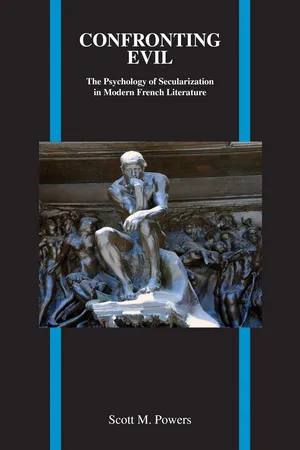
Confronting Evil
The Psychology of Secularization in Modern French Literature
- 264 pages
- English
- ePUB (mobile friendly)
- Available on iOS & Android
eBook - ePub
About this book
Confronting Evil: The Psychology of Secularization in Modern French Literature holds that the concept of evil is central to the psychology of secularism. Drawing on notions of secularization as a phenomenon of ambivalence or dualism in which religion continues to exist alongside secularity in exerting influence on modern French thought, author Scott M. Powers enlists psychoanalytic theory on mourning and sublimation, the philosophical concept of the sublime, Charles Taylor's theory of religious and secular "cross-pressures," and William James's psychology of conversion to account for the survival of religious themes in Baudelaire, Zola, Huysmans, and Céline. For Powers, Baudelaire's prose poems, Zola's experimental novels, and Huysmans's and Céline's early narratives attempt to account for evil by redefining the traditionally religious concept along secular lines. However, when unmitigated by the mechanisms of irony and sublimation, secular confrontation with the dark and seemingly absurd dimension of man leads modern writers such as Huysmans and Céline, paradoxically, to embrace a religious or quasi-religious understanding of good and evil. In the end, Powers finds that how authors cope with the reality of suffering and human wickedness has a direct bearing on the ability to sustain a secular vision.
Trusted by 375,005 students
Access to over 1.5 million titles for a fair monthly price.
Study more efficiently using our study tools.
Information
Subtopic
French Literary CriticismIndex
LiteratureChapter One
Writing against Theodicy
Secularization in Baudelaire’s Poetry and Critical Essays
Scholars have not sufficiently identified the sustained reflections in Baudelaire’s writings on the coexistence of God and evil. The lack of attention to the poet’s engagement in the centuries-old dialogue on theodicy can be explained in part by the increasing unpopularity in Baudelairean criticism to discuss theological concepts as an inspiration for the poet’s writings.1 As part of an ongoing investigation into issues of rhetoric and (post-)structuralism, scholarship has focused its attention on dimensions of Baudelaire’s modernity, even post-modernity, including his poetics of irony and deconstruction. Another reason for scholars’ virtual silence with respect to Baudelaire’s reflections on the coexistence of God and evil is that these reflections emerge rather obliquely, and most often in lesser known essays. However, I argue below that Baudelaire’s continuous and evolving thought on God and evil, most detectable in his critical texts, helps to provide a conceptual framework for the shift from an idealist, metaphysical poetics in Les Fleurs du Mal toward a more “realist” poetry of “daily experience” in Le Spleen de Paris.2 My analysis seeks above all to delineate a project of secularization at the foundation of Baudelaire’s poetic vision.
Theodicy is a term that refers to a tradition in which theologians, over the centuries, have proposed a variety of arguments to justify the existence of a benevolent, omnipotent God in light of a world of evil and suffering. By suggesting that Baudelaire writes “against” theodicy, I mean that the poet calls into question God’s existence precisely because of the reality of evil. To argue that Baudelaire wrote “against theodicy” might appear implausible if one thinks solely of poems from Les Fleurs du Mal structured on binary opposites of good and evil, God and Satan, and “Spleen et Idéal,” and that seem to correspond to the poet’s oft-cited remark in his Journaux intimes that “Il y a dans tout homme, à toute heure, deux postulations simultanées, l’une vers Dieu, l’autre vers Satan” (OC 1: 682). And yet, there is also in Les Fleurs du Mal a move away from God, who fades in the presence of destructive impulses and evil figures. In “Au lecteur,” “Correspondances,” and “L’Héautontimorouménos” (to name but a few), evil emerges as a more compelling concept and as the triumphant force. Whereas a few poems in Les Fleurs suggest the poet’s fascination with the divine, what is most immediate—most real—is evil. “Au lecteur,” depicts evil as the individual’s irresistible response to the chronic existential crisis of ennui. As a positive force (positive in the sense that it is something that veritably exists), evil awakens the poet’s dulled sensibilities. As Benjamin Fondane eloquently described it, the poet is responding to the need to feel himself exist, to break with the monotony of the quotidian, and it is through pain that he most acutely feels alive.3 The collection’s sadomasochism can best be understood in light of Baudelaire’s candid statements in the Journaux intimes on the pleasure that he feels in committing acts of evil: “Moi, je dis: la volupté unique et suprême de l’amour gît dans la certitude de faire le mal. —Et l’homme et la femme savent de naissance que dans le mal se trouve toute volupté. […] Cruauté et volupté, sensations identiques, comme l’extrême chaud et l’extrême froid” (OC 1: 652, 683). An originality of Baudelaire’s thought is his rapprochement of evil with life itself, or in philosophical terms, evil’s conflation with Being. An extension of this thesis is Baudelaire’s equation of evil with the beautiful, as the title “Flowers of Evil” intimates.
Often times, Les Fleurs du Mal portrays even God as an evil force. In “Bénédiction,” the poet’s mother, a troubling avatar of the Virgin Mary, considers her pregnancy as a curse from God, whom she blames for her suffering. Her apostrophe to the deity constitutes an indictment of his wickedness: “Je ferai rejaillir ta haine qui m’accable / Sur l’instrument maudit de tes méchancetés” (OC 1: 7). Similarly, in “Le Reniement de Saint Pierre” God is cast as a bloodthirsty tyrant (“un tyran gorgé de viande”) and Saint Peter is praised for having forsaken a whip-thrashing Jesus (“Tu fouettais tous ces vils marchands à tour de bras / […] Le remords n’a-t-il pas / Pénétré dans ton flanc plus avant que la lance? […] Saint Pierre a renié Jésus… il a bien fait”; OC 1: 121–22).
It would prove fruitless, however, to seek in Les Fleurs du Mal a single, consistent vision of good and evil. Rather, its lyricism is inspired by a variety of religious, esthetic, and political models, including the Church’s belief in the spiritual benefits of human suffering (e.g., “Bénédiction,” “Réversibilité”), the romantic and démocrates-socialistes notion of the messianic devil (“Les Litanies de Satan”), and Proudhon’s proclamation that God is evil (e.g., “Le Reniement de Saint Pierre” and “Abel et Caïn”). And then there are poems such as “Harmonie du soir,” “À une Madone,” “Les Phares,” and “La Destruction” in which the lyric voice’s attraction to and fascination with religious figures and symbols betray the poet’s more visceral religiosity that derives from his Catholic upbringing. In the Journaux intimes, Baudelaire candidly admits his penchant for spiritual matters: “Dès mon enfance, tendance à la mysticité” (OC 1: 706). In light of the disparate portraits in Les Fleurs of God and the devil, good and evil, Jean Pommier’s general observation that the collection lacks an overarching “système” or “cohérence” proves apposite (157). In contrast, an overarching “système”—one that opposes theodicy—does take form in Baudelaire’s thought, as revealed in numerous texts subsequent to the 1857 edition of Les Fleurs, and lends “coherence” to the later writings.
Edward Kaplan aptly describes a fundamental difference between Baudelaire’s lyric poetry and his prose poems as a type of “conversion from ‘poetic’ idealism to a literature of daily experience” (1). This literature of daily experience involves expressions of charity toward marginal peoples, especially the poor, women, and the elderly. Charity in Baudelaire’s poetry is also a major trope of the “Tableaux parisiens” section of the 1861 edition of Les Fleurs du Mal. Most readers of Baudelaire are familiar with “Le Cygne,” in which the lyric voice sympathizes with suffering characters and classes of people. His empathy for Andromaque who mourns the loss of her homeland, for an emaciated and consumptive African woman who longs to return to her native Africa, and for forgotten castaways, informs the poem’s metaphor of the swan that has escaped its cage in Paris, condemned to a futile search for home. “Le Cygne” ends with the lyric voice in remorseful contemplation of the earth’s oppressed: “Je pense aux matelots oubliés dans une île, / Aux captifs, aux vaincus!… à bien d’autres encor!” (OC 1: 87).
In “Les Petites Vieilles,” another poem from “Les Tableaux parisiens,” the poet’s charity is inspired by the spectacle of elderly women. In an ethical gesture, he commands us to love the hunched-back, broken souls: “Brisés, bossus / Ou tordus, aimonsles!” (OC 1: 89). The poem lists a number of unfortunate incidents that have afflicted the aging women, and that evoke the image of a river of tears:
L’une, par sa patrie au malheur exercée,
L’autre, que son époux surchargea de douleurs,
L’autre, par son enfant Madone transpercée,
Toutes auraient pu faire un fleuve avec leurs pleurs! (OC 1: 90)
Whereas society at large neglects these unfortunate creatures (“Et nul ne vous salue, étranges destinées! / Débris d’humanité pour l’éternité mûrs!”) the poet adopts them as his spiritual children (“Tout comme si j’étais votre père”) and bids them each evening a solemn adieu. As is often the case with Baudelaire, the speaking subject’s contemplation of human suffering leads to a consideration of God’s nature. This somber poem concludes with an evocation of God not as the ultimate consoler of souls, but on the contrary as the cause of their suffering:
Ruines! ma famille! ô cerveaux congénères!
Je vous fais chaque soir un solennel adieu!
Où serez-vous demain, Èves octogénaires,
Sur qui pèse la griffe effroyable de Dieu? (OC 1: 91)
The juxtaposition between the poet’s role as spiritual father who shows compassion for the elderly and the oppressive force of a merciless God is noteworthy. The poem’s final image, God’s dreadful claw, strongly echoes an age-old belief in the devil’s talon, which would leave its seal on the foreheads of witches. This final stanza hints at a discrepancy between belief in a benevolent God and the reality of human suffering. The old women’s destiny is not redeemed by reference to Catholic theology on the merits of suffering, as is the case for the lyrical voice in earlier poems such as “Bénédiction” and “Réversibilité.” Rather, “Les Petites Vieilles” presents suffering as absurd, and termed “austere Misfortune”: “Ces yeux mystérieux ont d’invincibles charmes / Pour celui que l’austère Infortune allaita!” (OC 1: 90). Given the emphasis placed on the absurdity of suffering, we should ask whether “Dieu” in this poem is a true entity, whom Baudelaire considers unjust, or whether the divine has become a signifier for the individual’s miserable lot. In other words, does Baudelaire truly believe in (an evil) God?
Baudelaire as Critic of Religions
Not unlike “Les Petites Vieilles,” passages from Baudelaire’s essays take a critical approach to religion and the concept of God. In La Morale du joujou (1853), Baudelaire expresses admiration for the imagination of children, as demonstrated by their creative play with simple toys. To this description, Baudelaire adds a brief discussion of the effects of religion—namely, Protestantism—on children’s imagination. More specifically, he berates parents who refuse to give toys to their children. According to Baudelaire, parents thereby deprive their children of an intense pleasure and stifle their imaginative faculties. Baudelaire likens parental parsimony to Protestantism:
Il y a des parents qui n’en veulent jamais donner [de joujous]. Ce sont des personnes graves, excessivement graves, qui n’ont pas étudié la nature, et qui rendent généralement malheureux tous les gens qui les entourent. Je ne sais pas pourquoi je me figure qu’elles puent le protestantisme. Elles ne connaissent pas et ne permettent pas les moyens poétiques de passer le temps. Ce sont les mêmes gens qui donneraient volontiers un franc à un pauvre, à condition qu’il s’étouffât avec du pain, et lui refuseront toujours deux sous pour se désaltérer au cabaret. Quand je pense à une certaine classe de personnes ultra-raisonnables et anti-poétiques par qui j’ai tant souffert, je sens toujours la haine pincer et agiter mes nerfs. (OC 1: 586)
Here, Baudelaire reveals his thoughts on Protestantism as a frugal and anti-poetic religion. This form of Christianity, he implies, discourages its adherents from reveling in life’s beauty and hinders creative thought. While an opposing argument can also be made, it is not difficult to understand Baudelaire’s opinion of Protestantism as a frugal religion, emblematized by its desolate churches bereft of painting, sculpture, and precious jewels. What Baudelaire does not explicitly state, but which he implies is that Catholicism is indulgent and poetic—a religion whose art and ornamentation inspire one’s imaginative faculties. These implications anticipate Baudelaire’s praises of religion in the Journaux intimes (Protestantism notwithstanding) as that which most interests him (“Il n’y a d’intéressant sur la terre que les religions”), and that even without God, religion would be holy and divine (“Quand même Dieu n’existerait pas, la Religion serait encore Sainte et Divine; OC 1: 696, 649). Whereas many poems of Les Fleurs du Mal testify to Baudelaire’s emotional investment in the Catholic notions of God, Satan, and sin, in light of the associations made in La Morale du joujou between imagination, poetry, and the Catholic religion, we can identify a second tendency in Baudelaire’s thought at the time that critically examines the effects of religion on the minds of both children and poets. In this way, religion is considered less as divine revelation and more as the source of artistic inspiration. Accordingly, one could approach La Morale du joujou as a type of “art poétique” to be read alongside Les Fleurs du Mal. In light of the essay, it would make sense that the use of religious imagery in Les Fleurs du Mal does not reflect a coherent system of thought, such as a theological model, but rather, constitutes sources of inspiration that fuel the creative process by giving rise to a variety of images, visions, and themes.
In the Salon de 1859, Baudelaire appears to reverse the relationship between religion and the imagination. In this work devoted primarily to art, Baudelaire’s commentary praises the imagination for its ability to create new worlds and new sensations by exploiting the possibilities embedded in the Real. To elaborate on this, Baudelaire celebrates various pieces of religious art by praising the role of the imagination—rather than of faith—in the artist’s conception. Baudelaire begins the short chapter entitled “Religion, histoire, fantaisie” with the bold declaration that both impious artists and atheists have produced excellent religious works. He follows this with the statement that “la religion [est] la plus haute fiction de l’esprit humain” (OC 2: 628). As is often the case for italicized words in Baudelaire’s writing, the stress placed on “fiction” signals to the reader that the critic has carefully chosen the signifier for its multiple meanings. While its more common rendering denotes something unreal, a less common and older rendering refers to something that is created, fabricated, or invented. By virtue of drawing special attention to the word, Baudelaire alerts the otherwise unsuspecting reader to the less common usage of fiction. And yet, by choosing the term he deliberately invites both interpretations, thereby suggesting that religious works are something of a fantasy rather than history or ontological truth. In so doing, Baudelaire moves from his thesis in La Morale du joujou of religion (Catholicism) as a stimulus of the imagination to suggesting that it is the self who “imagines” the divine (OC 2: 628).
Baudelaire pursues this highly suggestive style of writing by stating in parentheses that he is speaking as if he were an unbelieving art professor, and that the reader should draw no conclusions regarding his own faith: “Je parle exprès comme parlerait un athée professeur de beaux-arts, et rien n’en doit être conclu contre ma foi” (OC 2: 628). And yet, instead of outright refuting inevitable doubts that his readers will entertain regarding his religious faith, Baudelaire provides at best a very weak affirmation of his faith by stating that readers cannot infer anything about his personal beliefs from his writings. To be sure, this parenthetical remark further aggravates rather than alleviates the reader’s suspicions of the critic’s lack of faith in God. The elusive nature of Baudelaire’s comments on his own faith suggests that he is aware of the radical nature of his thoughts, which he tries to mitigate by playing a game of cat and mouse with the reader.
Baudelaire then proceeds to explain exactly how an unbeliever can produce a religious work of art. The answer is that the artist can do this by tapping into his imagination. Such a deliberate act, as Baudelaire asserts, counters the proclamation made by Jesus in John 3:8 that “The wind blows wherever it pleases” (OC 2: 629). According to Baudelaire, “L’art est le seul domaine spirituel où l’homme puisse dire: ‘Je croirai si je veux, et si je ne veux pas, je ne croirai pas” (OC 2: 629). In his praise of the artist’s inspiration as belonging to his own faculties, Baudelaire unequivocally rejects Jesus’s statement on the individual’s irrelevance in God’s choice to grace certain individuals with his spirit: “La cruelle et humiliante maxime: Spiritus flat ubi vult, perd ses droits en matière d’art” (OC 2: 629). What Baudelaire is in fact saying is that for an artist to create a sublime piece of religious art, he needs not divine intervention but rather his own faculty of imagination: “L’artiste peut produire un bon tableau de religion, pourvu que son imagination soit apte à s’élever jusque-là” (OC 2: 629). If Delacroix painted glowing chapels ablaze with light (“chapelles ardentes”), it is because his imagination was no less ardent: “Son imagination, ardente comme les chapelles ardentes, brille de toutes les flammes et de toutes les pourpres” (OC 2: 632). In Baudelaire’s Salon, God as a concept is very much alive, and praised by the art critic as a sublime subject worthy of an artist’s disciplined exploitation of the imagination. Conversely, God as an actual being independent of the imagination is nowhere to be found. This understanding of art and religion illuminates Baudelaire’s declaration in his journal that even if God didn’t exist, Religion would still be holy and divine (OC 1: 649).4
Realism and Theodicy in Les Paradis artificiels
In Les Paradis artificiels (1860), Baudelaire adopts an ethical position for realism and against idealism by engaging in questions of theodicy.5 In the course of his argument, Baudelaire redefines the notion of prayer by subtracting God himself from the act, and ends by underscoring the absurdity that underlies justifications of God’s existence in the face of extreme human suffering. Baudelaire pre...
Table of contents
- Cover Page
- Halftitle Page
- Title Page
- Copyright Page
- Dedication
- Contents
- Acknowledgments
- Introduction
- Chapter One: Writing against Theodicy: Secularization in Baudelaire’s Poetry and Critical Essays
- Chapter Two: The Mourning of God and the Ironies of Secularization in Baudelaire’s Le Spleen de Paris
- Chapter Three: Sublimation and Conversion in Zola and Huysmans
- Chapter Four: The Staging of Doubt: Zola and Huysmans on Lourdes
- Chapter Five: Religious and Secular Conversions: Transformations in Céline’s Medical Perspective on Evil
- Conclusion
- Notes
- Bibliography
- Index
- About the Book
- About the Author
Frequently asked questions
Yes, you can cancel anytime from the Subscription tab in your account settings on the Perlego website. Your subscription will stay active until the end of your current billing period. Learn how to cancel your subscription
No, books cannot be downloaded as external files, such as PDFs, for use outside of Perlego. However, you can download books within the Perlego app for offline reading on mobile or tablet. Learn how to download books offline
Perlego offers two plans: Essential and Complete
- Essential is ideal for learners and professionals who enjoy exploring a wide range of subjects. Access the Essential Library with 800,000+ trusted titles and best-sellers across business, personal growth, and the humanities. Includes unlimited reading time and Standard Read Aloud voice.
- Complete: Perfect for advanced learners and researchers needing full, unrestricted access. Unlock 1.5M+ books across hundreds of subjects, including academic and specialized titles. The Complete Plan also includes advanced features like Premium Read Aloud and Research Assistant.
We are an online textbook subscription service, where you can get access to an entire online library for less than the price of a single book per month. With over 1.5 million books across 990+ topics, we’ve got you covered! Learn about our mission
Look out for the read-aloud symbol on your next book to see if you can listen to it. The read-aloud tool reads text aloud for you, highlighting the text as it is being read. You can pause it, speed it up and slow it down. Learn more about Read Aloud
Yes! You can use the Perlego app on both iOS and Android devices to read anytime, anywhere — even offline. Perfect for commutes or when you’re on the go.
Please note we cannot support devices running on iOS 13 and Android 7 or earlier. Learn more about using the app
Please note we cannot support devices running on iOS 13 and Android 7 or earlier. Learn more about using the app
Yes, you can access Confronting Evil by Scott M. Powers in PDF and/or ePUB format, as well as other popular books in Literature & French Literary Criticism. We have over 1.5 million books available in our catalogue for you to explore.