eBook - ePub
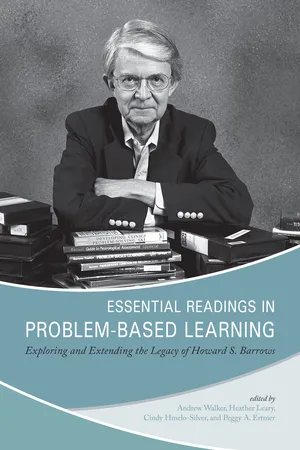
Essential Readings in Problem-Based Learning
Exploring and Extending the Legacy of Howard S. Barrows
- 388 pages
- English
- ePUB (mobile friendly)
- Available on iOS & Android
eBook - ePub
Essential Readings in Problem-Based Learning
Exploring and Extending the Legacy of Howard S. Barrows
About this book
Like most good educational interventions, problem-based learning (PBL) did not grow out of theory, but out of a practical problem. Medical students were bored, dropping out, and unable to apply what they had learned in lectures to their practical experiences a couple of years later. Neurologist Howard S. Barrows reversed the sequence, presenting students with patient problems to solve in small groups and requiring them to seek relevant knowledge in an effort to solve those problems. Out of his work, PBL was born. The application of PBL approaches has now spread far beyond medical education. Today, PBL is used at levels from elementary school to adult education, in disciplines ranging across the humanities and sciences, and in both academic and corporate settings. This book aims to take stock of developments in the field and to bridge the gap between practice and the theoretical tradition, originated by Barrows, that underlies PBL techniques.
Information
Print ISBN
9781612499130
9781557536822
Subtopic
Education Theory & PracticeSECTION III
COMBINING PROBLEM-BASED
LEARNING WITH OTHER
INTERVENTIONS
Edited by Heather Leary
Introduction
The six chapters in this section illustrate the expansion of problem-based learning from Howard Barrow’s initial work into many disciplines (Savery, 2006). It is very exciting to learn about successes in teacher education, middle school English language arts, middle school science, and medical education, to name a few. Together the chapters capture how PBL is being used with other interventions and approaches to teaching and learning such as learning by design, field learning, scaffolding, cross-curricular activities, academic potential, and independent projects. The integration and adaptation of PBL and elements of PBL within these interventions for learning are helping to expand the potential and successes available with problem-based learning.
Overview of Chapters
As theory and practice continue to have tensions, the first chapter by Jennifer Yeo, “Building Theory-Practice Nexus in Pre-Service Physics Teacher Education Through Problem-Based Learning,” explains how problem-based learning theory is integrated within a teacher education program to build a theory-practice connection that is beneficial for making linkages between pedagogical theories and classroom practices. She terms this practice-based work (PbW), describes the alignment with PBL, and provides a case in physics education as an example of how it works. Ultimately, this program supports and builds, using PBL as a base, pedagogical teacher knowledge and linkages between theory and practice. As noted by the author, “The design of PbW incorporates the instructional principles of problem-based learning and best practices in teacher education.” She continues to say that PbW has the potential to bring connections between theory and practice. Her chapter makes a strong argument for integrating theory and practice together in teacher education.
Loretta M. W. Ho and Lung S. Chan’s chapter, “Problem-Based Learning as the Instructional Approach to Field Learning in the Secondary School Setting,” presents a model for using PBL in a secondary school setting for field learning. Using a modified PBL model, they explore the feasibility of the model for teachers and their learning as well as student learning; with the aim being to develop teachers as a community of PBL practitioners and to provide students with a PBL experience in the context of practicing field work. They note that they were able to yield positive impacts on teacher understanding of field learning and demonstrate that teachers can design useful problems to engage learners. Their chapter provides a great example of expanding authentic experiences for teachers and students using PBL.
In “Distributing Scaffolding Across Multiple Levels: Individuals, Small Groups, and a Class of Students,” Sadhana Puntambekar describes scaffolding in problem-based learning in terms of Learning-By-Design. Emphasis is placed on distributed scaffolding, helping students through complex processes in learning to solve design problems, and provides a range of tools to support the scaffolding. The work focuses on building student knowledge but has implications for the teacher/facilitator. These implications of distributed scaffolding for problem-based facilitators and classroom teachers lie in the orchestration and coordination of small groups and whole class discussions. Overall, this chapter urges readers to note the tools and resources used as scaffolds and how they are combined so that learning is successful, which has implications for PBL problems and activities integrating and even expanding with other tools and interventions.
With PBL being used for cross-curricular activities, the chapter by Karen Swan, Phil Vahey, Ken Rafanan, Tina Stanford, Louise Yarnall, Mark van ’t Hooft, Annette Kratcoski, and Dale Cook, “Preparation for Future Learning: Exploring the Efficacy of Problem-Based Learning and Cross-Curricular Experiences,” explains a model of instruction called Preparation for Future Learning (PFL) that brings together cross-curricular activities for student skill and learning gains. The model involves social studies (preparation), mathematics (formal learning), science (application), and English language arts (communication), creating a sequence of learning using four different disciplines. Using this model amplifies learning and lends efficacy to the support of problem-based learning approaches. The authors indicate that “preparing students for data literacy learning can occur in one curricular context (social studies) with formal learning occurring in another (mathematics), strengthening the plausibility of claims that PFL uncovers a general mechanism of transfer.” The successful modeling of expansion and inclusion with PBL cross-disciplinary activities provides a great model for future work.
The chapter titled “Problem-Based Learning as a Means of Revealing Unseen Academic Potential” by Shelagh Gallagher and the late James Gallagher explains work conducted to identify advanced academic potential in students using PBL. The study was setup to examine if PBL would provide a means for advanced academic potential (AAP) students to be identified beyond traditional means of identification. The work found that engaging curriculum such as PBL can create a learning context that encourages students to be more engaged in the work and reveal more about their academic potential. This study gives evidence that students identified as AAP have the potential or the qualities associated with giftedness. The chapter provides a good understanding of how this work is important for practitioners as well as indicating how PBL can expand opportunities for learners.
The final chapter in this section, by Patangi K. Rangachari, titled “Drugs, Devices and Desires: A Historical Exploration of Medical Technology,” describes a course in a Bachelor of Health Sciences program at McMaster University. The course uses a modified PBL approach with an expanded element, an independent inquiry component. The inquiry element in the course provided students with various opportunities for self-directed learning and delving deeply into a range of resources while they explore and assess technologies in medical care. One student said of this two component integrated course that “the student-centered approach of this course allowed her to develop skills that were useful beyond academia since it cultivated transferrable skills, such as practice with interdisciplinary teamwork, critical thought and decision-making, and communication both verbally and in writing.” From this chapter we have a glimpse of how medical education, where PBL began, is continuing to expand using additional curricular activities and resources to improve learning with PBL.
Final Thoughts
The chapters in this section illustrate the success of combining and integrating PBL with other interventions and the positive impact that has on teachers and learners. We now better understand how PBL is being used with other interventions to become even more student centered. With current efforts for more cross-disciplinary and customized learning, using PBL or elements of PBL with other interventions and models provides a means for achieving those efforts now and in the future.
References
Savery, J. R. (2006). Overview of problem-based learning: Definitions and distinctions. Interdisciplinary Journal of Problem-Based Learning, 2(1), 9–20. http://dx.doi.org/10.7771/1541–5015.1002
BUILDING THEORY-PRACTICE
NEXUS IN PRE-SERVICE
PHYSICS TEACHER EDUCATION
THROUGH PROBLEM-BASED
LEARNING
Jennifer Yeo
Preface
This chapter describes a problem-based learning model for pre-service teacher education, referred to as practice-based work (PbW). Inspired by the success of problem-based learning (PBL) in helping medical students apply theoretical knowledge in diagnosing their patients’ medical problems, PbW incorporates the instructional principles of PBL with best practices of teacher education. In this model, pre-service teachers are engaged with iterative cycles of self-directed and collaborative learning as they go about finding solutions to instructional problems encountered in physics classrooms while helping students to understand physics better. Using a case example that tracks the understanding of one pre-service teacher’s pedagogical knowledge, this chapter shows how anchoring pre-service teachers’ learning in authentic problem solving can support them in making linkages between pedagogical theories and classroom practices. Findings also indicate that a prolonged period of exposure to problem-solving is necessary to overcome other issues that are embedded in a complex system. The opportunity to implement the solution and to reflect on the outcomes were also found to further strengthen the theory-practice links. Implications to pre-service teacher education are thus drawn.
Introduction
Professionalism is defined as “the methods and procedures employed by members of the profession (that) are based on theoretical knowledge and research” (Carr & Kemmis, 1983, p. 189). Applied to the context of the teaching profession, the actions and decisions made by a teacher should be guided by educational theories and research. Competencies in teaching should transcend technical concerns over what to do in a classroom; teachers should also be engaged in establishing relevant connections between theory and practice. In pre-service teacher education programs, it has traditionally been assumed that this integration will come naturally. However, it is well-documented in teacher education research that this theory-practice nexus is far from automated (Elim & Poyas, 2009; Leinhardt, Young, & Merriman, 1995). A number of internal and external factors contribute to the theory-practice divide. For example, Kember (2009) found that pre-service teachers’ choice of teaching approaches tend to be influenced by their conception of teaching rather than the theories they have been introduced to in pre-service programs.
The survival instinct in the initial stage of teaching tends to drive the focus of pre-service teachers towards the acquisition of a toolbox of ideas and activities rather than abstract conceptualizations of teaching (Korthagen & Vasalos, 2005). Misinterpretation of theories or the inadequacy of the theories introduced could also potentially affect pre-service teachers’ perception of the applicability of these theories into their teaching practice (Stones, 1983). External factors such as weak pedagogy in teacher education programs and a lack of coherence and/or fragmentation between newly learned theories and problems encountered in their teacher practice could further widen this theory-practice divide (Griffiths & Tann, 1992; Korthagon & Vasalos, 2005).
To overcome these difficulties arising from many sources of influence, Chen, Cheng, and Tang (2010) maintained that pre-service teachers need to be confronted with the influences from different sources and go through a process of active construction and reconstruction of knowledge (Chen, Cheng, & Tang, 2010). However, this process should not be left to chance during practicum, which often takes place at the end of the teacher education program as a platf...
Table of contents
- Cover Page
- Title Page
- Copyright Page
- Contents
- Foreword
- Acknowledgments
- Section I: The Process and Structure of Problem-Based Learning
- Section II: New Contexts for Problem-Based Learning
- Section III: Combining Problem-Based Learning With Other Interventions
- Section IV: Summarizing and Assessing the Impact of Problem-Based Learning
- Epilogue
- Index
Trusted by 375,005 students
Access to over 1.5 million titles for a fair monthly price.
Study more efficiently using our study tools.
Frequently asked questions
Yes, you can cancel anytime from the Subscription tab in your account settings on the Perlego website. Your subscription will stay active until the end of your current billing period. Learn how to cancel your subscription
No, books cannot be downloaded as external files, such as PDFs, for use outside of Perlego. However, you can download books within the Perlego app for offline reading on mobile or tablet. Learn how to download books offline
We are an online textbook subscription service, where you can get access to an entire online library for less than the price of a single book per month. With over 1.5 million books across 990+ topics, we’ve got you covered! Learn about our mission
Look out for the read-aloud symbol on your next book to see if you can listen to it. The read-aloud tool reads text aloud for you, highlighting the text as it is being read. You can pause it, speed it up and slow it down. Learn more about Read Aloud
Yes! You can use the Perlego app on both iOS and Android devices to read anytime, anywhere — even offline. Perfect for commutes or when you’re on the go.
Please note we cannot support devices running on iOS 13 and Android 7 or earlier. Learn more about using the app
Please note we cannot support devices running on iOS 13 and Android 7 or earlier. Learn more about using the app
Yes, you can access Essential Readings in Problem-Based Learning by Andrew Walker,Heather Leary,Cindy Hmelo-Silver in PDF and/or ePUB format. We have over 1.5 million books available in our catalogue for you to explore.