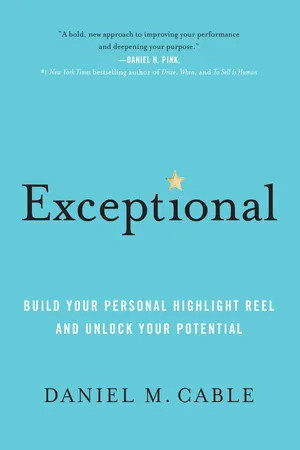
"A bold new approach to improving your performance and deepening your purpose." —DANIEL H. PINK, #1 New York Times bestselling author of Drive, When, and To Sell Is Human
A Three-Step Process to Access and Activate Your Full Potential
Imagine switching on the television to see a highlight reel of the best moments from your life. Like a professional athlete, with every clip you'd learn how to repeat past successes, pinpoint positive blind spots, and build confidence in your skills.
In Exceptional, London Business School professor and expert social scientist Daniel M. Cable reveals how building your own personal highlight reel—a collection of positive memories about yourself from your network—is key to accessing your potential. Using the latest science and proven research behind best-self activation, his three-step process will help you improve your life by:
• Focusing on what you do best
• Crafting a life around your strengths
• Increasing your confidence and resilience
Cable has worked with tens of thousands of people to create their highlight reels and make the most of their gifts. The three-step process ultimately reveals how living up to your full potential can improve the relationships you value most and transform your mindset to one of possibility.
Each of us can bring forth a version of ourself that is uniquely outstanding. It's a version of ourself that already exists—all we have to do is access it.
• A practical book on how to create one's own human highlight reel, and then use that highlight reel to direct one to success, growth, happiness, and fulfillment in work and life based on scientific results
• Great for readers interested in achieving self-improvement and a sense of purpose.
• You'll love this book if you love books like Mindset: The New Psychology of Success by Carol S. Dweck, Presence: Bringing Your Boldest Self to Your Biggest Challenges by Amy Cuddy, and The Power of Habit: Why We Do What We Do in Life and Business by Charles Duhigg.
Digital audio edition read by the author.
- 224 pages
- English
- ePUB (mobile friendly)
- Available on iOS & Android
eBook - ePub
About this book
Information
Chapter 1
Start with What We Do Right
Many of us think the best path to self-improvement is to face the cold truth about ourselves at our worst. We believe criticism is the most effective way to motivate change. This is why many people’s initial instinct is to fight against the positive method, because it is a process that asks us to focus purely on what we do well.
As a professor of organizational behavior, I work with students and executives who come to the London Business School to maximize their leadership impact. And when they arrive, they usually expect to learn what they are doing wrong. They assume I will reveal which dimensions of leadership they score the worst on, and this will motivate them to grit their teeth and grind away at those weaknesses.
Actually, neuroscience tells us the opposite happens when people receive lots of negative feedback. Sharp criticism of the self will prompt threat and anxiety, often triggering the amygdala in the brain to release the stress hormone cortisol. A common result is that people “lock up” as the body prepares for defense. Or even worse, they feel overwhelmed and helpless. These negative emotions repel personal change.
When people feel defensive and threatened, they revert back to old habits rather than experiment with new behaviors. People learn and evolve when they have a safe place for self-exploration. This is how change happens: When we refocus our attention on our strengths, and lean into the positive momentum it creates, we are motivated to push ourselves harder, to try new things and take steps that lead to personal transformation.
This is where your personal highlight reel comes in, because it reflects stories and evidence of your strengths—of you at your best.
Peter Dowrick, a professor of psychiatry at the University of Auckland, observed the effect of personal highlight reels in a workshop for young adults with difficulties finding employment due to physical disabilities. In the workshop, people were given a series of individual assembly tasks to complete over the span of two weeks. One group of individuals watched themselves each workday on videotapes that showed them doing these assembly tasks—except that their mistakes and excess hesitations were edited out. Another group of individuals received financial incentives for each 10% increase in output in the assembly tasks. Over two weeks, productivity rose 15% for individuals who watched their highlight reel, but only 3% for those who got incentives. These trends were still in place four months later.
It is motivating to model our behaviors around peak performances. When we use methods like a personal highlight reel to reinforce our strengths, we build real and lasting confidence in our abilities that can help us perform even better in the future. We also feel deeper satisfaction with our identities and empowered to step into our potential.
Focusing on our core values and strengths also activates a part of our brain that releases powerful motivational chemicals like dopamine. In order to reprogram our minds to prioritize strengths over weaknesses, it helps to understand the power that giving positive feedback has on others and how impactful it can be to receive it.
Gratitude Visits
Humans are so strange with the timing of our gratitude and appreciation for one another. So often we wait until the end of someone’s life to praise them for the impact they’ve had on us. This means most of us never hear, or understand, the positive and profound influence we have on other people. Why do we wait until it’s too late?
Dela, a funeral insurance company in the Netherlands, recognized that “the most beautiful words are often spoken to someone after that someone passes away.” So, Dela gave people a chance to publicly express gratitude to someone living that they really cared about. Dela filmed the exchanges and aired these moments as TV commercials. In one of these gratitude videos, a twenty-year-old woman stood up at a sports event that her parents were attending and publicly thanked them for moving their family from Iran to the Netherlands in order to provide her with the freedom to pursue an education. As her parents sat there looking stunned and breathless, their daughter acknowledged them for making her dreams come true: “I want to thank you for your courage and perseverance, and for everything you have done for me.”
If you get a chance to watch these exchanges online, you’ll find they are both emotional and awkward. It is really interesting to observe the people who are hearing their family and friends express gratitude about them. Their faces contort, as they try to evade the bittersweet emotions that they feel. Their fingers try to push away the unexpected tears that come to their eyes. How uncomfortable they seem during such a lovely event.
It’s a very powerful thing, when people remind us of how we touched their lives and of who we are in our best moments. Yet both sides of this event—the giver and the recipient—feel exposed and vulnerable as they share their appreciation for one another.
But in these Dela videos it is clear that the giver wants to thank them. They are expressing something they have wanted to tell them for years, maybe even decades. And you can tell that the recipients definitely want to hear what is being said. They are hanging on to every word, and it is affecting them profoundly. Without the Dela scheme, however, these beautiful exchanges would not have happened.
Dela’s idea is similar to the gratitude visit invented by Martin Seligman, a professor, author, and someone who has often been referred to as “the father of positive psychology.” I first read about Seligman’s gratitude visits at a very special time in my life. I had just begun to wean myself off chemotherapy and was starting to allow myself to believe I might still have some life left in me. This research had a huge impact on my own research identity and the creation of the positive method.
In these gratitude visits, Seligman’s participants wrote a detailed letter to someone who had made a significant impact on their lives. They told a story that explained in concrete terms what the person did, and why they were grateful. They described what made that person’s actions so valuable and unique to them.
Seligman then had the participants visit those people and read their letters aloud to them. He suggested that they take their time reading the letter, so both parties could savor it. Seligman said the exercise was always very moving for both people involved: “Everyone cries when you do a gratitude visit.”
The empirical research showed that these gratitude visits increased quality of life for both the writer and the recipient. A full month after the visit, they were still experiencing substantially more joy in their lives. They also experienced substantially less depressive symptoms, compared to a control group who were told to live their lives as usual, without any intervention.
Even more importantly, both the giver and the receiver of the gratitude visit felt closer to each other after the experience. And people who were thanked often started thanking others. The result is a self-motivating chain of gratitude and positive memories being shared among more and more people.
But for the most part, people aren’t in the habit of highlighting others’ unique contributions, or sharing positive feedback freely. Later in the book, we’ll talk about the science behind why such a beautiful thing can feel so uncomfortable or socially awkward and how we can move past it.
Around the same period of time that I discovered Seligman’s gratitude visits, I read about another positive psychology approach recommended by Laura Morgan Roberts and her colleagues at the University of Michigan. Roberts’s approach struck me as similar in some ways to Seligman’s, because they both help people learn about their best impact on others. However, Roberts suggested that we should be proactive rather than wait for people to give us a gratitude visit (which, let’s be honest, might not happen for a long time). She recommended that if we want to understand our unique impact on others, we should reach out to our friends, family, and colleagues and ask them to write down their memories about us at our best.
Roberts and her team called this approach a Reflected Best-Self Exercise. These memories written by the important people in your life act as a mirror, reflecting your positive impact back to you. You might get twenty or twenty-five stories from ten different people. Together, these stories are something like your eulogy, except you get to hear them while you’re still alive!
What I love about Roberts’s approach is that it allows you to see yourself through other people’s eyes. And, these are people that you trust and respect. Their stories help you remember, and re-experience, moments when you were at your very best. Because, like Rebecca in the introduction, we all have limitations, but we also all have moments where we shine. We all have times when we make a bigger, better impact on the people in our lives and the world. We all have moments when we are exceptional.
Some people call it “being in flow” or “in your zone.” You could say you are approaching your own potential during those moments.
Of course, it’s not all the time. For lots of us, it’s not even every day. Most days, we’re at our personal average. There is nothing wrong with that. Your personal average may be first-rate, much better than my daily average. But sometimes, you are exceptional, even by your standards.
Roberts’s exercise focuses on a large number of contributors from different parts of our social network. Seligman’s exercise is a one-to-one personal meeting. But in both exercises, people who we care about tell us their fondest memories of us. They give us narratives of when we are extraordinary. They help build our personal highlight reel.
Both exercises are powered by gratitude and the gift of hearing our own eulogy.
As you read about Roberts’s and Seligman’s exercises, you might find yourself resisting the idea of focusing only on the positive. Many people ask, “Shouldn’t we at least balance the best-self stories with some stories about people at their worst?” In other words, don’t we need to show people their limitations along with their strengths? The answer is no. Because that is not how our brains work. If you show people both strengths and weaknesses, they will focus on the weaknesses.
Why is this?
Our brains have evolved to concentrate on negative information first. Research shows that negative events (losing money, being abandoned by friends, or receiving criticism) grab our attention more than positive events of the same type (winning money, gaining friends, or receiving praise). We tune in to bad emotions and bad feedback much more than good. We process negative information more thoroughly than positive information.
Of course, addressing our limitations and flaws sometimes is necessary. But remediation is a very different exercise from thriving. Prevention of failure rarely leads to excellence. This is why, if we want to learn how to become our best more often, we are not going to highlight limitations and flaws in our highlight reels.
Both Seligman’s gratitude visits and Roberts’s Reflected Best-Self Exercise had a big effect on me and my own research. They are at the very core of becoming exceptional.
I’ve spent a long time working on a new approach, called the positive method, that integrates Seligman’s and Roberts’s research. Once you understand how the positive method can change the way your mind works, we’re going to use it to create your own personal highlight reel.
Your highlight reel allows you to relive the moments when you were closest to your full potential, which will improve your mental well-being and help you reach your dreams and goals. But the point is not only to bathe in the success that comes from this process. In recognizing your most exceptional qualities and strengths, the positive method ultimately helps you make your best impact in the world around you and in the lives of those you care for the most. Using your strengths to make a positive influence on others is what creates real satisfaction with life, long after the buzz of awards—and financial rewards—fades away.
This is where it gets exciting, because there is much more power in positive psychology than just feeling nice. When we experience positive psychology, our brain operates differently, and we are able to crea...
Table of contents
- Introduction
- STEP 1
- STEP 2
- STEP 3
- Conclusion
- Acknowledgments
- Notes
Trusted by 375,005 students
Access to over 1.5 million titles for a fair monthly price.
Study more efficiently using our study tools.
Frequently asked questions
Yes, you can cancel anytime from the Subscription tab in your account settings on the Perlego website. Your subscription will stay active until the end of your current billing period. Learn how to cancel your subscription
No, books cannot be downloaded as external files, such as PDFs, for use outside of Perlego. However, you can download books within the Perlego app for offline reading on mobile or tablet. Learn how to download books offline
Perlego offers two plans: Essential and Complete
- Essential is ideal for learners and professionals who enjoy exploring a wide range of subjects. Access the Essential Library with 800,000+ trusted titles and best-sellers across business, personal growth, and the humanities. Includes unlimited reading time and Standard Read Aloud voice.
- Complete: Perfect for advanced learners and researchers needing full, unrestricted access. Unlock 1.5M+ books across hundreds of subjects, including academic and specialized titles. The Complete Plan also includes advanced features like Premium Read Aloud and Research Assistant.
We are an online textbook subscription service, where you can get access to an entire online library for less than the price of a single book per month. With over 1.5 million books across 990+ topics, we’ve got you covered! Learn about our mission
Look out for the read-aloud symbol on your next book to see if you can listen to it. The read-aloud tool reads text aloud for you, highlighting the text as it is being read. You can pause it, speed it up and slow it down. Learn more about Read Aloud
Yes! You can use the Perlego app on both iOS and Android devices to read anytime, anywhere — even offline. Perfect for commutes or when you’re on the go.
Please note we cannot support devices running on iOS 13 and Android 7 or earlier. Learn more about using the app
Please note we cannot support devices running on iOS 13 and Android 7 or earlier. Learn more about using the app
Yes, you can access Exceptional by Daniel M. Cable in PDF and/or ePUB format, as well as other popular books in Psychology & Leadership. We have over 1.5 million books available in our catalogue for you to explore.