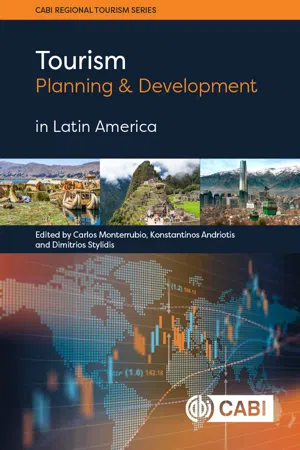
Despite the significance of tourism to the economic, social and environmental structures of Latin America, little has been documented in the English-language literature about tourism in this region. Filling that void, this book focuses exclusively on tourism development and planning, and the impact this has on a wide number of Latin American countries. It covers experiences, challenges, successful and unsuccessful stories, specific cases, and other tourism-related issues, with respect to 10 countries in total. Each chapter is authored by scholars who have done extensive research on tourism in the countries covered. This book: Examines the impact of tourism development and planning within Latin American countries.Takes a multidisciplinary approach including Anthropology, Development, Economics, Ecology, Policy, Sociology and Tourism Planning and Management.Is the first book in English to offer an insight into extensive research undertaken within the region.This book will provide a valuable insight for tourism researchers, practitioners and decision-makers in private and public organisations, not only from the regions of Central, South and North America, but also individuals from other parts of the world who want a more encompassing view of global tourism.
eBook - ePub
Tourism Planning and Development in Latin America
- 216 pages
- English
- ePUB (mobile friendly)
- Available on iOS & Android
eBook - ePub
Tourism Planning and Development in Latin America
About this book
Information
1 Strategies for Regional Tourism Development in Argentina. A Path with New Initiatives for Tourism Dispersal Policies
NATALIA PORTO* AND CAROLINA INÉS GARCIA
Universidad Nacional de La Plata, Argentina
* Email: [email protected]
Introduction
With the new decade, tourism is facing many challenges. Technology development and changing patterns of behaviour, with consumers more demanding, independent and connected, have been increasing over time (Dwyer et al., 2009; Singapore Tourism Board, 2013; Dietz et al., 2019). Such a situation places tourism destinations within a difficult competitive scenario. In countries like Argentina, regarding international tourism, additional challenges include its geographical position – somehow apart from the rest of the world and away from the main outbound travel markets – together with persistent uncertainty concerning social and economic matters.
At the same time, tourism has been playing a key role as an income generator and a source of employment, contributing to economic growth and development in many countries around the world. According to the UNWTO (World Tourism Organization, 2019a), international tourist arrivals worldwide grew by 5.4% in 2018 (versus 2017), reaching 1.4 billion that year, and there was also a positive tendency in total international expenditure, with US$1,448 billion in 2018 (versus US$1,344 billion in 2017). Moreover, the World Travel and Tourism Council (WTTC, 2019) indicated that one in ten jobs in the world was generated by tourism in the same year. It is worth noting that domestic tourism constitutes a powerful force in the flourishing evolution of tourism in certain regions: 71% of worldwide tourism spending in 2018 was explained by domestic tourism, which grew even more in developing countries (WTTC, 2019).
Challenges arise when considering that the development of tourism should embrace a sustainability approach, not only from an economic perspective but also taking into account social and environmental issues. Over-tourism, environmental degradation and social conflicts between residents and tourists are potential troubles in tourism destinations; thus, the balanced distribution of the activity’s positive results becomes relevant. In most cases, tourist arrivals, expenditure and job generation tend to concentrate in certain regions within countries or their main gateways. This presents both a difficulty and a great opportunity for the development of alternative tourism destinations. Tourism dispersal, understood as the ‘tendency of visitors to travel beyond the main gateways of the host destination’ (Koo et al., 2012, p. 1209), becomes the key to overcoming such difficulties. To promote it, we need to properly diagnose and characterize tourism and the viability of motivating tourists to disperse around the whole territory, as well as the effectiveness of national and subnational policies related to dispersal (Tourism Research Australia, 2012; Weber et al., 2017).
This chapter studies the tourism situation in Argentina, focusing on strategies to stimulate regional economic growth and employment generation through tourism while ensuring their equitable distribution throughout the territory. There is a descriptive analysis; and measures of tourism dispersal in Argentina are computed. Some regional policies to be implemented are suggested. Following this introduction, section 1.2 presents a brief review of the literature related to regional development and tourism dispersal, taking into account theoretical and empirical studies. Section 1.3 deals with the current Argentine national and regional scenarios. Tourism distribution from the demand and supply sides is particularly addressed. Also, in order to identify who is visiting us, the profiles of international and domestic visitors in different regions of the country are presented. In section 1.4, tourism policies at both national and regional/provincial levels are discussed. We identify three strategic axes in the national tourism strategy that are correlated with national and regional/provincial policies. We also outline the need to define strategies in certain unaddressed areas. Section 1.5 presents some final remarks.
1.1 Regional Tourism Development as a Means for Tourism Dispersal
The role of tourism as a source of growth and development in specific country regions has been broadly studied in the literature. Some studies emphasize the relationship between the development of the tourism sector and its effects on regional employment and income distribution (Leatherman and Marcouiller, 1996; Lee and Kang, 1998; O’Hare and Barrett, 1999; Porto, 1999, 2004). Other authors define and characterize tourism and recreation-based regions taking into account the endowment of amenities, local services and other variable inputs to analyse regional differences in employment levels, wages and income and the possible effects on income distribution (Leatherman and Marcouiller, 1996; Lee and Kang, 1998; O’Hare and Barrett, 1999; Marcouiller and Xia, 2008; Lacher and Oh, 2012).
Although the literature and empirical evidence have shown the powerful effect of tourism in regional development, one of the main concerns for most countries has become tourism congestion in primary destinations. One way to deal with this is the promotion of local and regional development and the scattering of tourism benefits to secondary destinations. The powerful idea behind this is the tourism dispersal phenomenon, which is based on visitors and travellers going beyond the main gateway or attraction of a country and using their time to enjoy and discover other places in the destination, visiting different regions and following itineraries off the beaten track (Porto and Garcia, 2019).
Tourism dispersal is defined as the likelihood that a tourist’s visit will take place at the gateway point of a destination (country) but will also include other regions. In other words, tourism dispersal is related to the ‘tendency of visitors to travel beyond the main gateways of the host destination’ (Koo et al., 2012, p. 1209). The concept is directly linked to the carrying capacity of a place, defined as ‘the maximum level of visitor use and related infrastructure that an area can absorb before the values of the place are diminished to an unacceptable degree’ (World Tourism Organization, 2005, p. 20).
Tourism dispersal is relevant in the path towards sustainable development, as it can reduce the congestion of primary destinations where tourism has exceeded the place’s carrying capacity (i.e. over-tourism has become a reality there). Also, it can be an opportunity for secondary destinations to become more relevant and receive the benefits of tourism. In order to achieve this, it is important to measure tourism and its impacts and to make decisions that will determine the proper management of tourism.
Recent specific literature related to tourism dispersal includes: Koo et al. (2017), which examines the geographical dispersal of visitors using data on the spatial distribution of international visitors in Australia; Koo et al. (2012), which uses the Australian International Visitor Survey to explain tourist dispersal propensities in an empirical way; and Foyster et al. (2017), which develops an applied study, also for Australia, with a special focus on the Chinese market. Additionally, Tourism Research Australia (2012) analysed visitor dispersal from Sydney to the region of New South Wales. It is worth noting that Koo et al. (2012, p. 1209) stated that:
Visitor dispersal determines the locations of tourist spend, which affects the economic contribution of tourism in sub-regions of a destination. The more visitors spend in different locations; the wider is the economic contribution that tourism makes to regions outside the major tourism gateways. Since some of these regions may be experiencing lower levels of income and employment than the urban areas that are generally associated with tourism gateways, the dispersal of tourists and their spending can benefit the distribution of income in the wider economy.
Although the definition of tourism dispersal is theoretically clear, issues related to its measurement are complex and involve some difficulties. This chapter aims to present a descriptive analysis and to compute measures of tourism dispersal in Argentina, taking into account the availability of data from both the demand and the supply side. Thus, the concept of tourism dispersal is related to the engines of regional economic growth and development. Another important feature of our study is the analysis of different tourism strategies that could be implemented in Argentina’s regions.
Regional tourism development and tourism dispersal policies are relevant issues that destinations have to bear in mind. Based on the literature, strategies implemented by provinces/regions should deal with the following.
1.1.1 Brand promotion for regional consolidation
Liu and Chou (2016) pointed out that brand equity is important for destination differentiation and development. Analysing the components of this equity, Tasci (2018) identified that familiarity and image were the most relevant factors to explain loyalty. These perspectives are crucial when thinking about the positioning of destinations at the local and regional levels.
1.1.2 Smartness, innovation and competitiveness
Buhalis and Amaranggana (2014) set a framework for Smart Tourism Destinations, considering that it makes destinations more competitive. In the same line, SEGITTUR (2015) outlined the need to develop the fundamental axes of technology, innovation, accessibility and sustainability in order to create competitive serv...
Table of contents
- Cover
- Half Title
- Title
- Copyright
- Contents
- Contributors List
- Contributors’ biographies
- Introduction
- 1. Strategies for Regional Tourism Development in Argentina. A Path with New Initiatives for Tourism Dispersal Policies
- 2. The Commitment to Sustainable Tourism and the Development of Indigenous Tourism in Chile
- 3. Tourism Development in Colombia: Between Conflict and Peace
- 4. Ecotourism Development in Costa Rica
- 5. The Challenges of Natural and Cultural Heritages of Galapagos and Quito, Ecuador
- 6. Tourism Development in Mexico
- 7. Panama, the ‘Affordable Exotic Destination’: Planned Tourism Success and its Unplanned Consequences
- 8. The Impacts of Tourism in Economic Growth and Development in Uruguay
- 9. Peru and Nicaragua: Tourism Development in Post-conflict Eras
- 10. Ecuador and Panama: Lifestyle Mobilities, the Golden Years and the Quest for Paradise
- Conclusion
- Index
- Cabi
- Back
Trusted by 375,005 students
Access to over 1.5 million titles for a fair monthly price.
Study more efficiently using our study tools.
Frequently asked questions
Yes, you can cancel anytime from the Subscription tab in your account settings on the Perlego website. Your subscription will stay active until the end of your current billing period. Learn how to cancel your subscription
No, books cannot be downloaded as external files, such as PDFs, for use outside of Perlego. However, you can download books within the Perlego app for offline reading on mobile or tablet. Learn how to download books offline
Perlego offers two plans: Essential and Complete
- Essential is ideal for learners and professionals who enjoy exploring a wide range of subjects. Access the Essential Library with 800,000+ trusted titles and best-sellers across business, personal growth, and the humanities. Includes unlimited reading time and Standard Read Aloud voice.
- Complete: Perfect for advanced learners and researchers needing full, unrestricted access. Unlock 1.5M+ books across hundreds of subjects, including academic and specialized titles. The Complete Plan also includes advanced features like Premium Read Aloud and Research Assistant.
We are an online textbook subscription service, where you can get access to an entire online library for less than the price of a single book per month. With over 1.5 million books across 990+ topics, we’ve got you covered! Learn about our mission
Look out for the read-aloud symbol on your next book to see if you can listen to it. The read-aloud tool reads text aloud for you, highlighting the text as it is being read. You can pause it, speed it up and slow it down. Learn more about Read Aloud
Yes! You can use the Perlego app on both iOS and Android devices to read anytime, anywhere — even offline. Perfect for commutes or when you’re on the go.
Please note we cannot support devices running on iOS 13 and Android 7 or earlier. Learn more about using the app
Please note we cannot support devices running on iOS 13 and Android 7 or earlier. Learn more about using the app
Yes, you can access Tourism Planning and Development in Latin America by Carlos Monterrubio, Konstantinos Andriotis, Dimitrios Stylidis, Carlos Monterrubio,Konstantinos Andriotis,Dimitrios Stylidis, Konstantinos Andriotis,Dimitrios Stylidis in PDF and/or ePUB format, as well as other popular books in Business & Hospitality, Travel & Tourism Industry. We have over 1.5 million books available in our catalogue for you to explore.