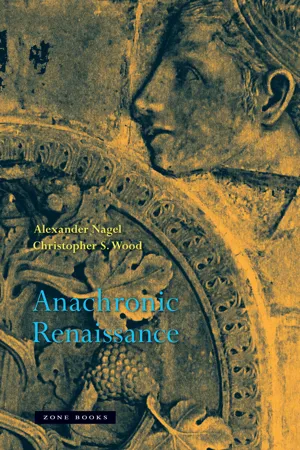
In this widely anticipated book, two leading contemporary art historians present a stunning reconsideration of the problem of time in the Renaissance. With intellectual brilliance, Alexander Nagel and Christopher S. Wood reexamine the meanings, uses, and effects of chronologies, models of temporality, and notions of originality and repetition in Renaissance images and artifacts.
Anachronic Renaissance reveals a web of paths traveled by works and artists, a landscape obscured by art history's disciplinary compulsion to anchor its data securely in time. The buildings, paintings, drawings, prints, sculptures, and medals addressed in this book were shaped by concerns about authenticity, about reference to prestigious origins and precedents, and about the implications of transposition from one medium to another. Byzantine icons taken to be early Christian antiquities, the acheiropoeton or image made without hands, the activities of spoliation and citation, differing approaches to art restoration, legends about movable buildings, and forgeries and pastiches: all of these emerge as basic conceptual structures of Renaissance art. The authors show how the complex and layered temporalities of images offered a counterpoint to the linear chronologies that increasingly structured commerce, politics, travel, and everyday life in the fourteenth and fifteenth centuries.
While a work of art does bear witness to the moment of its fabrication, Nagel and Wood argue that it is equally important to understand its temporal instability: how it points away from that moment, backward to a remote ancestral origin, to a prior artifact or image, even to an origin outside of time, in divinity. The authors conclude with an analysis of Roman episodes and projects of the decades around 1500, culminating in Raphael's Stanza della Segnatura. This book is not the story about the Renaissance, nor is it just a story. It imagines the infrastructure of many possible stories. Clearly, Anachronic Renaissance will be essential reading for historians of Western art and all those concerned with the historiography of material culture.
- 457 pages
- English
- PDF
- Available on iOS & Android
eBook - PDF
Anachronic Renaissance
About this book
Information
Topic
KunstSubtopic
Kunstgeschichte der RenaissanceTable of contents
- Contents
- Plural Temporality of the Work of Art
- The Image of the Image of Our Lady
- What is Substitution?
- An Antique Statue of Christ
- The Plebeian Pleasure of Anachronism
- Architectural Models
- Double Origins of the Christian Temple
- Icon Maintenance
- Fashion in Painting
- Ancient Painting
- Substitution Symbolized
- Author and Acheiropoieton
- Antiquity of Buildings Overrated
- Non-Actual Histories of Architecture
- Temples Painted, Printed, and Real
- Citation and Spoliation
- Neo-Cosmatesque
- Movable Buildings
- The Titulus Crucis
- The Fabrication of Visual Evidence
- Retroactivity
- Forgery 1: Copy
- Forgery 2: Pastiche
- Anti-Architecture
- The Primitive Hut Amidst the Ruins of St. Peter’s
- Mosaic/Paint 1: Limits of Substitution
- Mosaic/Paint 2: Intermedial Comparison
- Space for Fiction
- Acknowledgments
- Notes
- Index
Trusted by 375,005 students
Access to over 1.5 million titles for a fair monthly price.
Study more efficiently using our study tools.
Frequently asked questions
Yes, you can cancel anytime from the Subscription tab in your account settings on the Perlego website. Your subscription will stay active until the end of your current billing period. Learn how to cancel your subscription
No, books cannot be downloaded as external files, such as PDFs, for use outside of Perlego. However, you can download books within the Perlego app for offline reading on mobile or tablet. Learn how to download books offline
We are an online textbook subscription service, where you can get access to an entire online library for less than the price of a single book per month. With over 1.5 million books across 990+ topics, we’ve got you covered! Learn about our mission
Look out for the read-aloud symbol on your next book to see if you can listen to it. The read-aloud tool reads text aloud for you, highlighting the text as it is being read. You can pause it, speed it up and slow it down. Learn more about Read Aloud
Yes! You can use the Perlego app on both iOS and Android devices to read anytime, anywhere — even offline. Perfect for commutes or when you’re on the go.
Please note we cannot support devices running on iOS 13 and Android 7 or earlier. Learn more about using the app
Please note we cannot support devices running on iOS 13 and Android 7 or earlier. Learn more about using the app
Yes, you can access Anachronic Renaissance by Alexander Nagel,Christopher S. Wood in PDF and/or ePUB format, as well as other popular books in Kunst & Kunstgeschichte der Renaissance. We have over 1.5 million books available in our catalogue for you to explore.