For half a century Sarah Josepha Hale was the most influential woman in America. As editor of Godey's Lady's Book, Hale was the leading cultural arbiter for the growing nation. Women (and many men) turned to her for advice on what to read, what to cook, how to behave, and—most important—what to think. Twenty years before the declaration of women's rights in Seneca Falls, NY, Sarah Josepha Hale used her powerful pen to promote women's right to an education, to work, and to manage their own money.
There is hardly an aspect of nineteenth-century culture in which Hale did not figure prominently as a pathbreaker. She was one of the first editors to promote American authors writing on American themes. Her stamp of approval advanced the reputations of Edgar Allan Poe, Harriet Beecher Stowe, and Nathaniel Hawthorne. She wrote the first antislavery novel, compiled the first women's history book, and penned the most recognizable verse in the English language, "Mary Had a Little Lamb."
Americans' favorite holiday—Thanksgiving—wouldn't exist without Hale. Re-imagining the New England festival as a patriotic national holiday, she conducted a decades-long campaign to make it happen. Abraham Lincoln took up her suggestion in 1863 and proclaimed the first national Thanksgiving.
Most of the women's equity issues that Hale championed have been achieved, or nearly so. But women's roles in the "domestic sphere" are arguably less valued today than in Hale's era. Her beliefs about women's obligations to family, moral leadership, and principal role in raising children continue to have relevance at a time when many American women think feminism has failed them. We could benefit from re-examining her arguments to honor women's special roles and responsibilities.
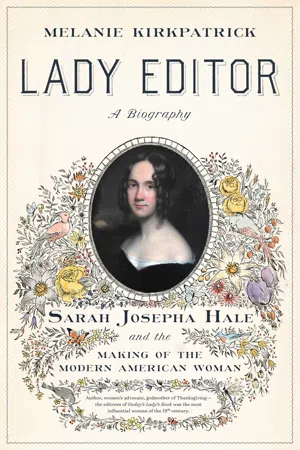
Lady Editor re-creates the life of a major nineteenth-century woman, whose career as a writer, editor, and early feminist encompassed ideas central to American history.
eBook - ePub
Lady Editor
Sarah Josepha Hale and the Making of the Modern American Woman
- 251 pages
- English
- ePUB (mobile friendly)
- Available on iOS & Android
eBook - ePub
About this book
Information
Subtopic
Journalist BiographiesIndex
Social SciencesCHAPTER ONE
Daughter of the Revolution

SARAH JOSEPHA BUELL was born on October 24, 1788, on her family’s farm in the picturesque hill country of central New Hampshire. Her hometown, Newport, had been founded just twenty-seven years earlier, in 1761, and it still had a frontier feel to it. The land was heavily forested, and settlements were widely separated. Old-timers remembered when wolves roamed the area and it behooved you to take your musket with you when you went out to the fields.
Among Newport’s early settlers were a number of Buells who had emigrated from Killingworth, Connecticut, a coastal town almost two hundred miles to the south. Sarah’s parents, Gordon and Martha Buell, moved to Newport shortly after the Revolution, settling on four hundred acres belonging to Gordon’s grandfather along a slope of East Mountain in the southeast corner of the town. The house in which Sarah grew up does not survive, but a sketch depicts a classic New England farmstead with a main house connected to a series of outer buildings in one continuous structure. In winter the family could walk from house to kitchen to buttery to barn without stepping outside into the snow.
The first U.S. Census, in 1790, counted only 132 households in Newport, 18 of which were occupied by families named Buell. The young Sarah grew up surrounded by an extended family of aunts, uncles, and cousins galore. Among her relatives were the town’s first selectman, a popular singing master, and a housewife who was famous for her bear and pumpkin mincemeat pies, the recipe for which regrettably hasn’t survived. Sarah’s great-aunt Love Buell Nettleton was the local midwife. Aunt Love was admired both for her professional skills and for her dedication to duty, having once traveled three miles on snowshoes to attend a woman giving birth. Sarah, in short, came from a family of upright, hardworking citizens who possessed a high sense of duty to their community.
Two miles down a mountainside track from the Buell homestead stood the village of Newport. The village was so tiny that in the year of Sarah’s birth it lacked that most familiar feature of New England towns: a church steeple. During Sarah’s youth worshippers met at Proprietors’ House, a rough-hewn, barnlike, multipurpose structure that functioned as meeting house, schoolhouse, and, on the rare occasions that it was necessary, courthouse. All public functions were held in Proprietors’ House. It was there, in 1776, that townspeople gathered to hear the Declaration of Independence read aloud. The interior of the building was unfinished, with a primitive ceiling made of planks that had been nailed across the overhead beams. When an event drew a capacity crowd, the children would climb up and sit on the beams and boards, from where they would pay attention (or not) to the proceedings down below.
Edmund Wheeler, a mid-nineteenth-century chronicler of the early history of Newport, extolled the area’s natural beauty. “It is difficult to conceive of a more charming spot than that occupied by the main village,” he wrote. He described the “gently-swelling verdant hills,” the “wide-spreading branches of the elms,” and the graceful waters of the Croydon and Goshen branches of the Sugar River that wind through town. He even had cheerful words to say about the village swamp, “in which the frogs, at certain seasons of the year, gave free concerts.” In the 1820s, by which time Sarah was a wife and mother, the swamp, now drained, had become the town common. She lived in a house facing the common, where townspeople grazed their cows.1
Like Wheeler, Hale was moved by the beauty of her surroundings. In the summer of 1822, shortly before her husband’s death, she wrote a poem titled “Address to Sugar River.” The sentimental poem is perhaps not one of her better efforts, but it expresses her affection for the surroundings in which she grew up. She recalls halcyon childhood days spent reading on the bank of the Sugar and watching a little waterfall whose wonders she compared to Niagara’s. Shakespeare had the Avon River, she writes, and Pope the Thames:
But my soft-gliding, native river raisesA thousand images of home-felt joy;And though their names in lofty lays may shine,In sweetness they can ever equal thine.2
SARAH BELONGED TO the eighth generation of Buells to call New England home. The family traced its American roots back to 1630, when a young carpenter called William Buell arrived from England aboard the ship Mary & John. William was a member of the religious community led by the Reverend John Warham, a Puritan pastor. Upon their arrival in the New World, Warham and his followers first founded Dorchester, now incorporated into the city of Boston. A few years later they helped establish the first permanent English settlement in Connecticut—the town of Windsor at the confluence of the Farmington and Connecticut Rivers. William’s son Samuel eventually moved south to Killingworth, Connecticut, where his descendants stayed put for several generations. Sarah’s mother’s family—the Whittleseys—hailed from the town of Saybrook, adjacent to Killingworth. There had been Whittleseys in Saybrook since 1623, when the Dutch controlled the area.
Sarah’s Puritan heritage is reflected in the given names of the ancestors found on the Buell family tree. The Puritans favored names from the Old Testament. In keeping with that tradition we find Buell men called Samuel, Nathaniel, and Asa along with women christened Mehitable, Hepzibah, Hannah, Abigail—and, of course, Sarah. Another Puritan naming practice was to call children after virtues. Sarah’s ancestors include the sisters Mindwell and Freelove, the latter being a reference to God’s free love for His believers, not the sexual revolution of the 1960s. Sarah’s paternal grandmother was called Thankful, a name that turns up in Sarah’s generation on another branch of the family tree. Sarah Josepha was named after her mother’s parents, Sarah and Joseph Whittlesey, who were alive and living in Saybrook at the time she was born.
Sarah was Gordon and Martha Buell’s third child and their first girl. Her older brothers—Charles Whittlesey Buell and Horatio Gates Buell—were born in 1784 and 1787, respectively. A younger sister, Martha Maria, arrived in 1793. The first Census records a third boy living in the Buell household in 1790, identity unknown. He might have been a hired hand, a visiting cousin, or even a third son who died when he was very young. All the children were close, but Sarah and Horatio—only nineteen months apart—were especially so. Both were highly intelligent, and there was a friendly spirit of intellectual competition between them. As the first daughter in the family, with two older brothers and a sister five years younger, Sarah was always trying to keep up with the boys.
OF THE MILLIONS of words that Sarah Josepha Hale wrote over the course of her long life, few were about her childhood in Newport or, for that matter, her personal life overall. If she wrote about herself, she preferred to focus on what she termed her literary life—her books, essays, poetry, and other prose. Even so, the attentive reader can catch glimpses of her personal life through her writing.
Hale lived at a time when it wasn’t polite to talk too much about yourself, and in any case, she—ever the lady—would have felt uncomfortable doing so. In 1837, when she was approaching fifty, she wrote an essay about herself for inclusion in a collection of biographical sketches of female writers that she was editing. She opens the essay with an extended apology for writing about herself and later asks the reader not to think it “vanity or weakness” on her part when she praises her late husband.3 Sarah would not have been comfortable as a member of the me generation.
Nearer to the end of her life, Hale explained her reticence to talk about her childhood in a letter to Edmund Wheeler, the Newport historian. Wheeler was writing a history of their mutual hometown, and he wanted to include a biography of its famous native daughter. “My birthplace will always be dear to me,” Hale wrote to Wheeler. “But I cannot expect the public to take interest in things whose places are in most instances probably now occupied by objects of greater beauty or usefulness. In short my dear townsman, I do not wish you to go at all into any details of my life or family. All that the public care to know is connected with my literary history.”4
In reply, Wheeler did the sensible thing: Rather than attempt the impossible—writing an essay that would be acceptable to the famous editor—he invited Mrs. Hale to write the section on Mrs. Hale. The autobiographical essay that eventually appeared in Wheeler’s book provides a window on Sarah’s early life.
The most important influences on her childhood, she writes, were her parents, who had a love of learning and a deep religious faith. Their teaching, personal conduct, and life stories sparked her thinking on the two chief subjects that she championed throughout her half century as a writer, editor, and social reformer: women’s education and America’s emerging cultural identity.
The central event of Sarah’s father’s life was the Revolutionary War, and he passed along to his daughter a profound love of country. Gordon Buell served under the command of General Horatio Gates, after whom he named his second son. He fought with Gates at the Battle of Saratoga in 1777. The battle was a turning point in the war, with the American victory helping to persuade the French to enter the war on the side of the Americans. Gordon served four years in the Continental Army, rising to the rank of captain, the title by which he was addressed for the remainder of his life. During his military service he suffered an unspecified injury to his health, making the exhausting, relentless labor of farming difficult, especially as he grew older and less physically able. In 1810 the family gave up their farm on East Mountain and moved into town, where Captain Buell built the Rising Sun Tavern along the newly constructed Croyden Turnpike.
Gordon wasn’t the only Buell to fight in the Revolution. Other Buells did so too—at Bunker Hill, Fort Ticonderoga, and elsewhere—and Sarah grew up in a household where Americans’ newly won freedoms and the patriots who fought for them were deeply revered.
For the Buells in post-Revolution Newport, the valuable old-growth pine forest on the family farm was a potent symbol of American independence. Under the terms of the Newport town charter, granted by King George III, the original owners of the pine trees had been required to preserve the trees for the use of the Royal Navy, which commandeered them for masts for its ships. After the war, the property rights reverted to the owners of the forest. The Buells, not some faraway king, could now decide what to do with their pine trees. Sarah would spend hours lying on the forest floor gazing up at the towering treetops.
When she was ten years old, Sarah read David Ramsay’s The History of the American Revolution, which affected her deeply. Ramsay was a cultural nationalist. He believed that it wasn’t sufficient for the new nation to declare political independence. Americans must also liberate themselves from England by declaring cultural independence. That meant creating their own literature and art and conducting their own scientific research. He warned that the new nation would fracture if Americans weren’t bound together by a common culture. Ramsay’s book “made me a patriot for life,” Hale wrote.5 It provided the intellectual underpinnings of her future editorial vision to publish original works by American authors on American themes. It also helped explain her championship of a national Thanksgiving Day, a homegrown American holiday. She hoped that a shared holiday would draw together the nation, which was splitting over the issue of slavery, and prevent civil war.
Another book that had a large impact on the young Sarah was the Gothic novel The Mysteries of Udolpho, by Englishwoman Ann Radcliffe. The book represented two significant firsts for Sarah. It was the first novel she read, and it was the first book she read of any genre that had been written by a woman. She wrote: “Here was a work, the most fascinating book I had ever read … written by a woman! How happy it made me! The wish to promote the reputation of my own sex, and to do something for my own country, was among the earliest mental emotions I can recollect.”6
Both sides of Sarah’s family—the Buells and the Whittleseys—placed great value on education, as can be seen in the biographical sketches Wheeler provides of family members in his history of Newport. Among Sarah’s relatives on the Buell side were a “lady of superior education and intelligence” and a man who was a “lover of books.” Men and women on Sarah’s mother’s side of the family, the Whittleseys, receive similar accolades. Martha’s brother, Arphaxad Whittlesey, was a schoolteacher, described by a former pupil as “a very competent teacher, an able writer, and a fluent and forcible speaker.” Martha’s sister Polly was “a lady of culture.”
Wheeler reserved his highest encomium, though, for Martha Buell herself, whom he described as possessing “intellectual endowments of a high order.” Martha appears to have been exceptionally well educated for a woman of her day, and she passed along her knowledge to her four children, whom she home-schooled. Girls weren’t treated differently than boys in Mrs. Buell’s schoolroom. Sarah received the same education as her older brothers.7
In her autobiographical profile, Sarah, without elaborating, describes her mother as having “enjoyed uncommon advantages of education.” Martha possessed “a mind clear as rock-water, and a most happy talent of communicating knowledge.” According to her daughter, Martha excelled, too, as a teacher, amusing and instructing her children at the same time. “She always contrived to teach us some serious truth, while she charmed us.”8
The Puritans’ emphasis on literacy meant that in New England in the late eighteenth century a high percentage of men—perhaps as high as 70 percent—could read, write, and do basic arithmetic. Literacy rates for women were lower but still strong when compared with England and other parts of Europe. While American women often were taught to read—principally so that they could read the Bible—they were not necessarily taught to write, which was considered a separate skill. If girls were educated, instruction often took place at home and was intermittent. Sewing, deportment, and household skills were taught, but it was uncommon for girls to pursue intellectual studies beyond basic literacy and numeracy.
Hale might have been thinking of her mother when she wrote in 1829, eighteen years after that lady’s death, “There is no influence so powerful as that of a mother … but next in rank and efficacy … is that of a schoolmaster.”9 Martha Whittlesey Buell was both Sarah’s mother and her first schoolteacher, and her influence was profound. Under Martha’s tutelage, Sarah’s education went ...
Table of contents
- Cover
- Title Page
- Copyright
- Dedication
- Contents
- Introduction: A Summer Snowstorm
- Chapter One: Daughter of the Revolution
- Chapter Two: Wife and Widow
- Chapter Three: The Ladies’ Magazine
- Chapter Four: Mary’s Lamb
- Chapter Five: Let the Ladies Do It
- Chapter Six: The Prince of Publishers
- Chapter Seven: Literary Ladies
- Chapter Eight: The Dignity of Housekeeping
- Chapter Nine: A Suitable Job for a Woman
- Chapter Ten: Mrs. Hale’s Magazine
- Chapter Eleven: Our Glorious Thanksgiving Day
- Chapter Twelve: Hale’s Civil War
- Chapter Thirteen: Twilight Years
- Afterword: Sarah Who?
- In Her Own Words
- Acknowledgments
- Notes
- Index
Trusted by 375,005 students
Access to over 1.5 million titles for a fair monthly price.
Study more efficiently using our study tools.
Frequently asked questions
Yes, you can cancel anytime from the Subscription tab in your account settings on the Perlego website. Your subscription will stay active until the end of your current billing period. Learn how to cancel your subscription
No, books cannot be downloaded as external files, such as PDFs, for use outside of Perlego. However, you can download books within the Perlego app for offline reading on mobile or tablet. Learn how to download books offline
Perlego offers two plans: Essential and Complete
- Essential is ideal for learners and professionals who enjoy exploring a wide range of subjects. Access the Essential Library with 800,000+ trusted titles and best-sellers across business, personal growth, and the humanities. Includes unlimited reading time and Standard Read Aloud voice.
- Complete: Perfect for advanced learners and researchers needing full, unrestricted access. Unlock 1.5M+ books across hundreds of subjects, including academic and specialized titles. The Complete Plan also includes advanced features like Premium Read Aloud and Research Assistant.
We are an online textbook subscription service, where you can get access to an entire online library for less than the price of a single book per month. With over 1.5 million books across 990+ topics, we’ve got you covered! Learn about our mission
Look out for the read-aloud symbol on your next book to see if you can listen to it. The read-aloud tool reads text aloud for you, highlighting the text as it is being read. You can pause it, speed it up and slow it down. Learn more about Read Aloud
Yes! You can use the Perlego app on both iOS and Android devices to read anytime, anywhere — even offline. Perfect for commutes or when you’re on the go.
Please note we cannot support devices running on iOS 13 and Android 7 or earlier. Learn more about using the app
Please note we cannot support devices running on iOS 13 and Android 7 or earlier. Learn more about using the app
Yes, you can access Lady Editor by Melanie Kirkpatrick in PDF and/or ePUB format, as well as other popular books in Social Sciences & Journalist Biographies. We have over 1.5 million books available in our catalogue for you to explore.