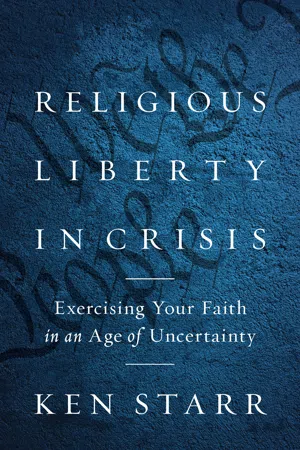
What was unfathomable in the first two decades of the twenty-first century has become a reality. Religious liberty, both in the United States and across the world, is in crisis.
As we navigate the coming decades, We the People must know our rights more than ever, particularly as it relates to the freedom to exercise our religion. Armed with a proper understanding of this country's rich tradition of religious liberty, we can protect faith through any crisis that comes our way. Without that understanding, though, we'll watch as the creeping secular age erodes our freedom.
In this book, Ken Starr explores the crises that threaten religious liberty in America. He also examines the ways well-meaning government action sometimes undermines the religious liberty of the people, and how the Supreme Court in the past has ultimately provided us protection from such forms of government overreach. He also explores the possibilities of future overreach by government officials. The reader will learn how each of us can resist the quarantining of our faith within the confines of the law, and why that resistance is important. Through gaining a deep understanding of the Constitutional importance of religious expression, Starr invites the reader to be a part of protecting those rights of religious freedom and taking a more active role in advancing the cause of liberty.
In the second week of March 2020, I was in New York City to film Firing Line, the television show created by one of my heroes, the late William F. Buckley, Jr. It was to be a quick trip, in and out. From there, I was to fly to Denver for a daylong set of presentations at Colorado Christian University in suburban Lakewood.
Like everyone else, I was tracking the news. A new virus was spreading across the globe. Still, no recordings or speaking events had been canceled. No one in the airports or on the streets was wearing face masks. No lockdown orders had been issued. It was another day in a now foregone era, the era before COVID-19 changed everything.
In the early hours of that morning, I made my way to the Empire Hotel gym across from Lincoln Center for a preshow workout. I looked around that small room, hoping to find sanitary wipes. Seeing none and aware of the growing threat of the coronavirus to those my age, I left the gym, informed the night clerk of the need for new wipes, and opted for a walk outside in America’s most exciting city.
There was a nervous energy as I walked through the city. There were fewer people on the streets, and those who’d ventured out kept their heads down. Everyone seemed to avoid each other. A few wore masks before it was en vogue. The people had already gotten the message. Within hours, Governor Andrew Cuomo announced a statewide lockdown.
I think about my last stroll through New York City more and more these days. Aware of the growing threat, I made a choice and took my exercise the old-fashioned way—a vigorous walk in the bracing weather of early March—instead of subjecting myself to any number of viruses that might have been haunting the gym.
The people of New York City were already making their choices, too. They were huddled up in their homes. But within mere days of that brisk walk, our choices evaporated. Gyms across the country closed at the instruction of state and local governments. Shelter-in-place and social-distancing orders quickly became routine, while governors and mayors stepped into leadership roles ordinarily associated with a local or regional natural disaster, such as a hurricane. In those roles, they asked hard questions: Which businesses had to close? What services were essential? Could worship services continue?
As lockdown orders rolled out, different states (and sometimes cities within those states) fashioned different approaches. Business closures and layoffs cascaded across the country at unprecedented levels. Unemployment skyrocketed to levels not seen since the Great Depression. The human and economic wreckage was appalling.
What’s more, churches were not shielded from the onslaught, nor were religiously affiliated institutions. Many state and local governing authorities significantly limited, or outright banned, worship services. As a result, church giving declined. In some places, the falloff in giving was so significant that church staff had to be reduced. Religion, just like virtually every other sector of American society, other than Walmart and the local liquor stores, was facing a deep crisis.
FAITH IN LOCKDOWN: RELIGIOUS LIBERTY IN THE CORONAVIRUS AGE
In the book of Matthew, the opponents of Jesus came with a question: Was it lawful for a God-fearing Jew to pay taxes to Caesar? You may remember Jesus’s answer. He asked one of these opponents to produce a Roman coin, then inquired: “Whose face is on the coin?” When his interrogator answered, “Caesar’s,” Jesus answered, “Render to Caesar the things that are Caesar’s, and to God the things that are God’s.”
What did Jesus mean? Interpreting the Messiah can be a tricky business, but I believe he meant that governments have certain powers in this world, and we should honor and respect those powers.
But what happens when Caesar’s orders conflict with religious faith and practice? What happens when, for instance, Caesar’s orders create a crisis of belief in the middle of a health crisis? Who wins?
Perhaps a better question is this: who should win, particularly in a country in which the Constitution seems by its very words to prohibit government meddling with faith?
What do I mean?
Let’s recall the text of the First Amendment to the United States Constitution:
Congress shall make no law respecting an establishment of religion, or prohibiting the free exercise thereof; or abridging the freedom of speech, or of the press; or the right of the people peaceably to assemble, and to petition the government for a redress of grievances.
Baked into that amendment are the bedrock rights of America: to believe as you will; to express those beliefs; and to assemble with those who are like-minded, all without government intrusion.
This clause, often known as the establishment clause, is a significant check on the government. But in the face of the twenty-first century COVID-19 pandemic, a very large number of American Caesars—mostly governors and city mayors—have seemed to run afoul of this clause. How?
Living through the COVID lockdowns, we are vividly aware of the closure of houses of worship while other “essential businesses” are allowed to remain open. In Missouri, citizens could only attend places of worship if no more than ten people were present, but liquor stores remained open to the public.1 In California, citizens were prohibited from attending church services while marijuana dispensaries were considered “essential businesses” and allowed to sell recreational weed.2
In Nevada, the Governor issued an astonishing order that in effect shut down worship services, but allowed casinos to operate. The case made its way to the Supreme Court on an emergency basis, but to no avail. The nation’s highest court allowed, strangely, this disparity to continue. Objecting vehemently to this church vs. casino dichotomy, Justice Gorsuch excoriated the five-member Court majority’s turning a blind eye to the outrage: “[T]here is no world in which the Constitution permits Nevada to favor Caesars Palace over Calvary Chapel.”
TO RESIST OR COMPLY? THAT IS THE QUESTION
In New York City, which bore the brunt of the first wave of the pandemic, faith communities obeyed the mayor’s stay-at-home orders. But compliance with similar orders across the country was even more noteworthy since many communities were largely spared the first wave of the horrific pandemic impact.
Still, informed that large gatherings created settings where the virus could spread with astonishing speed, and believing the government’s specific warnings, people of faith went along with Caesar’s directives. Zoom, a video-conferencing platform, became a necessary ministry tool. Online worship services became the “new normal” for the faithful. Some churches were even more creative.
Paul Daugherty, lead pastor of the 13,000-member Victory Church in Tulsa, OK, preached to thousands of congregants on a regular basis, but as the pandemic took hold and lockdown orders went into effect, he had an idea. He could comply with Caesar’s orders and still speak to his people in the flesh. So, he opened the parking lot for the congregants’ vehicles and, elevated on a scissor lift thirty feet in the air, he conducted a drive-in worship service. The praise team led music from the church roof and when the music stopped, he preached from his lofty perch.
The resulting worship experience was inspirational, with joy-filled Victory Church worshipers honking their horns in a benedictory response of gratitude. What’s more, the service was carried live on a local FM station and livestreamed to more than 120,000 souls who saved gas money and remained safely at home.
Here’s the part of this story that has been often overlooked. Pastor Daugherty sought and received preclearance from Tulsa’s mayor to conduct the service. It was a small act with large significance. The country had entered a new era; an era in which Caesar had to be consulted in advance of holding worship services.
Victory Church’s innovations were mirrored across the nation, as countless houses of faith sincerely sought to comply with official directives and Center for Disease Control guidelines.
But not all were quite so compliant. In fact, there were loud exceptions.
At The River Church in Tampa, FL, megachurch pastor Rodney Howard-Browne continued services as usual. The result? He was arrested for holding services in defiance of local government orders and charged with both “unlawful assembly” and “violation of a public health emergency order.”3 It was a move that did not sit well with everyone.
Pastor Howard-Browne’s attorney, Liberty Counsel’s Mat Staver, attacked the criminal charges, noting that The River Church had taken extra precautions and went “above and beyond” the six-foot social distancing restriction. Law enforcement’s rigid approach failed to take those ameliorating factors into account, the lawyer maintained, which would likely have doomed officialdom’s efforts on judicial challenge. This doubtless influenced officials’ decision to dismiss the ill-conceived charges.
Similarly, at Life Tabernacle Church in Baton Rouge, LA, Pastor Tony Spell defied Governor John Bel Edwards’s order banning more than fifty people gathering together. “We have a constitutional right to congregate. We will continue,” he said. Drawing the battle lines, Pastor Spell emphasized that Life Tabernacle had implemented highly rigorous protective measures, boasting that it was a lot “cleaner” at Life Tabernacle than at Walmart or local gas stations which remained open for business.
The opinions regarding whether religious services should be held during a public health crisis may vary. You may believe seeking government approval before congregating is wise. You might believe civil disobedience is in order when the government issues a “do not assemble together” order. You may believe you should keep your head down, obey the authorities, and pray. But for all the varied and frequently conflicting responses of church communities in coping with the COVID-19 crisis, people of faith should be asking one common question: when does the government’s authority trump religious assembly and expression?
AUTONOMY: THE KEY TO RELIGIOUS LIBERTY
The COVID-19 crisis shines a bright spotlight on an important concept at the heart of religious liberty in America: the autonomy principle.
Autonomy. This is a special concept for friends of religious liberty. It is one of what we can call the Great Principles that undergird our system of ordered liberty. Properly understood, the autonomy principle provides an extra layer of constitutional protection for all faith communities, and it is one that the Supreme Court has vigorously policed and guaranteed.
How does it do so? Pay attention. You might need to know your rights in these odd times of the “new normal.”
Simply defined, the word “autonomy” relates to the ability to govern oneself. Put another way, autonomous individuals or organizations might say: “Leave me alone. I’m in charge of my (or our) own destiny.” Autonomy is the very bedrock guaranty of religious liberty and it is a fundamental guaranty for any free individual or institution, especially churches.
Throughout our nation’s history, the idea of autonomy, of leaving churches alone to govern their own affairs, has been deemed fundamental to our constitutional order. Simply put, faith-bearing Americans have upheld the notion that Caesar should mind his own business and stay out of matters of religion, including matters of church governance. This allows the faithful to freely exercise the tenets of their religion without fear of government interference, or of discrimination—a founding principle of our constitutional order.
Obviously, extreme examples demonstrate that rare exceptions may arise to the general rule. Government may have to intervene in the most exceptional circumstances to serve an overarching, powerful goal in promoting the public good. Is the outbreak of a pandemic one such example? Before we answer that question, let’s delve a little deeper. Let’s consider a hypothetical.
An unthinkable example is illustrative for purposes of understanding the principle. Consider human sacrifice as a ritual act of worship (which is and obviously should be a criminal act). In the event any religious group attempted to go through with such a macabre ceremony, the government would rightly step in to protect human life, even if the would-be “victim” of the ritual freely agreed to the life-ending ritual. Or, more realistically, consider possible claims of child abuse in a church school program. Once again, law enforcement or social services officials should intervene to protect the young and vulnerable.
In these hypothetical situations, the government has a “compelling” reason to intervene in religious institutions, and this laudable governmental goal provides the compelling reason for interfering with religious liberty. But extreme examples and public health emergencies aside, when viewed properly, the First Amendment does not so much create a “wall of separation” between the church and the state, but rather a “wall of protection” so that faith communities can freely chart their own course without disrupting significant public interests.
What does this look like practically speaking? Consider the rather exotic South Florida faith community of the Church of the Lukumi Babalu Aye. This is a real case, not a hypothetical.
As part of its worship services, the church engaged in the ritual sacrifice of animals. The City of Hialeah tried to put a stop to the practice by adopting an ordinance that expressed its “great concern regarding the possibility of public ritualistic animal sacrifices,” before banning the practice altogether.
The ordinance did not advance a compelling government interest, at least not one that justified its effect on religious practice. What’s more, the ordinance was not neutral in nature. It did not prohibit the slaughtering of chickens or cattle at a meatpacking plant.
Instead, it specifically targeted ritualistic religious sacrifices. By aiming at religious ceremonies rather than more generally outlawing the slaughtering of animals, the Supreme Court concluded that the city had violated the Constitution. It had run afoul of the implicit “non-discrimination principle” embedded in the First Amendment, and overtly threatened the autonomy of a religious organization to express its faith, even if that faith included what the community considered highly offensive rituals.
THERE’S MORE TO AUTONOMY THAN RITUALISTIC SACRIFICE
Exotica aside, we see the same great principle of autonomy at work in a case decided years later, one which pitted the civil rights forces of the Obama administration against a religious school.4
A Michigan Lutheran school, Hosanna-Tabor, employed Ch...
Table of contents
Cover
Title Page
Copyright
Dedication
Contents
Introduction: A Preliminary Word
1 Hands Off, Caesar!
2 Faith of Our Fathers
3 Free to Believe
4 Constitutional Combat Zone: The Battle Over School Prayer
5 Discrimination in the Schoolhouse
6 Friends in High Places: The Oval Office and Capitol Hill
7 Vouchers on Trial
8 Can Government Provide Financial Aid to Religious Institutions?
9 Lemon’s Bitter Medicine
10 Beating Swords into Plowshares: The Accommodation Principle
11 Damn the Torpedoes—Full Steam Ahead
12 Reconciliation and Redemption: The Fruits of Religious Liberty
13 The Rise of the Cancel Culture
Afterword
Acknowledgments
Notes
Index
Trusted by 375,005 students
Access to over 1.5 million titles for a fair monthly price.
Study more efficiently using our study tools.
Frequently asked questions
Yes, you can cancel anytime from the Subscription tab in your account settings on the Perlego website. Your subscription will stay active until the end of your current billing period. Learn how to cancel your subscription
No, books cannot be downloaded as external files, such as PDFs, for use outside of Perlego. However, you can download books within the Perlego app for offline reading on mobile or tablet. Learn how to download books offline
We are an online textbook subscription service, where you can get access to an entire online library for less than the price of a single book per month. With over 1.5 million books across 990+ topics, we’ve got you covered! Learn about our mission
Look out for the read-aloud symbol on your next book to see if you can listen to it. The read-aloud tool reads text aloud for you, highlighting the text as it is being read. You can pause it, speed it up and slow it down. Learn more about Read Aloud
Yes! You can use the Perlego app on both iOS and Android devices to read anytime, anywhere — even offline. Perfect for commutes or when you’re on the go. Please note we cannot support devices running on iOS 13 and Android 7 or earlier. Learn more about using the app
Yes, you can access Religious Liberty in Crisis by Kenneth Starr,Ken Starr in PDF and/or ePUB format, as well as other popular books in Law & Jurisprudence. We have over 1.5 million books available in our catalogue for you to explore.