This anthology, a companion to the Santa Fe 400th Anniversary Commemoration publication, All Trails Lead to Santa Fe, affords Native American authors the opportunity to unreservedly express their ideas, opinions and perspectives on the historical and cultural aspects of Santa Fe using their own voice and preferred writing styles that are not necessarily in accord with western academic and writing conventions. One cannot truly contemplate the history and culture of Santa Fe without the voices of the Native Americans—the original inhabitants of Po'oge, "White Shell Water Place". Indeed, much of Santa Fe's story is conveyed from a western colonial perspective, which, until fairly recently, has predominantly relegated Native Americans to the fringes. However, over the last thirty years colonial narratives regarding Native American history and culture have been, and continue to be, disputed and amended as the pursuit of academic, intellectual and cultural self determination gains momentum in respective Native American tribal and academic communities. The Santa Fe 400th Commemoration has created an opportunity for the Native American voice to be heard. This anthology is a ceremony of Native voices, a gathering of Native people offering scholarly dialogue, personal points of view, opinions, and stories regarding the pre and post–historical and cultural foundations of Santa Fe.
eBook - ePub
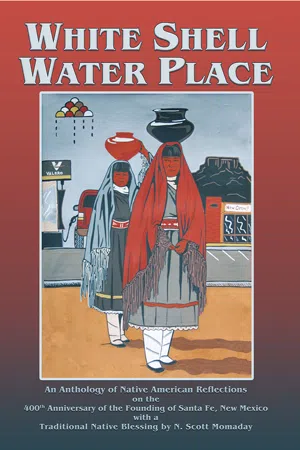
White Shell Water Place
An Anthology of Native American Reflections on the 400th Anniversary of the Founding of Santa Fe, New Mexico with a Traditional Native Blessing by N. Scott Momaday
- 188 pages
- English
- ePUB (mobile friendly)
- Available on iOS & Android
eBook - ePub
White Shell Water Place
An Anthology of Native American Reflections on the 400th Anniversary of the Founding of Santa Fe, New Mexico with a Traditional Native Blessing by N. Scott Momaday
About this book
Information
Subtopic
Asian HistoryIndex
HistoryWHITE SHELL
WATER PLACE
An Anthology of Native American Reflections
on the
400th Anniversary of the Founding of Santa Fe, New Mexico
with a
Traditional Native Blessing by N. Scott Momaday
Blessing
On this place
May blessings abound
Among these valleys and mountains
Along ancient trails of trade and pilgrimage
Where the waters of the sky fall
In fringes of rain and grain rises from the fields
Where animals graze in the meadows
And run wild in the forests
Where ravens and hawks have dominion
Over the blue and purple summits
On this place
May blessings abound
Bless our ancestors, may we honor them
Bless our children, may we be ever thankful for them
Bless the unborn, may they inherit the good in us
Bless us who make this prayer, may we be worthy
On this place
May blessings abound
Here in this house of art and learning
May our bodies be strong
Here in this house of art and learning
May our minds be open and clear
Here in this house of art and learning
May our spirits be one with Creation
On this place
May blessings abound
All our lives may we know truth
All our lives may we know the beautiful
All our lives may we know inspiration
All our lives may we know the sacred within us
On this place
May blessings abound
Let us live happily inside these words
Let us live peacefully inside these words
Let us live thankfully inside these words
Let us be wholly alive inside these words
In holiness do we make our prayer
In holiness do we make our prayer
—N. Scott Momaday
Acknowledgements
I would like to extend my gratitude to all who made this anthology possible: The All Indian Pueblo Council (AIPC); Maurice Bonal, Sandra Brintnall and The Santa Fe 400th Commemoration Board and Committee, for their collective and collaborative efforts and unflagging support; the authors, for their patience and efficiency; The Institute of American Indian Arts, most notably Ann Filemyr and Steve Wall, for their diligence, input and contributions; James Smith and the staff of Sunstone Press for their professionalism, support and continuous optimism throughout this undertaking; Laura Holt for preparing the index; Jason Garcia, for donating the art work for the book cover and cartouche; Mayor David Coss, the Santa Fe City Council, and private contributors for their financial support; and most important, the Native American tribal communities, both past and present, who throughout the centuries have endured and maintained the sacred history and memory of O’gha Po’oge.
—F. Richard Sanchez
Introduction
by
F. Richard Sanchez
Isleta Ancestry
This anthology, a companion to the Santa Fe 400th Anniversary Commemorative publication, All Trails Lead to Santa Fe, affords Native American authors the opportunity to unreservedly express their ideas, opinions and perspectives on the historical and cultural aspects of Santa Fe using their own voice and preferred writing styles that are not necessarily in accord with western academic and writing conventions.
One cannot truly contemplate the history and culture of Santa Fe without the voices of the Native Americans—the original inhabitants of O’gha Po’oge, “White Shell Water Place.” To be sure, much of Santa Fe’s story is conveyed from a western colonial perspective, which, until fairly recently, has predominantly relegated Native Americans to the fringes. However, over the last thirty years colonial narratives regarding Native American history and culture have been, and continue to be, disputed and amended as the pursuit of academic, intellectual and cultural self determination gains momentum in respective Native American tribal and academic communities. Thus, the Santa Fe 400th Commemoration committee and Maurice Bonal, Chairman and President of the Board of the Santa Fe 400th Anniversary, Inc., cooperated to create an opportunity for the Native American voice to be heard in this unique publication.
Indeed, this anthology is a ceremony of Native voices, a gathering of Native people offering scholarly dialogue, personal points of view, opinions, and stories regarding the pre-and post-historical and cultural foundations of Santa Fe.
Like most Native American ceremonies, this ceremony commences with a blessing, eloquently composed by N. Scott Momaday. And, rather than providing a synopsis of each chapter, I invite you to the ceremony, to listen, learn and hear the voices of the authors—some familiar and others not—and to form your own opinions and draw your own conclusions. To be sure, this anthology imparts engaging accounts of the struggles, strife and challenges created, both past and present, by imperialistic colonial influences and, of course, the Native Americans themselves, as well as thought provoking commentaries and personal pieces, some told in the tradition of Native storytellers.
The voices that comprise this anthology include: Herman Agoyo–Ohkay Owingeh, Gregory Cajete–Pueblo of Santa Clara, Ramón Gutiérrez–Genízaro of Laguna–Zuni ancestry, Carol Harvey–Diné, Evelina Zuni Lucero–Pueblo of Isleta/ Ohkay Owingeh, Matthew J. Martinez–Ohkay Owingeh, N. Scott Momaday–Kiowa, Diane Reyna–Pueblo of Taos/Ohkay Owingeh, James Riding In–Pawnee, Kim Suina–Pueblo of Cochiti, and Alvin H. Warren–Pueblo of Santa Clara. Nine of the authors are enrolled tribal members and the tenth, Ramon Gutiérrez, is a Genízaro, a person of majority-detribalized ancestry, or mixed-blood if you prefer, but does not meet the membership criteria established by his relevant ancestral tribes.
Regarding Genízaros, as a child growing up in Santa Fe I was taught, as were the children of Santa Fe’s “Spanish families”(never mind the occasional trips to Isleta Pueblo to visit relatives on my father’s side), that we were Spanish, direct descendants of the Conquistadores and Spanish colonials that established and colonized Santa Fe in 1604–1610. This was and continues to be the prevailing belief of many Native New Mexicans. As I grew older I became very aware of the inconsistencies in the above declaration. The idea of being a direct descendent of white European Spaniards—while possessing a brown skin tone—became problematic. Numerous volumes of anthropological and historical research have borne out the fact that New Mexico’s isolation on Spain’s furthest frontier created through the centuries an exceptional non-tribal Native population in New Mexico of Mestizos, people of mixed Indian and Spanish blood. The detribalized Genízaros are unique among this group. Their blood lines, usually established through genealogical research, readily identify their mixed-blood Native American ancestry, but they do not meet the minimum blood-quantum requirements for any single tribal membership. Ramon Gutiérrez is a Genízaro and was chosen for this project for his unique historical perspective of Genízaro history.
In her book, Caballeros, Ruth Laughlin writes, “Like the roads to Rome, all trails led to Santa Fe.” The delight of this anthology is in the reading of those whose ancestors blazed these trails and, for a brief time, regained and recovered their ancient ancestral homes and traditions, only to be, once again, usurped by imperialistic colonialism. However, the notion of trailblazing continues today as Native Americans progress concomitantly with the creative aspects of their lives as modern-day warriors, both male and female, who continue to perpetuate the Native American ideals of sovereignty and self determination through political, cultural, economic and academic venues.
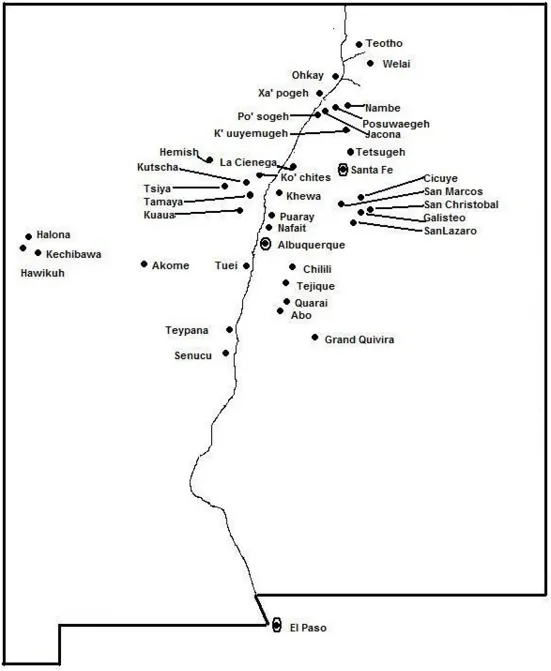
The Pueblos Circa 1600s
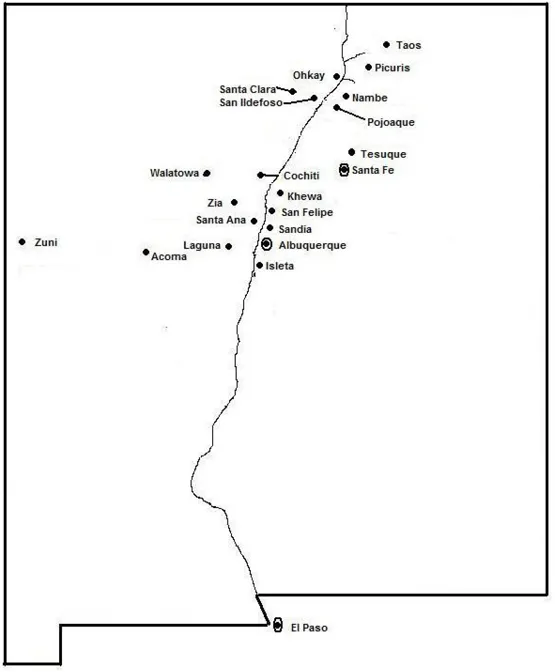
The Pueblos 2010
1 ~ A Pueblo Perspective of the History of Santa Fe
by
Introduction
The Tewa have a long and historically dynamic history with Santa Fe (O’gha Po’oge). Before the founding of Santa Fe by the Spanish, ancestors of the Northern and ...
Table of contents
- Blessing
- Acknowledgements
- Introduction
- 1 ~ A Pueblo Perspective of the History of Santa Fe
- 2 ~ Indian Slavery and the Birth of Genízaros
- 3 ~ Ohkay Owingeh: New Mexico’s First Capital
- 4 ~ Historia De Mañana
- 5 ~ Indians, Colonialism, and the Santa Fe Trail of Tears and Conquest
- 6 ~ “The Porch”
- 7 ~ “A Living Exhibition”Labor, Desire, and the Marketing of American Indian Arts and Crafts in Santa Fe
- 8 ~ Regarding Ethnicities and Cultures
- 9 ~ Grounded in Faith
- 10 ~ Sustaining the Revolution: Adaptations and Transformations in New Mexico State-Tribal Relations
- Notes
- Contributors
- STUDY GUIDE
Trusted by 375,005 students
Access to over 1.5 million titles for a fair monthly price.
Study more efficiently using our study tools.
Frequently asked questions
Yes, you can cancel anytime from the Subscription tab in your account settings on the Perlego website. Your subscription will stay active until the end of your current billing period. Learn how to cancel your subscription
No, books cannot be downloaded as external files, such as PDFs, for use outside of Perlego. However, you can download books within the Perlego app for offline reading on mobile or tablet. Learn how to download books offline
Perlego offers two plans: Essential and Complete
- Essential is ideal for learners and professionals who enjoy exploring a wide range of subjects. Access the Essential Library with 800,000+ trusted titles and best-sellers across business, personal growth, and the humanities. Includes unlimited reading time and Standard Read Aloud voice.
- Complete: Perfect for advanced learners and researchers needing full, unrestricted access. Unlock 1.5M+ books across hundreds of subjects, including academic and specialized titles. The Complete Plan also includes advanced features like Premium Read Aloud and Research Assistant.
We are an online textbook subscription service, where you can get access to an entire online library for less than the price of a single book per month. With over 1.5 million books across 990+ topics, we’ve got you covered! Learn about our mission
Look out for the read-aloud symbol on your next book to see if you can listen to it. The read-aloud tool reads text aloud for you, highlighting the text as it is being read. You can pause it, speed it up and slow it down. Learn more about Read Aloud
Yes! You can use the Perlego app on both iOS and Android devices to read anytime, anywhere — even offline. Perfect for commutes or when you’re on the go.
Please note we cannot support devices running on iOS 13 and Android 7 or earlier. Learn more about using the app
Please note we cannot support devices running on iOS 13 and Android 7 or earlier. Learn more about using the app
Yes, you can access White Shell Water Place by F. Richard Sanchez in PDF and/or ePUB format, as well as other popular books in History & Asian History. We have over 1.5 million books available in our catalogue for you to explore.