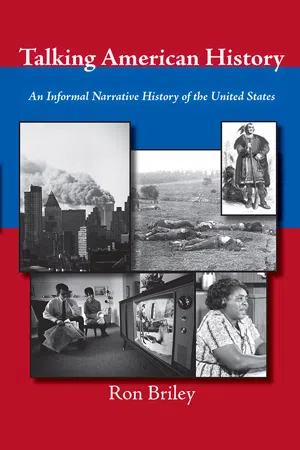
Offering an alternative to encyclopedic textbooks that confirm Henry Ford's complaint that the study of history is just "one damned thing after another," it provides an informal and conversational narrative history of the American experience from the Colonial period to the present day. Above all, history is a story, and the story of America is a complicated and contested tale. Rather than simply the exceptionalism of a shining city upon a hill, the American saga includes a dark stain of prejudice and nativism still present within the national fabric. Beginning with the assault upon Native lands and culture along with the introduction of racial slavery, patterns of exploitation and greed fostering gender, racial, and class inequality are an essential part of America's story. Themes of prejudice and inequality, however, are offset by the promise of social justice and an egalitarian America outlined by Thomas Jefferson's Declaration of Independence, Elizabeth Cady Stanton's Seneca Falls Declaration of Principles, Abraham Lincoln's Gettysburg Address, Franklin D. Roosevelt's The Four Freedoms, and Martin Luther King Jr.'s "I Have a Dream" oratory. While considering topics such as Presidential leadership, Talking American History emphasizes the efforts of American reformers, dreamers, freedom fighters, dissenters, radicals, and workers to move the nation toward the democratic promise laid out in its founding documents. The framework is a traditional political history narrative told from a progressive perspective. This is an interpretation with which not all readers will agree, but the intention is to facilitate dialogue and debate that are imperative for the survival of American democracy.
- 522 pages
- English
- ePUB (mobile friendly)
- Available on iOS & Android
eBook - ePub
About this book
Information
Topic
GeschichteSubtopic
Nordamerikanische GeschichteTalking American History
An Informal Narrative History of the United States
Ron Briley
For my mentors Pete Petersen and Dick Heath
and
The students of Sandia Preparatory School
Who taught me so much.
Introduction
Industrialist Henry Ford is touted to have dismissed the study of history by describing the discipline as one damned thing after another. Unfortunately, generations of history students in both the schools and universities might agree with Ford after suffering through endless formal lectures and massive textbooks filled with facts to be memorized. And the knowledge explosion of the internet has not necessarily made matters any better as our understanding of history is weighed down by even more “facts,” although this information is now available with one click on our computers. Buried under the avalanche of historical detail, students feel overwhelmed, and they understandably turn toward the more pragmatic STEM education with possible careers in science and engineering. Yet, these upcoming scientists are desperately in need of comprehending the historical and cultural context in which their research and discoveries will be implemented. In addition, academic specialization makes it difficult to make historical generalizations as scholars observe that there are significant exceptions to any historical argument. Thus, professional historians tend to qualify their conclusions with such phrases as “research appears to suggest” or “based on this case study one might argue.” As the disruptive political campaign of 2016, with its considerable confusion over the roles of immigration, religious liberty, race, civil rights for all Americans, foreign policy, gun violence, terrorism, and foreign policy, demonstrated, all inhabitants of the United States need a better understanding of their national history, within an international context, that will provide a foundation for debate and civil discourse.
Talking American History is an attempt to address the crisis in American history by providing an informal narrative history of the United States from the Colonial period to the present day addressed to the intelligent general reader rather than the professional historian. History, while requiring the application of analytical tools, is fundamentally a story with many strands that interconnect over the course of time. This organizational structure of Talking American History is, therefore, rather traditional, employing a chronological approach centered around a rather old-fashioned political framework. However, the contributions of contemporary historians regarding the roles of race, gender, and class will be incorporated into the narrative. In the interest of full disclosure, it is reasonable to expect some information regarding the background and historical orientation of the storyteller.
I was raised in a poor white family with little in the way of education. My father dropped out of elementary school during the Great Depression. He was the hardest working person I have ever known, but his labors led him to an early grave rather than the elusive American dream. My mother was a high school graduate who raised two sons and entered the workforce as a bookkeeper. To earn additional money for essentials, the entire family worked, often alongside my grandparents, in the cotton fields of the Texas Panhandle. Chopping cotton, hoeing the weeds around the cotton plants, and picking cotton during the late summer and early fall were back-breaking labor that I have never forgotten. There were few books in the home, but for some reason I loved reading. Despite my enthusiasm for books, my grades were average at the best, and there was no consideration of college.
That assumption changed when I learned that student deferments were available as the draft allotments for the Vietnam War increased. Although my high school grades were rather shaky, I was accepted at the regional college, West Texas State University. My academic deficiencies were monitored by a young professor from Iowa, Dr. Peter Petersen, and I fell in love with a world of books and scholarship that I had never before experienced. The undergraduate years were difficult as, in addition to compensating for the gaps in my academic background, I had to support a young family on part time jobs and student loans. While Canyon, Texas was somewhat of a political backwater and hardly a bastion of leftist politics, I, nevertheless, identified with the protest movements opposing the Vietnam War, racial segregation, and economic inequality. I gravitated toward the small number of dissidents in the campus chapter of Students for a Democratic Society and identified with the counterculture, although my work and family responsibilities left little time for recreational drugs. Approaching the study of American history within this historical and cultural framework, I believed that I had discovered the reasons for my family’s poverty in the exploitive nature of American capitalism and politics under the sway of large corporations. While today I perceive such political and economic questions as more complex, I still find considerable truth within these youthful assumptions.
After earning undergraduate and master’s degrees in history from West Texas State University, I applied to a number of PhD programs—most of which were located in the Midwest. Although I was accepted to several doctoral programs, and came close to attending the University of Iowa, I selected the University of New Mexico in Albuquerque because it was number one in my pocketbook, offering me a tuition waiver and graduate assistantship in my first year of study. Perceiving $3,600 annually as a large salary, I enthusiastically embraced my studies under the guidance of Professor Gerald Nash, with whom I got along personally but disagreed regarding politics and interpretations of American history. For my dissertation subject I decided to focus upon four Midwestern progressive members of the Senate Farm Bloc during the 1920s, a topic which resonated with my own political orientation.
After completing my written and oral comprehensive examinations for the doctorate, along with preliminary research in the National Archives and Library of Congress, I found myself in somewhat of an economic crisis when my graduate assistantship expired. Accordingly, I decided to teach in the schools while writing my dissertation—an extremely difficult task with the expenditure of time required by teaching, researching, and writing. After two years at a Catholic junior high school with some classes approaching fifty students, in 1978 I accepted a position with an Albuquerque prep school, Sandia Preparatory School. With my educational background, I had no understanding of what an independent preparatory school entailed. Sandia Prep, however, was a small struggling institution and displayed none of the pretentious class consciousness of the stereotypical prep school. The school proved to be an excellent match for me, and I threw myself into the job which became more a way of life than an occupation as the school grew. In addition to teaching both middle and high school history classes, I served as a class sponsor, academic adviser, chaperoned dances and school trips, coached softball, established a Model United Nations program, and eventually ended up serving twenty-six years as the assistant head of school. Beyond these many duties at Sandia Prep, I taught history for twenty years at the University of New Mexico, Valencia campus.
These obligations, however, rendered it virtually impossible to complete my dissertation. After a number of busy years, I, nevertheless, again felt the urge to pursue historical scholarship, but I had lost interest in the Senate Farm Bloc. It finally occurred to me that engaging in historical writing and research from my primary location in the schools could be a liberating experience. I did not have to worry about attaining tenure and decided to pursue topics that would be of greater personal interest—although others would hopefully be motivated to read my work. Accordingly, I have completed seven books, along with numerous scholarly articles and encyclopedia pieces, on the popular culture topics of film, music, and sport—especially baseball—within historical and political context. The growth of Sandia Preparatory School also offered me an opportunity to develop and teach courses on American History Through Film and World Cinema. The school was also able to help with some travel funding that allowed me to share my research with colleagues at academic conferences. It occurred to me that perhaps it was possible to pursue a traditional academic career from a high school base. Although my teaching duties always came first, I was able to assume an active role within historical organizations such as the American Historical Association (AHA), Society for History Education (SHE), and Organization of American Historians (OAH), and I was fortunate to receive summer Fulbright study opportunities in the Netherlands, Japan, and Yugoslavia. During my forty-year teaching career, I was honored with teaching awards from the AHA, OAH, SHE, National Council for History Education, and the New Mexico Golden Apple. But the most important legacy of my teaching career is the continuing friendship of many former colleagues and students.
This rather lengthy background of my teaching and academic career does not mean that Talking American History is intended to be some type of teaching memoir or methods textbook. That is the topic for another book. Rather, Talking American History is an interpretative history, and it is only fair that the reader have some grasp of the author’s prejudices. Of course, readers should take some inventory of their own assumptions and preconceptions. Thus, it makes considerable difference from whose perspective the story is told. History is not unlike the same accident which eyewitnesses describe so differently. It matters from whose perspective events are viewed. For example, the topic of Western expansion is considerably sk...
Table of contents
- Introduction
- 1 ~ Early English Settlement and Colonial Virginia
- 2 ~ Pilgrims and the Puritan City Upon a Hill
- 3 ~ Filling in the English Coastline
- 4 ~ Colonial Society and Economy
- 5 ~ Expulsion of the French and the American Revolution
- 6 ~ Articles of Confederation and Constitution
- 7 ~ The Early Republic: Presidencies of Washington, Adams, and Jefferson
- 8 ~ War of 1812 and Post War Nationalism
- 9 ~ Jacksonian Democracy, 1824–1840
- 10 ~ American Society, 1830–1860: Factories, Slavery, and Reform Movements
- 11 ~ Manifest Destiny and the Mexican War
- 12 ~ Political Breakdown and the Road to Civil War
- 13 ~ The American Civil War
- 14 ~ The Reconstruction Experiment and Its Premature End
- 15 ~ Emergence of Big Business, 1865–1900
- 16 ~ Late Nineteenth Century Politics and Populism
- 17 ~ The American West: Anglo Settlement and Native American Response
- 18 ~ Indigenous Radicalism and Labor’s Response to Industrialization
- 19 ~ The Progressive Movement, 1900–1917
- 20 ~ America on the World Stage, 1865–1920
- 21 ~ The 1920s
- 22 ~ The Great Depression and the New Deal
- 23 ~ The United States in World War II
- 24 ~ Origins of the Cold War and Truman and Eisenhower Administrations
- 25 ~ JFK and the New Frontier
- 26 ~ The Civil Rights Movement and the Struggle for Equality
- 27 ~ Vietnam War and Social Protest in the 1960s
- 28 ~ The Triumph of the Right: America in the 1970s and 1980s
- 29 ~ Post-Cold War America: The Age of Terror, The Great Recession, the Politics of Hope, and Living in Trump’s America
Trusted by 375,005 students
Access to over 1.5 million titles for a fair monthly price.
Study more efficiently using our study tools.
Frequently asked questions
Yes, you can cancel anytime from the Subscription tab in your account settings on the Perlego website. Your subscription will stay active until the end of your current billing period. Learn how to cancel your subscription
No, books cannot be downloaded as external files, such as PDFs, for use outside of Perlego. However, you can download books within the Perlego app for offline reading on mobile or tablet. Learn how to download books offline
Perlego offers two plans: Essential and Complete
- Essential is ideal for learners and professionals who enjoy exploring a wide range of subjects. Access the Essential Library with 800,000+ trusted titles and best-sellers across business, personal growth, and the humanities. Includes unlimited reading time and Standard Read Aloud voice.
- Complete: Perfect for advanced learners and researchers needing full, unrestricted access. Unlock 1.5M+ books across hundreds of subjects, including academic and specialized titles. The Complete Plan also includes advanced features like Premium Read Aloud and Research Assistant.
We are an online textbook subscription service, where you can get access to an entire online library for less than the price of a single book per month. With over 1.5 million books across 990+ topics, we’ve got you covered! Learn about our mission
Look out for the read-aloud symbol on your next book to see if you can listen to it. The read-aloud tool reads text aloud for you, highlighting the text as it is being read. You can pause it, speed it up and slow it down. Learn more about Read Aloud
Yes! You can use the Perlego app on both iOS and Android devices to read anytime, anywhere — even offline. Perfect for commutes or when you’re on the go.
Please note we cannot support devices running on iOS 13 and Android 7 or earlier. Learn more about using the app
Please note we cannot support devices running on iOS 13 and Android 7 or earlier. Learn more about using the app
Yes, you can access Talking American History by Ron Briley in PDF and/or ePUB format, as well as other popular books in Geschichte & Nordamerikanische Geschichte. We have over 1.5 million books available in our catalogue for you to explore.