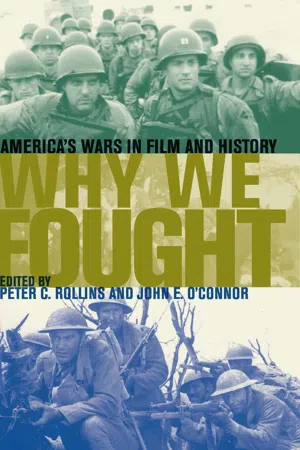
Film moves audiences like no other medium; both documentaries and feature films are especially remarkable for their ability to influence viewers. Best-selling author James Brady remarked that he joined the Marines to fight in Korea after seeing a John Wayne film, demonstrating how a motion picture can change the course of a human life—in this case, launching the career of a major historian and novelist. In Why We Fought: America's Wars in Film and History, editors Peter C. Rollins and John E. O'Connor explore the complexities of war films, describing the ways in which such productions interpret history and illuminate American values, politics, and culture. This comprehensive volume covers representations of war in film from the American Revolution in the 18th century to today's global War on Terror. The contributors examine iconic battle films such as The Big Parade (1925), All Quiet on the Western Front (1930), From Here to Eternity (1953), and Platoon (1986), considering them as historical artifacts. The authors explain how film shapes our cultural understanding of military conflicts, analyzing how war is depicted on television programs, through news media outlets, and in fictional and factual texts. With several essays examining the events of September 11, 2001, and their aftermath, the book has a timely relevance concerning the country's current military conflicts. Jeff Chown examines controversial documentary films about the Iraq War, while Stacy Takacs considers Jessica Lynch and American gender issues in a post-9/11 world, and James Kendrick explores the political messages and aesthetic implications of United 93. From filmmakers who reshaped our understanding of the history of the Alamo, to Ken Burns's popular series on the Civil War, to the uses of film and media in understanding the Vietnam conflict, Why We Fought offers a balanced outlook— one of the book's editors was a combat officer in the United States Marines, the other an antiwar activist—on the conflicts that have become touchstones of American history. As Air Force veteran and film scholar Robert Fyne notes in the foreword, American war films mirror a nation's past and offer tangible evidence of the ways millions of Americans have become devoted, as was General MacArthur, to "Duty, honor, and country." Why We Fought chronicles how, for more than half a century, war films have shaped our nation's consciousness.
- 624 pages
- English
- PDF
- Available on iOS & Android
eBook - PDF
About this book
Information
Publisher
The University Press of KentuckyYear
2008Print ISBN
9780813191911
9780813124933
eBook ISBN
9780813172972
Topic
StoriaSubtopic
Storia militare e marittimaTable of contents
- Cover
- Title
- Copyright
- Dedication
- CONTENTS
- FOREWORD
- ACKNOWLEDGMENTS
- INTRODUCTION
- Part I
- 1 / John E. O’Connor
- 2 / Frank Thompson
- 3 / James Yates
- 4 / Gary R . Edgerton
- 5 / Robert M. Myers
- Part II
- 6 / Michael T. Isenberg
- 7 / James Latham
- 8 / David Imhoof
- 9 / John Whiteclay Chambers II
- 10 / Cynthia J. Miller
- 11 / Ian S. Scott
- 12 / Frank J. Wetta and Martin A. Novelli
- 13 / J. E. Smyth
- 14 / Robert Brent Toplin
- Part III
- 15 / Thomas W. Maulucci Jr
- 16 / Susan A. George
- 17 / Peter C. Rollins
- 18 / Lawrence W. Lichty and Raymond L. Carroll
- 19 / William S. Bushnell
- Part IV
- 20 / John Shelton Lawrence and John G. McGarrahan
- 21 / Jeffrey Chown
- 22 / Stacy Takacs
- 23 / James Kendrick
- FILMOGRAPHY
- BIBLIOGRAPHY
- CONTRIBUTORS
- INDEX
- ABOUT THE EDITORS
Trusted by 375,005 students
Access to over 1.5 million titles for a fair monthly price.
Study more efficiently using our study tools.
Frequently asked questions
Yes, you can cancel anytime from the Subscription tab in your account settings on the Perlego website. Your subscription will stay active until the end of your current billing period. Learn how to cancel your subscription
No, books cannot be downloaded as external files, such as PDFs, for use outside of Perlego. However, you can download books within the Perlego app for offline reading on mobile or tablet. Learn how to download books offline
Perlego offers two plans: Essential and Complete
- Essential is ideal for learners and professionals who enjoy exploring a wide range of subjects. Access the Essential Library with 800,000+ trusted titles and best-sellers across business, personal growth, and the humanities. Includes unlimited reading time and Standard Read Aloud voice.
- Complete: Perfect for advanced learners and researchers needing full, unrestricted access. Unlock 1.5M+ books across hundreds of subjects, including academic and specialized titles. The Complete Plan also includes advanced features like Premium Read Aloud and Research Assistant.
We are an online textbook subscription service, where you can get access to an entire online library for less than the price of a single book per month. With over 1.5 million books across 990+ topics, we’ve got you covered! Learn about our mission
Look out for the read-aloud symbol on your next book to see if you can listen to it. The read-aloud tool reads text aloud for you, highlighting the text as it is being read. You can pause it, speed it up and slow it down. Learn more about Read Aloud
Yes! You can use the Perlego app on both iOS and Android devices to read anytime, anywhere — even offline. Perfect for commutes or when you’re on the go.
Please note we cannot support devices running on iOS 13 and Android 7 or earlier. Learn more about using the app
Please note we cannot support devices running on iOS 13 and Android 7 or earlier. Learn more about using the app
Yes, you can access Why We Fought by Peter C. Rollins,John E. O'Connor in PDF and/or ePUB format, as well as other popular books in Storia & Storia militare e marittima. We have over 1.5 million books available in our catalogue for you to explore.