Known as the celebrated director of critical and commercial successes such as Psycho (1960) and The Birds (1963), Alfred Hitchcock is famous for his distinctive visual style and signature motifs. While recent books and articles discussing his life and work focus on the production and philosophy of his iconic Hollywood-era films like Notorious (1946) and Vertigo (1958), Hitchcock Lost and Found moves beyond these seminal works to explore forgotten, incomplete, lost, and recovered productions from all stages of his career, including his early years in Britain.
Authors Alain Kerzoncuf and Charles Barr highlight Hitchcock's neglected works, including various films and television productions that supplement the critical attention already conferred on his feature films. They also explore the director's career during World War II, when he continued making high-profile features while also committing himself to a number of short war-effort projects on both sides of the Atlantic. Focusing on a range of forgotten but fascinating projects spanning five decades, Hitchcock Lost and Found offers a new, fuller perspective on the filmmaker's career and achievements.
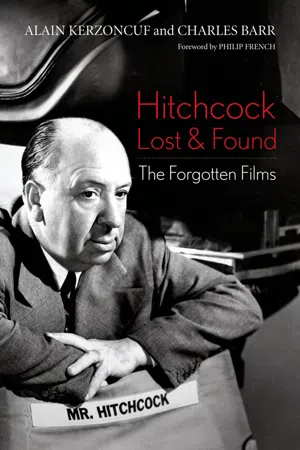
- 267 pages
- English
- PDF
- Available on iOS & Android
eBook - PDF
About this book
Information
Subtopic
Film & VideoTable of contents
- Front cover
- Copyright
- Contents
- Foreword
- Note on Citation Style and Images
- Introduction
- 1 Before The Pleasure Garden 1920–1925
- 2 The Early 1930s
- 3 The War Years
- 4 After the War
- Epilogue What Now?
- Acknowledgments
- Notes
- Bibliography
- Index
Trusted by 375,005 students
Access to over 1.5 million titles for a fair monthly price.
Study more efficiently using our study tools.
Frequently asked questions
Yes, you can cancel anytime from the Subscription tab in your account settings on the Perlego website. Your subscription will stay active until the end of your current billing period. Learn how to cancel your subscription
No, books cannot be downloaded as external files, such as PDFs, for use outside of Perlego. However, you can download books within the Perlego app for offline reading on mobile or tablet. Learn how to download books offline
Perlego offers two plans: Essential and Complete
- Essential is ideal for learners and professionals who enjoy exploring a wide range of subjects. Access the Essential Library with 800,000+ trusted titles and best-sellers across business, personal growth, and the humanities. Includes unlimited reading time and Standard Read Aloud voice.
- Complete: Perfect for advanced learners and researchers needing full, unrestricted access. Unlock 1.5M+ books across hundreds of subjects, including academic and specialized titles. The Complete Plan also includes advanced features like Premium Read Aloud and Research Assistant.
We are an online textbook subscription service, where you can get access to an entire online library for less than the price of a single book per month. With over 1.5 million books across 990+ topics, we’ve got you covered! Learn about our mission
Look out for the read-aloud symbol on your next book to see if you can listen to it. The read-aloud tool reads text aloud for you, highlighting the text as it is being read. You can pause it, speed it up and slow it down. Learn more about Read Aloud
Yes! You can use the Perlego app on both iOS and Android devices to read anytime, anywhere — even offline. Perfect for commutes or when you’re on the go.
Please note we cannot support devices running on iOS 13 and Android 7 or earlier. Learn more about using the app
Please note we cannot support devices running on iOS 13 and Android 7 or earlier. Learn more about using the app
Yes, you can access Hitchcock Lost and Found by Alain Kerzoncuf,Charles Barr in PDF and/or ePUB format, as well as other popular books in Media & Performing Arts & Film & Video. We have over 1.5 million books available in our catalogue for you to explore.