- 344 pages
- English
- ePUB (mobile friendly)
- Available on iOS & Android
eBook - ePub
About this book
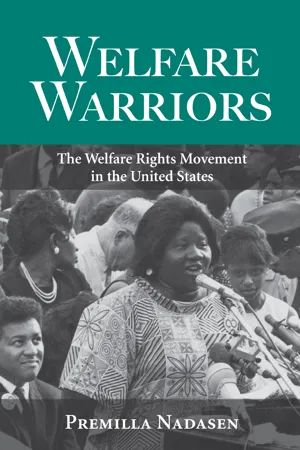
In her study of the welfare rights movement, Premilla Nadasen breaks new ground by tracing the history of a distinctive brand of feminism that emerged in the 1960s.
CHAPTER 1
The Origins of the Welfare Rights Movement
The Beginnings: 1966
On June 30, 1966, 35 people, mostly women and children, arrived in Columbus, Ohio, weary but jubilant, after a 10-day walk from Cleveland. Their 150-mile “Walk for Decent Welfare” drew attention to the inadequacy of welfare benefits in Ohio. When the marchers left Cleveland on June 20 they were 100 strong, and several hundred supporters joined them as they passed through towns and cities along their journey. Indicative of the racial hostility directed at the AFDC program, bystanders heckled and harassed the Ohio marchers, calling them bums and chanting “work, work, work” One night a cross was burned nearby as they slept.1 Upon their arrival in Columbus a crowd of 2,000 met them at East High School, where they gathered before the last leg of their march to the steps of the state capitol. The Ohio Rally for Decent Welfare sought to ensure that recipients receive 100 percent of the amount of money the state welfare department decided was necessary for a minimum standard of living.2 At the time, the state paid only 70 percent of the estimated amount. The Ohio Steering Committee for Adequate Welfare (OSCAW), which had planned the demonstration in conjunction with the National Association of Social Workers (NASW), demanded that the governor call a special session of the state legislature to increase welfare grants for the remainder of 1966 and that the budget for the following year meet the full standard of need for all welfare recipients.3
Protesters in Ohio were not alone in their efforts to reform the welfare system. On the same day that the Ohio marchers arrived in Columbus, recipients and their supporters around the country gathered at their state capitols, in public squares, and at local welfare departments to stage the first nationwide demonstration of recipients of AFDC, a program for poor single mothers and their children.4 In Chicago, 200 poor people marched to the city’s downtown welfare office. In Newark, 75 welfare recipients went to the state capitol to demand higher welfare benefits.5 In New York City, 2,000 mostly black women and children demanded an end to “indignities” of the welfare system, as well as an increase in the school clothing allowance for their children.6 Other protests occurred in Los Angeles, Baltimore, Trenton, Louisville, Boston, Washington, and San Francisco. An estimated 6,000 people demonstrated in 25 cities across the country. Made up overwhelmingly of women receiving AFDC, the movement also included a small number of male and female recipients of Aid to the Blind, Aid to the Disabled, and General Assistance.7 African Americans constituted the majority of participants with involvement by some whites, Latinos, and Native Americans.
Although the 1966 welfare protests did not receive as much attention as the civil rights marches led by Martin Luther King, Jr., they, nevertheless, managed to grace the front pages of many national newspapers. The protests for economic and social justice signaled a new phase in the struggle for black equality—one addressing more resolutely the problems of poverty. As the Ohio marchers embarked on the first major “walk” for welfare, State Representative Carl Stokes, a recently unsuccessful candidate for mayor of Cleveland, spoke to the participants about the importance of the impending protest. In reference to the concurrent Meredith March in Mississippi, he counseled, “As you go down this road, you must remember that this march is more significant than the Mississippi March, because it’s here and it’s about our problems.”8 According to organizer George Wiley, the welfare rights movement sought to do “what the civil rights movement did not do.”9 Indeed, for poor people in urban centers untouched by the activities of major civil rights organizations, it seemed their time had come.
June 30,1966, marked the official start of a nationwide mobilization for welfare rights in the United States. It was a date commemorated annually by welfare rights activists for many years. Comprised of an alliance of grassroots groups, the welfare rights movement gave a political voice to one of the most disenfranchised sectors of U.S. society and worked toward improving the living standards of all poor Americans.10 Recipients and welfare rights supporters had met a few months earlier at a conference in Chicago and made June 30 a national day of action around welfare, in solidarity with the Ohio Walk for Adequate Welfare, which was already planned. Conference members asked George Wiley, head of the Poverty/Rights Action Center (P/RAC) in Washington, to coordinate and publicize the event. Wiley and his staff at P/RAC traveled around the country informing recipients of the upcoming march and providing technical support to local groups. In addition, Wiley arranged several meetings over the course of 1966 resulting in the founding of the National Welfare Rights Organization (NWRO), which would encompass most, but not all, of the local groups that constituted the welfare rights movement, and would lead the struggle for welfare rights over the next decade. Wiley and many of the recipients participating in the first national demonstration would come to play prominent roles in the national movement.
The welfare rights movement sought to organize poor African American women to reform AFDC and, in the process, make the program more humane. They confronted a welfare system that gave them a meager monthly allowance leaving them unsure day to day whether they could pay rent or feed and clothe their children; that showed them little respect; and that stigmatized them as lazy, licentious, and unfit mothers. Welfare rights protesters rallied and marched, picketed and protested to pressure public officials to address the inadequacies in the welfare system. They demanded that welfare officials enforce regulations guaranteeing them a basic standard of living and eradicate those violating their civil rights. They believed that welfare should be distributed in a nondiscriminatory and dignified manner to everyone who needed it. These demands were the basis of the initial welfare rights protests.
Credit for emergence of the welfare rights movement is often given to the many middle-class organizers and supporters—such as African American civil rights activist George Wiley. Wiley and other civil rights activists began to work with welfare recipients in the mid-1960s.11 Many welfare recipients, however, initiated groups in the late 1950s and early 1960s in response to their own day-to-day difficulties with the welfare system, which was becoming increasingly harsh, particularly for black women. This, in conjunction with a political climate conducive to social action, encouraged them to organize on their own behalf. But despite the looming presence of welfare in their lives, these women did not understand their situation only as welfare recipients or poor people. Instead, their complicated identities emerged from their experiences with racism in the welfare system, their work as mothers, as well as their involvement in numerous community issues. Their multiple identities informed their participation in the movement and later developed into a clearer ideological position. If we take notice of these early welfare rights groups, we might conclude that even though the national movement made its debut in 1966, the struggle for welfare rights actually began much earlier. The grievances the women harbored and an opportune moment for protest had enabled welfare recipients to come together to question the regulations and administration of welfare.
History of AFDC/ADC
The AFDC program in the mid-1960s was dehumanizing, disempowering, and inefficient. Instituted in 1935 as part of the Social Security Act, Aid to Dependent Children (ADC)—as the program was known prior to 1962— offered a small monthly allowance for children and nothing for the mother. The Social Security Act, a watershed development in public policy, had built into it certain race and gender assumptions that profoundly influenced the political fate of various components of the legislation. Full-time wage earners, most of whom were men, were assured a decent level of economic assistance through unemployment compensation and social security, both of which were social insurance programs and tied to one’s past work history. Married women benefited as spouses of wage-earning men. However, part-time and unsteady workers and African Americans benefited the least. Southern and conservative congressmen limited assistance to African Americans by excluding two occupations in which they predominated: domestic and agricultural work.12
Part of a gendered and racialized two-track welfare system, ADC provided less generous and more restrictive assistance than social insurance. Along with Old Age Assistance and Aid to the Disabled, ADC was part of the public assistance programs serving the poor and a disproportionately larger number of women and people of color.13 The federal government provided oversight and matching funds for ADC, but states controlled eligibility criteria, determined budgets, and essentially ran the program. Consequently, local politics, to a large degree, shaped the program.14 ADC payments varied widely from state to state and were generally far lower than payments in federally run contributory social insurance programs such as social security and unemployment compensation.
Initially a small noncontroversial program, ADC, like its precursor mothers’ pensions programs, excluded most, but not all, of the women of color who needed assistance. White women, most of whom were widows or deserted by their husbands, overwhelmingly populated the welfare rolls in the late 1930s.15 Pitied and considered worthy of support if they met the social and moral standards set by caseworkers, these women were viewed as mothers and caretakers. To deflect potential criticism, caseworkers made assistance available only to recipients they believed were blameless for their current situation, morally pure, and properly disciplining and caring for their children. Consequently, ADC and mothers’ pensions contained strict eligibility criteria to force poor single mothers to conform to white middle-class notions of proper motherhood. Mothers’ pensions programs, for example, became an avenue for “Americanization” of southern and eastern European immigrant women.16 Despite these restrictive rules, the idea that single women should be supported in their work as mothers prevailed in the political discourse.17 In practice, however, most mothers worked or supplemented their monthly allowance, which was simply too little to support their children. Local welfare departments often expected recipients to work even though they saw recipients as primarily mothers.18
ADC was, nevertheless, an improvement over the Progressive Era’s mothers’ pensions and had the potential to be a widespread, nondiscriminatory support system for single mothers. The federal matching system encouraged states lacking mothers’ pensions programs to establish ADC programs. And federal oversight and funding gave the federal government some control over how local programs developed. Under ADC the number and proportion of African American families assisted increased. In 1931, of the 93,620 families receiving mothers’ aid, an estimated 3 percent were black.19 In 1940, approximately 17 percent of 372,000 ADC families were black.20
Even though more African American women received ADC than had received mothers pensions, patterns of discrimination in the program were widespread. A majority of African American women needing assistance didn’t receive it, particularly in the South and other areas where large numbers of African Americans lived.21 For example, in 1943 the state of Louisiana refused assistance to women during cotton picking season, and Detroit in the 1940s frequently denied assistance to African Americans due to having an “unsuitable home.”22 During the 1940s, the federal Bureau of Public Assistance and advocates in the social welfare community worked to expand benefits and extend eligibility.23 In 1945 the Social Security Board recommended that states repeal the suitable home law. Fifteen states did so in the 1940s. In 1946 the Board also raised the maximum matching federal payment. The following year it issued guidelines that everyone should have the opportunity to apply for ADC and that the application process must be prompt and efficient. However hesitantly, in the 1940s a network of welfare reform advocates worked to curb the exclusionary policies of states and improve the stature of ADC. Simultaneously, the number of needy women claiming assistance—both African American and white—climbed steadily, and, at times, dramatically.
The Backlash
During the 1950s a welfare backlash by local politicians, the conservative press, and many ordinary white Americans exposed purported welfare fraud and “chiseling.” In local areas around the country, including Washington, D.C., Detroit, and New Jersey, special investigative committees documented and ferreted out recipients allegedly unworthy of support. In most cases, hyperbole and inflammatory rhetoric shrouded the dialogue and publicity about welfare. Journalists or investigative committees charged that women recipients had several children out of wedlock, fathers took no responsibility for raising their children, and parents simply did not want to work. In most cases, the stereotypical welfare recipient was an African American woman. Investigations into these claims, however, rarely revealed widespread fraud and found minimal abuse in the system. In Detroit, for example, a 1948 study revealed only two cases of alleged fraud and in neither case was the recipient convicted of criminal wrongdoing.24 Nevertheless, the investigations aroused public suspicion about welfare and planted in the minds of many Americans an inextricable association among receipt of ADC, African Americans, immorality, and laziness.
The rhetoric and publicity encouraged legislative changes. These changes included a whole new slate of local regulations: “suitable home” laws denying aid to mothers who had children out of wedlock or engaged in other behavior caseworkers considered immoral or inappropriate; “substitute father” or “man-in-the-house” rules denying aid to women if there was evidence of a male present...
Table of contents
- Cover
- Half Title
- Full Title
- Copyright
- Table of Contents
- Acknowledgements
- Abbreviations
- Introduction
- 1 The Origins of the Welfare Rights Movement
- 2 Dignity and Representation
- 3 More Money Now!
- 4 In the Name of Equality
- 5 Internal Tensions
- 6 The Guaranteed Annual Income and FAP
- 7 Decline of the Movement
- Conclusion
- Notes
- Bibliography
- Index
Trusted by 375,005 students
Access to over 1.5 million titles for a fair monthly price.
Study more efficiently using our study tools.
Frequently asked questions
Yes, you can cancel anytime from the Subscription tab in your account settings on the Perlego website. Your subscription will stay active until the end of your current billing period. Learn how to cancel your subscription
No, books cannot be downloaded as external files, such as PDFs, for use outside of Perlego. However, you can download books within the Perlego app for offline reading on mobile or tablet. Learn how to download books offline
Perlego offers two plans: Essential and Complete
- Essential is ideal for learners and professionals who enjoy exploring a wide range of subjects. Access the Essential Library with 800,000+ trusted titles and best-sellers across business, personal growth, and the humanities. Includes unlimited reading time and Standard Read Aloud voice.
- Complete: Perfect for advanced learners and researchers needing full, unrestricted access. Unlock 1.5M+ books across hundreds of subjects, including academic and specialized titles. The Complete Plan also includes advanced features like Premium Read Aloud and Research Assistant.
We are an online textbook subscription service, where you can get access to an entire online library for less than the price of a single book per month. With over 1.5 million books across 990+ topics, we’ve got you covered! Learn about our mission
Look out for the read-aloud symbol on your next book to see if you can listen to it. The read-aloud tool reads text aloud for you, highlighting the text as it is being read. You can pause it, speed it up and slow it down. Learn more about Read Aloud
Yes! You can use the Perlego app on both iOS and Android devices to read anytime, anywhere — even offline. Perfect for commutes or when you’re on the go.
Please note we cannot support devices running on iOS 13 and Android 7 or earlier. Learn more about using the app
Please note we cannot support devices running on iOS 13 and Android 7 or earlier. Learn more about using the app
Yes, you can access Welfare Warriors by Premilla Nadasen in PDF and/or ePUB format, as well as other popular books in History & North American History. We have over 1.5 million books available in our catalogue for you to explore.