- 312 pages
- English
- ePUB (mobile friendly)
- Available on iOS & Android
eBook - ePub
About this book
The modern field of software metrics emerged from the computer modeling and "statistical thinking" services of the 1980s. As the field evolved, metrics programs were integrated with project management, and metrics grew to be a major tool in the managerial decision-making process of software companies. This book simplifies software measurement and explains its value as a tool for decision-makers at software companies. Techniques presented in Software Metrics: A Guide to Planning, Analysis, and Application are derived from best practices. The ideas are field-proven, down-to-earth, and straightforward, making it an invaluable resource for those striving for process improvement. This overview helps readers enrich their knowledge of measurements, analysis, and best practices, and demonstrates how ordinary analysis techniques can be applied to achieve extraordinary results. Easy-to-understand tools and techniques show how metrics create models that are indispensable to decision-making in the software industry.
Information
Chapter 1
Software Measurement
A New Order
In the last ten years the software industry has witnessed great growth. The discipline, called software management, has experienced several innovations. Foremost among these seems to be the rediscovery of management science. There is a new emphasis on measurements, denoting a drive for precision in decision making. Empowered by measurements, the modern decision maker is able to free himself from the clutches of prejudice to observe reality.
Fresh learning from process measurement has now tempered the established theories and practices; a new order has emerged.
In this new order, projects are now managed quantitatively with numbers. Intuition is enriched with empiricism, ushering in a new culture of managing by measurement.
To measure is to know, to learn, to understand. Measurement begins as recognition and is complete when we express our perception as numbers. Measurement reveals the architecture of our ideas, concepts, and models.
A common definition states that “measurement is a process by which numbers or symbols are assigned to attributes of entities of a software product, process, or project.” The assignment of numbers must be governed by rules or theory. The formulation of rules can be done in several ways. Though several prescriptions exist, it is better that the rules are derived from decision models, as Cem Kaner suggests.
In the beginning many used measurements to monitor progress, particularly in critical areas. Further down the line, measurements are associated with improvements. The paradigm turned out to be “if you can’t measure, you can’t improve.” Soon the industry realized that before improvement can be thought of, the current status had to be established. Measurements are used to assess the current status, and the improvement frameworks need this assessment because “if you don’t know where you are, a map won’t help.”
Software measurement has influence reaching far beyond determining the present status and paving the way for improvement. Software measurement helps in creating indicators, building models for simulation, and decision making; it aids goal setting and deployment; above all, it liberates one from the constraints of ideologies and makes one recognize and respond to reality. Measurements have also made statistical thinking a way of life.
Measurement in Quality Thinking
Measurement and statistical thinking, symbols of new management, are not at all new. Historically, it began in the name of quality control in industries. But the first lectures on statistical methods by Shewhart in the 1920s were for engineering graduates, taught as a design methodology. Shewhart also recommended “statistical process control” to bring economy in production. Deming has indicated the need for managers to acquire “profound knowledge” by understanding variation in the process using statistical methods. Crosby, in addition to identifying “maturity levels” in the evolution of organizations, urges us to measure the cost of poor quality. Juran recommends a “trilogy,” which uses control-chart representation of process improvement. Ishikawa ushered in a new revolution in Japan by creating “seven QC tools” for problem solving with emphasis on data collection and analysis. Taguchi applied “design of experiments” to build robust processes. Gradually, all these quality concepts and the associated measurement technologies have been acquired by software industries.
Humphrey, author of Capability Maturity ®Model (CMM) and ardent proponent of process management, supports metrics both at the organizational level and at the individual level. He has developed a metrics-based framework, PSP (personal software process), for creating “software engineering discipline.” IDEAL, a process improvement guideline from the CMM family of standards again emphasizes measurements for “process characterization” and diagnostics. ISO 9000:2000 focuses on measurement, analysis, and improvement. ISO 9126 gives a framework for measuring software quality. The Six Sigma movement, in one of its modern forms, is centered on the DMAIC principle: define, measure, analyze, improve and control. After the numerous contributions by gurus and collaborative developments of systems (of which the previous two paragraphs capture only a set of representative examples), it may be seen that measurement has secured a permanent position in the quality management culture.
Precision in Expression
From the world of scientific inquiry to management, measurements have moved along an eventful path, redefining life along the way. Business systems adopted measurements (and the scientific spirit they represented) for defin-ing performance standards, and tracking the actual performance against the standards. Soon an intrinsic worth of measurements was discovered in the ability of a measurement system to provide symbols for unambiguous communication. Managers began to express their goals quantitatively and publish results through numbers. Setting measurable goals became a leadership style that broke hierarchy and promoted understanding. In many instances this led to scaling down the goals to the capability levels of project teams, even changing those goals and aligning them toward customer needs.
Measurements helped managers achieve a precision that stood for knowledge. “When you can measure what you are speaking about and express it in numbers, you know something about it; but when you cannot measure it and when you cannot express it in numbers, your knowledge is of a meager and unsatisfactory kind,” as Lord Kelvin put it. In particular, software estimation benefited from this influence. Supported by software measurements, estimation stopped being an imprecise guesswork, and emerged as a scientific forecasting system. The wave of precision swept across software engineering and influenced a whole spectrum of activities, from planning to review.
Representation of Reality
We see in projects what we want to see, until we look at data coming from measurements, which represents realities. This power of data lies in the fact that hollow theories and prejudices that hitherto dominated human thinking are replaced by validated concepts, empirical formulae, and ideas that work.
These data are used in building statistical models for developing management strategies, prediction, and risk assessment. These models achieve success in representing realities in convenient and concrete forms (such as the Monte Carlo simulation of project schedule) for decision making.
Lack of visibility is a well-known constraint in software project management. Software measurements bring visibility into processes. As the measurement capability improves, detailed process models can be constructed from data. The “vision” permeates into the processes, bringing in fresh certainty, transparency, and understanding. Correspondingly, risk comes down.
With the help of detailed measurements of process, it is now possible to set goals and performance standards at “micro levels” within the project, enabling process optimization.
Knowledge Creation
The corporate world has started recognizing intellectual assets as part of its inventory. It is now believed that data is the wealth of an organization.
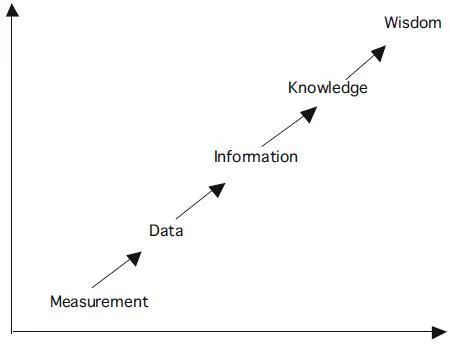
Exhibit 1. Quality of decision making.
Despite this significant recognition, the common scenario is that data remains not only locked in databases and lost in records but it is also difficult to access and to interpret; moreover, it remains incomplete and invalid. As a result, effective use of data is an elusive concept. What industry needs is the knowledge that is embedded in the data. One has to go beyond data gathering to unleash knowledge as a management support for decision making. Data remains in reality, a passive ore in dormant forms. Knowledge is not readily available from data; one has to mine it.
As shown in Exhibit 1, the first step is to create information from data by suitable methods; the next is to generate knowledge by processing information; and finally, to apply this knowledge for decision making. The integration of knowledge with decision making is wisdom. This is a road map from data to wisdom, consisting of a sequence of transformations, adding value every time.
The linear sequence is inspired and directed by goals, and supported by theoretical models en route. This sequence inherits its relevance from an organizational framework.
This data-to-wisdom route is the lifeline of modern decision support systems and knowledge engineering initiatives.
Measurement Technology
Is software measurement a separate discipline? Yes, it is a separate process area in Capability Maturity Model integration (CMMi). The core concepts in software measurements are based on the science of measurements or metrology. Proper understanding of this technology will make measurements look a lot easier than is believed. Improper understanding, on the contrary, complicates the matter and makes measurement look like an intricate process.
Measurement, as a process, exhibits an internal evolution and happens in three phases. The phases of measurement can be related to the concept of measurement scales well delineated in measurement theory. One can also identify measuring agencies or instruments, which are human-centric in software measurements.
These aspects of measurement technology are presented in subsequent paragraphs.
Measuring with the Mind: Cognitive Phase
The essential measurement is a mental process. We measure with the mind, the inward eye. In this context, measurement begins with perception. For example, measurement of risk in a project begins with perceiving risk elements, in the first place. Then, the probability of occurrence of each risk element and its impact on the project are guessed.
Measurement also involves judgment. One takes stock of a situation in the project and develops feelings or ideas that relate to and represent our assessment of the situation. This assessment or judgment is also an act of measurement...
Table of contents
- Cover Page
- Title Page
- Copyright Page
- Preface
- Chapter 1: Software Measurement
- Chapter 2: Software Metrics
- Chapter 3: Designing a Metrics System
- Chapter 4: Metrics Data Visualization
- Chapter 5: Metrics Data Analysis In Frequency Domain
- Chapter 6: Metrics Data Analysis In Time Domain
- Chapter 7: Metrics Data Analysis In the Relationship Domain
- Chapter 8: Process Models
- Chapter 9: Estimation Models
- Chapter 10: Metrics for Defect Management
- Chapter 11: Online Use of Metrics
- Chapter 12: Metrics-Based Decision Support Systems
- Chapter 13: Metrics for Strategic Vision
- Chapter 14: Metrics System Implementation
- Bibliography
Trusted by 375,005 students
Access to over 1.5 million titles for a fair monthly price.
Study more efficiently using our study tools.
Frequently asked questions
Yes, you can cancel anytime from the Subscription tab in your account settings on the Perlego website. Your subscription will stay active until the end of your current billing period. Learn how to cancel your subscription
No, books cannot be downloaded as external files, such as PDFs, for use outside of Perlego. However, you can download books within the Perlego app for offline reading on mobile or tablet. Learn how to download books offline
Perlego offers two plans: Essential and Complete
- Essential is ideal for learners and professionals who enjoy exploring a wide range of subjects. Access the Essential Library with 800,000+ trusted titles and best-sellers across business, personal growth, and the humanities. Includes unlimited reading time and Standard Read Aloud voice.
- Complete: Perfect for advanced learners and researchers needing full, unrestricted access. Unlock 1.5M+ books across hundreds of subjects, including academic and specialized titles. The Complete Plan also includes advanced features like Premium Read Aloud and Research Assistant.
We are an online textbook subscription service, where you can get access to an entire online library for less than the price of a single book per month. With over 1.5 million books across 990+ topics, we’ve got you covered! Learn about our mission
Look out for the read-aloud symbol on your next book to see if you can listen to it. The read-aloud tool reads text aloud for you, highlighting the text as it is being read. You can pause it, speed it up and slow it down. Learn more about Read Aloud
Yes! You can use the Perlego app on both iOS and Android devices to read anytime, anywhere — even offline. Perfect for commutes or when you’re on the go.
Please note we cannot support devices running on iOS 13 and Android 7 or earlier. Learn more about using the app
Please note we cannot support devices running on iOS 13 and Android 7 or earlier. Learn more about using the app
Yes, you can access Software Metrics by C. Ravindranath Pandian in PDF and/or ePUB format, as well as other popular books in Computer Science & Project Management. We have over 1.5 million books available in our catalogue for you to explore.