eBook - ePub
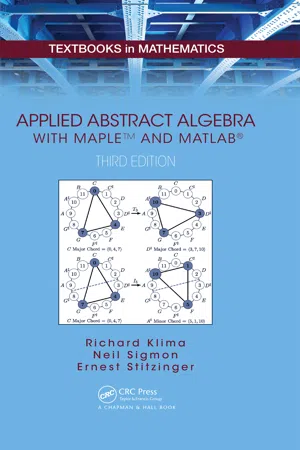
Applied Abstract Algebra with MapleTM and MATLAB
- 555 pages
- English
- ePUB (mobile friendly)
- Available on iOS & Android
eBook - ePub
Applied Abstract Algebra with MapleTM and MATLAB
About this book
Applied Abstract Algebra with MapleTM and MATLAB provides an in-depth introduction to real-world abstract algebraic problems. This popular textbook covers a variety of topics including block designs, coding theory, cryptography, and counting techniques, including Polya's and Burnside's theorems. The book also includes a concise review of all prereq
Information
Publisher
Chapman and Hall/CRCYear
2015Print ISBN
9781032292083
9781482248234
Edition
3eBook ISBN
9781482248289
Chapter 1
Preliminary Mathematics
There are two purposes to this chapter. We very quickly and concisely review some of the basic algebraic concepts that are probably familiar to many readers, and also introduce some topics for specific use in later chapters. We will generally not pursue topics any further than necessary to obtain the material needed for the applications that follow. Topics reviewed in this chapter include permutation groups, the ring of integers, polynomial rings, finite fields, and examples that incorporate these topics using the philosophies of concepts covered in later chapters.
1.1Permutation Groups
Suppose a set G is closed under an operation *. That is, suppose a * b ∈ G for all a, b ∈ G. Then * is called a binary operation on G. We will use the notation (G, *) to represent the set G with this operation. Suppose (G, *) also satisfies the following three properties.
- (a * b) * c = a * (b * c) for all a, b, c ∈ G.
- There exists an identity element e ∈ G for which e * a = a * e = a for all a ∈ G. 3.
- For each a ∈ G, there exists an inverse element b ∈ G for which a * b = b * a = e. The inverse of a is usually denoted by a−1 if * is a general operation or multiplication, and −a if * is addition.
Then (G, *) is called a group. For example, it can easily be verified that for the set ℤ of integers, (ℤ, +) is a group with identity element 0, but (ℤ, ·) with normal integer multiplication is not a group.
Let S be a set, and let B(S) be the collection of all bijections (i.e., one-to-one and onto mappings) on S. Then any α ∈ B(S) can be uniquely expressed by its action α(s) on the elements s ∈ S.
Example 1.1 If A = {1, 2, 3}, then B(A) contains six elements. One α ∈ B(A) can be expressed as α(1) = 2, α(2) = 3, and α(3) = 1. □
Let ∘ represent the composition operation on B(S). Specifically, if α, β ∈ B(S), then define α ∘ β by the action (α ∘ β)(s) = α(β(s)) for s ∈ S. Since the composition of two bijections on S is also a bijection on S, then α ∘ β ∈ B(S). Thus, ∘ is a binary operation on B(S). It can easily be verified that (B(S), ∘) is a group.
A group (G, *) is said to be abelian or commutative if a * b = b * a for all a, b ∈ G. For example, since m + n = n + m for all m, n ∈ ℤ, then the group (ℤ, +) is abelian. However, for a set S with more than two elements, there do exist α, β ∈ B(S) such that α ∘ β ≠ β ∘ α. Thus, for a set S with more than two elements, the group (B(S), ∘) is not abelian....
Table of contents
- Cover
- Half Title
- Series Page
- Title Page
- Copyright Page
- Table of Contents
- Preface
- 1 Preliminary Mathematics
- 2 Block Designs
- 3 Error-Correcting Codes
- 4 BCH Codes
- 5 Reed-Solomon Codes
- 6 Algebraic Cryptography
- 7 Vigenère Ciphers
- 8 RSA Ciphers
- 9 Elliptic Curve Cryptography
- 10 The Advanced Encryption Standard
- 11 Pólya Theory
- 12 Graph Theory
- 13 Symmetry in Western Music
- Bibliography
- Hints or Answers for Selected Exercises
- Index
Trusted by 375,005 students
Access to over 1.5 million titles for a fair monthly price.
Study more efficiently using our study tools.
Frequently asked questions
Yes, you can cancel anytime from the Subscription tab in your account settings on the Perlego website. Your subscription will stay active until the end of your current billing period. Learn how to cancel your subscription
No, books cannot be downloaded as external files, such as PDFs, for use outside of Perlego. However, you can download books within the Perlego app for offline reading on mobile or tablet. Learn how to download books offline
Perlego offers two plans: Essential and Complete
- Essential is ideal for learners and professionals who enjoy exploring a wide range of subjects. Access the Essential Library with 800,000+ trusted titles and best-sellers across business, personal growth, and the humanities. Includes unlimited reading time and Standard Read Aloud voice.
- Complete: Perfect for advanced learners and researchers needing full, unrestricted access. Unlock 1.5M+ books across hundreds of subjects, including academic and specialized titles. The Complete Plan also includes advanced features like Premium Read Aloud and Research Assistant.
We are an online textbook subscription service, where you can get access to an entire online library for less than the price of a single book per month. With over 1.5 million books across 990+ topics, we’ve got you covered! Learn about our mission
Look out for the read-aloud symbol on your next book to see if you can listen to it. The read-aloud tool reads text aloud for you, highlighting the text as it is being read. You can pause it, speed it up and slow it down. Learn more about Read Aloud
Yes! You can use the Perlego app on both iOS and Android devices to read anytime, anywhere — even offline. Perfect for commutes or when you’re on the go.
Please note we cannot support devices running on iOS 13 and Android 7 or earlier. Learn more about using the app
Please note we cannot support devices running on iOS 13 and Android 7 or earlier. Learn more about using the app
Yes, you can access Applied Abstract Algebra with MapleTM and MATLAB by Richard Klima,Neil Sigmon,Ernest Stitzinger in PDF and/or ePUB format, as well as other popular books in Mathematics & Cryptography. We have over 1.5 million books available in our catalogue for you to explore.