- 224 pages
- English
- ePUB (mobile friendly)
- Available on iOS & Android
eBook - ePub
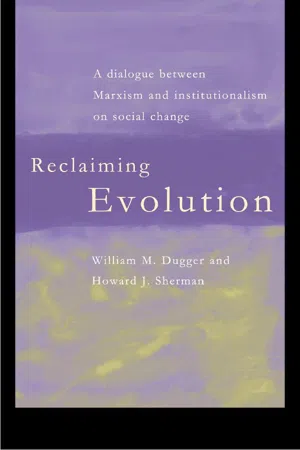
Reclaiming Evolution
About this book
Howard Sherman and William M. Dugger engage in a dialogue on social evolution from Institutionalist and Marxist perspectives, each representing one side. Together they explore the way society develops using the equally radical, but very different approaches of Thorstein Veblen and Karl Marx.
Trusted by 375,005 students
Access to over 1 million titles for a fair monthly price.
Study more efficiently using our study tools.
Information
Part I
PRELIMINARIES
1
WHAT IS EVOLUTION?
We begin with the evolution of evolutionary thought to find where it went astray and how it may be reclaimed for its original path.
Reclaiming evolution
For centuries in the medieval period and beyond, the dominant view was that nothing important ever really changes. Loren Eiseley expresses that dominant view as follows:
Throughout eternity the same waters hurry to the sea, the same animal forms expand or contract their habitat. All things pass and come again. The Newtonian world view, the eternal and balanced machine of the heavens, is repeated upon earth.
(Eiseley 1961: 329)
As late as the nineteenth century that was still the dominant view, but it was being challenged. Some geologists began to talk about gradual changes leading to major changes of the Earth over millions of years. Some astronomers began to talk about the evolution of the solar system and other star systems (Eiseley 1961: 332–34).
Some biologists, such as Darwin, talked about the evolution of biological species. In the introduction to his book, The Origin of Species, Darwin changed our thinking forever when he said the following:
I am fully convinced that species are not immutable; but that those belonging to what are called the same genera are lineal descendants of some other and generally extinct species, in the same manner as the acknowledged varieties of any one species are the descendants of that species.
(Darwin 1859: 14)
Marx and Veblen
A few social scientists also began to talk about social evolution – the evolution of society. The first major social scientist in the nineteenth century to present a theory of evolution was Karl Marx. Marx was very impressed by Darwin’s theory of biological evolution and stated that it was one of the three greatest discoveries of the nineteenth century (see quote of Marx and discussion of context in John Henry 1990: 49). Marx’s contribution to the theory of social evolution was called historical materialism. His view of evolution includes both gradual change and revolution, and will be discussed in later chapters. Marx’s collaborator, Frederick Engels, wrote his famous book on the family and evolution in the 1880s (Engels, 1886, 1942). He emphasized that the family is a major institution of society, that it had evolved, and that it varied greatly in different societies. He also traced the history of government and found that its form and content – like that of the family – had evolved in relation to changes in class and property relations. Years later in 1946, following up on Engels, the Marxist economist, Maurice Dobb, wrote the classic book on the transition from feudalism to capitalism. After a long tradition of Marxist literature on evolution, the well-known anthropologist and archeologist, V. Gordon Childe, published a careful book on social evolution from a Marxist view in 1951. For the next half century Marxist historians and anthropologists filled in the details and argued about theoretical issues of evolution in a large number of books (see discussion of the literature in Ollman 1987, Sherman 1995, Chapter 4, and Sitton 1996).
Other evolutionary thinkers were also hard at work. At the turn of the twentieth century, the great US social scientist, Thorstein Veblen, criticized orthodox economics for not being an evolutionary science. In his famous 1898 essay, “Why is Economics not an Evolutionary Science,” Veblen clearly differentiated between evolutionary and pre-evolutionary views. Veblen emphasized that it was not so much what scientists have gained through adopting the evolutionary view; rather, it is the biases they have lost that really matters. In the pre-evolutionary view, explanations of facts and social relations are grounded in the belief in a “guiding hand of a spiritual agency or a propensity in events” (Veblen 1898: 63). Veblen critiqued the pre-evolutionary view and presented his own theory of social evolution. Veblen’s critique and his theory will be presented at length in later chapters. His followers would become known as institutional economists and have maintained a rich literature expanding Veblen’s theory of evolution (a useful survey of Veblen’s thought on evolution appears in the institutionalist work on evolutionary theory by Hodgson 1996).
The theory of social evolution, as both Veblen and Marx originally used it, was quite subversive. What made it subversive was the belief that society can change radically, that society is not bound into a single iron mold by something unchanging called human nature. Charlotte Perkins Gilman’s poem in the Appendix to this chapter provides a delightfully subversive illustration. Gilman was a leading American feminist working around the same time as Veblen.
It should be stressed that because of its subversive nature, the evolutionary theory of Marx and the evolutionary theory of Veblen were both rejected by orthodox social scientists – so all orthodox economists (and most orthodox political scientists) still state eternal, ahistorical laws based on psychological axioms.
Marx’s ideas spawned various competing theories. The prevalent theory among the dominant socialist party in the late nineteenth century and early twentieth century – the German Social Democrats – declared it was inevitable that capitalism followed feudalism and it was inevitable that socialism would follow capitalism. The German Social Democrats found unalterable laws of historical evolution that predetermined historical events and inevitably led to progress. They traced all social change back to economic causes. Soviet Marxists from 1917 to 1990 followed the German Social Democrats on these key points, even though they feuded violently over everything else. The Communist parties were uncritical of inherited dogma and they were uncritical of the practices of the Soviet Union and the other countries of its bloc.
Contemporary Marxists have criticized these official party views unmercifully and have developed a completely different viewpoint, which they also trace back to Marx. Thus the old uncritical Marxism has been replaced with a new critical Marxism. In this book it is the new critical Marxism that readers will find as one side of a dialogue on social evolution. (Further discussion of the history of Marxist thought on these subjects is in Sherman 1995.)
Veblen (see, e.g. Veblen 1919), the founder of institutional economics, also gave rise to competing views. For forty years after Veblen’s death in 1929, many of Veblen’s evolutionary insights were submerged. Influenced by the more conservative institutionalism of John R. Commons (see e.g. Commons 1934), swayed by Joseph Dorfman’s conservative biography of Veblen, (see Dorfman 1934, 1972) and dazzled by the brilliant theorizing of Clarence Ayres (see e.g. Ayres 1978), institutionalists submerged Veblen’s radical institutionalism under a more moderate (liberal) institutionalism. The baleful effects of the Cold War also kept Veblen’s radical insights in the underground of American economics for years. The red thread was nearly lost. (But see Dugger 1992.)
The moderate institutionalists believed that there was evolutionary change in society, but that it was mostly smooth, virtually irresistible, involved little class conflict and led to progress. The moderates also believed that such progress seldom, if ever, took place through revolution. Nevertheless, Veblen’s radical institutionalism re-surfaced in the 1970s and, with the end of the Cold War, has become widely recognized as an important tradition. In this book it is that re-surfaced radical institutionalism of Veblen that readers will find as the other side of our dialogue on social evolution. We discuss mainly the new Veblenian radical institutionalism. (Further discussion of institutionalist thought is in Dugger 1989b.)
Evolution gone astray
Immediately after Darwin, many conservative religious writers completely rejected evolutionary theory – and at this time it is still vehemently rejected by some of the people who control schools in Kansas! Some, however, put forth a version of evolution that was a conservative weapon – and was the dominant view of evolution for some time. Nineteenth-century Social Darwinists, led by Herbert Spencer, argued that western “races” and societies had evolved and spread because they were superior to all others (see discussion in Hofstadter 1944). Twentieth-century Sociobiologists, led by Edward O. Wilson, argue that human behavior is genetically determined to be selfish and competitive (see discussion in Dugger 1981). This type of thinking was dominant in the nineteenth century and some of it came back during the period of the Cold War from 1950 to 1990. In biology, it has been attacked and superseded by a whole new generation of biologists who believe very differently. A leading figure in the revival and renaissance of biological evolution freed from reactionary notions from the nineteenth century and freed from absolutist belief in inevitable progress is Stephen Jay Gould (see e.g. Gould 1996).
The biologists have put the theory of biological evolution on a scientific, Darwinian track. But the social scientists and their theory of social evolution have lagged far behind. We want to close the gap between the advanced state of the theory of biological evolution and the retarded state of the theory of social evolution. However, while we can get some inspiration from the progress made in the theory of biological evolution, there is a great difference between biology and society – and our interest in this book is social evolution. So, we do not just apply the concepts of biological theory directly to social theory. We are social scientists, not biologists. We study the evolution of societies, not the evolution of species.
In addition to modern Sociobiologists, we also take issue (as discussed above) with the uncritical Marxist view of the Cold War that there is inevitable progress to a socialism in which there is harmonious progress forever. We also disagree with the Cold War view of some institutionalists (discussed above) that sees automatic progress from technology and a constantly improving capitalist society.
Instead of using the concept of social evolution as an ideological weapon in the Cold War, we reconstruct or reclaim the idea of evolution as a crucial part of all critical social thought. We do not believe that our world or any subset of it is the best of all possible worlds. The mountains of corpses we humans stacked up in the twentieth century have bloodied us, forced us to our very knees, humbled us profoundly, vaporized our arrogance. Therefore, we cannot possibly believe in Social Darwinism. Nor can we possibly believe in its later manifestation – Sociobiology. We cannot believe that all of time has been moving towards our selfish and competitive society as its crowning achievement. Instead, we believe that through all of time there has been only one ultimate or constant – change, itself. We believe change can be understood and that such understanding is inherently radical. We also believe that understanding change can reclaim the concept of evolution from the Cold War Warriors of both sides, and from the Social Darwinists and the Sociobiologists. The concept of evolution, reclaimed from those who misused it, is for the use of critical thinkers everywhere.
What is social evolution?
Having explained some of the evolution of evolutionary theories and what evolution is not, we must begin the task of saying what it is. This task will require the whole book. To start, a four-fold definition is offered here. First of all, evolution means not only incremental change in all aspects of society, but also structural change in the basic institutions and relationships of society. Second, evolution means change caused by the internal dynamics of society (called endogenous change), rather than change caused by external causes from outside of society. Third, evolutionary change cannot be reduced to the affects of a single factor, but is due to the operation of the relationships of the whole of society (holistic or relational change). Fourth, evolution in all stratified or class divided societies involves conflict between groups.
Structural change
Evolution includes both gradual, incremental change and revolutionary structural change. Structural change means that social structures – basic institutions – actually change in fundamental ways. Institutions have a beginning and an ending. They do not have an infinite future. Nor do they have an...
Table of contents
- Cover Page
- Title Page
- Copyright Page
- Acknowledgements
- Part I: Preliminaries
- Part II: Elements
- Part III: Processes
- Part IV: Denouement
- References
Frequently asked questions
Yes, you can cancel anytime from the Subscription tab in your account settings on the Perlego website. Your subscription will stay active until the end of your current billing period. Learn how to cancel your subscription
No, books cannot be downloaded as external files, such as PDFs, for use outside of Perlego. However, you can download books within the Perlego app for offline reading on mobile or tablet. Learn how to download books offline
Perlego offers two plans: Essential and Complete
- Essential is ideal for learners and professionals who enjoy exploring a wide range of subjects. Access the Essential Library with 800,000+ trusted titles and best-sellers across business, personal growth, and the humanities. Includes unlimited reading time and Standard Read Aloud voice.
- Complete: Perfect for advanced learners and researchers needing full, unrestricted access. Unlock 1.4M+ books across hundreds of subjects, including academic and specialized titles. The Complete Plan also includes advanced features like Premium Read Aloud and Research Assistant.
We are an online textbook subscription service, where you can get access to an entire online library for less than the price of a single book per month. With over 1 million books across 990+ topics, we’ve got you covered! Learn about our mission
Look out for the read-aloud symbol on your next book to see if you can listen to it. The read-aloud tool reads text aloud for you, highlighting the text as it is being read. You can pause it, speed it up and slow it down. Learn more about Read Aloud
Yes! You can use the Perlego app on both iOS and Android devices to read anytime, anywhere — even offline. Perfect for commutes or when you’re on the go.
Please note we cannot support devices running on iOS 13 and Android 7 or earlier. Learn more about using the app
Please note we cannot support devices running on iOS 13 and Android 7 or earlier. Learn more about using the app
Yes, you can access Reclaiming Evolution by William Dugger,Howard J. Sherman in PDF and/or ePUB format, as well as other popular books in Business & Business General. We have over one million books available in our catalogue for you to explore.