- 992 pages
- English
- ePUB (mobile friendly)
- Available on iOS & Android
eBook - ePub
About this book
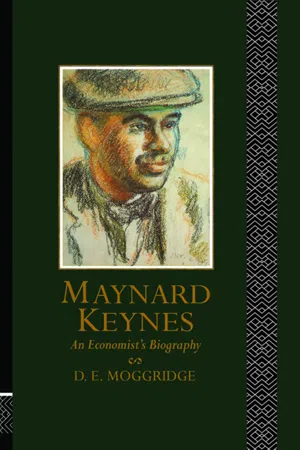
Based on an intimate knowledge of the subject and his environment, this biography of the most influential economist of the twentieth century traces Keynes' career on all its many levels. From academic Cambridge, to artistic Bloomsbury, to official Whitehall and to the City, we see the intellectual roots of Keynes' achievements and failures. We also
Information
1
FOREBEARS AND CHILDHOOD
I like the name suggested. John Maynard Keynes sounds like the substantial name of the solid hero of a sensible novel.
(KCKP, John Brown to F. A. Keynes, 6 June 1883)
John Maynard Keynes was born at 9.45 a.m. on Tuesday, 5 June 1883 at 6 Harvey Road, Cambridge, a solid, double-fronted, three-storey house of dark yellow brick finished the previous autumn. It had been built by his father, John Neville Keynes, for his bride, Florence Ada Brown, whom he had married in August 1882. Maynard, as he was to be called – although his mother occasionally used, and originally preferred, John – was to be the first of three children.a The other two were Margaret Neville, born on 4 February 1885, and Geoffrey Langdon, born on 25 March 1887.
Victorian changes in the University had brought his parents to Cambridge. The further transition from the last Victorian reforms of the 1880s to the modern state-supported institution that emerged after the First World War encompassed both Neville and Maynard Keynes’s connections with the administration of the University. For this reason it is necessary to provide some institutional background against which the Keyneses’ lives and times can be set.
At the beginning of the nineteenth century, candidates for honours degrees in the University of Cambridge had only one tripos, Mathematics. The next half century saw the addition of three more – Classics (1824), Moral Sciences (1848) and Natural Sciences (1848) – but these were only open to those who had taken a first degree, which in the arts subjects meant the Mathematics Tripos. Not surprisingly, examination results in the Mathematics Tripos remained the dominant criterion for election to College fellowships, the next step in a Cambridge career. Inevitably, this meant that trained mathematicians dominated the early development of the ‘newer’ subjects. It was only after 1850 that the new triposes came to stand on their own as possible direct routes to an honours degree – Classics in 1854, Moral and Natural Sciences in 1860.
Candidates for honours degrees were not in a majority amongst those who matriculated, or entered, into the Victorian or Edwardian University. There was the alternative of the ordinary degree, now only a consolation prize for students after academic disasters. The standard of this degree was low, in part because the Colleges’ standards of admission were low and in part because in the Victorian education system the pool of candidates sufficiently qualified to consider even trying for honours, although growing, was not large.
For both ordinary and honours candidates, the Colleges and the University at mid-century provided little in the way of instruction. The professors, the only teaching officers appointed by the University, lectured, but their lectures were not integrated into the programme of undergraduate studies. Nor did many professorships provide an adequate income for their incumbents, who themselves were not obliged to be resident in Cambridge.b Even if the professors took undergraduate teaching seriously, and some did, the University had few places where lectures could take place and laboratory space was even scarcer. Nor were the Colleges an alternative source of education. They did provide some elementary lectures, but these were often inferior to those given to the top form at a good public school. The Colleges did not provide extensive tuition.
The combination of the poor University and College arrangements for undergraduate teaching and the existence of prizes in the form of College fellowships for those coming highest in Tripos examinations resulted in the growth of a set of teaching arrangements outside the system. Private tutors, or coaches, mainly College fellows or lecturers or married graduates whose success was measured by the examination results of their clients, came to dominate the day-to-day teaching in Cambridge. The rewards for success as a coach were high: the best earned far more than College fellows, not to mention most professors.1 However, the system did not reward originality in teachers or taught.
The Colleges did not offer career prospects likely to attract good teachers or, for that matter, scholars. By mid-century, changes in ecclesiastical standards and practices plus the expansion of secular opportunities for educated men made it less likely that the few available College teaching posts would attract good candidates. Most College fellowships, which often did not require their holders to be resident in Cambridge, were restricted to celibates. If a College fellow took holy orders, he was guaranteed a fellowship for life – or until a lucrative College living turned up. Normally College offices were restricted to those in holy orders. Otherwise, except in certain specific cases, tenures were limited. In neither case was scholarly attainment a condition of continued tenure.
Mid-Victorian Cambridge was thus an Anglican society. The Act of Uniformity of 1662 required all professors, readers, masters and fellows of Colleges, on pain of losing their posts, to declare their adherence to the doctrine of the Church of England, to disclaim the right of resistance to the King and to declare the Solemn League and Covenant an illegal oath. A further Act of 1714 required all Heads of Houses and all persons supported on the foundation of a College aged 18 or over to declare on oath ‘that no foreign Prince, Person, Prelate, State or Potentate hath, or ought to have, any jurisdiction, power, superiority, pre-eminence or authority, ecclesiastical or spiritual, within this realm’.2 Just after mid-century, the Cambridge University Act of 1856 removed the requirement for an oath under the 1714 Act from holders of scholarships. However, it added that no Cambridge MA or doctor could sit in the Senate of the University, and thus take part in its government, unless he declared himself a bona fide member of the Church of England.
Despite this provision, the 1856 Act marked the beginnings of serious reform in Victorian Cambridge. Between 1850 and 1878 the University was the subject of parts of the deliberations of three Royal Commissions and three major Acts of Parliament. The first Royal Commission, the Graham Commission of 1850–2, resulted in the 1856 Act, which produced the first major revision of University and College statutes since the reign of Elizabeth I (or in the case of King’s College since 1453). Here, as later, the purpose was to adapt University government to changed circumstances and to face the problem of financing the expansion of University activities that the new age seemed to require. The process of adaptation was far from simple. It involved a delicate interaction between the Statutory Commissioners appointed under the Act and the members of the bodies subject to reform. Initially, the University and the Colleges made proposals to the Commissioners, who would then decide on them. If the process of negotiation failed, or if it proved too lengthy, after 1 January 1858 the Commissioners could make the necessary remaining statutes themselves. The result was a complicated bargaining process in which the dons, or senior members of the Colleges, had considerable influence over the direction of reform. Between such bouts of externally organised reform, the University and the Colleges worked within the established framework. The dons maintained considerable control over the direction and speed of change.
Another constraint on change was the income available to the University. In 1852 the Graham Commission estimated that the University’s general income was £8,000, with another £10,000 tied up in appropriations for special subjects.3 This represented about a tenth of the gross income available to the Colleges. Unless the University received new sources of income, every new professorship, building or activity meant an often lengthy search for funds through fees, voluntary College donations or private benefactions, one of the most visible being the gift of the original Cavendish Laboratory by the Duke of Devonshire.
The 1850s, 1860s and 1870s, despite difficulties, were a period of slow progress.4 New triposes in Law, History, Theology, Semitic and Indian Languages made their appearance. After the inevitable initial period, when they were considered what we would call ‘soft options’,c these and the triposes started just before mid-century became more popular and even began to attract good students. By the 1870s, some were prepared to argue that the distinction of the Senior Moralists – those who came top of the first class in Moral Sciences – was superior to that of the Senior Wranglers in Mathematics.5 As well as new triposes, new professorships appeared in archaeology, zoology, Sanskrit, mechanism and applied mechanics and Anglo-Saxon, while many old foundations were reorganised. In an attempt to improve standards in the schools the University created a local examinations scheme. It also started to reach out into the wider community with extra-mural lectures. Following from these examinations and lectures came schemes and facilities for the full-time higher education of women with the founding of what are now Newnham and Girton Colleges, although it would be only after the Second World War that women would become full members of the University.
There were also stirrings of change in collegiate teaching arrangements, particularly in Trinity and St John’s. In this period, these made a number of distinguished teaching appointments – for example, Henry Sidgwick, James Ward, J. E. B. Mayor, J. B. Pearson, Alfred Marshall, H. S. Foxwell and Henry Cunningham in the moral sciences. It was these appointees who provided the beginnings of another innovation, an inter-collegiate programme of lectures for tripos candidates.6 Still later came the modern College provision of supervisions.
In this period, the University also became more open. In 1871, after almost a decade of intermittent debate, Parliament passed an Act abolishing the religious tests for all but Heads of Houses and candidates for divinity degrees. This opened posts at Oxford, Cambridge and Durham to non-Anglicans who had hitherto been allowed posts only in the secular University College, London and the newly formed northern civic colleges – the forerunners of the redbrick universities.
Despite these changes, Cambridge, along with Oxford, was still subject to considerable criticism. There was a widespread belief that in higher education Britain was falling behind other countries, particularly Germany. Much of the emphasis in this criticism fell on scientific and technological education, but there was also criticism of the lack of professionalism in Oxbridge university teaching.7 Contemporary concerns became manifest in the appointment of a Select Committee on Scientific Instruction in 1868 and subsequently of a Royal Commission on the subject under the Duke of Devonshire. Both bodies heard of the strained financial position of Cambridge. The Devonshire Commission, which devoted a separate report to Oxford and Cambridge, also remarked on the problem of using the existing resources of the Colleges to create genuine careers in teaching, given the celibacy restrictions on most College posts and the fact that few College fellowships (120 out of 350) were held by persons resident in the University engaged in educational or administrative tasks.8 Before the Devonshire Commission reported, partly in response to continued criticism of the existing situation from within the Universities themselves, the Government set up another Royal Commission to enquire into the finances of the ancient Universities and their Colleges. This revealed that, in contrast to the relative poverty of the universities, many colleges had incomes in excess of what they needed for educational purposes.
Revelations such as these, plus the climate of criticism and concern, brought action from the Government. In 1875 Disraeli promised that university reform would be part of the Government’s programme. The next Queen’s Speech referred to forthcoming legislation. The proposed legislation was some time in appearing, but in 1877 the Government introduced a Bill appointing Statutory Commissions for Oxford and Cambridge. The resulting Act required that the revised statutes should make provision for College financial contributions for University purposes, that fellowships and other College emoluments should be attached to University or College offices and that the tenure of unattached College fellowships should be reviewed.
The ensuing process of statute-making was lengthy: the Statutory Commissioners for Cambridge did not agree to affix their seal to the University statutes until 15 March 1881. The new University statutes, which took effect in 1882, provided for a scheme of College contributions for University purposes which would rise to £30,000 per annum in 1896, if the contributions were not reduced by the Chancellor on the recommendation of the Financial Board because of continuing agricultural depression. The statutes created new professorships, readerships and University lectureships, a General Board of Studies to organise University teaching and a Financial Board, as well as regularising and raising professorial stipends. The new College statutes would not allow Colleges to require that thei...
Table of contents
- Cover
- Halftitle
- Title
- Copyright
- Dedication
- Contents
- List of plates
- Preface
- Acknowledgements
- Abbreviations
- 1 Forebears and Childhood
- 2 Eton
- 3 King’s Undergraduate
- 4 Post-Graduate
- 5 Moore and Keynes’S Early Beliefs
- 6 Probability
- 7 Civil Servant to Young Don
- 8 The Young Economist
- 9 Bloomsbury
- 10 War
- 11 External Finance in Total War
- 12 Negotiating the Peace
- 13 Economic Consequences of the Peace
- 14 Adjustments to a Way of Life
- 15 Reparations and Journalism
- 16 Lydia and Maynard
- 17 The Return to Gold
- 18 Industry and Politics
- 19 The Emergence of the Treatise
- 20 Crisis, Criticism and New Directions
- 21 Towards the General Theory
- 22 International Affairs and the Arts
- 23 Fertile of Mind, Frail of Body
- 24 How to Pay for the War
- 25 ‘Scraping the Bottom of the Box’
- 26 The Clearing Union
- 27 Domestic ‘Newjerusalems’
- 28 Bretton Woods
- 29 The Shadow of Debt
- 30 The Loan
- 31 The Last Months
- Annex I – A Key for the Prurient: Keynes’s Loves, 1901–15
- Bibliography
- Dramatis Personae
- Index
Trusted by 375,005 students
Access to over 1.5 million titles for a fair monthly price.
Study more efficiently using our study tools.
Frequently asked questions
Yes, you can cancel anytime from the Subscription tab in your account settings on the Perlego website. Your subscription will stay active until the end of your current billing period. Learn how to cancel your subscription
No, books cannot be downloaded as external files, such as PDFs, for use outside of Perlego. However, you can download books within the Perlego app for offline reading on mobile or tablet. Learn how to download books offline
Perlego offers two plans: Essential and Complete
- Essential is ideal for learners and professionals who enjoy exploring a wide range of subjects. Access the Essential Library with 800,000+ trusted titles and best-sellers across business, personal growth, and the humanities. Includes unlimited reading time and Standard Read Aloud voice.
- Complete: Perfect for advanced learners and researchers needing full, unrestricted access. Unlock 1.5M+ books across hundreds of subjects, including academic and specialized titles. The Complete Plan also includes advanced features like Premium Read Aloud and Research Assistant.
We are an online textbook subscription service, where you can get access to an entire online library for less than the price of a single book per month. With over 1.5 million books across 990+ topics, we’ve got you covered! Learn about our mission
Look out for the read-aloud symbol on your next book to see if you can listen to it. The read-aloud tool reads text aloud for you, highlighting the text as it is being read. You can pause it, speed it up and slow it down. Learn more about Read Aloud
Yes! You can use the Perlego app on both iOS and Android devices to read anytime, anywhere — even offline. Perfect for commutes or when you’re on the go.
Please note we cannot support devices running on iOS 13 and Android 7 or earlier. Learn more about using the app
Please note we cannot support devices running on iOS 13 and Android 7 or earlier. Learn more about using the app
Yes, you can access Maynard Keynes by Donald Moggridge in PDF and/or ePUB format, as well as other popular books in Social Sciences & Social Science Biographies. We have over 1.5 million books available in our catalogue for you to explore.