Europe Contested analyses the failures and achievements of an astonishing era of economic advance and political chaos, from the First World War up to the present day.
Beginning with the Great War, the book goes on to examine connections between the self-destruction of liberal democracy, market economics, and the international political and security framework in the interwar period. It then considers the mass politics that surrounded the glorification of new-style leaders Lenin, Stalin, Mussolini, and Hitler before moving on to explore the ways in which the interwar legacy was superseded post-1945. James examines the deceptive appearance of stability brought by a new convergence in European politics that focused around the market and the principle of liberal democracy, and demonstrates how the impact of globalization and openness to migration and to destabilizing financial capital flows has eroded traditional politics and ended the stable left-right polarization at the core of the postwar order. This new edition has been thoroughly updated throughout, demonstrating also how an era of crisis is challenging Europe and its values.
Supported by boxed case studies, illustrations, chronologies and an annotated bibliography, and focusing on Europe as a whole, it is the perfect introduction for students of Modern European History.
There is a way of telling the story of Europe’s twentieth century that casts a particular and perhaps disconcerting light on politics, and on what politics can accomplish. The easiest way to summarize that view of development is “modernization”. Modernization involves a transformation of society, a shift to urban existence, industrial and service sector employment, female emancipation, the individualization of existence, the questioning of traditional values, and frequently a waning of religion. There is in short a remaking of the idea of man and woman. By the early twenty-first century, this development had reached a point where many began to challenge the binary division of human society, instead favoring the notion that gender itself could be fluid.
Modernization
Modernization also usually produces new demands about what political institutions should do to help in the realization of the new vision of humanity. Should and does the political process play a part in the breaking down of traditions? Sometimes, indeed, the long-term developmental story is politicized, and commentators point out the modern aspects of brutal and repressive dictatorships. This path has been taken by a minority of scholars in the case of Mussolini’s Italy (James Gregor), and by rather more for Hitler’s Germany (David Schoenbaum, and most provocatively Rainer Zitelmann); but it has been the bedrock of much of the analysis of Stalin’s Russia (beginning with the studies of Isaac Deutscher and Alec Nove, which explained that brutality was the price for advance).1 The theory underlying this approach was that the new world could not emerge without a violent destruction of the old world, and that the old encrustations were stronger and more resistant on a gradient to the south and east of the European continent.
Tested against empirical evidence, these theories of the need for violent modernization actually fare surprisingly badly. The period of Mussolini’s regime, far from representing a “developmental dictatorship”, actually saw the poorest performance of the Italian economy in the twentieth century. Nazi Germany published some impressive statistics about growth, but recent investigations of infant mortality and nutrition (which are the most reliable guides to overall well-being) indicate that the rhetoric about generating a new general prosperity was essentially empty.2 Stalin’s Russia produced quick industrialization, by transferring resources out of the big agricultural sector and impoverishing it (so that it is wrong to talk about rising living standards), and set the stage for decades of dismal economic performance. Conversely, it was the country which was usually held up as a pioneer of modernity, the United Kingdom, that did its best to maintain and even invent odd traditions, and which preserved feudalism longest (until 2004, in Scotland).
Politics (even or indeed especially when based on a promise to “modernize”) actually more easily obstructed modernization than promoted it. It may be true that political developments could hold up, and perhaps sometimes accelerate, the emergence of “modernity”, but so many different elements went into Europe’s modernization that it would be grossly overstating the case to say that politics in any country consciously made modernity in the old continent. The causation from politics to modernity is by no means clear. Again, to take the three examples mentioned, there was a substantial but chaotic modernization in Italy, Germany, and Russia during and immediately after the First World War. Indeed, it would be much more plausible to argue that this modernization on a broad front created a room for new politics, rather than the other way round.
After that initial demand for a new kind of political existence, spurred by economic change and reflecting the demands of new social groups (above all of a new and uncomfortable working class), a different relationship between the push to modernize and its political manifestation was established (that is the theme of Chapters 3 and 4). When modernization became controversial, and politics more violent, a vicious cycle developed in which poor growth and bad politics reinforced one another. That cycle could only, in general, be broken from the outside: by military defeat and political humiliation.
Greater wealth
Mostly, however, the modernization story seems to work rather independently of politics. Since the European political and social response to modern life is the subject of almost all of this book, this initial chapter discusses modernity in its simplest form, without politics. The elemental story is one of a relatively constant process of enrichment, and its consequences.3 Modernization, in other words, simply means the greater control of resources by individuals. The misapprehension about modernization that gripped many people in the twentieth century (and which is analyzed in more detail in Chapters 5, 7, 8, and 9) is that it involved an entrapment, or a fundamentally inhuman dynamic of the greater control of individuals by the resources that they might want.
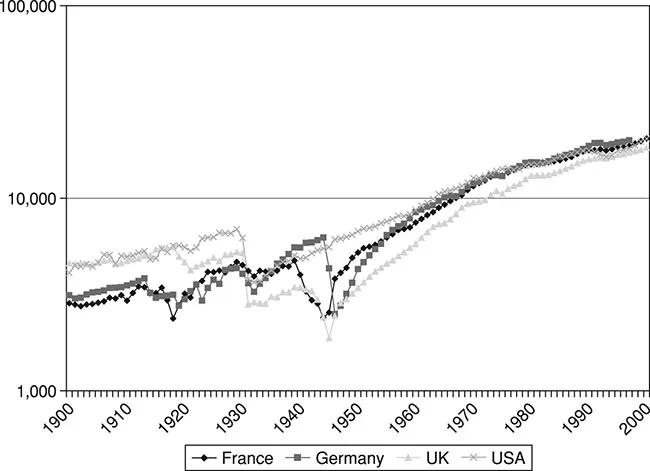
Figure 1.1 Gross Domestic Product (GDP) per capita, 1900–2000 (1990 US dollars).
(Source: Angus Maddison (2001), The World Economy: A Millennial Perspective, Paris: OECD Development Centre, updated from University of Groningen and the Conference Board, GGDC Total Economy Database, 2003, www.eco.rug.nl/ggdc).
Figure 1.1 shows one way of thinking about this process: it simply depicts the development of Gross Domestic Product (GDP; in other words, the sum of services and goods produced in the economy) per head of population. In this figure, the calculation is shown on a logarithmic axis, in order that a constant rate of growth should appear as a straight line (in a conventional figure, the line would appear to curve upwards). Unlike GDP charts, which show a falling-off of European performance toward the end of the century, this chart depicts an astonishing constancy of growth in most European societies, the exception being catch-up periods of faster growth in the aftermath of the interruptions produced by war. During the First, but even more in the Second World War, the US economy grew while that of Europe contracted, setting the stage for a large potential for Europeans to catch up by taking over American technological and managerial innovation.
There is broad agreement on what caused this amazing performance, unprecedented in previous centuries: even in the eighteenth century (in the United Kingdom) or in the nineteenth century (in continental Europe), in the age of the classical Industrial Revolution, growth rates were lower. The great riches of the modern world flowed from the adoption of modern technology. This concept in its broadest sense encompasses not only the process of applying the results of scientific discovery, but also organizational and managerial improvements. The two are interconnected, most obviously in the case of advances in information technology, from the typewriter, telephone, and cable before the First World War to the revolution of computing (see Chapter 9), and the new linkages created by the internet in the 1990s (Chapter 13).
Indeed, the effect of the technology is so profound that it is really hard to compare the living standards of Europeans at the end and the beginning of the century. To be sure, it is possible to calculate the great decline in the time of work needed to earn a loaf of bread or a pint or liter of beer. But such figures do not really measure adequately the change in people’s lives. No one would now want to spend all their income on bread or beer, and it is the possibilities that exist for new sorts of spending that have transformed lives most. It was thus possible at the end of the century to see and hear a great opera or symphonic performance, or a popular singer, for a small price (by purchasing a video or DVD), or indeed even at no marginal cost at all (through the Internet); while at the beginning of the century such enjoyment would have required a long and expensive journey and hotel costs, as well as the price of a theater or concert ticket. Some of the goods that are now available, and readily taken for granted, represent major conveniences: the item most commonly missed by participants in experiments to recreate the way of life a century ago is hair shampoo, which simply did not exist. More significantly, at the beginning of the century an effective medical treatment of bacterial infections was impossible; but by the end of the century, antibiotic drugs had become quite cheap (though some drug-resistant forms of bacteria were beginning to emerge).
It is important to notice that the increase in prosperity does not necessarily mean more happiness. Weighing the happiness gain is a much harder exercise: to take one of the examples above, a large part of the world of house-made music disappeared under the pressure of aesthetically superior recorded and reproducible music. If the pleasure of participation is balanced against the enjoyment of passive listening, some will feel that “the world we have lost” had its own unique attractions.
Transformed demographics
Being richer – the major fact of the twentieth century in all of Europe – dramatically changed what people did with their lives. It changed, to start with the most basic level, the way they were born, lived, and died.
In demographic terms, both fertility and mortality declined more or less continuously in the course of the century. A “demographic transition” had begun in almost every northern and western European country in the 1890s, with reduced numbers of births. This long-term trend continued through the big political disturbances of the twentieth century, which had some impact, but only of a temporary character: births fell further in most countries during the world wars, and then bounced back in a recovery phase of “baby boom”.
The lower rates of fertility reflected increasingly prevalent birth control, which was often described in the vocabulary of modernization and rationalization. In 1928, the Prussian Minister of Social Welfare described the new situation: “There is no doubt that the limitation of births is willful. Intercourse is rationalized, at least by the great part of the population. People simply do not want more than one or two children.”4
Where contraception failed or was not used, abortion was frequent. In Russia, physicians had spoken about an epidemic of abortions before the First World War. In revolutionary Russia it became the standard method of birth control, and in 1920 doctors in hospitals (but not the traditional midwives of rural Russia) were permitted to perform abortions. In Leningrad the number of abortions per 1,000 people soared from 5.5 to 31.5 between 1924 and 1928. The Soviet state eventually retreated and reversed its abortion policy in 1936, because it was alarmed by the demographic consequences of too much abortion. Elsewhere in the 1920s, a large-scale demand for liberalization of abortion laws began. In Germany, it was estimated that in 1931 1 million women had abortions. After the Second World War came a new wave of abortions, justified in part as a pragmatic response to the mass raping of women. Abortion continued to be practiced as a widespread method of family planning in communist Europe, in the absence of readily available contraception, and in some cases (as in Romania) in secret defiance of natalist policies designed to increase national population and power.
Abortion, especially when it was conducted in the illegal circumstances of the back streets or was self-induced, often produced infections and high rates of mortality. Legalization, and the availability of better methods of contraception, was a key to the reduction of female mortality.
Improvements in hygiene also reduced mortality rates. The big innovations of the nineteenth century concerned public hygiene: the provision of clean water and separate sewage systems. In the twentieth century, hygiene was personalized. It took a long time for some basic elements of hygiene to become regularly established. Washrooms with baths and showers for students were installed in most Oxford and Cambridge colleges only in the interwar period, with often peculiar names (“the gate of necessity”). France’s Elle magazine in 1951 reported that a quarter of the women surveyed never brushed their teeth. Flossing was unusual in Europe until the 1980s and 1990s.
Medical advances had a relatively late impact on mortality rates, and then they were mostly pharmaceutical. In the nineteenth century, immunization began to limit some types of epidemic (it was especially successful against smallpox). Only, however, in the mid-twentieth century did improved medicine, largely the result of the introduction of penicillin and then other antibiotics, dramatically alter the response of the human body to bacterial infection.
Individuals thus lived longer. Life expectancy at birth had risen very slowly in the nineteenth century, but much more dramatically in the twentieth. For a French person born in 1820, for instance, the average life expectancy was 40; in 1900 it was 47, and in 1992, 77. In the nineteenth century, female expectations were lower than those of males, because of the risks associated with childbirth; and in the twentieth century, they rose to higher levels than those of men.
After and before work
People also had a more constant expectation about how long they might live, and were less prone to meditate on the uncertainty of life. Nineteenth-century life had frequently been short and uncertain, and “retirement” rare. In 1881, three-quarters of men in the United Kingdom over 65 were still working. It was only in 1898 that the British civil service began to enforce a retirement age. By 1931, half of men in the United Kingdom over 65 were still in employment; by 1981 that ratio had fallen to a tenth. Retirement ages fell at the same time as life expectancy increased. At its most extreme, Italians by the end of the century had a retirement age of 55 for men and 50 for women. In the European Union as a whole, in 2000 only 31 percent of men and 15 percent of women aged between 60 and 65 were working.
In addition, more people spent longer in full-time education. Higher education grew enormously. At the beginning of the twentieth century, there were 35,000 university students in Germany, as well as another 17,000 in technical high schools (the equivalent of universities). In France, there were around 20,000, as there were in the United Kingdom; by 1939 these figures had risen to 80,000 and 50,000 respectively. The rapidity of growth continued after the Second World War. By the end of the century, there wer...
Table of contents
Cover Page
Half Title
Series Page
Title Page
Copyright Page
Table of Contents
Acknowledgments
List of Illustrations
List of Boxes
Map
Introduction
Chronology
1 The Twentieth Century in an Iron Cage: Modernization and Rationalization
2 War and Peace: Lenin and Wilson
3 The 1920s: Precarious Democracy
4 Europe and the World of the Depression
5 Peace and War: The Failure of the International Order in the 1930s
6 The Second World War
7 The Reconstruction of Europe, Western Style: Making the 1950s
8 Yalta and Communism: The Reconstruction of Europe, Eastern Style, from the 1940s to the 1970s
9 A Golden Age: The 1960s
10 The Limits to Growthmanship: The 1970s
11 Right Step: The 1980s
12 Malta and Communism: 1989 and the Restoration of Europe
13 The Return to Europe: The New Politics and the End of the Cold War
14 Europe in a New World Order
Appendix 1: Populations of Major European Countries
Appendix 2: Short Biographies
Appendix 3: Further Reading
Index
Trusted by 375,005 students
Access to over 1.5 million titles for a fair monthly price.
Study more efficiently using our study tools.
Frequently asked questions
Yes, you can cancel anytime from the Subscription tab in your account settings on the Perlego website. Your subscription will stay active until the end of your current billing period. Learn how to cancel your subscription
No, books cannot be downloaded as external files, such as PDFs, for use outside of Perlego. However, you can download books within the Perlego app for offline reading on mobile or tablet. Learn how to download books offline
Perlego offers two plans: Essential and Complete
Essential is ideal for learners and professionals who enjoy exploring a wide range of subjects. Access the Essential Library with 800,000+ trusted titles and best-sellers across business, personal growth, and the humanities. Includes unlimited reading time and Standard Read Aloud voice.
Complete: Perfect for advanced learners and researchers needing full, unrestricted access. Unlock 1.5M+ books across hundreds of subjects, including academic and specialized titles. The Complete Plan also includes advanced features like Premium Read Aloud and Research Assistant.
Both plans are available with monthly, semester, or annual billing cycles.
We are an online textbook subscription service, where you can get access to an entire online library for less than the price of a single book per month. With over 1.5 million books across 990+ topics, we’ve got you covered! Learn about our mission
Look out for the read-aloud symbol on your next book to see if you can listen to it. The read-aloud tool reads text aloud for you, highlighting the text as it is being read. You can pause it, speed it up and slow it down. Learn more about Read Aloud
Yes! You can use the Perlego app on both iOS and Android devices to read anytime, anywhere — even offline. Perfect for commutes or when you’re on the go. Please note we cannot support devices running on iOS 13 and Android 7 or earlier. Learn more about using the app
Yes, you can access Europe Contested by Harold James in PDF and/or ePUB format, as well as other popular books in History & 20th Century History. We have over 1.5 million books available in our catalogue for you to explore.