- 184 pages
- English
- ePUB (mobile friendly)
- Available on iOS & Android
eBook - ePub
About this book
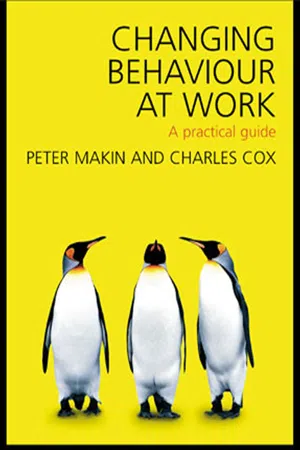
Problems with costs, quality, productivity and attendance, primarily stem from bad behavioural patterns encouraged within the organization. To prevent and manage these problems, a behavioural approach to managing people is often the most effective.This dynamic textbook illustrates how behaviour analysis theory can be used to alter how people behave
Trusted by 375,005 students
Access to over 1 million titles for a fair monthly price.
Study more efficiently using our study tools.
Information
Subtopic
Business GeneralIndex
BusinessChapter 1
History and background
The purpose of this book is to enable you to change people’s behaviour to make it more effective, whether it is your own behaviour, that of other individuals, groups of individuals, or even whole organizations. The theory and techniques we will use are referred to as the behavioural approach. We will also, occasionally, use ideas taken from other theories where we have found them to be useful and compatible with the behavioural approach.
THE BEHAVIOURAL APPROACH TO MANAGEMENT
What’s different about the behavioural approach?
- It is based on sound psychological theory that has a proven track record.
- Despite the fact that it is theory-based, the approach is very pragmatic. Rather than deal with the psychological ‘causes’ of behaviour, like attitudes and personalities, it deals with problem behaviour directly.
- It is very difficult for managers to change attitudes and even more difficult, if not impossible, for them to change someone’s personality. Behaviour, on the other hand, can be changed using techniques that are relatively easy to learn and apply.
- We have taught the techniques to hundreds of managers, who have used them to solve a wide range of behavioural problems. These range from individual problems, such as stopping a colleague making derogatory personal comments in front of subordinates, or improving golf putting, to getting a whole factory to behave more safely.
In this chapter we will describe the background to the theory and give a brief historical overview of its place in psychological thinking.
In Chapter 2 we will look at some of the more important and influential ‘traditional’ approaches to dealing with people problems in order to contrast them with the behavioural approach.
Chapter 3 will then deal with basics of behavioural theory, using examples from work and every-day life to demonstrate the important concepts.
In Chapters 4 to 6 we will show how the theory can be used to change the behaviour of individuals, groups and even organizations. Case studies will be used which, with few exceptions, are drawn from projects carried out by managers we have taught. Additions and extensions to the theory will be introduced where they are appropriate for the case study being described.
The final chapter will deal with the ‘mechanics’ of how behaviour can be correctly specified and measured. The second part of the chapter will deal with practical problems in behavioural change programmes and how they can be minimized.
Introduction to the behavioural approach
The theory we will be using is part of ‘behavioural psychology’. Unfortunately for clarity, the theory is currently in the throes of a name change. Originally the theory was known as behaviour modification (BMod for short), which, when applied to organizations became, not surprisingly, organizational behaviour modification (OBMod). More recently, possibly because the term ‘modification’ has overtones of manipulation, some writers have started using the term behavioural analysis which, in its applied form, is referred to as applied behavioural analysis. (More confusion is also possible because some writers use ‘behaviour’, rather than ‘behavioural’.) Despite this potential confusion, however, the theory remains the same. In fact one important term remains common to both titles – behaviour. The presence of ‘behaviour’ in both titles is important, for reasons that, we hope, will soon become clear. In this book we will tend to use the terms BMod and OBMod but we may, on occasions, use the alternatives.
Unlike some of the traditional approaches, which we will consider in the next chapter, the behavioural approach does not look for deep, internal, causes of behaviour such as attitudes or personality. Instead it concentrates on the behaviour itself, and on ways of influencing behaviour to bring about the desired change. As we will see, however, getting managers to specify people problems in terms of behaviour is not always easy. An example from the authors’ experience will serve to illustrate this.
We were running a management course in a London hotel and, unknown to us, the person putting out the buffet lunch at the back of the room was the hotel’s assistant manager. He must have been paying attention to what we were saying because, after the course was over, he approached us for advice about one of his receptionists. This receptionist, he explained, had a prejudice against Arabs, and he wanted advice as to how to stop this racism. It took us some time to get him to see that what he needed to change was not her racism, but her behaviour. Her behaviour towards guests of other racial groups was exemplary and what he wanted was for her to display the same behaviour towards his Arab clientele. (The underlying problem of ‘racism’, whilst to be deplored, is not an issue for the manager, her behaviour whilst at work, on the other hand, is.)
Specifying problems in behavioural terms makes them more amenable to solution. Behaviour can be changed, personalities cannot. We will be showing how this can be done in later chapters. Before moving on, however, it is perhaps worth pointing out some of the additional advantages of specifying problems in behavioural terms.
One advantage is that employees become aware of precisely what behaviour is expected of them. It may be thought that employees are already aware of what behaviour is required, but this is often not the case. This may appear strange, but it is, in our experience, very common. Even ‘simple’ jobs, such as that of a bartender or cleaner may benefit from an analysis in behavioural terms. It is, for example, often not clear as to whether bartenders, or their managers, are fully aware of what customers expect of a ‘good’ bartender. Young people, often students, are taken on as bar staff and put behind the bar with little or no instruction as to how to deal with customers. Managers often comment that ‘it should be obvious’ what is expected of them. One of the authors, tired of poor service, analysed in behavioural terms what customers expected of a ‘good’ bartender.
Talking to pub customers, it became apparent that one of the main annoyances, especially in crowded pubs, is getting noticed by the bartender so as to be served, hopefully, in your proper place in the queue. Often, in customers’ perceptions, the bartender finishes serving a customer and then serves either the person standing immediately behind, or the one who shouts loudest, irrespective of whether or not it was their turn. A specification of the precise behaviours required was, therefore, suggested, that included the following. A good bartender:
- acknowledges people arriving at the bar for service,
- indicates to them their place in the queue, and
- serves them in that order.
This was tried out by one of our post-graduate students who worked part-time in a bar. She followed the behaviours specified above to see what would happen.
Although it was not possible to measure customer satisfaction directly, it was thought that the level of tips would provide an indirect indication of any change. She monitored, therefore, the level of tips before and after the behaviour change. Until she implemented the change her tips had been very close to the average for other staff in the bar. Very shortly after the change was implemented her tips had tripled. The other staff noticed this and wondered what was leading to her enhanced earnings. Because they knew she was doing a Master’s degree in psychology they came to the conclusion that she was hypnotizing the customers!
Just the correct specification of behaviour may, therefore, lead to improved performance – the ‘clarification effect’. Another, more systematic, example of such effects is provided by Anderson et al. (1988), who concentrated on clarifying the tasks required for cleaning a bar. Even before other behavioural techniques were used, the clarification produced by the behavioural specification produced a 13 per cent improvement.
Another advantage is that specifying problems in behavioural terms often avoids negative emotional reactions to criticism. The reason for this is simple. It is very common to criticize people in terms of broad ‘personality’ categories, as we have noted above. The danger of phrasing problems in personal, and global, terms is that problems expressed in this way are perceived as threatening. Such global descriptions are perceived as an attack upon the person’s identity. If I am described as ‘lazy’ or ‘selfish’, for example, I may well resist this description of myself ‘as a person’ and respond accordingly. Such traits are relatively stable and difficult to change – hence the defensive reaction. If, on the other hand the problem is expressed in specific behavioural terms the threat is much reduced. To be told that what you did on a specific occasion made someone else feel under-valued is more useful. You may, for example apologize for the behaviour, explain that it was not what you had intended, and promise that it would not happen again. As another example, we all, on occasion, behave stupidly. That does not, however, mean that we are stupid. Interestingly, in their training, teachers are often taught to ‘criticize the behaviour, not the child’, a technique that parents, and managers, might be well advised to adopt. Concentrating on what people ‘do’ rather than ‘who they are’ may help overcome problems more easily.
An interesting example of the way problems may be easier to solve by specifying them in behavioural terms occurred whilst the authors were carrying out some consultancy work. We were making a presentation, on the lines above, of why it was better not to talk about ‘personality-type’ descriptions of problem. One manager commented that there was one trait that managers had to do something about, because of health and safety implications. The trait he had in mind was ‘alcoholism’. It is true that alcoholism presents problems, but the distinction can still be made between traits and behaviour. A person can be an alcoholic (relatively stable trait) but not drink alcohol (specific behaviour). Although neither of the authors has personal experience of Alcoholics Anonymous, it appears that this organization considers this distinction to be very important. When members speak at a meeting they introduce themselves by saying that ‘I am an alcoholic, but I haven’t had a drink for x weeks/months/years’. The disposition to drink does not necessarily mean that they have to do so.
Even positive generalizations may pose problems, as Carol Dweck (1999) has shown. Her research, and that of her co-researchers, has demonstrated the problems associated with praising children for being ‘clever’. Whilst the child is doing well there are no problems. The problems arise when things go wrong, as they inevitably will. When the child is faced with failure, their self-perception of themselves as being ‘clever’ is threatened. As with personality, there is little one can do to improve one’s ‘cleverness’. The child may often, therefore, avoid such situations in the future, so as to avoid further threats to their self-image. If, on the other hand, the successes are attributed to ‘effort’, rather than ‘ability’, then there is something they can do to improve their future performance.
On the positive side there may also be advantages to specifying the precise behaviour required. For example, a law in England, dating from 1947, does not allow fireman, even if they are part-time, to serve beyond the age of 55. This is, presumably, because a fireman’s job is very physical. This has meant, however, that the fire service has lost possible part-time recruits. In one situation a person was turned down because he was too old. This was despite the fact that he was an extremely fit marathon runner. Recruiting on the basis of what someone has to be able to do, rather than how old they are, is perhaps more sensible.
Having outlined the behavioural approach, we now briefly describe its short, but influential, history. If you are not interested in this, you can safely skip to the section ‘Early behavioural theory’.
A BRIEF HISTORY OF BEHAVIOURAL PSYCHOLOGY
Like all modern sciences, psychology was originally part of philosophy. The experimental approach, which characterizes the ‘modern’ scientific method, is a relatively recent development, dating arguably from the Renaissance period (from the mid-fifteenth to mid-seventeenth centuries – the long sixteenth century as it has been called).
Originally psychology followed the ‘philosophical’, i.e. the reflective rather than experimental, approach. In the nineteenth century, however, it moved into experimentation into its unique subject matter – ‘the mind’. The earliest experiments, in the 1870s were carried out in the laboratories of Wilhelm Wundt, often called the founding father of modern psychology. In his Leipzig laboratory he carried out experiments using both introspection (which we will consider shortly) and the use of precision instruments. These instruments were used to examine, for example, reaction times, i.e. how long it takes someone to lift their finger from a key once a light comes on.
The other main investigative method used in early psychology was ‘introspection’ – asking subjects to ‘look in’ on their own experiences and then to report them, as accurately as they could, to the researcher. People were asked, for example, to report their mental states when they were imaging events, or experiencing various emotions.
Around the start of the twentieth century the introspective technique came under increasing criticism. The problems with it are fairly obvious. How can someone accurately report what they are experiencing, especially whilst they are experiencing it? It is like the old party trick of getting someone to pat their head and, at the same time, rub their tummy in a circular motion. In addition, people may not always be aware of what they are experiencing, or even be innocently mistaken in their reports. For these reasons, and others, there was a move away from introspection as a technique and towards more observable, and hence verifiable, sources of information.
(In passing, it is worth noticing that introspection is still around. As with many theories and techniques, although they may be superseded, they retain an influence in specialist areas. Introspection is still, perhaps, the main technique in psychotherapy. It is difficult to see how it could be otherwise. I am the only person who has direct access to what I am thinking and feeling.)
The move away from introspection came mainly from America. It could be argued that the move was rooted in the Anglo-American philosophical traditions of ‘empiricism’ and ‘pragmatism’, and it is interesting that the ‘school’ of psychology that it spawned was most influential in those cultures. Rather than looking ‘inside’, the new school looked only at observable behaviour – hence its name ‘behaviourism’.
The ‘founding father’ of the behaviourist school was John B. Watson, an American. In 1913 he published a famous article in which he suggested that introspection should be abandoned and that psychology should concentrate only on observable behaviour. The scientific investigation of the behaviour of the human animal should follow that used in investigating other animals. These animals cannot report their inner states so all that can be studied is what they do, i.e. their observable behaviour.
One of the authors of this book was, before he changed careers, in electrical engineering, and found the concept of the ‘black box’, used...
Table of contents
- COVER PAGE
- TITLE PAGE
- COPYRIGHT PAGE
- FIGURES
- TABLES
- BOXES
- GLOSSARY
- CHAPTER 1: HISTORY AND BACKGROUND
- CHAPTER 2: TRADITIONAL APPROACHES TO MANAGEMENT
- CHAPTER 3: THE BEHAVIOURAL APPROACH TO MANAGEMENT
- CHAPTER 4: MANAGING YOURSELF AND OTHER INDIVIDUALS
- CHAPTER 5: MANAGING GROUPS
- CHAPTER 6: MANAGING AT THE ORGANIZATIONAL LEVEL
- CHAPTER 7: APPLYING THE BEHAVIOURAL APPROACH
Frequently asked questions
Yes, you can cancel anytime from the Subscription tab in your account settings on the Perlego website. Your subscription will stay active until the end of your current billing period. Learn how to cancel your subscription
No, books cannot be downloaded as external files, such as PDFs, for use outside of Perlego. However, you can download books within the Perlego app for offline reading on mobile or tablet. Learn how to download books offline
Perlego offers two plans: Essential and Complete
- Essential is ideal for learners and professionals who enjoy exploring a wide range of subjects. Access the Essential Library with 800,000+ trusted titles and best-sellers across business, personal growth, and the humanities. Includes unlimited reading time and Standard Read Aloud voice.
- Complete: Perfect for advanced learners and researchers needing full, unrestricted access. Unlock 1.4M+ books across hundreds of subjects, including academic and specialized titles. The Complete Plan also includes advanced features like Premium Read Aloud and Research Assistant.
We are an online textbook subscription service, where you can get access to an entire online library for less than the price of a single book per month. With over 1 million books across 990+ topics, we’ve got you covered! Learn about our mission
Look out for the read-aloud symbol on your next book to see if you can listen to it. The read-aloud tool reads text aloud for you, highlighting the text as it is being read. You can pause it, speed it up and slow it down. Learn more about Read Aloud
Yes! You can use the Perlego app on both iOS and Android devices to read anytime, anywhere — even offline. Perfect for commutes or when you’re on the go.
Please note we cannot support devices running on iOS 13 and Android 7 or earlier. Learn more about using the app
Please note we cannot support devices running on iOS 13 and Android 7 or earlier. Learn more about using the app
Yes, you can access Changing Behaviour at Work by Charles J. Cox,Peter J. Makin in PDF and/or ePUB format, as well as other popular books in Business & Business General. We have over one million books available in our catalogue for you to explore.