eBook - ePub
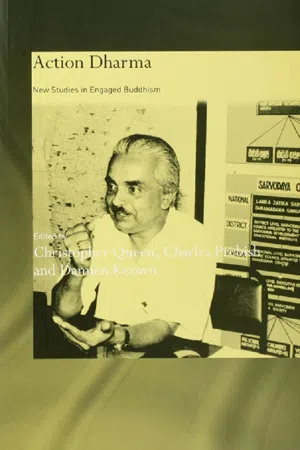
Action Dharma
New Studies in Engaged Buddhism
- 368 pages
- English
- ePUB (mobile friendly)
- Available on iOS & Android
eBook - ePub
Action Dharma
New Studies in Engaged Buddhism
About this book
Action Dharma charts the emergence of a new chapter in an ancient faith - the rise of social service and political activism in Buddhist Asia and the West. Fourteen new essays treat the historical origins, global range, teachings and practices, and leaders and organizations that make up the latest turning of the Dharma. Environmentalism and peace wa
Information
I
Historical Roots
1
Do Bodhisattvas Relieve Poverty?
Occasionally, Buddhists have considered the question of how poverty could continue in a world that is cultivated by celestial bodhisattvas. This chapter considers the question of whether Indian Buddhist texts “identify and address sources of human suffering outside of the cravings and ignorance of the sufferer – such as social, political, and economic injustice” – an often-cited criterion of contemporary “engaged Buddhism.” Focusing on poverty, it concludes that these sources distinguish between compassionate intentions and action and between material and moral benefit. Furthermore, relief of poverty is seen as a prerequisite for moral development and its neglect is seen as a cause for social degeneration. Therefore, in order to prepare the conditions necessary for teaching the Dharma, the bodhisattva is called in to relieve these material wants, not only through moral leadership, but also through direct action. The strongest conclusions here are made in reference to the Large Sūtra on Perfect Wisdom, with cross-referencing and support from a broad range of other Indian sources.
The call for papers for the Journal of Buddhist Ethics online conference states that engaged Buddhism is:
characterized by a reorientation of Buddhist soteriology and ethics to identify and address sources of human suffering outside of the cravings and ignorance of the sufferer – such as social, political, and economic injustice, warfare, violence, and environmental degradation.1
This chapter addresses the question of whether this thesis, that concern to identify and address modes of suffering “outside of the cravings and ignorance of the sufferer” amounts to a reorientation, can be challenged on the basis of Indian Buddhist literature.
Because of the paucity of resources for study, particularly in comparison to East Asia, it is very difficult to say in regard to India how, or to what degree, Buddhism in practice was “socially engaged.” However, we do know that in the more historically clear environments of China and Japan, Buddhist activities included road and bridge building, public works projects, social revolution, military defense, orphanages, travel hostels, medical education, hospital building, free medical care, the stockpiling of medicines, conflict intervention, moderation of penal codes, programs to assist the elderly and poor including “inexhaustible treasuries” to stockpile resources for periods of hunger and hardship, famine and epidemic relief, and bathing houses.2 Perhaps this was purely the unique response of East Asian culture to Indian Buddhism, but we can at least make the weak initial observation that it is reasonable to speculate that East Asians were following Indian models of Buddhist activity.
This chapter seeks to show the types of Buddhalogical resources that were available in Indian Buddhist texts to support such activity. Were these conceptual resources strictly metaphorical, as when the Buddha is described as the physician of the world? Are they merely intentional, that is, is their main purpose to generate character qualities that are conducive to the spiritual liberation of those who have them? If there is concrete action intended, then what kind of action? Are the texts merely concerned with activities of conveying the Dharma or do they enjoin the reader to activities that we would recognize as social action? If there is a distinction between spiritual and material benefit, then what is their relationship? Finally, do the textual resources support the idea that, even in India, social activities similar to those in East Asia occurred?
These questions open up a variety of issues that merit independent study. It would be possible to focus the topic here on a variety of types of action. The variety of justifications in Buddhist literature for compassionate violence, from political revolution to capital punishment, are fascinating, and the materials regarding the practice, teaching, manufacture, and science of medicine would also make an excellent example. Here I will focus on the provision of concrete material life support including food, shelter, and clothing.3
Sources are cited broadly here for their general support and interest for the subject. However, strong and specific conclusions are made in regard to the Large Sūtra on Perfect Wisdom, where there is a clear identification and concern for material modes of suffering, a definite distinction between material and spiritual benefit, an understanding that material support is a prerequisite for moral and spiritual development, and where bodhisattvas are enjoined to actively create the material conditions necessary for the spiritual development of sentient beings.
Sāntideva’s sandals
It is significant to ask whether the questions raised here about the relationship between compassionate intentions and the concrete relief of suffering were asked by the ancient Buddhists themselves. In at least two disparate but important sources, the Saṃdhinirmocana Sūtra and the Bodhicaryāvatāra, there are passages that show that they did. In the Saṃdhinirmocana Sūtra we find the following fascinating question that shows a concrete distinction between spiritual and material assistance and that relief of poverty was expected from the activity of bodhisattvas.
Bhagavan, if the resources of bodhisattvas are inexhaustible and if they have compassion, why are there poor people in the world? Avalokiteśvara, that is solely the result of the karma of those sentient beings themselves… The fact that hungry ghosts, whose bodies are pained by thirst, perceive the watery ocean as dry is not the ocean’s failing… Similarly, the absence of good results is not a failing of the ocean-like generosity of bodhisattvas.4
If there were no expectation of the actual relief of material suffering this objection could not arise. But, the fact that the outcome does not match the intention shows that the content of intentions may be quite different from their practical outcomes.
Śāntideva, responding to the question of why, if there have been countless bodhisattvas who have vowed to save the endless numbers of sentient beings, does the world continue to be filled with suffering, answers that it is in fact not possible to change the world and that generosity is merely a state of mind.
(9) If the perfection of generosity
Were the alleviation of the world’s poverty,
Then since beings are still starving now,
In what manner did the previous Buddhas perfect it?
(10) The perfection of generosity is said to be
The thought to give all beings everything,
Together with the fruit of such a thought,
Hence it is simply a state of mind. …
(12) Unruly beings are as (unlimited) as space:
They cannot possibly all be overcome,
But if I overcome thoughts of anger alone,
This will be equivalent to vanquishing all foes.
(13) Where would I possibly find enough leather
With which to cover the surface of the Earth?
But (wearing) leather just on the soles of my shoes
Is equivalent to covering the earth with it.
(14) Likewise it is not possible for me
To restrain the external course of things;
But should I restrain this mind of mine,
What would be the need to restrain all else?5
The continuation of the suffering in the world despite the past vows of countless Buddhas is explained as only natural, since the vow of bodhisattvas to relieve all suffering is pragmatically impossible because sentient beings are limitless. Just as one can cover one’s own feet with leather, but not the whole world, the vow of the bodhisattva perfectly purifies their mind, but not the minds of all sentient beings. In Buddhist practice, molding compassionate intentions in itself is beneficial for the practitioner. Generating compassion is good for everything from snakebite protection to attaining heavenly realms.6 Here there is a disjunction between the aspiration and its end, which is considered impossible.
So are the intentions to feed the hungry or heal the sick only sublime inspirations? It seems quite reasonable to ask, as Buddhists have above, what relationship compassion really has to the relief of material suffering. Is compassion in Buddhist practice active or is it merely a matter of shaping a character that is most conducive toward spiritual goals? In what sense does it actually get down to relieving the suffering of others?
Buddhist Definitions of Karuṇā
Buddhaghosa, whose commentaries are the central authority for the interpretation of the Pāli scriptures for Theravāda Buddhism, gives an analysis of the word karuṇā; that shows that in mainstream Buddhism the concept of compassion calls for aggressive action for the relief of the suffering of others:7
When others suffer it makes the heart of good people tremble (kampa), thus it is karuṇā it demolishes others’ suffering, attacks and banishes it, thus it is karuṇā; or it is dispersed over the suffering, is spread out through pervasion, thus it is karuṇā,8
Buddhaghosa is implicitly giving a philological analysis (nirutti) here. What is important here is not the actual etymology, but the meanings presented through this traditional analysis. The fact that the actual etymology of the word karuṇā is obscure allows a variety of creative suggestions. Here he suggests three verb roots that may be the basis of the noun karuṇā kṛ, meaning to make, cause, or act; kṛt, meaning to cut or break; and kṛr, which can mean to disperse or spread. It is notable that the second of Buddhaghosa’s roots, kṛt, meaning to cut or break, gives an even more explicitly active meaning to compassion which i...
Table of contents
- Cover
- Half Title
- Title Page
- Copyright
- Dedication
- Contents
- Notes on contributors
- Preface
- Introduction
- Part I: Historical Roots
- Part II: Asian Narratives
- Part III: Western Frontiers
- Part IV: Three Critiques
- Index
Trusted by 375,005 students
Access to over 1.5 million titles for a fair monthly price.
Study more efficiently using our study tools.
Frequently asked questions
Yes, you can cancel anytime from the Subscription tab in your account settings on the Perlego website. Your subscription will stay active until the end of your current billing period. Learn how to cancel your subscription
No, books cannot be downloaded as external files, such as PDFs, for use outside of Perlego. However, you can download books within the Perlego app for offline reading on mobile or tablet. Learn how to download books offline
Perlego offers two plans: Essential and Complete
- Essential is ideal for learners and professionals who enjoy exploring a wide range of subjects. Access the Essential Library with 800,000+ trusted titles and best-sellers across business, personal growth, and the humanities. Includes unlimited reading time and Standard Read Aloud voice.
- Complete: Perfect for advanced learners and researchers needing full, unrestricted access. Unlock 1.5M+ books across hundreds of subjects, including academic and specialized titles. The Complete Plan also includes advanced features like Premium Read Aloud and Research Assistant.
We are an online textbook subscription service, where you can get access to an entire online library for less than the price of a single book per month. With over 1.5 million books across 990+ topics, we’ve got you covered! Learn about our mission
Look out for the read-aloud symbol on your next book to see if you can listen to it. The read-aloud tool reads text aloud for you, highlighting the text as it is being read. You can pause it, speed it up and slow it down. Learn more about Read Aloud
Yes! You can use the Perlego app on both iOS and Android devices to read anytime, anywhere — even offline. Perfect for commutes or when you’re on the go.
Please note we cannot support devices running on iOS 13 and Android 7 or earlier. Learn more about using the app
Please note we cannot support devices running on iOS 13 and Android 7 or earlier. Learn more about using the app
Yes, you can access Action Dharma by Christopher Queen, Damien Keown,Charles S. Prebish,Christopher Queen, Damien Keown, Charles S. Prebish, Christopher Queen in PDF and/or ePUB format, as well as other popular books in Social Sciences & Eastern Philosophy. We have over 1.5 million books available in our catalogue for you to explore.