As sociologists deepen their examinations of human rights in their teaching, research, and thinking, it is essential that such work is conducted in a manner that is both mindful and critical of the knowledge we are building upon in sociology and human rights. As the authors of this volume reveal, creating sociological knowledge that examines human rights for the expansion of human rights is something that sociologists are well equipped to undertake, whether through the use of mathematics, comparative-historical analysis, the study of emotions, conversations, or social psychology. In these chapters you will find the roots of the study of human rights deep within sociological research and thinking as well as emerging techniques that will push the discipline as it seeks to expand understanding of human rights together with so many other aspects of the social condition.
eBook - ePub
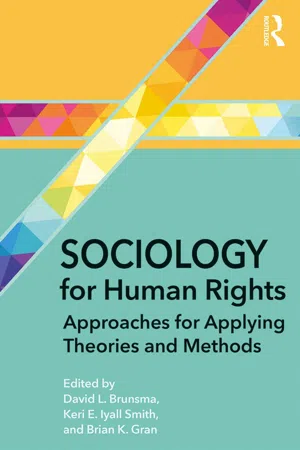
Sociology for Human Rights
Approaches for Applying Theories and Methods
- 230 pages
- English
- ePUB (mobile friendly)
- Available on iOS & Android
eBook - ePub
Sociology for Human Rights
Approaches for Applying Theories and Methods
About this book
Information
CHAPTER ONE
INTRODUCTION
CREATING KNOWLEDGE ABOUT HUMAN RIGHTS SOCIOLOGICALLY
David L. Brunsma, Keri E. Iyall Smith and Brian K. Gran
Sociologists have engaged with the notion of human rights from the earliest days of the discipline, particularly in the American context. Ideas of dignity and self-determination were especially present in the community-engaged sociologies of those who were marginalized in the discipline at the turn of the last century. Consider W.E.B. DuBois’ work in The Philadelphia Negro and Black Reconstruction as well as the work of Jane Addams whose scholar-activism in the discipline was unparalleled. Theirs was a model of sociological knowledge production that had at its core the ways that the sociological method can make better the lives of the individuals, families, and communities who were the subjects of their inquiries.
These founding mothers and fathers of American sociology, however, were significantly marginalized by their contemporaries (Morris, 2015). The communities where they studied and worked benefited from their tireless efforts and the scholarship they produced. Yet sociology itself, its theories and its methods, remained mired by a desire to copy the epistemological standards of the natural sciences, enlightenment ideals that split the mind and the body, as well as the positivist stranglehold of objectivity. Indeed, it was not until the 1960s, which brought epistemological, theoretical, and methodological challenges from sociologists (and their sociologies) that had been marginalized and made invisible to the heart of the discipline – feminists, black sociologists, public scholar-activists, Chicano sociologists, indigenous sociologists, Marxist sociologists, and others – that a space was opened for potential engagement with human rights. These challenges focused our sociological lenses in new (but very old, grounded) ways, and, indeed, again brought core notions of human rights into the sociological soup.
Knowledge production is what disciplines do. It also is a political endeavor – full of contradictions, power plays, (in)validations, and complexities. Sometimes that knowledge is for knowledge’s sake alone. The work of knowledge production may boost the careers of researchers while objectifying those who share their lives in the form of “data.” Other times research is conducted for the good that it can do to better the human condition. Researchers and the communities they study may become collaborators, sharing the work of knowledge production at all stages, as they also share the benefits of scientific research. New ways of doing social science research and theorizing are emerging as we are all pushed to improve the work of research and grow our understanding of human societies.
Sociology is about the study of relationships that are unique to social groups (Peter Blau, 1999). In some ways, this is a modest endeavor for an academic discipline. Yet when one embarks on the work of examining relationships that are unique to social groups, complexities begin to emerge. As scholars of human rights, we have a deep knowledge of the human condition that we can utilize to help us think critically about how we practice the science of sociology. In this way, the ways that we seek to create knowledge must be flexible and dynamic, while not sacrificing the reliability of the empirical data. To produce knowledge within a particular discipline is to practice a science in particular ways – ways that are fundamentally grounded in the way we think about ontology, epistemology, theory, methodology, and application. How a discipline thinks about these things is key to the kind of knowledge it can produce. Human rights bring new ways to think about ontology (notions of personhood, collectivity), epistemology (who can know, how we know, and what is known), theory (models of knowing), methodology (processes of data collection), and application (applying knowledge that is produced). This book collects some of these approaches.
Representing an exciting moment for sociology to further energize and develop a sociology of human rights (or, more to the point, sociologies of human rights), Sociology for Human Rights: Approaches for Applying Theories and Methods brings together leading and emergent scholars who seriously engage in revolutionary questions, resituate their substantive concerns within new terrains, and begin mapping the intellectual and practical contours of a human rights sociology. Each chapter responds to two primary questions: (1) How does a human rights perspective change the questions that sociologists ask, the theoretical perspectives that sociologists utilize, the methods that sociologists use, and the implications of sociological inquiry? And (2) How can the sociological enterprise (its epistemologies, theories, methodologies, results) inform and push forward human rights theory, discourse, and implementation toward a better world for all humanity?
When we began this project the American Sociological Association sponsored 45 sections that support its members’ interests in substantive, theoretical, methodological, and applied areas (there are now 52, with Human Rights being added just after we started this project, followed by sections on: Altruism, Morality and Social Solidarity; Body and Embodiment; Global and Transnational Sociology; Inequality, Poverty & Mobility; and the Sociology of Development). We approached progressive, critical scholars in the hope they would contribute work to this project that is intended to accomplish several goals. The first objective is to present a brief summary of the state of the area of sociological inquiry and a reckoning of the central concerns and questions that motivate this area. The second objective is to give readers a summary of the key findings in this area as well as the most prominent methods its practitioners use. The third objective is to provide readers with a critical discussion of what the human rights paradigm can learn from the work in their area, as well as to describe how it might resituate the area and its constituent questions, methods, theories, and findings, and, in turn, reorient readers toward a new set of questions, particularly how human rights redefines the research situation and what new questions can and should be asked. Finally, given this, we encouraged the authors to think broadly and critically about doing the work of human rights sociology, a look forward – new questions, new possibilities for both the area/field, and human rights realizations.
The authors of the chapters in this volume pay particular attention to ways of thinking about and doing research on human rights, using tools that have been crafted and honed by sociologists. As sociologists deepen their examinations of human rights in their research and thinking, it is essential that we conduct this work in a manner that is both mindful and critical of the knowledge we are building upon in both sociology and human rights. As the authors of this volume reveal, creating sociological knowledge that examines human rights for the expansion of human rights is something that sociologists are well equipped to undertake, whether through the use of mathematics, comparative-historical analysis, or the study of emotions, conversations, or social psychology. In these chapters you will find both the roots of the study of human rights deep within sociological research and thinking and emerging techniques that will push the discipline as it seeks to expand our understanding of human rights together with so many other aspects of the social condition.
CHAPTER TWO
METHODOLOGY
Amir B. Marvasti and Karyn D. McKinney
As sociologists, we are new to the study of human rights. Frankly, it used to be that when we heard the phrase “human rights,” we immediately associated it with the fields of international law and politics. However, it seems that sociologists are increasingly taking an interest in human rights. For example, the American Sociological Association recently established a section on human rights, and esteemed sociologists like Judith Blau and Alberto Moncada (2009; see also Blau and Moncada 2007a, 2007b) and Norman Denzin (2010) have published books explicitly on this topic. Contrary to common perception, human rights is not the specific provenance of law or politics. Indeed, to the degree that the study of human rights concerns how people are, or should be, treated by others, American sociology has long been interested in the topic, but without explicitly referring to it as such. For example, C. Wright Mills (1956, 1959; see also Hayden 2006), whose research focused on oppression and the necessity of social change, could be viewed as an early champion of human rights. So we begin this chapter with the assumption that, in some ways, sociology has always been about rights, though that inclination has become more explicit in recent years.
Before we discuss a qualitative approach to the study of human rights, the focus of this chapter, we should note that the choice of research methods does not help advocate or hinder human rights. More specifically, quantitative data and methods are not inherently anti-human rights. In fact, numerical data can be very useful for producing evidence of inequality (e.g., the difference between the rich and the poor in terms of education, access to health care, quality of life, or treatment in the criminal justice system). On the other hand, certain features of quantitative methods make them less appealing to human rights researchers. In particular, the dominant paradigm of objective truth and positivism sometimes discounts the experiential reports of human rights violations on the grounds that they are based only on anecdotal evidence.
Returning to the task at hand, what can we say about the relationship between qualitative research methods and the study of human rights? Here we highlight the unique strengths of qualitative methods and analysis for the study of human rights.
CONCEPTUALIZING AND MEASURING RIGHTS QUALITATIVELY
From a methodological perspective, conceptualization and measurement are foundational and interrelated concerns: one must have a working definition of the thing to be studied before proceeding to observe or measure it. In particular, a qualitative approach to human rights must begin with the question, What are rights? We suggest that the answer to this question is neither self-evident nor universal. To illustrate this point, let us begin with the UN Universal Declaration of Human Rights (UDHR). Among other things, this document calls for a “spirit of brotherhood.” One might ask, Why not “a spirit of sisterhood”? Why is one half of humanity implicitly excluded from a statement about human rights? Similarly, Article 5 of the declaration states, “No one shall be subjected to torture or to cruel, inhuman or degrading treatment or punishment.” One need only look at recent debates over what constitutes torture in the context of the so-called War on Terror to realize that even the seemingly self-evident is not exempt from definitional quandaries.
Thus the first challenge for scholarly research is pinning down the very definition of rights. The many questions (adapted from Fields 2010 and Brinkmann 2010) that complicate this task are, What is the level of analysis (group or individual rights)? What is the topical focus of analysis (social, political, civil, or economic rights)? What is the theoretical/epistemological foundation of rights (international/universal law versus traditional, local, or tribal law)? Who is the affected population for the purpose of analysis (human, animal, or plant rights)? A qualitatively oriented study of human rights favors a pragmatic approach that is focused on the empirical dispute at hand as it is lived or experienced in everyday settings as opposed to a priori normative assumptions about what human rights are or should be.
OBSERVING WRONGS
Human rights tend to become conspicuous through their absence; for the purposes of empirical social science, human rights often become socially or politically relevant because they have been violated. Arguably, human rights are rarely debated outside perceived or actual violations of those rights. Returning to the UDHR, it is important to note that the rationale for the document was the deplorable violations of human rights in the course of World War II. Indeed, this is noted in the preamble: “Whereas disregard and contempt for human rights have resulted in barbarous acts which have outraged the conscience of mankind . . . . Now, therefore, the General Assembly proclaims this Universal Declaration of Human Rights as a common standard of achievement for all peoples and all nations” (OHCHR 1998, 3–4). Thus, rights become realized in reaction to imagined or actual violations or wrongs.
This intricate rights-violation relationship is made clear by Svend Brinkmann’s (2010) discussion of “human vulnerabilities” as being inseparable from human rights. In particular, Brinkmann argues,
If we educate students in qualitative inquiry so that they see it as their duty to understand rights as a central part of social life in-the-making – both for ethical and epistemic reasons – then we could possibly assist in generating a public where the sufferings and rights violations of each and every human being ultimately come to matter. (2010, 97)
Similarly, Norman Denzin and Michael Giardina state,
Hope alone will not produce change. First there must be pain, and despair. Persons must make pain the object of conscious reflection, the desire to resist, to change. This desire must be wedded to a conscious struggle to change the conditions that create pain in the first place. (2010, 29)
For the purpose of this chapter, defining rights in terms of possible and actual wrongs allows us (1) to focus on the observable disputes or claims about rights, and (2) to circumvent a priori definitions of rights and instead rely, phenomenologically, on members’ own definitions. This in turn helps us feature the strengths of qualitative research, especially in terms of its capacity for analyzing rhetoric, claims, justifications, and narratives of wrongs as ongoing and always in the making. In short, with this phenomenological emphasis, we can use qualitative methods as a way of understanding the language, culture, and practices within which rights and wrongs are contested.
In the following section, we illustrate the qualitative research paradigm using examples, first in terms of data-collection strategies (i.e., methods of soliciting data) and then in terms of analytical themes (i.e., ways of making sense of data). Readers should note that the methods described here are not mutually exclusive, nor are they inherently pro-human rights. The goal here is to offer examples of how qualitative methods could be used to study and advocate human rights and not to argue that they indeed are or should be supportive of human rights.
DATA-SOLICITATION STRATEGIES
Whether it is study of human rights, wrongs, or any other subject matter, as an empirical enterprise, social-science research begins with the collection of some form of data that is later analyzed and represented to a given audience. Three of the most common qualitative data-collection strategies are discussed below.
IN-DEPTH INTERVIEWS
The interview in all its variations (e.g., open-ended, closed-ended, focus group, etc.) is a procedure used by social scientists to gather information from their research respondents. Among qualitative researchers, the in-depth interview is particularly common (Johnson 2001). The in-depth interview basically involves a face-to-face encounter during which a researcher poses a series of questions to respondents. The goal is to use fairly flexible lines of inquiry (open-ended or unstructured questions) that will allow respondents to tell their stories with minimal interference from the researcher. The stories are expected to be in-depth in the sense that they are usually l...
Table of contents
- Cover
- Half Title
- Title
- Copyright
- Contents
- 1 Introduction: Creating Knowledge About Human Rights Sociologically
- 2 Methodology
- 3 Mathematical Sociology
- 4 Ethnomethodology and Conversation Analysis
- 5 Comparative and Historical Sociology
- 6 Political Economy of the World-System
- 7 Social Psychology
- 8 Sociological Practice and Public Sociology
- 9 Teaching and Learning
- 10 History of Sociology
- 11 Theory
- 12 Emotions
- 13 Marxist Sociology
- Discussion Questions
- List of Acronyms
- Bibliography
- About the Contributors
Trusted by 375,005 students
Access to over 1.5 million titles for a fair monthly price.
Study more efficiently using our study tools.
Frequently asked questions
Yes, you can cancel anytime from the Subscription tab in your account settings on the Perlego website. Your subscription will stay active until the end of your current billing period. Learn how to cancel your subscription
No, books cannot be downloaded as external files, such as PDFs, for use outside of Perlego. However, you can download books within the Perlego app for offline reading on mobile or tablet. Learn how to download books offline
Perlego offers two plans: Essential and Complete
- Essential is ideal for learners and professionals who enjoy exploring a wide range of subjects. Access the Essential Library with 800,000+ trusted titles and best-sellers across business, personal growth, and the humanities. Includes unlimited reading time and Standard Read Aloud voice.
- Complete: Perfect for advanced learners and researchers needing full, unrestricted access. Unlock 1.5M+ books across hundreds of subjects, including academic and specialized titles. The Complete Plan also includes advanced features like Premium Read Aloud and Research Assistant.
We are an online textbook subscription service, where you can get access to an entire online library for less than the price of a single book per month. With over 1.5 million books across 990+ topics, we’ve got you covered! Learn about our mission
Look out for the read-aloud symbol on your next book to see if you can listen to it. The read-aloud tool reads text aloud for you, highlighting the text as it is being read. You can pause it, speed it up and slow it down. Learn more about Read Aloud
Yes! You can use the Perlego app on both iOS and Android devices to read anytime, anywhere — even offline. Perfect for commutes or when you’re on the go.
Please note we cannot support devices running on iOS 13 and Android 7 or earlier. Learn more about using the app
Please note we cannot support devices running on iOS 13 and Android 7 or earlier. Learn more about using the app
Yes, you can access Sociology for Human Rights by David Brunsma,Keri Iyall Smith,Brian Gran,David L. Brunsma,Keri E. Iyall Smith,Brian K. Gran in PDF and/or ePUB format, as well as other popular books in Social Sciences & Human Rights. We have over 1.5 million books available in our catalogue for you to explore.