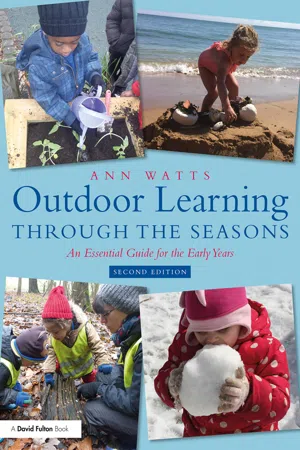
Outdoor learning and play experiences are an essential part of young children's development. The importance of offering children first-hand experience of the natural world becomes more urgent as research evidence demonstrates the benefits of becoming physically and emotionally involved with the natural world. Outdoor Learning through the Seasons shows how we can encourage young children to engage with nature on a daily basis throughout the year.
Using the four seasons as a framework, it supports adults to develop their own awareness of the world around them and feel confident about taking children outside every day. There are suggestions for caring for gardens and wildlife through the year, and ideas to brighten grey winter days, enjoy the summer sunshine or explore in the snow. Now featuring full-colour photographs throughout, this new edition has been updated to include references to recent research, new material on Forest Schools, discussion questions for practitioners and in-depth case studies of learning in action.
Features include:
Ideas for all seasons, weather conditions and working with the four elements: earth, air, water and fire
Guidance on fulfilling the learning requirements of EYFS and the Characteristics of Effective Learning
Advice on working with parents and the role of adults
Practical tips and suggestions of how to make the most of a small space or how to re-plan an existing space
Useful reference lists of further resources including stories, poems and websites
This practical book is essential reading for all those looking to provide rich and stimulating outdoor learning and play provision for children in early years settings on a daily basis and for parents and carers wishing to get the most of time outdoors with their children.
This part of the book refers directly to the revised Early Years Foundation Stage. In the United Kingdom all early years providers are required to work within the statutory framework known as the Early Years Foundation Stage (referred to hereafter as EYFS). This document can be found online in a number of places. A search for EYFS framework will give several ways of accessing this. The most recent update at the time of writing was published in March 2017.
As well as giving the statutory requirements for all aspects of health and safety it outlines the seven areas of learning, the early learning goals and the characteristics of effective learning.
It is important when working within the EYFS to remember that the early learning goals are the expectations for children who are at the end of the Foundation Stage. Most children will transfer from a nursery preschool or childminder into a reception class in a primary school before the end of the Foundation Stage. We need to ensure that all children, whether at home or in early years settings, are working towards these goals, but it is even more important to ensure that they are establishing the patterns and styles of learning which will remain with them for life. Effective practice will enable children to develop attitudes and dispositions to manage their own feelings, behaviours and learning.
The early years framework discusses the need to create an “enabling environment”. This comes under the heading “Overarching principles” on page 6. This means that the environment itself can offer and stimulate creativity and learning through its layout, resourcing and design, but it also refers to the need for strong partnerships between practitioners and carers. The next four chapters show how close collaboration and an understanding of the way in which children learn will ensure that high-quality outdoor provision becomes a fully integrated part of children’s early learning experience.
Practitioners need firstly to understand how children learn effectively and then work together with colleagues, parents and children to plan and implement changes in the outdoor environment. These need to take into account the specific needs of your children as well as differing weather conditions and seasonal change.
How children learn
Through play and discovery, young children are able to manage their own learning, thus developing lifelong skills. From the moment they are born, babies begin the learning process. Their behaviour is reinforced by experiences. A tiny baby only a few days old is able to copy the lip and mouth movements of adults. This usually sparks an emotional response in the adult, which is communicated back, and so the baby engages in social and emotional interaction. The learning process in a young baby is a complex interaction of instinctive, intuitive and learnt behaviours.
As parents, grandparents and practitioners, we all want the children in our care to become effective learners. In particular, children with additional needs may need more specific support and guidance so they too can learn effectively. Learning is not a passive process of knowledge acquisition with measurable and predictable outcomes. It is a process which draws on past experiences so the learner can understand and evaluate the present before taking action to shape the future and thereby acquire new knowledge. Adults play an important part in this learning process and need to understand how the learning process can best be developed. Vygotsky (1978) used the term ‘scaffolding of learning’ and explained how new learning takes place when supported by what has happened previously. He also introduced the term ‘zone of proximal development’ and this is where adult interaction can be most successful. It represents the gap between what the child already knows and what he or she is capable of learning with assistance from an adult or a more knowledgeable and skilled peer.
Child-initiated learning is becoming more widespread as practitioners feel enabled to observe children’s interests and encourage them to develop their own ideas. Planning for the moment expresses the idea that adults and children work together to plan what will happen that day and maybe there is discussion about what may be needed to enable this. Practitioners need to be confident as they let go of their own ideas sometimes and follow the lead of a child or a group of children.
The role of the outdoor space
Being outdoors will enable children and adults to have more freedom. Adults should be able to find time to observe the ways in which children are interacting with the environment and how their learning is being extended in different ways according to the situation and also the different times of the year and the elements available. A skilled adult will be able to adapt and extend the natural environment to offer a wide range of learning experiences throughout the year.
Babies listen closely to sounds, and the development of internal language starts at a very young age. Sensory experiences are particularly important for very young children and babies respond immediately to the outdoor environment, watching movements, discovering textures, and hearing new sounds. The focus of all provision should be the process of learning which is taking place in each child. Good outdoor provision does not necessarily rely on expensive equipment. It entails making the most of the natural spaces and resources you have, and combining this with positive, engaged and enthusiastic adults. Children’s learning is a result of complex interactions between the child’s experiences of relationships and environments.
1Creating an enabling environment outdoors
EYFS: The seven areas of learning
This chapter focuses in turn on each of the seven areas of learning and gives a brief outline of experiences that can be offered to children outside throughout different times of the year. There are three prime areas focusing on all-round holistic development. These are personal, social and emotional development, communication and language and physical development. Following this come the four specific areas which focus on more structured learning – literacy, mathematics, understanding the world and expressive arts and design.
It is crucial, however, to remember that the best learning and play opportunities will cover many areas of the curriculum at the same time. These areas are closely interwoven and children benefit from holistic learning experiences which encompass these. In particular, the three prime areas of learning are interdependent and their strands are like the threads of a textured woven pattern which come together to create a whole. These areas are of particular importance when working with the youngest children. Each area of learning has a main heading and several subheadings as seen in the following sections.
Three prime areas of learning
Personal, social and emotional development
Moore and Wong (1997) believed that the natural world provided the major stimulus and most significant context for emotional experiences. They realised that the ever changing and diverse scenes within this world offered the widest range of possible interactions.
If we are to introduce children to these experiences it is imperative that we are able to acquaint ourselves in some way with the world of nature. It may mean going back to our own childhood and thinking about experiences we still recall with pleasure. We may need to become more familiar with the animals and plants around us and, for some, this may mean taking on a healthier lifestyle as we spend more time in the open air and imbibe something of the world around us.
Making relationships and understanding others
Establishing close relationships with the children in our care means that there is mutual trust, and shared outdoor experiences will help to build and consolidate these relationships.
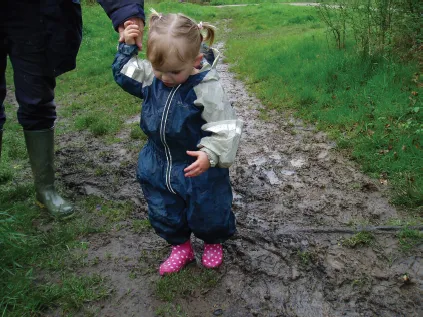
Holding an adult’s hand enables confidence to develop at an early age.
Adults need to be able to share a child’s excitement at seeing a butterfly, or finding a frog, as well as encouraging a child who may be afraid of small insects. Children, too, will help each other as in the case of four-year-old Harry who carefully explained to his two-year-old sister who was nervous of flying insects, “A butterfly is very pretty, it just flies around and it would never hurt you”.
Resources and experiences
Opportunities to join in group gardening activities, care for plants and wildlife at different times of the year.
Provision of crates, gutter...
Table of contents
Cover
Half Title
Title
Copyright
Contents
Acknowledgements
Introduction
Part I The Early Years Foundation Stage
Part II The four seasons
Part III The four elements
Bibliography
Trusted by 375,005 students
Access to over 1.5 million titles for a fair monthly price.
Study more efficiently using our study tools.
Frequently asked questions
Yes, you can cancel anytime from the Subscription tab in your account settings on the Perlego website. Your subscription will stay active until the end of your current billing period. Learn how to cancel your subscription
No, books cannot be downloaded as external files, such as PDFs, for use outside of Perlego. However, you can download books within the Perlego app for offline reading on mobile or tablet. Learn how to download books offline
Perlego offers two plans: Essential and Complete
Essential is ideal for learners and professionals who enjoy exploring a wide range of subjects. Access the Essential Library with 800,000+ trusted titles and best-sellers across business, personal growth, and the humanities. Includes unlimited reading time and Standard Read Aloud voice.
Complete: Perfect for advanced learners and researchers needing full, unrestricted access. Unlock 1.5M+ books across hundreds of subjects, including academic and specialized titles. The Complete Plan also includes advanced features like Premium Read Aloud and Research Assistant.
Both plans are available with monthly, semester, or annual billing cycles.
We are an online textbook subscription service, where you can get access to an entire online library for less than the price of a single book per month. With over 1.5 million books across 990+ topics, we’ve got you covered! Learn about our mission
Look out for the read-aloud symbol on your next book to see if you can listen to it. The read-aloud tool reads text aloud for you, highlighting the text as it is being read. You can pause it, speed it up and slow it down. Learn more about Read Aloud
Yes! You can use the Perlego app on both iOS and Android devices to read anytime, anywhere — even offline. Perfect for commutes or when you’re on the go. Please note we cannot support devices running on iOS 13 and Android 7 or earlier. Learn more about using the app
Yes, you can access Outdoor Learning through the Seasons by Ann Watts in PDF and/or ePUB format, as well as other popular books in Didattica & Pianificazione urbana e paesaggistica. We have over 1.5 million books available in our catalogue for you to explore.