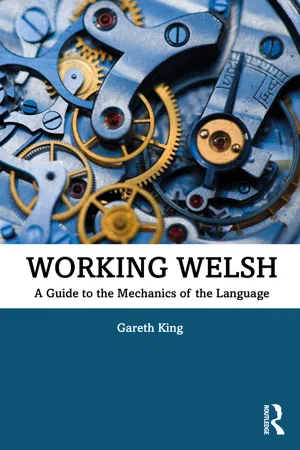
Working Welsh
eBook - ePub

Working Welsh

A Guide to the Mechanics of the Language

  1. 192 pages
  2. English
  3. ePUB (mobile friendly)
  4. Available on iOS & Android
eBook - ePub

Working Welsh

A Guide to the Mechanics of the Language

About this book

Working Welsh offers a new approach to building up and consolidating learners' fluency and confidence, focusing on the mechanics – the words and phrases that build and drive sentences and make them fit together.

200 Welsh words and phrases are listed alphabetically, explained in clear and accessible language, and given ample exemplification to illustrate their meaning and use. All instances of mutation are marked with the usual typographic signs, and cross-references are given throughout to related entries. Grammatical appendices and an English index round off the manual.

Working Welsh is an innovative resource for post-beginner students wishing to explore and master the principal discourse-drivers in modern spoken and standard Welsh.

Trusted by 375,005 students

Access to over 1.5 million titles for a fair monthly price.

Study more efficiently using our study tools.

Information

Publisher
Routledge
Year
2020
Print ISBN
9780367209933
Edition
1
eBook ISBN
9780429559730

Alphabetical entries 1–200

1 a° (particle)

Unlike the word ah and (which is so easy that it doesn’t need an entry here - te a h choffi tea and coffee – what more is there to say about it?) this little particle is often not even heard in normal speech, though the SM that follows it always is – so we could think of it as (a)°. At the start of a sentence, it makes the verb immediately following into a question. So for example Collodd hi She lost, but A °gollodd hi? Did she lose? – more usually just °Gollodd hi? Similarly Dôn nhw They will come, but A °ddôn nhw? Will they come? – more usually just °Ddôn nhw?
  • (A) °ddylen ni °ddweud wrtho am yr hyn naethon nhw?
  • Should we tell him about what they did?
  • (A) °fydden nhw’n °fodlon cyfaddawdu, ti’n meddwl?
  • Would they be willing to compromise, do you think?
Two other particles that can jump in front of the verb at the start of the sentence are → 58 fe° and → 112 mi° – go and have a look at them now.
A° is also used for indirect questions, in which case it corresponds to English if, and appears in the middle of the sentence.
  • Rhaid inni °ofyn (a) °fydd hyn yn °ddigon
  • We have to ask if this will be enough
  • Cer i °ofyn iddo (a) ydy’r bwyd yn °barod
  • Go and ask him if the food is ready
  • Dwn ’im (a) °fasai Sioned yn teimlo’n euog am hynna
  • I don’t know if Sioned would feel guilty about that
Note that, by influence of English, many speakers use → 140 os in these examples – Rhaid inni °ofyn os bydd…, Cer i °ofyn iddo os ydy’r bwyd…, Dwn ’im os basai Sioned… – but strictly speaking this is incorrect, and (a)° is, to say the least, much better style, even if it is not pronounced and leaves only the mutation.

2 a° (relative)

Like → 1 a°, this identically pronounced word precedes a verb and is often dropped in speech, leaving only the SM to indicate its presence – so we could think of this also as (a)°. But in this case, the verb is always further down the sentence, and the meaning of this a° is who or which (/that), not as a question (for that you need → 149 pwy and → 141 pa°) but as a relative – sentences like This is the idiot who hit my car, We need an option that suits everybody. Simple really, then – you put the a° in front of the verb exactly where the who/which/that goes in English.
  • Ŷn ni angen rhywun (a) °fydd ar °gael trwy’r dydd yfory
  • We need someone who will be available all day tomorrow
  • Y °bobol (a) oedd yn y stafell aros
  • The people who were in the waiting room
  • Mae’r rhai (a) °gyrhaeddodd yn °gynnar wedi mynd i’w hystafe­lloedd yn °barod
  • Those who arrived early have gone to their rooms already
  • Llyfr (a) ysgrifennwyd mewn dicter
  • A book (which was) written in anger
  • Dyma’r twpsyn (a) °darodd n nghar i
  • This is the idiot who hit my car
  • Sefyllfa (a) °ddaw’n °fwy eglur gydag amser, gobeithio
  • A situation that will hopefull...

Table of contents

  1. Cover
  2. Half-Title
  3. Title
  4. Copyright
  5. Dedication
  6. Contents
  7. Introduction
  8. List of entries
  9. Alphabetical entries 1–200
  10. Appendix 1 – that-clauses
  11. Appendix 2 – i-clauses
  12. Appendix 3 – mutations
  13. Appendix 4 – endings
  14. Essential grammatical terms
  15. Index

Frequently asked questions

Yes, you can cancel anytime from the Subscription tab in your account settings on the Perlego website. Your subscription will stay active until the end of your current billing period. Learn how to cancel your subscription
No, books cannot be downloaded as external files, such as PDFs, for use outside of Perlego. However, you can download books within the Perlego app for offline reading on mobile or tablet. Learn how to download books offline
Perlego offers two plans: Essential and Complete
  • Essential is ideal for learners and professionals who enjoy exploring a wide range of subjects. Access the Essential Library with 800,000+ trusted titles and best-sellers across business, personal growth, and the humanities. Includes unlimited reading time and Standard Read Aloud voice.
  • Complete: Perfect for advanced learners and researchers needing full, unrestricted access. Unlock 1.5M+ books across hundreds of subjects, including academic and specialized titles. The Complete Plan also includes advanced features like Premium Read Aloud and Research Assistant.
Both plans are available with monthly, semester, or annual billing cycles.
We are an online textbook subscription service, where you can get access to an entire online library for less than the price of a single book per month. With over 1.5 million books across 990+ topics, we’ve got you covered! Learn about our mission
Look out for the read-aloud symbol on your next book to see if you can listen to it. The read-aloud tool reads text aloud for you, highlighting the text as it is being read. You can pause it, speed it up and slow it down. Learn more about Read Aloud
Yes! You can use the Perlego app on both iOS and Android devices to read anytime, anywhere — even offline. Perfect for commutes or when you’re on the go.
Please note we cannot support devices running on iOS 13 and Android 7 or earlier. Learn more about using the app
Yes, you can access Working Welsh by Gareth King in PDF and/or ePUB format, as well as other popular books in Languages & Linguistics & Languages. We have over 1.5 million books available in our catalogue for you to explore.