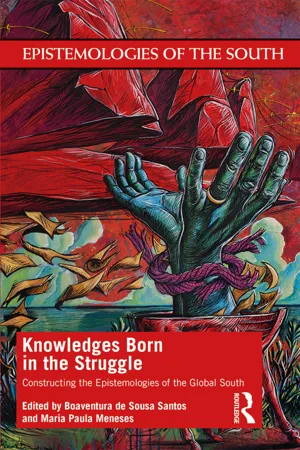
In a world overwhelmingly unjust and seemingly deprived of alternatives, this book claims that the alternatives can be found among us. These alternatives are, however, discredited or made invisible by the dominant ways of knowing. Rather than alternatives, therefore, we need an alternative way of thinking of alternatives. Such an alternative way of thinking lies in the knowledges born in the struggles against capitalism, colonialism, and patriarchy, the three main forms of modern domination. In their immense diversity, such ways of knowing constitute the Global South as an epistemic subject. The epistemologies of the South are guided by the idea that another world is possible and urgently needed; they emerge both in the geographical north and in the geographical south whenever collectives of people fight against modern domination. Learning from and with the epistemic South suggests that the alternative to a general theory is the promotion of an ecology of knowledges based on intercultural and interpolitical translation.
eBook - ePub
Knowledges Born in the Struggle
Constructing the Epistemologies of the Global South
- 254 pages
- English
- ePUB (mobile friendly)
- Available on iOS & Android
eBook - ePub
Knowledges Born in the Struggle
Constructing the Epistemologies of the Global South
About this book
Information
PART I
Unveiling the Eurocentric Roots of Modern Knowledge
1
GLOBAL SOCIAL THOUGHT VIA THE HAITIAN REVOLUTION
Gurminder K. Bhambra1
Introduction
In recent years, sociology—along with many other disciplines—has gone through a “global turn.” This focus on “the global” has been seen as a way in which sociology can redress a previous neglect of those represented as “other” in its construction of modernity. The most common form of engagement is to call for additional accounts of events, processes, and thinkers to supplement the already existing narratives, both of canonical texts and historical events. On such understandings, “the global” and “global sociology” are presented as descriptors of the present and a call for sociology to be different in the future. Ulrich Beck’s (2000) argument for a cosmopolitan social science, for example, challenges what he presents as its standard methodological nationalism. Instead, he argues for the need to take “world society” as the starting point of sociological and other research. His “world society,” however, is one in which the historically inherited inequalities arising from the legacies of European colonialism and slavery play no part. Beck (2002) argues that he is not interested in the memory of the global past, but simply in how a vision of a cosmopolitan future could have an impact on the politics of the present. This, as I have argued at greater length elsewhere, is disingenuous at best (Bhambra 2014).
Any theory that seeks to address the question of “how we live in the world” cannot treat as irrelevant the historical construction of that world (Trouillot 1995). In this chapter, I take issue with the claims of global sociology more generally and examine the implications, precisely, of taking seriously the historical construction of the world in our theoretical conceptualizations. In contrast to the approach of Beck and others, I ask how sociological thought could be differently conceptualized if we took seriously global historical interconnections. I focus on a particular example, that of the Haitian Revolution, to see what can be learnt, both from its omission from accounts of events claimed to be of “world historical” significance, and from how theory would need to be re-thought once we took other such events seriously. What is at stake in such rethinking is what Santos (2014) has called “cognitive injustices,” and I shall argue how these might be redressed through an approach I call “connected sociologies” (Bhambra 2014).
A Critique of the “Global” Sociology
Calls for a “global sociology” began to gather momentum from the start of the twenty-first century. There was an earlier argument by Akiwowo (1988, 1999), among others, for the “indigenization” of social science, which was taken up by Alatas (2001, 2006) and Sinha (2003) for an “autonomous” social science. These have been complemented by arguments for Southern theory by Connell (2007, 2010), for diverse sociologies by Patel (2010a, 2010b), and global sociology from below by Burawoy (2010a, 2010b). These arguments go beyond recognizing the significance of “the global” as a topic or theme within sociology—as Beck proposed—and argue instead for sociology to recognize its multiple and globally diverse origins; that is, to consider what a properly conceptualized global sociology might look like and how it might better serve the global futures towards which we are seen to be headed.2
Alatas (2006), for example, has argued for sociology to acknowledge the importance of civilizational contexts for the development of autonomous, or alternative, social science traditions. More generally, he has criticized “the lack of a multicultural approach in sociology” (2006: 5). Autonomous traditions, he argues, need to be “informed by local/regional historical experiences and cultural practices” as well as by alternative “philosophies, epistemologies, histories, and the arts” (2001: 59). This is because the autonomy of the different traditions, in his view, rests on historical (and other) phenomena believed to be unique to particular areas or societies. In this context, Western social science becomes a reference point for the divergence (or creativity, as expressed through the appropriation of Western traditions read through local contexts) of other autonomous traditions. There is little discussion, however, of what the purchase of these autonomous traditions would be for a global sociology, beyond a simple multiplicity of sociological “cultures.”
In this respect, the approach is similar to that of “multiple modernities” which emerged in Western sociology (Eisenstadt 2000; Eisenstadt and Schluchter 1998). In part, it was a response to the unexpected fall of communism in Europe and a belief in the idea that, as Fukuyama (1992) argued, the “West” had “won.” Even for Fukuyama, however, the question emerged that, if this was the case, then why was “the West” just a universal model and not universally in existence across all societies in the world. It was in the attempt to explain both the seeming triumph of liberal capitalism and the continuing diversity and heterogeneity of existing societies that led to the reformulation of modernization theory as multiple modernities.3 Multiplicity, or simple pluralization, as has been argued by Dirlik (2003), serves to contain challenges to the dominant understanding. It does not involve a reconstruction of that understanding based on deficiencies associated with an earlier neglect of other experiences of modernity. This can be the case even when theorists seek explicitly to challenge the mono-civilizational accounts of standard definitions.4
In developing their approach, theorists of multiple modernities addressed criticisms emerging from non-Western sociologies and argued that two main fallacies needed to be addressed. The first, advanced against earlier modernization theory, is the claim that there is only one form of (Western) modernization. The second is advanced against critiques made by theorists of underdevelopment and dependency and suggests that looking from the West to the East was not necessarily a form of Orientalism or Eurocentrism. While it was accepted that the particular historical trajectories and experiences of societies beyond the West needed to be taken into consideration in discussing the subsequent developments of modernity, the originary form of modernity was still nonetheless believed to be a uniquely European phenomenon. The focus of multiple modernities, then, was on the recognition of divergent paths and of the diversity of modern societies, not any reconsideration of what (European) modernity had been understood to be and its developmental path. This acceptance of plurality and diversity was believed to protect theories of multiple modernities against charges of ethnocentrism or the inappropriate privileging of some histories over others. However, as Dirlik has argued, while the idea of multiple modernities concedes “the possibility of culturally different ways of being modern” (2003: 285), it does so without contesting what it is to be modern and without drawing attention to the social and historical interconnections in which modernity has been constituted and developed.5
This is because they continue to accept standard historical narratives of modernity, narratives that are contested in the discipline from which they are derived. Thus, the central sociological account locates the emergence of modernity in a supposed “Age of Revolutions” spanning the late eighteenth to the mid-nineteenth centuries that bore witness to the American Declaration of Independence and the French and Industrial Revolutions, a periodization popularized by Hobsbawm (2003). While these events are not the only ones to have merited consideration, they are the most frequently cited events, and they establish a particular idea of modernity, its initiation, and its expansion.6 The Industrial Revolution, for example, is understood to be a European phenomenon that was subsequently diffused globally. However, if we take the cotton factories of Manchester and Lancaster as emblematic of this revolution, then we see that cotton was not a plant that was native to England, let alone to the West (Washbrook 1997). It came from India, as did the technology of how to dye and weave it. It was grown in the plantations of the Caribbean and the Southern United States by enslaved Africans who were transported there as part of the European trade in human beings. The export of the textile itself relied upon the destruction of the local production of cotton goods in other parts of the world, not simply through price competition, but also through direct suppression. Zimmerman (2010), for example, documents how cotton production in West Africa was suppressed and undermined in favor of cotton from the USA. In this way, we see that industrialization was not solely a European or Western phenomenon, but one that had global conditions for its very emergence and articulation (Beckert 2015).
The history of modernity as commonly told, however, rests, as Homi Bhabha argues, on “the writing out of the colonial and postcolonial moment” (1994: 250; see also Chakrabarty 2000). The rest of the world is assumed to be external to the world-historical processes selected for consideration and, concretely, colonial connections significant to the processes under discussion are erased, or rendered silent. Braudel’s three volume study of Civilization and Capitalism is a prime example of this. While he points to the importance of global connections to what is presented as Europe’s Industrial Revolution, nowhere in the volumes does he empirically address the substance of those connections, that is, imperialism, enslavement, dispossession, and colonialism. Instead, he talks about “the discovery of America” (1985: 388), slavery as part of the solution to a “problem” of a shortage of labor in the Americas, “India’s self-inflicted conquest” (1985: 489), and so on. The failure to offer a systematic account of phenomena claimed to be European, but demonstrated to be global, I suggest, is not an error of individual scholarship, it is something that is made possible by the very disciplinary structure of knowledge production that separates the modern (sociology) from the traditional and colonial (anthropology) and a “selection bias” in the engagement with available historiographies. The consequence is that no space is left for consideration of what could be termed, the “colonial and postcolonial modern,” that is, an understanding of the modern in terms of the global conditions of its emergence.7
Scholars who have taken on this challenge, such as Anibal Quijano and Walter Mignolo, have very pointedly argued for “modernity” to be understood as “modernity/coloniality” to highlight the inextricable association between them. The modernity that Europe takes as the context for its own being, as Quijano (2007) argues, is so deeply imbricated in the structures of European colonial domination over the rest of the world that it is impossible to separate the two. Mignolo (2007) further elaborates this distinction in the context of the work of epistemic decolonization necessary to undo the damage wrought by both modernity and by understanding modernity/coloniality only as modernity. By silencing the colonial past within the historical narratives of modernity that are central to the formation of sociology, the discipline itself is called into question. As such, Santos (2014) calls for an “epistemology of the South” that, in acknowledging the distortions created in the production of knowledge by colonialism, would enable the retrieval of different ways of knowing.
In particular, Santos (2007) points to the system of visible and invisible distinctions that structure both social thought and social reality. He argues that those events and processes that are standardly acknowledged—that is, are visible—within understandings of modernity are also constituted by events and processes “on the other side of the line” that are not deemed to be significant for such understandings—that is, they are invisible. This form of thinking legitimates particular inequalities, according to Santos, and their address requires us to move beyond “abyssal” thinking to take into account those aspects that have thus far been silenced. As suggested earlier, the standard accounts of modernity typically acknowledge events within Europe and the USA and ignore consideration both of the global contexts of the emergence of these events and also ignore events beyond these particular geographical sites. Most discussions of the political revolutions seem to be constitutive of the modern world, for example, center on the American and French Revolutions. The Haitian Revolution is rarely considered alongside them despite occurring at around the same time. The contestation and reconfiguration of our understandings of modernity, through the examination of other historical sites, points also to the possibility of a different politics for the present as the following sections will discuss.
Democratizing Revolutionary Narratives
In this section, I will begin to deconstruct the idea of what Palmer (1959) calls “the age of democratic revolution” by placing the Haitian Revolution alongside its two primary exemplars, the American Declaration of Independence and the French Revolution. Palmer argues that while there were a great number of differences between the two latter revolutions, they nonetheless shared a good deal in common. The key commonality was that the revolutions were essentially “democratic,” which was understood in the broadest terms, and, as such, defined the “Atlantic civilization” of which they were a part. “Democratic,” in Palmer’s terms, was used to signify “a new feeling for a kind of equality, or at least a discomfort with older forms of social stratification” (1959: 4). Further, “equality” in its political context signified a repudiation of the exercise of coercive authority by any individual or individuals over others. While many scholars today would question whether these revolutions were actually democratic on the basis of the definitions provided—citing the denial of the franchise to all but propertied white men, the dispossession and genocide of indigenous peoples, and the institution of slavery within the USA and the colonies claimed by France, among other aspects—few go on to re-examine the claims made in the context of taking these “anomalies” seriously. The “democratic revolution” did not simply fail to carry through its mandate against feudal remnants of privilege, but created new forms of privilege and coercion.
Alongside the USA and France, the other countries that Palmer pointed to as sharing in the spirit of the democratic revolutions were, notably, “England, Ireland, Holland, Belgium, Switzerland, and Italy” (1959: 5). The one democratic revolution within the Atlantic civilization that he misses out is the Haitian Revolution, a revolution against the enslavement that was coterminous with modernity for a significant proportion of the global population. This is, in part, a consequence of Palmer endin...
Table of contents
- Cover
- Title Page
- Copyright Page
- Table of Contents
- List of Figures
- List of Contributors
- Preface
- Introduction
- PART I: Unveiling the Eurocentric Roots of Modern Knowledge
- PART II: Other Territories, Other Epistemologies: Amplifying the Knowledges of the South
- PART III: The Arts and the Senses in the Epistemologies of the South
- PART IV: Decolonizing Knowledge: The Multiple Challenges
- Conclusion
- Index
Trusted by 375,005 students
Access to over 1.5 million titles for a fair monthly price.
Study more efficiently using our study tools.
Frequently asked questions
Yes, you can cancel anytime from the Subscription tab in your account settings on the Perlego website. Your subscription will stay active until the end of your current billing period. Learn how to cancel your subscription
No, books cannot be downloaded as external files, such as PDFs, for use outside of Perlego. However, you can download books within the Perlego app for offline reading on mobile or tablet. Learn how to download books offline
We are an online textbook subscription service, where you can get access to an entire online library for less than the price of a single book per month. With over 1.5 million books across 990+ topics, we’ve got you covered! Learn about our mission
Look out for the read-aloud symbol on your next book to see if you can listen to it. The read-aloud tool reads text aloud for you, highlighting the text as it is being read. You can pause it, speed it up and slow it down. Learn more about Read Aloud
Yes! You can use the Perlego app on both iOS and Android devices to read anytime, anywhere — even offline. Perfect for commutes or when you’re on the go.
Please note we cannot support devices running on iOS 13 and Android 7 or earlier. Learn more about using the app
Please note we cannot support devices running on iOS 13 and Android 7 or earlier. Learn more about using the app
Yes, you can access Knowledges Born in the Struggle by Boaventura de Sousa Santos, Maria Meneses, Boaventura de Sousa Santos,Maria Meneses,Maria Paula Meneses, Boaventura de Sousa Santos, Maria Paula Meneses in PDF and/or ePUB format, as well as other popular books in Filosofía & Epistemología en filosofía. We have over 1.5 million books available in our catalogue for you to explore.