My child is there, in a greater sense, than what the diagnosis tells me.
Parent (Rogers, 1999)
We believe that children with complex communication profiles (CCP) express their unique identity each with individual thoughts, feelings and emotions, and a depth of understanding that impacts participation with others across environments. Children with complex communication profiles want to learn and communicate with other children, siblings, parents, teachers, coaches, and anyone ready to listen in the participation of life’s activities. Our goal then is to hear each child’s voice by augmenting and assisting communication vital to their participation across cultures. We aim to enable children in a variety of interactions and participate in activities of their choice (Beukelman & Mirenda, 2013). Prizant and Fields-Meyer (2015, p. 214) note that human development is a lifelong process – and that priorities shift. The authors go on to state that when a child becomes a competent and confident communicator, regardless of how he or she is communicating, the child is more available for learning and engaging (p. 234). This engagement includes a family centered approach that will build confidence and trust as each team member contributes to decisions about AAC in the best interests of the child, an idea that is supported by Mandak and Light (2018).
Children’s communication grows as each child participates in activities with others. Our priorities change when we see communication like a dance, with each communication partner synchronizing with the other by moving our eyes, gestures, smiles, voices, and forms of technology. Children and their communication partners are stating, I share my meaning in unique sounds, gestures, and tools. My body may work differently than yours, but I see that we are sharing what matters to both of us. We aim to demystify forms of augmentative and assistive technology (AAC) by unifying perspectives of family and professionals as communication partners with children that use AAC. Helen Keller wrote in her book Optimism (1903) that she came to know finger spelling as a form of living and belonging, no longer isolating.
Once I only knew darkness and stillness . . . my life was without past or future, but a little word from the fingers of another fell into my hand that clutched at emptiness and my heart leaped to the rapture of living . . . With the first word I used intelligently, I learned to live, to think, to hope.
(pp. 10–11)
The purpose of our book is to detail how the focus on participation drives vital learning and engagement for children that use AAC through case studies and practical intervention strategies.
Augmentative and Assistive Communication: A Protocol and Intervention for Children with Complex Communication Profiles offers families and interventionists a functional protocol titled Hear Me into Voice that identifies communication behaviors, and provides intervention strategies including case studies for children that use AAC and their communication partners who support communication and participation. McNaughton et al. (2019) state that the use of case studies can provide students with clinical context for new information and introduce them to the wide range of goals and strategies. Students, in this book refers to you, the reader.
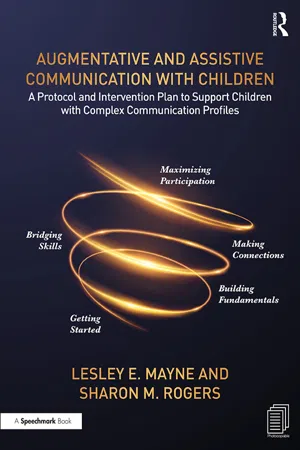
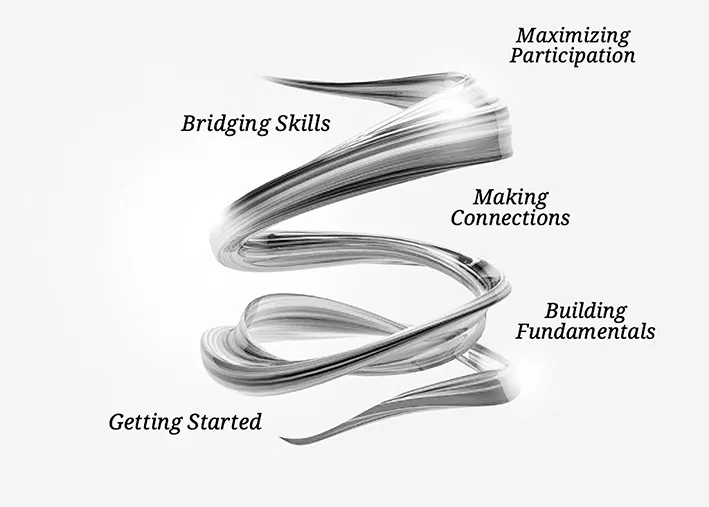
The primary chapters cover stages of AAC including Getting Started, Building Fundamentals, Making Connections, Bridging Skills, and Maximizing Communication. Each chapter provides the reader with a case study and a six-section intervention plan including social awareness, communication activities, facilitator tips, vocabulary, literacy, and tools and access. The authors recognize and invite you to recognize that a child may be interacting and communicating at different stages. For example, a child may be in the stage of Making Connections with communication activities and in the Getting Started stage of literacy. Progress across stages as appropriate for each individual child. At the end of each chapter we offer a section of functional tips and resources titled, Before we go. Investigate how the tips and resources support your child’s communication and participation today and plan for every tomorrow.
Defining augmentative and assistive communication (AAC)
Augmentative and assistive communication is defined in this book as all forms of communication, both physical and technological, that children and adults with limited-verbal or nonverbal abilities use to learn, comprehend, and express themselves with communication partners across environments. All communicators augment their communication with nonverbal gestures, facial expression, and body positions. Similarly, most communicators access technology for work, school, and social purposes. When the use of technology is required for access to life functions, that includes communication...