eBook - ePub
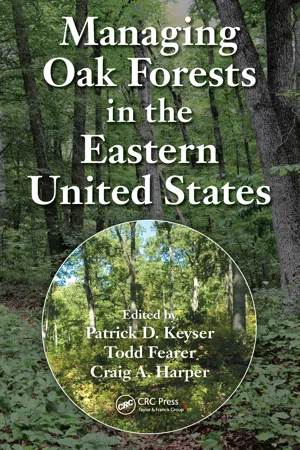
Managing Oak Forests in the Eastern United States
- 305 pages
- English
- ePUB (mobile friendly)
- Available on iOS & Android
eBook - ePub
Managing Oak Forests in the Eastern United States
About this book
If you are responsible for oak management, Managing Oak Forests in the Eastern United States is for you. It is the definitive practical guide for anyone interested in improving stewardship of eastern oak forests. Organized into three sections, the first section, "Background and Biology: Setting the Stage," helps you establish a solid understanding
Information
Section one
Background and biology: Setting the stage
Chapter one
The mighty oak
Why do we manage oaks?
Bryan Burhans, Patrick D. Keyser, Craig A. Harper, and Todd Fearer
Although the authors of this chapter grew up in different states at different times, all four of us took for granted the oak trees that surrounded us. As bowhunters, we looked to each fall’s mast crop to guide our hunting strategies. We cherish our vivid recollections of early fall days scouring the woods for oaks producing abundant acorns and searching for the best place to hang a deer stand.
Regardless of your background, it is easy to find something exhilarating, enchanting, and satisfying about our oak forests, whether it is cutting firewood, hunting, or simply enjoying their timeless beauty. Years as students, managers, researchers, educators, and leaders in conservation of this great natural resource have added to our perspective. These oak forests are one of the largest and most diverse temperate forest ecosystems on the planet. Scores of species of wildlife call it home. Hunting within them puts millions of pounds of lean, wholesome venison on tables across the country; it also supports a vast recreational economy. And timber harvest provides countless jobs and revenue for our country.
While the lush, canopied forests that blanket the landscape of the Eastern United States—from Southern Wisconsin and New England to Northern Georgia and Central Arkansas—seem enduring, that is not the case. Many of the forces that helped shape today’s oak forests have changed, perhaps permanently. Fires are rare and many large herbivores are gone. Deer are at record-setting densities and their natural enemies, the wolf and the mountain lion, no longer keep them in balance with forested habitat. In places, this imbalance is wreaking havoc on the understory vegetation.
Recent data collected by the U.S. Department of Agriculture (USDA) Forest Service’s Forest Inventory and Analysis (FIA) project clearly illustrate the dramatic changes that have occurred in our forests and what that portends for the future. These FIA data show that the volume of oaks in the 5.0- to 6.9-inch stem diameter class decreased by more than 35% between 1987 and 2007. These oak saplings are needed to replace the aging oaks in the overstory. Unless something changes, other hardwood species that dominate the understory, such as maples, will eventually replace the oaks when they die or are harvested.
It is important to understand that oaks across much of the Eastern United States do not form the climax state of the forest, but rather they are mid-successional species. In the absence of disturbance, such as a timber harvest or fire, these forests will naturally transition into ones dominated by late-successional species. In Connecticut, for example, the conversion from oak t...
Table of contents
- Preface
- Contributors
- Editors
- Section one - Background and biology: Setting the stage
- Section two - Silviculture: What is in the tool box?
- Section three - Managing oaks: How do I make it work for me?
Trusted by 375,005 students
Access to over 1.5 million titles for a fair monthly price.
Study more efficiently using our study tools.
Frequently asked questions
Yes, you can cancel anytime from the Subscription tab in your account settings on the Perlego website. Your subscription will stay active until the end of your current billing period. Learn how to cancel your subscription
No, books cannot be downloaded as external files, such as PDFs, for use outside of Perlego. However, you can download books within the Perlego app for offline reading on mobile or tablet. Learn how to download books offline
Perlego offers two plans: Essential and Complete
- Essential is ideal for learners and professionals who enjoy exploring a wide range of subjects. Access the Essential Library with 800,000+ trusted titles and best-sellers across business, personal growth, and the humanities. Includes unlimited reading time and Standard Read Aloud voice.
- Complete: Perfect for advanced learners and researchers needing full, unrestricted access. Unlock 1.5M+ books across hundreds of subjects, including academic and specialized titles. The Complete Plan also includes advanced features like Premium Read Aloud and Research Assistant.
We are an online textbook subscription service, where you can get access to an entire online library for less than the price of a single book per month. With over 1.5 million books across 990+ topics, we’ve got you covered! Learn about our mission
Look out for the read-aloud symbol on your next book to see if you can listen to it. The read-aloud tool reads text aloud for you, highlighting the text as it is being read. You can pause it, speed it up and slow it down. Learn more about Read Aloud
Yes! You can use the Perlego app on both iOS and Android devices to read anytime, anywhere — even offline. Perfect for commutes or when you’re on the go.
Please note we cannot support devices running on iOS 13 and Android 7 or earlier. Learn more about using the app
Please note we cannot support devices running on iOS 13 and Android 7 or earlier. Learn more about using the app
Yes, you can access Managing Oak Forests in the Eastern United States by Patrick D. Keyser, Todd Fearer, Craig A. Harper, Patrick D. Keyser,Todd Fearer,Craig A. Harper in PDF and/or ePUB format, as well as other popular books in Technology & Engineering & Ecology. We have over 1.5 million books available in our catalogue for you to explore.