
- 664 pages
- English
- ePUB (mobile friendly)
- Available on iOS & Android
eBook - ePub
About this book
Covering the fundamental principles of bearing selection, design, and tribology, this book discusses basic physical principles of bearing selection, lubrication, design computations, advanced bearings materials, arrangement, housing, and seals, as well as recent developments in bearings for high-speed aircraft engines. The author explores unique so
Information
1
Classification and Selection of Bearings
1.1 INTRODUCTION
Moving parts in machinery involve relative sliding or rolling motion. Examples of relative motion are linear sliding motion, such as in machine tools, and rotation motion, such as in motor vehicle wheels. Most bearings are used to support rotating shafts in machines. Rubbing of two bodies that are loaded by a normal force (in the direction normal to the contact area) generates energy losses by friction and wear. Appropriate bearing design can minimize friction and wear as well as early failure of machinery. The most important objectives of bearing design are to extend bearing life in machines, reduce friction energy losses and wear, and minimize maintenance expenses and downtime of machinery due to frequent bearing failure. In manufacturing plants, unexpected bearing failure often causes expensive loss of production. Moreover, in certain cases, such as in aircraft, there are very important safety considerations, and unexpected bearing failures must be prevented at any cost.
During the past century, there has been an ever-increasing interest in the friction and wear characteristics of various bearing designs, lubricants, and materials for bearings. This scientific discipline, named Tribology, is concerned with the friction, lubrication, and wear of interacting surfaces in relative motion. Several journals are dedicated to the publication of original research results on this subject, and several books have been published that survey the vast volume of research in tribology. The objectives of the basic research in tribology are similar to those of bearing design, focusing on the reduction of friction and wear. These efforts resulted in significant advances in bearing technology during the past century. This improvement is particularly in lubrication, bearing materials, and the introduction of rolling-element bearings and bearings supported by lubrication films. The improvement in bearing technology resulted in the reduction of friction, wear, and maintenance expenses, as well as in the longer life of machinery.
The selection of a proper bearing type for each application is essential to the reliable operation of machinery, and it is an important component of machine design. Most of the maintenance work in machines is in bearing lubrication as well as in the replacement of damaged or worn bearings. The appropriate selection of a bearing type for each application is very important to minimize the risk of early failure by wear or fatigue, thereby to secure adequate bearing life. There are other considerations involved in selection, such as safety, particularly in aircraft. Also, cost is always an important consideration in bearing selection—the designer should consider not only the initial cost of the bearing but also the cost of maintenance and of the possible loss of production over the complete life cycle of the machine.
Therefore, the first step in the process of bearing design is the selection of the bearing type for each application. In most industries there is a tradition concerning the type of bearings applied in each machine. However, a designer should follow current developments in bearing technology; in many cases, selection of a new bearing type can be beneficial. Proper selection can be made from a variety of available bearing types, which include rolling-element bearings, dry and boundary lubrication bearings, as well as hydrodynamic and hydrostatic lubrication bearings. An additional type introduced lately is the electromagnetic bearing. Each bearing type can be designed in many different ways and can be made of various materials, as will be discussed in the following chapters.
It is possible to reduce the size and weight of machines by increasing their speed, such as in motor vehicle engines. Therefore, there is an increasing requirement for higher speeds in machinery, and the selection of an appropriate bearing type for this purpose is always a challenge. In many cases, it is the limitation of the bearing that limits the speed of a machine. It is important to select a bearing that has low friction in order to minimize friction-energy losses, equal to the product of friction torque and angular speed. Moreover, friction-energy losses are dissipated in the bearing as heat, and it is essential to prevent bearing overheating. If the temperature of the sliding surfaces is too close to the melting point of the bearing material, it can cause bearing failure. In the following chapters, it will be shown that an important task in the design process is the prevention of bearing overheating.
1.1.1 Radial and Thrust Bearings
Bearings can also be classified according to their geometry related to the relative motion of elements in machinery. Examples are journal, plane-slider, and spherical bearings. A journal bearing, also referred to as a sleeve bearing, is widely used in machinery for rotating shafts. It consists of a bushing (sleeve) supported by a housing, which can be part of the frame of a machine. The shaft (journal) rotates inside the bore of the sleeve. There is a small clearance between the inner diameter of the sleeve and the journal, to allow for free rotation. In contrast, a plane-slider bearing is used mostly for linear motion, such as the slides in machine tools.
A bearing can also be classified as a radial bearing or a thrust bearing, depending on whether the bearing load is in the radial or axial direction, respectively, of the shaft. The shafts in machines are loaded by such forces as reactions between gears and tension in belts, gravity, and centrifugal forces. All the forces on the shaft must be supported by the bearings, and the force on the bearing is referred to as a bearing load. The load on the shaft can be divided into radial and axial components. The axial component (also referred to as thrust load) is in the direction of the shaft axis (see Fig. 1-1), while the radial load component is in the direction normal to the shaft axis. In Fig. 1-1, an example of a loaded shaft is presented. The reaction forces in helical gears have radial and axial components. The component Fa is in the axial direction, while all the other components are radial loads. Examples of solved problems are included at the end of this chapter. Certain bearings, such as conical roller bearings, shown in Fig. 1-1, or angular ball bearings, can support radial as well as thrust forces. Certain other bearings, however, such as hydrodynamic journal bearings, are applied only for radial loads, while the hydrodynamic thrust bearing supports only axial loads. A combination of radial and thrust bearings is often applied to support the shaft in machinery.
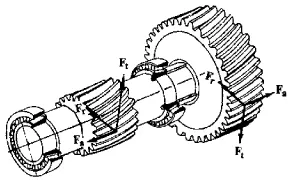
FIG. 1-1 Load components on a shaft with helical gears.
1.1.2 Bearing Classification
Machines could not operate at high speed in their familiar way without some means of reducing friction and the wear of moving parts. Several important engineering inventions made it possible to successfully operate heavily loaded shafts at high speed, including the rolling-element bearing and hydrodynamic, hydrostatic, and magnetic bearings.
1. Rolling-element bearings are characterized by rolling motion, such as in ball bearings or cylindrical rolling-element bearings. The advantage of rolling motion is that it involves much less friction and wear, in comparison to the sliding motion of regular sleeve bearings.
2. The term hydrodynamic bearing refers to a sleeve bearing or an inclined plane-slider where the sliding plane floats on a thin film of lubrication. The fluid film is maintained at a high pressure that supports the bearing load and completely separates the sliding surfaces. The lubricant can be fed into the bearing at atmospheric or higher pressure. The pressure wave in the lubrication film is generated by hydrodynamic action due to the rapid rotation of the journal. The fluid film acts like a viscous wedge and generates high pressure and load-carrying capacity. The sliding surface floats on the fluid film, and wear is prevented.
3. In contrast to hydrodynamic bearing, hydrostatic bearing re...
Table of contents
- Cover
- Title Page
- Copyright Page
- Dedication
- Preface
- Table of Contents
- Symbols
- Chapter 1 Classification and Selection of Bearings
- Chapter 2 Lubricant Viscosity
- Chapter 3 Fundamental Properties of Lubricants
- Chapter 4 Principles of Hydrodynamic Lubrication
- Chapter 5 Basic Hydrodynamic Equations
- Chapter 6 Long Hydrodynamic Journal Bearing
- Chapter 7 Short Journal Bearings
- Chapter 8 Design Charts for Finite-Length Journal Bearings
- Chapter 9 Practical Applications of Journal Bearings
- Chapter 10 Hydrostatic Bearings
- Chapter 11 Bearing Materials
- Chapter 12 Rolling Element Bearings
- Chapter 13 Selection and Design of Rolling Bearings
- Chapter 14 Testing of Friction and Wear
- Chapter 15 Hydrodynamic Bearings Under Dynamic Conditions
- Chapter 16 Friction Characteristics
- Chapter 17 Modeling Dynamic Friction
- Chapter 18 Case Study: Composite Bearing—Rolling Element and Fluid Film in Series
- Chapter 19 Non-Newtonian Viscoelastic Effects
- Chapter 20 Orthopedic Joint Implants
- Appendix A Units and Definitions of Material Properties
- Appendix B Numerical Integration
- Bibliography
Trusted by 375,005 students
Access to over 1.5 million titles for a fair monthly price.
Study more efficiently using our study tools.
Frequently asked questions
Yes, you can cancel anytime from the Subscription tab in your account settings on the Perlego website. Your subscription will stay active until the end of your current billing period. Learn how to cancel your subscription
No, books cannot be downloaded as external files, such as PDFs, for use outside of Perlego. However, you can download books within the Perlego app for offline reading on mobile or tablet. Learn how to download books offline
Perlego offers two plans: Essential and Complete
- Essential is ideal for learners and professionals who enjoy exploring a wide range of subjects. Access the Essential Library with 800,000+ trusted titles and best-sellers across business, personal growth, and the humanities. Includes unlimited reading time and Standard Read Aloud voice.
- Complete: Perfect for advanced learners and researchers needing full, unrestricted access. Unlock 1.5M+ books across hundreds of subjects, including academic and specialized titles. The Complete Plan also includes advanced features like Premium Read Aloud and Research Assistant.
We are an online textbook subscription service, where you can get access to an entire online library for less than the price of a single book per month. With over 1.5 million books across 990+ topics, we’ve got you covered! Learn about our mission
Look out for the read-aloud symbol on your next book to see if you can listen to it. The read-aloud tool reads text aloud for you, highlighting the text as it is being read. You can pause it, speed it up and slow it down. Learn more about Read Aloud
Yes! You can use the Perlego app on both iOS and Android devices to read anytime, anywhere — even offline. Perfect for commutes or when you’re on the go.
Please note we cannot support devices running on iOS 13 and Android 7 or earlier. Learn more about using the app
Please note we cannot support devices running on iOS 13 and Android 7 or earlier. Learn more about using the app
Yes, you can access Bearing Design in Machinery by Avraham Harnoy in PDF and/or ePUB format, as well as other popular books in Tecnologia e ingegneria & Design industriale. We have over 1.5 million books available in our catalogue for you to explore.