- 288 pages
- English
- ePUB (mobile friendly)
- Available on iOS & Android
eBook - ePub
About this book
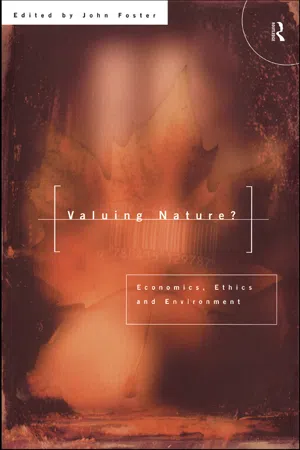
The state of the environment is now widely acknowledged as a serious cause for concern. Valuing Nature? argues that responding to this concern by economic valuation of the environment as a consumer good only makes matters worse. The book brings together philosophers, economists and sociologists to put the case for a new and more creative approach to environmental policy. The discussion covers: • the structure of environmental policy-making • the current orthodoxy in environmental economics and its deficiencies • the deeper problems with contingent valuation surveys and cost-benefit analysis for environmental decisions • alternative valuation methods Embracing three disciplines, this book is nevertheless written in a clear, accessible style. It includes chapters by Geoff Hodgson, Clive Spash, Michael Jacobs, Brian Wynne and John O'Neill. Its ground-breaking critique and suggestions will be of great interest both to specialists in the field and to students of the disciplines concerned; it has important messages for anyone concerned with how decisions about the environment are made.
Part I
ECONOMICS AND ENVIRONMENTAL POLICY
1
THE ENVIRONMENTAL ‘VALUATION’ CONTROVERSY
Observations on its recent history and significance
Robin Grove-White
1. INTRODUCTION
Modern environmentalism has tended to embody a deep suspicion of economists. It is not hard to see why. At the most obvious level, economic theory has provided—indeed continues to provide—the underpinning for many environmentally destructive practices. Moreover, in the 1970s and 1980s, the environmental movement gained popular strength partly as an implicit counter to political-economy doctrines about the imperatives of undifferentiated economic growth and about the supposedly central role of markets as sources of human welfare.
But these days many economists are on the side of the angels. They are keen to develop new theoretical tools and methods of analysis which can help solve environmental problems. They argue that, since it is economic realities which dominate the imperatives of modern government, environmental priorities too need to be expressed in such terms. Only so, it is urged, will these priorities be taken seriously within government. Such economists see themselves, understandably, as friends of the environment. The burgeoning school of economic theorists concerned to develop methods for capturing in monetary terms the ‘value’ of environmental goods exemplifies this trend. With the most benign of intentions, such individuals have been advancing new concepts and techniques for use within costbenefit analyses: ‘contingent valuation’, ‘existence value’, ‘hedonic pricing’ and the like. In what follows, I refer to these innovations collectively as ‘surrogate valuation’ methods.
The chapter considers two issues. First, it discusses some of the recent history of this emerging conceptual toolkit, focusing particularly on the realworld application of surrogate valuation methods in selected political contexts in Britain over the past two decades. And second, through this discussion, it tries to throw light on a paradox: that despite their increasingly evident intellectual limitations (a number of which are discussed in subsequent chapters of this volume), the influence of such methods in the policy world continues to grow.
These observations draw on a measure of personal experience, as a participant in a range of environmental-political arguments over the past twenty years.1 It seems to me that the impetus behind the development of surrogate valuation methods needs to be understood not only as an attempt to advance environmental ends within government. It is driven also by powerful political realities which have been reshaping the requirements of our dominant administrative culture. Thus the drive towards the attempted quantification of public values reflected in such methods appears to go with the grain of the new audit culture (Power 1995) now emerging in Whitehall and its equivalents around the world.
Such a suggestion relates in turn to a wider body of recent discussion about the hitherto under-recognised significance of ‘cultural’ dimensions of the environmental problematique, by sociologists, anthropologists and philosophers.2 Such commentary pictures environmental concern not only as a response to the physical ‘externalities’ of industrial exploitation of nature, but also, quite as significantly, as a manifestation of groping wider social reactions to deep cultural tensions in modern complex societies (Lash et al 1996). It points also, more particularly, to the significance of the reductionist tacit representations of human nature employed in neoclassical economics (and hence implicitly within the surrogate valuation methods which are the concern of this chapter), as contributors to the tensions which are tending to find expression in contemporary environmental controversy.3 My purpose in this chapter is thus to suggest, through some reflections on the emergence of the new valuation methdologies, that the tensions surrounding their development and, more particularly, their application may have a wider signficance for current developments in the polity as a whole.
2. OBSERVATIONS ON RECENT HISTORY
The current wave of interest in and energetic promotion of ‘surrogate valuation’ methods in the policy world can be dated in Britain to July 1989, with the accession of Chris Patten MP as Secretary of State for the Environment in the third Conservative administration of Mrs Margaret Thatcher. Mr Patten was promoted in the backwash of Mrs Thatcher’s landmark speech to the Royal Society in 1988, which had elevated environmental policy to a claimed central concern of her government. In an attempt to underline his ambition to bring environmental concerns to the heart of Cabinet discussion, he announced rapidly that he was appointing a new kind of Special Adviser: Professor David Pearce, then the country’s leading protagonist of cost-benefit/surrogate valuation methodologies in the environmental domain. 4 The political symbolism underlying the announcement, in the context of the then-dominance of ‘marketeconomics’ idioms in Whitehall, was clear and deliberate. From now on, Patten was understood to be saying, it was to be the Department of the Environment’s numbers against the Treasury’s. As astute observers such as Tom Burke pointed out, the move was intended to signal an elevation of environmental policy. No longer was the latter to be seen by other departments as soft and discretionary; by becoming translated into the grown-up language of economics, environmental priorities would begin to gain the authority they merited at the centre of the concerns of modern government.
Appropriately, Professor Pearce’s promotion attracted considerable media interest. A succession of initiatives followed. Pearce’s previously unpublicised work for the Department of the Environment (DoE) (commissioned under the tenure of Patten’s predecessor, Nicholas Ridley) was published, reinforcing the wave of interest. A sequence of speeches by the Secretary of State consolidated the message.5 The ripple effects were wide and rapid. The Economic and Social Research Council (ESRC), using Pearce’s earlier ESRC-funded work in environmental economics as a standard-bearer, embarked on the development of its Global Environmental Change Programme (its largest-ever single research funding programme), leading in due course to the creation of a designated Research Centre with Professor Pearce and other leading economists of the same neo-classical school at its fulcrum.6 Within government and its agencies, and within international bodies like OECD, UNEP (United Nations Environment Programme) and the World Bank, intensive activity on the same lines gained extra momentum. Although the September 1990 White Paper This Common Inheritance gave a lower profile to the role of such methods than many had anticipated, given the initial expectations aroused by both Patten and Pearce, it was nevertheless the case that within eighteen months, the tools and techniques of environmental valuation, however imperfect, had become established as a mounting preoccupation within many government agencies, and some national non-governmental organisations (NGOs), in Britain. In 1991, the DoE published the manual Policy Appraisal and the Environment, which was distributed throughout Whitehall. This highlighted further the officially endorsed significance of economic/surrogate valuation techniques for capturing environmental ‘values’, in routine administration and decisionmaking.
These developments were not uncriticised at the time. Whilst the Secretary of State’s promotion of the overall significance of economic instruments for future environmental policy was largely welcomed, his more specific endorsement of the potentialities of surrogate valuation methods caused anxiety in the breasts of independent figures in the environmental world, such as Nigel Haigh of the Institute for European Environmental Policy and Fiona Reynolds of the Council for the Protection of Rural England (CPRE). From their perspective, Patten appeared innocently—and dangerously—to be endorsing approaches to environmental ‘valuation’ which already had a long and troubled history behind them. This was a history which, they implied, Whitehall had apparently forgotten, or which, if remembered, was being misread or deliberately overridden.
Several previous examples of the use of such methods in environmentally controversial contexts were alive vividly in the minds of such critics. It is useful briefly to recall one or two of these.
First, and furthest back in time, was the case of the third London Airport controversy of the late 1960s and early 1970s. This had crystallised politically in the Roskill Inquiry (Roskill 1971), an official Commission of Inquiry which in 1967–70 explored and evaluated a range of possible sites for London’s third airport, relying heavily on techniques of formal cost—benefit analysis, and in particular on surrogate valuation methods, to reach its conclusion in favour of an inland site at Cublington in Buckinghamshire. Famously, the report and its methods attracted derision for the valuation of a Norman church at Stewkley by surrogate means of its commercial insurance value (£50,000), as well as for a variety of other assumptions, particularly about the value of the ‘time’ of individuals, in particular population groups relevant to the proposed new airport. The case provoked an intervention (the first of many redoubtable challenges in this field over the coming twenty-five years) by Dr John Adams, an academic geographer at London University and subsequently adviser to Friends of the Earth, who challenged the fundamental epistemological pretensions of the methods.
Sir Colin Buchanan’s common-sense Minority Report dissented eloquently from the Roskill Commission’s conclusions (and methods), and the government opted, albeit only temporarily, for Foulness on the Essex coast, rather than the recommended Cublington site. This outcome led to a brief flurry of exchanges in the broadsheet press, in which economists criticised sceptical lay opinion as emotional and irrational, and noneconomists inveighed against the encroachments of economic methodology into domains of moral and philosophical ‘value’. It was to be a pattern of exchange which would recur in a number of fields over the next two decades.
A second key arena was the government’s motorway construction programme of the 1970s. This programme, flowing from commitments announced officially in 1971, had spawned a succession of local controversies by the middle of the decade, including significant civil disobedience at public inquiries into new road proposals up and down the country, as the social and environmental impacts of new motorways became increasingly familiar (Levin 1979). A key focus for controversy was the cost-benefit appraisal model (‘COBA’) employed within the Ministry of Transport (at the time under the umbrella of the Department of the Environment), to justify particular schemes. The critiques of Friends of the Earth and others, crystallised by Adams and others (Adams 1979), highlighted the undue significance given to a small number of variables encompassed within COB A as ‘benefits’. These imputed economic values to, for example, the projected savings in the cumulative driving times of individuals using the new motorway, and to the accident ‘reductions’ claimed likely to result from construction. The dominant emphasis on such selective surrogate representations of ‘value’, and the effective marginalisation of other less readily quantifiable environmental and social ‘costs’ in the official justifications for new motorways, fanned the flames of controversy—particularly when coupled to the mechanistic traffic forecasting methods then employed by the ministry.
Cumulatively, these various developments came rapidly to threaten a crisis of legitimacy for the motorways programme overall. In 1974–5, to defuse the situation, the government found itself forced to set up two parallel committees of inquiry: the Leitch Committee into ‘Trunk Road Assessment’, and an inquiry into ‘Highways Inquiry Procedures’. The first of these led directly to the creation of the permanent Standing Committee on Trunk Road Assessment (SACTRA), which exists to this day. This was read at the time as a tacit acknowledgement that quantified cost-benefit analytical methods—and, in particular, reliance on surrogate valuation of a small range of variables—in this sphere had backfired politically.
It is crucial to recall that the controversies surrounding COBA and the surrogate valuation methods it employed were far from simply technical. The methods were a focus of contention because they became seen by objectors (local and national) as having been developed by technical experts as biased contributors to the intellectual rationale for an unbalanced national transport policy.7 Increasingly, innovative national NGOs such as Friends of the Earth, the Conservation Society and CPRE linked with local objectors and amenity societies to highlight the potential cumulative consequences of ever greater commitment to road transport— consequences which, they claimed, the methods in question were acting to obscure, rather than to clarify. It has to be said that, twenty years later, these arguments appear broadly vindicated. Indeed, the 1994 report of the Royal Commission on Environmental Pollution, ‘Transport and the Environment’,8 can properly be read as an authoritative update of precisely the critique of trends in transport policy underpinning the 1970s’ NGO challenges to COBA and its unbalanced surrogate valuation methods.9 Yet there is disconcertingly little sign of recognition of this continuity, or its implications, within government.10
The third London Airport and the motorways programme were far from being the only arenas in which ‘environmental’ controversies about surrogate valuation methods took hold in the 1970s and 1980s. Both the Ministry of Agriculture’s land drainage programmes, and the National Radiological Protection Board’s cost—benefit approaches to public exposures to low-level radiation from nuclear power stations, generated analogous criticisms. In all of these various cases, apparently technical methodological challenges reflected deeper tensions of mounting social and environmental significance.
What insights might Chris Patten and his advisers properly have distilled from this history, before embarking on the government’s promotion of surrogate valuation methods in the early 1990s?
In the first place, he might have noted the significance of the particular patterns of ‘lay’ dissent that had been provoked by the methods. The sporadic brouhahas surrounding surrogate valuation had been brought alive not by economists, but rather for the most part by lay individuals peering into official methodological thickets, in attempts, as citizens, to understand how contentious new schemes were being justified by government. These processes generated powerful and durable insights. However, what was also striking was how little the resulting critiques disturbed, or were even acknowledged seriously by, the economists favouring such methods.11 After a burst of controversy in each case, and a response from government aimed at displacing it (the rejection of an airport at Cublington, the creation of the Leitch Committee, etc.), NGO and government attention moved elsewhere. Like most administrators in government, the NGO non-economists who had crystallised the controversies had little interest in economic methodology per se. One consequence was that, as particular storms blew themselves out, economists interested in new methodological refinements simply continued down their specialist paths, unperturbed. When the political climate towards environmental concerns changed in the late 1980s, the same surrogate valuation approaches, albeit refined technically in ways significant for economists themselves, were available to be taken up.
All of this points to a further significant feature of these historical disputes: the particular moral intensity which had characterised the arguments. On the lay NGO side, what appeared to be at stake was more than simply an intellectual critique of a technical methodology. Central to the passions aroused were unarticulated feelings of acute threat and moral resentment at the way in which issues of wide normative public significance were being converted into a Procrustean and trivialising technical language, by official fiat. In other words, the idioms of surrogate valuation were experienced as imposed, with no discussion about whether or not they were socially appropriate,12 and minimal negotiation about which variables or specific valuations, if any, might be appropriate for inclusion.
Equally, on the economists’ side too, there were strong normative commitments. The key protagonists inside and outside government saw themselves as having a mission to develop and employ techniques of economic appraisal, techniques which were not only more ‘rational’ but also more likely to have purchase on government behaviour than less quantified forms of evaluation. Moreover, few environmental economists would endorse the picture I have drawn above of surrogate valuation as in some respects hegemonic. Rather they saw (and continue to see) themselves as embattled standard-bearers for clearer headed, more ‘objective’ approaches to questions of environmental value than the supposedly ‘emotional’, even Luddite, approaches of ‘conventional’ environmental campaigners. The intensity of the resulting disputes continues to surface publicly from time to time.
The above historical reflections illustrate that surrogate valuation methods had already had a bumpy history of their own in the environmental sphere, well before Chris Patten’s period as Secretary of Stat...
Table of contents
- COVER PAGE
- TITLE PAGE
- COPYRIGHT PAGE
- CONTRIBUTORS
- PREFACE
- ACKNOWLEDGEMENTS
- INTRODUCTION: ENVIRONMENTAL VALUE AND THE SCOPE OF ECONOMICS
- PART I: ECONOMICS AND ENVIRONMENTAL POLICY
- PART II: ENVIRONMENTAL VALUE: LIMITS OF AN ECONOMIC MODEL
- PART III: VALUING NATURE: NEW DIRECTIONS
- BIBLIOGRAPHY
Trusted by 375,005 students
Access to over 1.5 million titles for a fair monthly price.
Study more efficiently using our study tools.
Frequently asked questions
Yes, you can cancel anytime from the Subscription tab in your account settings on the Perlego website. Your subscription will stay active until the end of your current billing period. Learn how to cancel your subscription
No, books cannot be downloaded as external files, such as PDFs, for use outside of Perlego. However, you can download books within the Perlego app for offline reading on mobile or tablet. Learn how to download books offline
Perlego offers two plans: Essential and Complete
- Essential is ideal for learners and professionals who enjoy exploring a wide range of subjects. Access the Essential Library with 800,000+ trusted titles and best-sellers across business, personal growth, and the humanities. Includes unlimited reading time and Standard Read Aloud voice.
- Complete: Perfect for advanced learners and researchers needing full, unrestricted access. Unlock 1.5M+ books across hundreds of subjects, including academic and specialized titles. The Complete Plan also includes advanced features like Premium Read Aloud and Research Assistant.
We are an online textbook subscription service, where you can get access to an entire online library for less than the price of a single book per month. With over 1.5 million books across 990+ topics, we’ve got you covered! Learn about our mission
Look out for the read-aloud symbol on your next book to see if you can listen to it. The read-aloud tool reads text aloud for you, highlighting the text as it is being read. You can pause it, speed it up and slow it down. Learn more about Read Aloud
Yes! You can use the Perlego app on both iOS and Android devices to read anytime, anywhere — even offline. Perfect for commutes or when you’re on the go.
Please note we cannot support devices running on iOS 13 and Android 7 or earlier. Learn more about using the app
Please note we cannot support devices running on iOS 13 and Android 7 or earlier. Learn more about using the app
Yes, you can access Valuing Nature? by John Foster in PDF and/or ePUB format, as well as other popular books in Economics & Business General. We have over 1.5 million books available in our catalogue for you to explore.