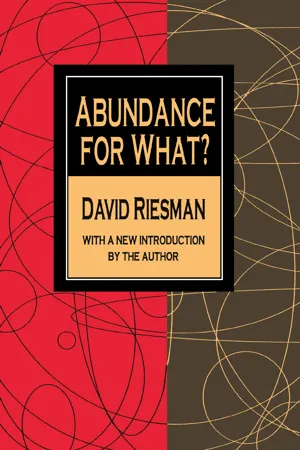
This classic collection of essays by David Riesman discusses the implications of affluence in America. Riesman maintains that the question that should be raised by wealth has shifted over time from how to obtain wealth to how to make use of it. Another key theme concerns issues relevant to higher education, such as academic freedom. Abundance for What? examines the notion that America is not as open a society as it may appear to be; it then shows how social science may be used to explain why this is so. And now in a brilliant, lengthy reevaluation Riesman both clarifies and revises that earlier assessment with unusual luster and candor., The volume begins with a group of essays that describe the impact of the Cold War. After warning against depending on a war economy, Riesman shifts the focus of discussion to a central characteristic of the Cold War epoch: the uses and abuses of abundance in expanding leisure time. Several essays deal with suburbs as the locale of abundance, while others study the place of the automobile in American life. Riesman describes the impact of American abundance on other nations. Among the many other subjects discussed in Abundance for What? are the education of women, generational shifts in attitudes, and a study of the national character., In his major new 100-page introduction, Riesman also relates the experiences that originally inspired him to write these essays. He then talks about the social and historical changes that have occurred since their publication. His synthesis of old Ideas with contemporary ones makes this a compelling volume. Abundance for What? continues to hold a significant place in the social and cultural critiques of contemporary America and will be of interest to historians, psychologists, educators, and urban policymakers alike.
- 626 pages
- English
- ePUB (mobile friendly)
- Available on iOS & Android
eBook - ePub
Abundance for What?
About this book
Information
SECTION II
Abundance for What?
Preface
Given a disciplined and literate labor force, modern factory organization, automation, quality control, credit facilities, and a modicum of managerial ability, high productivity looks surprisingly easy. I say “surprisingly” because even now we barely realize how truly productive modern industry can be, if there is flexible planning to assure markets and supplies, including an adequate supply of technically trained people.
The case of Japan makes it clear that natural resources are no longer necessary for high productivity. The postwar boom in once ravaged countries like Japan, Yugoslavia, Germany, and France makes us ask what these various economies were doing before the war that made them turn out so relatively little? Once a society realizes that its national budget is not simply an extrapolation from a household budget—and a petty bourgeois one at that—high growth rates seem possible under a variety of political labels, in industry if not on the farm. It would seem that national ideology is less important in organizing production as such than in helping to shape the pre-industrial world, especially the educational and cultural background for the moral and intellectual disciplines that propel economic advance and make it seem worthwhile. (Several essays in the next section deal with this matter.)
Once the techniques of industrialization have been invented, shown to be effective, and rendered transportable, it is no longer necessary for newly developing societies to go through the miseries of the firstcomers, whether one thinks of the industrial revolution in Great Britain or of the wildly and cruelly forced pace of industrialization in Stalin’s Russia. I agree with Seymour Melman in The Peace Race that, in a disarmed world, America’s excess capacity could be put to use mitigating the pains of transition for the large part of the world that is poor.
The considerable minority of Americans who are still poor have tended to drop out of the political and cultural spotlight. Indeed, as Stimson Bullitt has pointed out in To Be a Politician, the economically depressed in today’s America are a disorganized minority, living in scattered pockets of poverty, kept down by the sheer weight of the relatively affluent middle majority, and thus not available to support political leaders who can mobilize them in pursuit of their long-run economic interest. The patrician reformers who once devoted themselves to these “masses,” and to some degree still do, have become even more concerned with foreign policy or with racial rather than economic equality. Slums and levels of misery exist in the United States that European countries with lower per capita levels of living would not tolerate. The momentum of distributive justice has been halted, only partly in order to focus on a much greater and still more implacable burden of misery in the rest of the globe; and little has been done to develop the kind of economic and educational plans that might help relocate and employ the undereducated rural and urban poor (who are often Negroes). In “A Career Drama in a Middle-aged Farmer,” I set forth a vignette of one of the many millions of Americans who didn’t make it; a man who, but for the Second World War, might never have left the state of virtual peonage in which he lived on a Missouri farm.1
For the past twenty years I have mistakenly assumed that what might be termed military Keynesianism had “solved” the problem of assuring reasonably full employment. This politically salutary and noncontroversial medicine for the economy, however, seems to be encountering the same sort of difficulties that some of the new drugs encounter when resistant strains of bugs get used to them. For the shift in military procurement away from heavy hardware toward the research and development of small-scale and non-mass-produced devices, along with the continuing automation of production itself, makes it possible greatly to increase defense spending without appreciably absorbing the pool of unemployed.2 Hence we find an increasing demand for highly specialized scientists and technicians (as can be seen, for example, by perusing the advertisements for personnel in any issue of Scientific American), while the demand for semiskilled and to some degree for what used to be called skilled labor has diminished.
Once it becomes harder to sell goods than to make them, the nature of both work and leisure undergoes changes—changes discussed at length in The Lonely Crowd. On the side of leisure and consumption, there is the compulsion to prove oneself a good, normal American by acquiring what Howard Roseborough and I, in “Careers and Consumer Behavior,” refer to as the standard package of consumer goods. We try to outline there the relation between the life cycle and the ability to consume, taking account of the demands on one’s domestic economy at various stages on life’s way. “Leisure and Work in Post-Industrial Society” explores the paradoxical distribution of leisure and work, so that those with the most exciting work tend to have the least leisure, while those whose work is boring are deluged with more leisure than their lives can endure. In another essay, “Work and Leisure: Fusion or Polarity?” (with Warner Bloomberg, Jr.), this theme is explored with reference to the factory worker as his situation has changed in the last hundred years, and especially as it now exists in the unionized and relatively well-paid industries.
Careful readers of this article will see, perhaps, that the authors do not regard the industrial worker as quite so alienated as Paul Goodman, Erich Fromm, and C. Wright Mills have pictured him. Goodman, for example, in Growing Up Absurd, describes a garage mechanic who does not care to work on a Cadillac tail fin or fender because he knows it’s all junk anyhow, a symbol of the corruption of the whole society. My own impression is that, while many workers may feel this, many others are still a long way from such detachment: they take the world much more for granted, are psychologically more “adjusted” and politically less adventurous than the concept of alienation might predict. Such workers enjoy the hedonistic fruits of the “system” and suffer its deprivations less than intellectual onlookers often suppose; and their bitterness is mixed with sufficient hope and good humor to make a focussed indignation unlikely.3
In an essay in Individualism Reconsidered (“Recreation and the Recreationists”) I recommended the establishment in the federal government of an Office of Recreation, charged with making plans for greatly increased recreational facilities and personnel, once disarmament and underemployment freed resources for this purpose; and I argued that in a severe recession “it may turn out that a ‘Play Progress Administration’ rather than a WPA [Works Progress Administration] will be necessary to spend the money fast enough.” When I make such suggestions, and in general when I discuss leisure, I often encounter the attitude that the subject is not quite serious—and certainly not a solid topic for research. We are still work-minded in our view of what constitutes a proper subject for research, even though people will agree that our general attitudes are greatly shaped by our leisure, our sociability, and our behavior as consumers.
I have encountered these attitudes especially in connection with a study of sociability, primarily at parties, which several of us began at the University of Chicago in 1955 under a grant from the National Institute of Mental Health. One essay coming out of that work is reprinted here: “Sociability, Permissiveness and Equality: a Preliminary Formulation,” in which my collaborators were Robert J. Potter and Jeanne Watson. This deals with some of the consequences for the style and pacing of middle-class sociability of the loss of earlier conventions. We discuss some of the not always happy consequences of the effort of people to be casual and not to push themselves or each other around, and suggest some of the dilemmas for host and guest created by these new styles. But we proceed on the basis of very limited evidence and what we say is tentative and exploratory.
In “Some Issues in the Future of Leisure,” Robert S. Weiss and I cope once again with the social management of leisure (and its relation to work), this time in terms of generational differences. Professor Weiss, as a member of the Survey Research Center at the University of Michigan, directed national surveys on how people define work, what it means to them, and what they get out of it. In this essay we draw on this research but engage primarily in speculation.
The changes in the relationship between work and leisure have been influential in the growth of suburbs and the migration of more and more middle- and even working-class people out of the central city. The view of the suburb that appears in “The Suburban Dislocation” and “Flight and Search in the New Suburbs” has been sharply challenged by a former student at Chicago, Herbert J. Gans, who has been a participant-observer in Park Forest, Illinois; in the West End of Boston (now undergoing redevelopment); and in Levittown, New Jersey. (In Park Forest and Levittown he was on the spot at the beginning of development, with access to both tenants and homeowners and planners and officials.) Gans observes that the attack launched against the suburbs by urban-bred intellectuals is often a disguised attack on the values of the nonintellectual world, particularly those of the lower-middle class—values more visible in the new suburbs than in the crowded tenements of the city. And Gans contends that people like myself should not project large esthetic and political judgments onto people in the first stages of emancipation from poverty and crowding, people who are often feeling for the first time that they have a real stake in society.4
I would be less uneasy about Gans’s qualified and discriminating relativism if I could feel more confident about the prospects of American life as a whole. The suburbs represent both a liberation and a scattering of human energies and potentialities. And I believe that in a long life, inevitably beset by loneliness and loss, the densities and facilities of the city provide higher horizons and greater opportunities. It is conceivable that in the future great cultural variety may be possible in the suburbs even if the cities disintegrate; and I am aware that most residents of the city are, in Gans’s phrase, “urban villagers” who draw hardly at all on its resources. I can leave the question open, but not without anxiety.
Similar issues arise with respect to the article Eric Larrabee and I wrote on the auto. Here, too, our attitude is that of lovers of the city who fear its strangulation by the private car. Yet we would have to admit that the car has made much possible in our own and our friends’ lives and has to some extent compensated for the decentralization to suburb and exurb. Plainly neither Larrabee nor I share the fascination with cars that has come to be part of American folklore, especially among men. But the trouble is that the car is not simply a plaything or hobby; it is the creator of a set of dynamic and intractable institutions that are virtually out of social control. This is true of the individual driver who, as our paper suggests, is in but not of the stream of traffic so that his conduct is not judicialized. And it is true of drivers as a class who act as a lobby on the entire culture.
The essay that gives this book its tide was originally written as a contribution to a symposium, mostly of economists, in which the Committee for Economic Development asked individuals to discuss what they regarded as the major problems of economic development in the United States in the years ahead. I should add that I have no particularly original blueprint myself for an answer to the question, Abundance for what? Within the United States and the other countries of relative abundance we are far from even beginning to decide what we would do with the surplus if we were able to plan for a better existence.
Such questions do not appear to trouble the selected college seniors of 1955 whose interviews I report in the essay, “The Found Generation.” These college students impressed me when I read their interviews (as such students have done in person) as extremely decent, lacking for the most part in greed or malice, tolerant, urbane, and friendly. Yet, given the fact that this was a privileged group, what struck me were their limitations as well as their good qualities: their general coolness, comfortable acceptance of the world, and unreflecting naïveté, disguised as realism and sobriety, about the dilemmas of existence. As I try to make clear in my essay, the older generation is in no position to point the finger of scorn, for its own values bear examination even less. And the college seniors of 1955 are not the seniors of 1963: the latter seem at once more awake and more anxious, more dissatisfied and more involved.5
With a few exceptions the interviews reported on in “The Found Generation” were all with young men, and a survey of the general literature on youth will show, I believe, that most of it is concerned with young men. (So much is this tacit bias the case that David Potter has recently argued that discussions of American character, including my own, are really discussions of male character.6) In “Some Continuities and Discontinuities in the Education of Women,” I try to say something about what the opportunities and hazards of abundance have been for college-educated women, and how their situation has changed since the feminist movement of an earlier day. Indeed I see the residential college as presuburban, just as the Oxford colleges may have provided a model for suburban development in both England and, later, this country.
At the University of Chicago in 1958 I gave a series of lectures under the title, “The American Future,” in which I discussed a number of the issues considered in the essays in this section. The final lecture was “The Search for Challenge,” which, like the others, was tape-recorded. Paul Goodman, in one of his recent essays, has ridiculed the idea of building artificial mountains and ski trails as a “moral equivalent” for anybody (I suggest it in the lecture only for the young), and I recognize that my proposals, here as elsewhere, are far from matching my critical diagnoses.
“The Search for Challenge,” written before the Peace Corps, proposes something like it: a civilian corps analogous to the Civilian Conservation Corps during the Great Depression. An idea for which there seemed little chance in the Eisenhower period has since blossomed, thanks to the response to Kennedy’s campaign speech at Ann Arbor and to the dedication of Sargent Shriver and his staff. There are virtuous as well as vicious circles in history; one good idea can lead to another, one “impossible” proposal to another, until our very idea of what is possible changes. History keeps catching up with us, and in seeking to anticipate the future, our critical faculties are among the few assets that stand between us and what Veblen called “the vis a tergo of brute causation.”
What in The Lonely Crowd are spoken of as the veto groups in American life are immensely strong, so strong that it is astonishing when anything gets accomplished over alert and well-organized opposition. The veto groups represent not only interests, in the old-fashioned sense of economic blocs, which could conceivably be persuaded or bought off in building a new program for our domestic life, but also vested ideologies, set and sometimes curdled ways of seeing the world—and these, it seems to me, backed by all the rhetorical momentum of the cold war, are even stronger than they were a dozen years ago. Even so, intellectuals in America would be wrong to use these obstacles as an excuse for not thinking about a better future. Such a future may never come into being in America, but it might in some other country; and hopefully, in the world that lies ahead, every man’s patriotism will be planetary.
1 In “Some Observations on Interviewing in a State Mental Hospital,” Bulletin of the Menninger Clinic, Vol. 23, No. 1, January, 1959, pp. 7–19, not included here, there are references to similarly rejected persons who turn up in the wards of our big state mental hospitals—wards where, among other places, we have hidden the people who belie the youthful, smiling, radiant, and glamorous faces in our advertisements that purport to show what an American ought to look like.
2 See Gerard Piel, “Can Our Economy Stand Disarmament?” The Atlantic Monthly, September 1962, pp. 35–40. (Phi Beta Kappa Address at Harvard, June 11, 1962.)
3 For fuller discussion, see Robert S. Weiss and Riesman, “Social Problems and Disorganization in the World of Work,” in Robert A. Nisbet, ed., Contemporary Social Problems (Harcourt, Brace & World, Inc., 1961), pp. 459–514. See also my essay written with Eric Larrabee, “Company Town Pastoral: the Role of Business in ‘Executive Suite,’” Mass Culture: The Popular Arts in America, Bernard Rosenberg, ed. (The Free Press), pp. 325–37.
4 See, e.g., his essay, “The Effects of the Move from City to Suburb,” in Leonard J. Duhl, ed., The Urban Condition: People and Policy in the Metropolis (New York: Basic Books, 1963); and The Urban Villagers: Group and Class in the Life of Italian-Americans (Glencoe, Ill: The Free Press, 1962).
5 I say this with hesitation because I have no comparable empirical survey; indeed quick scrutiny of questionnaires gather by The Intercollegian, the YMCA magazine, asking students in 1962 such questions as what they would live and die for, indicates in the main a picture not greatly different from that in “The Found Generation.” My sense of change comes about from talking to Peace Corps volunteers, and to students active in the sit-in movement or concerned with...
Table of contents
- Cover
- Half Title
- Title Page
- Copyright Page
- Acknowledgments
- Dedication
- Author’s Note
- Table of Contents
- Introduction to the Transaction Edition
- Section I: The Impact of the Cold War
- Section II: Abundance for What?
- Section III: Abundance for Whom?
- Section IV: Social Science Research: Problems, Methods, Opportunities
- Index
Trusted by 375,005 students
Access to over 1.5 million titles for a fair monthly price.
Study more efficiently using our study tools.
Frequently asked questions
Yes, you can cancel anytime from the Subscription tab in your account settings on the Perlego website. Your subscription will stay active until the end of your current billing period. Learn how to cancel your subscription
No, books cannot be downloaded as external files, such as PDFs, for use outside of Perlego. However, you can download books within the Perlego app for offline reading on mobile or tablet. Learn how to download books offline
Perlego offers two plans: Essential and Complete
- Essential is ideal for learners and professionals who enjoy exploring a wide range of subjects. Access the Essential Library with 800,000+ trusted titles and best-sellers across business, personal growth, and the humanities. Includes unlimited reading time and Standard Read Aloud voice.
- Complete: Perfect for advanced learners and researchers needing full, unrestricted access. Unlock 1.5M+ books across hundreds of subjects, including academic and specialized titles. The Complete Plan also includes advanced features like Premium Read Aloud and Research Assistant.
We are an online textbook subscription service, where you can get access to an entire online library for less than the price of a single book per month. With over 1.5 million books across 990+ topics, we’ve got you covered! Learn about our mission
Look out for the read-aloud symbol on your next book to see if you can listen to it. The read-aloud tool reads text aloud for you, highlighting the text as it is being read. You can pause it, speed it up and slow it down. Learn more about Read Aloud
Yes! You can use the Perlego app on both iOS and Android devices to read anytime, anywhere — even offline. Perfect for commutes or when you’re on the go.
Please note we cannot support devices running on iOS 13 and Android 7 or earlier. Learn more about using the app
Please note we cannot support devices running on iOS 13 and Android 7 or earlier. Learn more about using the app
Yes, you can access Abundance for What? by David Riesman in PDF and/or ePUB format, as well as other popular books in Social Sciences & Social Policy. We have over 1.5 million books available in our catalogue for you to explore.