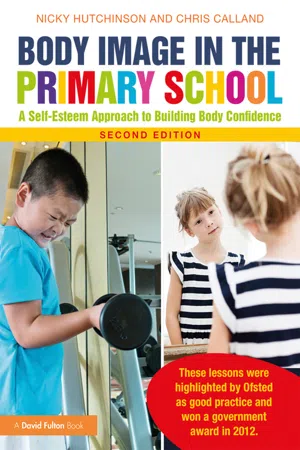
75% of 10- to 11-year-olds would like to change their appearance.
Children as young as 6 are worrying about their shape and size.
Body image is an important aspect of children's self-esteem and confidence. Unfortunately, many young children are suffering from anxieties about their appearance, which has a harmful effect on their overall mental health and wellbeing.
This updated second edition of the award-winning Body Image in the Primary School recognises these anxieties as a concern for younger children that needs to be addressed at an early age, and examines some of the pressures that young people face. Presenting a clear, easy-to-use scheme of work to support emotional literacy and Personal, Social, Health and Economic Education (PSHE), throughout the primary school and into the first years of secondary school, this new edition offers:
A practical evidence based curriculum for children aged 4 –13.
More than 60 lively, varied and detailed lesson plans.
Additional lessons on gender, social media and the selfie culture.
An overview of research on the links between body image, academic achievement and emotional wellbeing.
The evidence-based lessons in Body Image in the Primary School have been awarded the quality kitemark by the PSHE Association and highlighted by Ofsted as an example of excellent practice. This book will be of significant interest to all teachers, teaching assistants and practitioners working with primary aged children.
A third of adults have felt anxious about their bodies, with one in eight experiencing suicidal thoughts.
Mental Health Foundation (2019)
The term ‘body image’ refers to our idea of how our body looks and how it is perceived by others. It is the mental picture that we hold about our physical appearance, and encompasses how we feel about the size, shape, weight and look of our bodies. Our body image is quite independent of our actual size, shape or appearance. Anyone, of any physical description, can have a positive or negative body image. Because our feelings about our bodies are so deeply connected to our overall view of ourselves, having a poor body image is strongly associated with low self-esteem. A negative body image can be linked to mental health problems such as anxiety and depression, and to anorexia, bulimia nervosa and other eating disorders. Obsessive and exhausting over-exercising behaviour, yo-yo dieting, reluctance to socialise, difficulties with relationships and financial problems have all been associated with poor body image.
The ability of a person to enjoy life, form good relationships and make the most of opportunities can be directly affected by their body image. Feeling positive about your body improves your outlook and how you interact with others, and gives you the freedom and confidence to approach new challenges and experiences. Our feelings and attitudes about our bodies and our physical appearance are closely connected to our self-esteem, or how we feel about our whole selves. Self-esteem can be defined as the beliefs and opinions you have of yourself and how you value and respect yourself as a person. Having a positive body image and feeling content about the way we look is a vital part of our overall emotional health and wellbeing.
The leading UK charity for people with eating disorders, Beat, estimates that 1.6 million people in the UK have a diagnosed eating disorder, of whom 1.4 million are female. Those most at risk of suffering from an eating disorder are young women between the ages of 14 and 25, but male sufferers are on the rise and the number of boys being treated in hospital for eating disorders are at a record high (NHS Digital 2018) As many as 1 in 10 secondary school students are likely to be affected. Eating disorders have the highest mortality rate of any mental illness, and many young people who develop anorexia or bulimia will suffer serious long-term health consequences. These include bone and joint disorders, growth retardation and fertility problems.
An extreme disorder of body image is known as body dysmorphic disorder. Sufferers worry excessively that some aspect of their appearance is unattractive, although in reality the perceived flaw is non-existent or minimal. They become preoccupied with the imagined defect and this can have a devastating impact on their daily life. In some cases they avoid all social contact and will not leave the house. The condition is thought to affect as many as 1 in 50 people and often develops in the teenage years (BDD Foundation 2019).
The standards of beauty portrayed by the media in our western society are narrow and inflexible. Television, advertising billboards, magazines and reality TV shows bombard us constantly with images of slim beautiful people and the culture of ‘compare and despair’ can have a damaging impact on how we see ourselves. On social media we scroll through photoshopped images of both celebrities and our family and friends; after just an hour online, we are more likely to be dissatisfied with our own bodies (Graff & Czarnomska 2018). Not only are the vast majority of the images we see manipulated and changed, we are now filtering our own photos to post online so we don’t even look like ourselves! Regularly analysing our own pictures can lead to a poor body image. Women who regularly take selfies and post them to social media report feeling less confident about their attractiveness and have increased anxiety (Mills et al. 2018; Salomon & Brown 2018). A young person today is thought to be exposed to more images of physical perfection in one day than their great grandmother would have seen throughout her entire adolescence. This has the effect of making exceptional good looks seem normal, real and achievable. Many studies show that looking at pictures of slim, beautiful models has a negative impact on body image (Treasure et al. 2008; Jucker et al. 2017). People are adversely affected by the rigid images of beauty that surround them in the media. They measure their own appearance against these high standards of physical perfection. They begin to view their own body negatively and engage in destructive behaviours to try to reach this unrealistic ideal. Females under the age of 19 and those who are already feeling insecure about their bodies are especially vulnerable.
Fashionable standards of female beauty became progressively more unrealistic throughout our society during the previous century. In 1917 the ‘perfect’ woman was 5 feet 4 inches tall and weighed 10 stone. As the 20th century progressed, the female beauty ideal became thinner and less representative of an average woman. In the 1970s, top models weighed, on
average, 8% less than the average woman, whereas in the 21st century they weigh 23% less (Derenne & Beresin 2006). The current fashionable feminine ideal that is peddled by the media is a toned, thin, large-breasted look. This would be a physical impossibility for most women unless they resorted to plastic surgery. We often hear about celebrities who have ‘achieved’ a size 0 (an English size 4). This gives a woman the waist measurement of an average 8-year-old. The current media ideal is achievable by less than 5% of the population; that is just in terms of size and weight. If you were to add the perfect facial features, too, it would be attainable by hardly anyone at all. Anita Roddick, founder of The Body Shop, reminded us that ‘there are over three billion women who don’t look like supermodels and only eight who do’ (Haywood 2009).
We know that eating disorders are a serious mental health concern with a range of complex causes, but many research studies point to a direct link between the media’s use of thin models and the rise of eating disorders (Lister 2010). More frequent use of Facebook has also been associated with disordered eating and the maintenance of weight concerns (Mabe et al. 2014).
For many, food has become such a moral issue in the 21st century and is often connected with feelings of guilt and anxiety. We are surrounded by messages about dieting, obesity and what we should and shouldn’t eat. Social media is saturated with large numbers of young healthy looking food bloggers telling us what food group to cut out and how to lose weight. Many are unqualified but have millions of dedicated followers and the messages can be risky for those who are more vulnerable. In recent years this focus on fad diets and ‘clean eating’ have been the start point to unhealthy eating patterns and eating disorders (Berelowitz 2016).
Each decade has seen a steady rise in the incidence of anorexia and although there are support groups accessible on the internet to help those who struggle with eating disorders, there are also pro-ana sites which encourage and perpetuate unhealthy attitudes and behaviours around food.
It would be wrong to assume that this is an issue that just affects women. There is growing evidence that larger numbers of males are also suffering from negative body image. This coincides with an increase in the number of adverts and images we see nowadays that focus on the appearance of the male body (Papadopoulos 2010; Moss 2015). Reality shows on TV and influencers on social media often highlight appearance as the most important aspect of a man and present male grooming as the new normal. Many teenage boys feel pressure from friends and social media to be muscular (Credos 2016), and a study found that 38% would sacrifice at least a year of their lives in exchange for the perfect body (Campbell 2012). Men with a negative body image worry about their weight, body shape and muscle definition. This can lead to eating disorders, social problems, depression, anxiety, withdrawal and obsessive exercising in the gym. Increasing numbers of body-conscious young males are using anabolic steroids to bulk up their physique, which can lead to serious health consequences. Magazines for men on improving their appearance have grown in popularity. Statistics from the British Association of Aesthetic Plastic Surgeons show that there has been a marked increase in the numbers of men opting for cosmetic surgery (BAAP 2017).
There are unclear statistics on body image amongst ethnic groups in Britain. There is some evidence to suggest that black and Asian women feel happier with their bodies and less pressure to be slim than white women. In general, it seems that there is a more flexible standard of attractiveness and a greater acceptance of different body shapes amongst black people (Altabe 1996; Bucchianeri et al. 2016).
It is clear that our media-driven society is causing widespread pressure to conform to a certain image or look. Beautiful bodies sell products and the diet and advertising industries are multi-million-pound concerns. A recent survey of 5,000 women found that only 3% are happy with the way they look and 73% think about their size and shape everyday (REAL magazine 2019). In a recent poll of 4,500 adults, a third of respondents said their body image left them feeling anxious or depressed. Additionally, 20% of those surveyed felt shame about how they looked and 19% reported feeling ‘disgusted’ (2019 Mental Health Foundation). Another survey found that 95% of 16- to 21-year-olds said they would like to change their bodies and 70% of 18–24 year olds said they would consider plastic surgery (BAAPS 2017). One research study of 2,000 people reported that 1 in 10 women say they feel sick when they see a photo of themselves on Facebook, and 13% dislike their appearance so much that they avoid being photographed at all (Daily Telegraph 2010).
Body image is clearly having an adverse effect on millions of people’s mental wellbeing. Relying too much on appearance to define ourselves is likely to result in poor emotional health. Of course, everyone worries about their looks at times, but when it becomes an obsession and begins to damage a person’s whole self-perception, it starts to be a problem. Many people now feel that their physical appearance is more important than their health or any other personal goals or ambitions. For many now the idea of changing what they look like, or trying to stop the aging process through medical procedures has become normalised. It is almost commonplace for some people to have botox and fillers while the statistics for plastic surgery in Britain continue to rise dramatically with breast augmentation being the most popular procedure (BAAPS 2016). People are increasingly trying to model themselves on a narrow and unrealistic beauty ideal. There is often a feeling, promoted by the media, that this ideal can be achieved by anyone willing to work hard enough for it. When people fail to achieve this look, they can feel frustrated and guilty. They connect their inability to match up to these images with failure and poor self-worth. Even celebrities and supermodels often do not look exactly like their printed images, which may have been airbrushed or digitally enhanced. If we attempt to measure up to an impossible image of physical attractiveness, we are setting ourselves up to feel dissatisfied and critical of our bodies.
In our image-obsessed culture, with its emphasis on celebrity and fashion, worries about looks, eating problems and weight concerns have become the norm. Body image dissatisfaction is widespread as increasing numbers of both men and women report feeling anxious and unhappy about their physical appearance. It seems that body worries are everyday concerns for many people in Britain, with high numbers of both women and men feeling dissatisfied with their looks.
Children face exposure to the media on a far greater scale than ever before. Their ideas about themselves, their bodies and their place in society are forming and developing. We must ensure that their development is not limited in any way by the restrictive and unrealistic messages about beauty and the ideal body that they encounter daily in the media. This curriculum project is designed to help children form a healthy body image that is a prerequisite for their emotional health and ability to fulfil their potential.
Chapter 2 Body image in children
It’s good to be skinny.
Ruby, aged 6
A positive body image helps children to feel confident, to be resilient and to flourish. All children need to feel they belong, to celebrate their own individuality, and to have a healthy self-esteem. These strengths will help them to navigate their modern world and become more resilient to the pressures about perfect looks which surround them. Unfortunately, many of our children are displaying distressing levels of body anxiety which has a damaging effect on their wellbeing, ability to enjoy life, and reach their potential. As the psychotherapist Susie Orbach states: ‘Without a body that girls (and boys) feel alright about, nothing much else in their lives feels okay’ (Orbach 2010).
Early intervention
Literature on young people’s body image has traditionally focused on adolescents, with a poor body image being presented as a teenage problem. We now know that a negative body image frequently develops at a much younger age than this. Although we often associate body dissatisfaction and eating problems with teenagers, the roots of these difficulties in adolescents can often be traced back to an earlier time in childhood. Recent studies show that a negative body image can often develop during the pre-teen period and that children are becoming anxious about their physical appearance and body image at an increasingly young age. Therefore, education to tackle this problem has to begin in the primary school years.
Self-esteem relates to the feelings we have about our own worth as individuals. Because children’s feelings about how they look are so closely linked to their feelings about themselves, body image is a crucial factor in their self-esteem and overall mental health and wellbeing. We want our children to have high self-esteem and be body confident. They need to feel loved and accepted for who they are and what they look like, so that they are able to accept and value themselves, face challenges and lead satisfying and happy lives.
A large-scale longitudinal study led by the Institute of Child Health at UCL used data from over 6,000 participants (Micali 2015). Using a scale to assess self-esteem, they found that higher scores at 8.5 years had a protective effect against developing body dissatisfaction and eating disorder behaviours as a teenager. Even a one-point increase in the self-esteem scale at age 8.5 years decreased the odds of boys later engaging in self-induced vomiting or laxative use for weight loss at age 14 by 19%. The researchers concluded that public-health initiatives on body image should target younger children to prevent them from developing eating disorders in their teenage years. Intervention programmes aimed at adolescents may be too late to prevent many young people from developing a negative body image with its associated eating problems, self-harm behaviours, depression, low self-esteem and anxiety.
Research studies
Evidence indicates that children as young as 9 and 10 years old, and sometimes even younger, are showing a disturbing level of anxiety about their weight and their physical appearance (Pacey 2016; Government Equalities Office 2015; Papadopoulos 2010; Schur et al. 2000; Maloney et al. 1993). One study reported that slightly more than half of all 9-year-olds were not satisfied with their body image (Hill et al. 1992). A wide-ranging survey of 150,000 children by Ofsted found that by the age of 10, 33% of girls and 22% of boys cited their bodies as their main source of worry. Girlguiding UK, who conduct the largest annual research of its kind, has noted a steep 5-year decline in girls body confidence since 2011. In a study of over 1,000 girls they found nearly 75% of 7- to 11-year-olds said they would change something about their appearance, and by the ages of 10 and 11, one in eight girls wanted to be thinner. A third of 7–10 year old girls believe they are judged on their appearance and two-fifths think they’re not pretty enough. A quarter of girls of the same age feel the need to be p...
Table of contents
Cover
Half Title
Title
Copyright
Contents
Author’s preface to the new edition
Acknowledgements
1 Body image
2 Body image in children
3 The role of parents and carers
4 Introduction to the body image curriculum
5 Guidance for school
6 Body image curriculum (for ages 4–7)
7 Body image curriculum (for ages 7–13)
8 Transition: growing up and moving on
9 Involving parents and carers
Appendix: resources
Bibliography
Trusted by 375,005 students
Access to over 1.5 million titles for a fair monthly price.
Study more efficiently using our study tools.
Frequently asked questions
Yes, you can cancel anytime from the Subscription tab in your account settings on the Perlego website. Your subscription will stay active until the end of your current billing period. Learn how to cancel your subscription
No, books cannot be downloaded as external files, such as PDFs, for use outside of Perlego. However, you can download books within the Perlego app for offline reading on mobile or tablet. Learn how to download books offline
Perlego offers two plans: Essential and Complete
Essential is ideal for learners and professionals who enjoy exploring a wide range of subjects. Access the Essential Library with 800,000+ trusted titles and best-sellers across business, personal growth, and the humanities. Includes unlimited reading time and Standard Read Aloud voice.
Complete: Perfect for advanced learners and researchers needing full, unrestricted access. Unlock 1.5M+ books across hundreds of subjects, including academic and specialized titles. The Complete Plan also includes advanced features like Premium Read Aloud and Research Assistant.
Both plans are available with monthly, semester, or annual billing cycles.
We are an online textbook subscription service, where you can get access to an entire online library for less than the price of a single book per month. With over 1.5 million books across 990+ topics, we’ve got you covered! Learn about our mission
Look out for the read-aloud symbol on your next book to see if you can listen to it. The read-aloud tool reads text aloud for you, highlighting the text as it is being read. You can pause it, speed it up and slow it down. Learn more about Read Aloud
Yes! You can use the Perlego app on both iOS and Android devices to read anytime, anywhere — even offline. Perfect for commutes or when you’re on the go. Please note we cannot support devices running on iOS 13 and Android 7 or earlier. Learn more about using the app
Yes, you can access Body Image in the Primary School by Nicky Hutchinson,Chris Calland in PDF and/or ePUB format, as well as other popular books in Psychology & Behavioural Management. We have over 1.5 million books available in our catalogue for you to explore.