- 312 pages
- English
- ePUB (mobile friendly)
- Available on iOS & Android
eBook - ePub
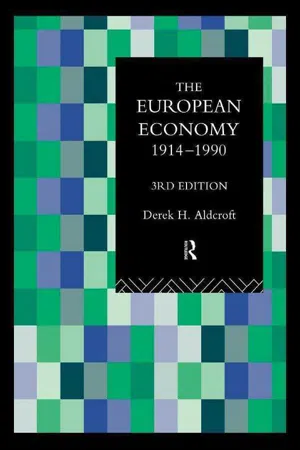
The European Economy 1914-1990
About this book
This new edition of The European Economy 1914-1980 has been up-dated and revised to take account of the decade 1980-90 and, as such, covers some of the most dramatic and profound economic events of the twentieth century. The European Economy 1914-1990 includes two additional chapters, one dealing with the Western European economies, and in particul
1
THE END OF THE OLD REGIME,
1914–1921
INTRODUCTION
During the nineteenth century the European continent—taken here to include Britain at one extreme in the west to Russia in the east—had experienced substantial economic development. Few countries had failed to be affected in some way by the forces of modern economic growth which had had their origins in the northwest corner of the continent. As Pollard rightly points out, the development process may be seen as a general European phenomenon transcending national frontiers rather than as something confined to the geographic boundaries of a few states. On the other hand, economic growth was very uneven in its incidence, while in comparison with more recent times rates of economic growth were quite modest. The centre of progress was undoubtedly in northwest Europe— Britain, France, Germany, Belgium, Holland—whence it spread south and east through the rest of the continent getting weaker the further it moved from the point of origin. It is true that in the later nineteenth century and through to 1914 the pace of economic change was quite rapid in some of the lesser developed countries, notably Italy, Austria and Russia. Even so, by the eve of the First World War most of the countries of east and southeast Europe remained very backward in comparison with the northwest. Incomes per head on average in southern and eastern Europe were one half or less those in the northwest and in some cases, for example Bulgaria, Romania, Spain and Greece, they were but a fraction of those prevailing in the most developed sector of the continent. In fact, an income contour map for Europe would show (with minor exceptions) income contour lines of steadily diminishing strength as one moved south and east from the ‘high pressure’ zone of advanced development.
Though eastern and southern Europe undoubtedly benefited from the transmission of growth forces from the point of origin, modern capitalism found more fertile ground in some overseas territories, particularly in North America and Oceania, than it did elsewhere in Europe. The former areas were more receptive to the flows of European capital, labour and technology, so much so that by 1913 incomes per head were already above those in northwest Europe. What is more, these three areas—northwest Europe, North America and Oceania, more especially the first two—monopolized modern economic development. They accounted for the bulk of the world’s manufacturing production and though containing only 18 per cent of the world’s population they accounted for nearly 62 per cent of global income.
To a certain extent Europe’s position was already being challenged by developments overseas, more especially by the rapid rise in the economic strength of the United States. But the threat to European supremacy was not at this stage serious, since in many respects developments in both continents were partly complementary. Moreover, the world order of the pre-war period was such as to ensure the survival of both parties. The strength of prewar capitalist development rested on the freedom with which resources could be transferred between nations, the ease with which the industrial nations of the centre, especially northwest Europe, could draw upon the primary resources (food and raw materials) of the periphery—mainly but not exclusively the less developed nations—and the fact that there was no serious disparity in the rate of economic progress among the major industrial countries. The latter point is important since it was this rather than the commonly alleged virtues of the international gold standard which gave the pre-war system a measure of stability, a stability which was regarded with some nostalgia in the years of disequilibrium following the First World War.
What would have happened to this set-up had the 1914–18 war not intervened is a debatable counterfactual proposition which will no doubt be put to the test in the course of time. One can say with certainty, however, that the war affected Europe’s economic position adversely. Europe emerged from the war in a seriously weakened state and with a residue of problems that were to plague it and the international economy for much of the inter-war period. But whether the war can be blamed for all the difficulties of that period or whether it can be regarded as a direct cause of the slump of 1929– 32 are matters which will be taken up at a later point in this study. Some of the more immediate consequences of the war must be considered first.
Given the scale of the European war it is hardly surprising that the consequences were far-reaching. Resource mobilization exceeded anything previously known. Altogether more than 60 million men were drafted into the armed services during the four years or so of hostilities and in all belligerent countries there was extensive control of economic activity especially in the latter half of the period. The details of wartime operations and resource mobilization need not concern us here since the primary interest is to determine the main consequences of war, and more especially those which have a bearing on subsequent events in the 1920s and early 1930s.
It is important, however, to distinguish between the direct economic consequences of war and the policy actions of the Allied governments in the immediate aftermath. The war itself gave rise to manpower losses, physical destruction, financial disorganization, a contraction in output and unstable social and political conditions. Given the weakened state of many countries, especially in central and eastern Europe, the process of reconstruction and recovery required the assistance of the Allied powers, the United States in particular. In fact, as we shall see, not only was the amount of direct assistance forthcoming minimal, but the process of reconstruction was hindered by the peace treaty settlements and the policies adopted to deal with the boom of 1919–20.
POPULATION LOSSES
It is difficult to make an exact count of the population losses arising from the war. This is partly because the data for the period are far from perfect but also because military casualties were but a small proportion of the total number of deaths recorded in the period. Many more people died of starvation and disease, or as a result of civil war, than on the battlefield. In addition, some estimate must be made of the population deficit caused by the shortfall in births as a result of wartime conditions. The Russian statistics are notoriously difficult to interpret.
Military casualties were quite small in relative terms. During the period of hostilities some 8.5 million men (including tentative guesses for Russia) lost their lives in active service, that is, about 15 per cent of those mobilized for duty. This was equivalent to less than 2 per cent of the total European population and about 8 per cent of all male workers. In addition, some 7 million men were permanently disabled and a further 15 million more or less seriously wounded.
The incidence of fatalities varied considerably although obviously the belligerents were the main sufferers. The largest absolute losses were in Germany and Russia with 2 and 1.7 million respectively; France lost 1.4 million, Austria-Hungary 1.2 million and the UK and Italy almost three-quarters of a million each. Some of the smaller countries such as Romania (250,000) and Serbia and Montenegro (325,000) also suffered badly. In most cases, however, the proportionate impact in terms of population was quite small. Of the major powers France was the chief loser with 3.3 per cent of the population decapitated through military action; Germany was not far behind with 3 per cent; in most other cases the proportion was 2 per cent or less. In fact in relative terms the smaller countries came off worst generally; Serbia and Montenegro, for example, lost 10 per cent of their population.
The impact of course was greater than the absolute figures indicate since most of the persons killed were in the prime of their life and therefore constituted the most productive part of the labour force. In the case of Germany, 40 per cent of the casualties fell within the age group 20–24 and 63 per cent were between 20 and 30 years old. Both France and Germany lost about 10 per cent of their male workers, Italy 6 per cent and Britain 5 per cent. On the other hand, callous as it may sound, the losses may have been something of a blessing in disguise given the limited employment opportunities which were to eventuate in the inter-war period.
Civilian losses are more difficult to determine; these arose from several causes including disease, famine, privation as well as military conflict, the assumption being that they would not have occurred but for the war. War-induced deaths of civilians probably amounted to about 5 million in Europe excluding Russia, with Austria-Hungary, Germany and Italy bearing the brunt of the burden in absolute terms, though once again Serbia and Montenegro experienced the greatest relative impact.
Adding together military and civilian deaths gives a combined death toll for Europe excluding Russia in the region of 12 million, of which just over 6.5 million were due to military causes. This amounted to some 3.5 per cent of Europe’s pre-war population. Germany and Austria-Hungary had the largest absolute losses, while in relative terms mortality ranged from about 1 per cent in Scandinavia to as much as 20 per cent in Serbia. France, Italy, Germany and Austria-Hungary lost about 4 per cent of their populations, and the UK and Belgium under 2.5 per cent.
Account must also be taken of the birth deficits or numbers of unborn arising from wartime conditions. Some of the belligerents recorded very high birth deficits: Austria-Hungary 3.6 million, Germany 3 million. France and Italy had deficits of about 1.5 million, Britain 700,000 and Romania just over 500,000. Altogether the population loss from this cause was similar to the combined figure for military and civilian deaths.
The combined tally of the European population deficit therefore amounts to between 22 and 24 million people. This was equivalent to 7 per cent of Europe’s pre-war population, or the whole of her natural increase between 1914 and 1919. Thus at the beginning of 1920 Europe’s population was about the same as it was at the start of the war. The largest absolute losses were incurred by Germany and Austria-Hungary with over 5 million apiece, but in relative terms Serbia and Montenegro were by far the worst sufferers with deficits approaching one-third of their pre-war population. The neutral powers fared best with losses of 2 per cent or less. Of the Allied powers, France and Italy bore the brunt of the burden. France’s population deficit amounted to just over 3 million, or 7.7 per cent of her pre-war populations. This includes a shortfall of some 1.4 million in births as a result of a dramatic decline in her birth rate. The net result was that by the middle of 1919 France’s population, at 38.7 million, was some 1.1 million lower than in 1914 even with the inclusion of Alsace-Lorraine which she had recovered from Germany.
The figures for Russia are much less reliable though it is probable that losses in this country exceeded the combined total for the rest of Europe. Military casualties in the Great War itself were relatively small but millions died in the subsequent revolution and civil war. The total toll was not far short of 16 million. Add to this some 10 million for birth deficits and one gets a figure of 26 million, and even this takes no account of the losses in the territories ceded by Russia as a result of the peace treaty concluded with Germany in 1918.
Europe therefore suffered a serious depletion and deterioration in quality of population during the war period. Moreover, the figures cited are not strictly complete since further losses, arising from causes associated with the war, occurred in the post-armistice period. The influenza epidemic of 1918– 19 claimed many victims, while substantial numbers of people died in eastern Europe and the Balkans as a result of famine. Post-war border conflicts and massacres between 1919 and 1921, especially in southeastern Europe, added further to the toll.
In sum, therefore, the final casualty list for the whole war period, 1914– 21, runs into many millions. An approximate figure would be between 50 and 60 million with Russia accounting for around one-half. Direct military deaths in the war proper formed only a small proportion of the total population loss in this period.
In human terms the disaster can be regarded as nothing short of tragic. But it is doubtful whether the loss had a severe or lasting impact on the countries concerned. Most countries of course lost some of their best manpower, often highly skilled, but few, apart from France, suffered from labour shortages in the decade following the war. Indeed, as it turned out, the post-war period was marked by high unemployment in many European countries and so it could be argued that the check to population growth was something of a mixed blessing.
PHYSICAL DESTRUCTION AND CAPITAL LOSSES
Capital losses are even less easy to estimate with accuracy than those of population. The value of Europe’s capital stock undoubtedly deteriorated during the war as a result of physical damage, the sale of foreign assets, the check to investment and the neglect of maintenance. Stamp calculated that the war destroyed some three to four years’ normal growth of income-yielding property in Europe (excluding Russia), or one part in thirty of its original value, and to this must be added an unknown quantity for the deterioration of the existing capital stock due to neglect or lack of maintenance. Europe also lost about one-thirtieth of her fixed assets as a result of destruction and physical damage, while some countries, notably France and Germany, relinquished most of their foreign investments. In addition, of course, some countries sacrificed territory and property under the peace treaty settlements. This aspect is discussed separately in a later section.
The incidence of the destructive impact varied considerably from country to country. The neutral countries—Scandinavia, the Netherlands, Switzerland and Spain—escaped unscathed and in some cases were in better physical shape in 1919 than at the beginning of the war. Most of the belligerent countries, on the other hand, experienced substantial cuts in investment with the result that their capital stocks were lower at the end of hostilities. Physical damage was greatest in the main theatres of war, especially in France and Belgium, though Italy, Russia and some eastern European countries also fared badly. By comparison Britain, Austria and Germany, though major belligerents, got off fairly lightly. Bulgaria too did much better than her neighbours on the Balkan peninsula since the country never became a war zone and so avoided severe destruction or despoliation of property.
The occupied territories undoubtedly fared the worst since they shared the privations of the central empires while at the same time they were exploited to the utmost for the good of their temporary masters. It was inevitable that Belgium and France should bear the main burden given that much of the fighting occurred on their land. Destruction of farms, factories and houses was widespread and substantial in both cases, though in France most of the physical damage tended to be concentrated in the north of the country. Belgium was less fortunate. Practically the whole of the country was invaded and the list of damage makes dismal reading. About 6 per cent of the housing stock, half the steel mills and three-quarters of the railway rolling stock were destroyed or smashed beyond repair, thousands of acres of land were rendered unfit for cultivation, while the animal population was decimated. Though geographically concentrated, France’s losses were severe and they occurred in the richest and most advanced part of the country.
In absolute terms these two countries accounted for the bulk of the wartime property losses. Yet in relative terms some of the smaller countries further east probably emerged from the war in an even more devastated condition. The value of property lost by Poland was only a little less than that of Germany but the impact was very much greater. The occupying powers literally devastated the country by destruction and looting. Large tracts of good agricultural land were laid waste, 60 per cent of the cattle stock disappeared, much of the railway rolling stock was taken, many factories were either destroyed or denuded of equipment, and 1.8 million buildings were lost by fire. The same story could be told of Serbia, parts of Austria and also of Russia, though in the latter case much of the damage occurred as a result of the civil war. In fact, in some areas the scale of destruction was so great that the question of repair could scarcely be considered; rather it was a matter of clearing the land and rebuilding from scratch.
Elsewhere the physical damage was far lighter, though most countries had a substantial backlog of investment to work off. Germany lost few domestic assets but most of her foreign assets were either sold or seized and she was to pay a heavy price in reparations for her transgression. Most of Britain’s physical losses consisted of shipping though she did sell a small portion of her overseas investments to pay for the war. France lost about two-thirds of her pre-war foreign assets by sale, default, as in the case of Russian investments, or through inflation.
The task of reconstruction was certainly a substantial one and in some countries it could only be accomplished by a resort to inflationary financing.
However, the process of European recovery as a whole was made more difficult by the fact that the peace treaty settlements imposed heavy penalties on the vanquished and proceeded to carve up the map of Europe in a manner detrimental to the economic well-being of that continent.
FINANCIAL LEGACIES OF WAR
The financial implications of the First World War were more serious than those of the Second. Essentially this was because the method of financial control was much laxer in the first case, and not because the scale of military operations was greater—in fact it was the reverse. The total direct cost was of course large—some 260 billion dollars if all the belligerents are included—though the absolute figures do not have a great deal of meaning. The largest expenditures were incurred by Britain, the United States, Germany, France, Austria-Hungary and Italy in that order. An idea of the magnitude of the total outlay can be gained from the fact that it represented about six and a half times the sum of all the national debt accumulated in the world from the end of the eighteenth century up to the eve of the First World War.
The size of the war-expenditure programme is not particularly significant though one could naturally point to the more fruitful and constructive ways in which the money might have been spent. What matters is the way the spending was financed. Almost overnight governments hastily abandoned the sound financial orthodoxy of the nineteenth century which meant abandonment of the discipline of the gold standard and a resort to deficit financing. Credit operations of one sort or another rather than taxation were the main source of war finance. Germany and France, for example, relied almost entirely on borrowing, while even in the United States only just over 23 per cent of war expenditures was derived from revenue sources. On average, some 80 per cent or more of the total war expenditure of the belligerents was financed by borrowing. This method of financing the war need not have been unduly inflationary had the loans been derived from genuine savings, but in fact much of the finance was raised through bank credit. Banks either granted loans to governments by the creation of new money or else received ‘promises to pay’ from the governments and then pr...
Table of contents
- COVER PAGE
- TITLE PAGE
- COPYRIGHT PAGE
- LIST OF FIGURES AND TABLES
- INTRODUCTION
- 1. THE END OF THE OLD REGIME, 1914–1921
- 2. RECOVERY AND INSTABILITY PROBLEMS IN THE 1920s
- 3. ECONOMIC CRISIS AND RECOVERY, 1929–1939
- 4. WAR AND RECONSTRUCTION, 1940–1950
- 5. WESTERN EUROPE’S SUSTAINED EXPANSION, 1950–1970
- 6. THE SOCIALIST ECONOMIES OF EASTERN EUROPE, 1950–1970
- 7. WESTERN CAPITALISM IN THE 1970s
- 8. WESTERN EUROPE IN THE 1980s: THE SEARCH FOR STABILITY
- 9. EASTERN EUROPE IN TRANSITION, 1970–1990
- BIBLIOGRAPHY
Trusted by 375,005 students
Access to over 1.5 million titles for a fair monthly price.
Study more efficiently using our study tools.
Frequently asked questions
Yes, you can cancel anytime from the Subscription tab in your account settings on the Perlego website. Your subscription will stay active until the end of your current billing period. Learn how to cancel your subscription
No, books cannot be downloaded as external files, such as PDFs, for use outside of Perlego. However, you can download books within the Perlego app for offline reading on mobile or tablet. Learn how to download books offline
Perlego offers two plans: Essential and Complete
- Essential is ideal for learners and professionals who enjoy exploring a wide range of subjects. Access the Essential Library with 800,000+ trusted titles and best-sellers across business, personal growth, and the humanities. Includes unlimited reading time and Standard Read Aloud voice.
- Complete: Perfect for advanced learners and researchers needing full, unrestricted access. Unlock 1.5M+ books across hundreds of subjects, including academic and specialized titles. The Complete Plan also includes advanced features like Premium Read Aloud and Research Assistant.
We are an online textbook subscription service, where you can get access to an entire online library for less than the price of a single book per month. With over 1.5 million books across 990+ topics, we’ve got you covered! Learn about our mission
Look out for the read-aloud symbol on your next book to see if you can listen to it. The read-aloud tool reads text aloud for you, highlighting the text as it is being read. You can pause it, speed it up and slow it down. Learn more about Read Aloud
Yes! You can use the Perlego app on both iOS and Android devices to read anytime, anywhere — even offline. Perfect for commutes or when you’re on the go.
Please note we cannot support devices running on iOS 13 and Android 7 or earlier. Learn more about using the app
Please note we cannot support devices running on iOS 13 and Android 7 or earlier. Learn more about using the app
Yes, you can access The European Economy 1914-1990 by Derek Aldcroft,George Penelis in PDF and/or ePUB format, as well as other popular books in Business & Business General. We have over 1.5 million books available in our catalogue for you to explore.