Eros Crucified
eBook - ePub

Eros Crucified

Death, Desire, and the Divine in Psychoanalysis and Philosophy of Religion

  1. 184 pages
  2. English
  3. ePUB (mobile friendly)
  4. Available on iOS & Android
eBook - ePub

Eros Crucified

Death, Desire, and the Divine in Psychoanalysis and Philosophy of Religion

About this book

Bringing contemporary philosophers, theologians, and psychoanalysts into dialogue with works of art and literature, this work provides a fresh perspective on how humans can make sense of suffering and finitude and how our existence as sexual beings shapes our relations to one another and the divine. It attempts to establish a connection between carnal, bodily love and humanity's relation to the divine.

Relying on the works of philosophers such as Manoussakis, Kearney, and Marion and psychoanalysts such as Freud and Lacan, this book provides a possible answer to these fundamental questions and fosters further dialogue between thinkers and scholars of these different fields. The author analyzes why human sexuality implies both perversion and perfection and why it brings together humanity's baseness and beatitude. Through it, the author taps once more into the dark mystery of Eros and Thanatos who, to paraphrase Dostoevsky, forever struggle with God on the battlefield of the human heart.

This book is written primarily for scholars interested in the fields of philosophical psychology, existential philosophy, and philosophy of religion

Frequently asked questions

Yes, you can cancel anytime from the Subscription tab in your account settings on the Perlego website. Your subscription will stay active until the end of your current billing period. Learn how to cancel your subscription.
At the moment all of our mobile-responsive ePub books are available to download via the app. Most of our PDFs are also available to download and we're working on making the final remaining ones downloadable now. Learn more here.
Perlego offers two plans: Essential and Complete
  • Essential is ideal for learners and professionals who enjoy exploring a wide range of subjects. Access the Essential Library with 800,000+ trusted titles and best-sellers across business, personal growth, and the humanities. Includes unlimited reading time and Standard Read Aloud voice.
  • Complete: Perfect for advanced learners and researchers needing full, unrestricted access. Unlock 1.4M+ books across hundreds of subjects, including academic and specialized titles. The Complete Plan also includes advanced features like Premium Read Aloud and Research Assistant.
Both plans are available with monthly, semester, or annual billing cycles.
We are an online textbook subscription service, where you can get access to an entire online library for less than the price of a single book per month. With over 1 million books across 1000+ topics, we’ve got you covered! Learn more here.
Look out for the read-aloud symbol on your next book to see if you can listen to it. The read-aloud tool reads text aloud for you, highlighting the text as it is being read. You can pause it, speed it up and slow it down. Learn more here.
Yes! You can use the Perlego app on both iOS or Android devices to read anytime, anywhere — even offline. Perfect for commutes or when you’re on the go.
Please note we cannot support devices running on iOS 13 and Android 7 or earlier. Learn more about using the app.
Yes, you can access Eros Crucified by Matthew Clemente in PDF and/or ePUB format, as well as other popular books in Philosophy & Human Sexuality in Psychology. We have over one million books available in our catalogue for you to explore.

Information

Part I

Creation: A theological aesthetic

For my beloved

If touch awakens flesh and soul
And touching part touches the whole
Then wake me with your sacred flesh
And bless me with your love-caress.
Kiss with mouth both chaste and true.
Whisper songs ancient and new.
Nurse with overflowing breasts.
And in your arms give restless rest.
With lilac perfume earth and air.
Let song birds nest within your hair.
Your belly, plump and ripe with fruit.
Your body sings. Your lips are mute.
With toes and teeth and finger tips
A child wraps about your hips.
He knows the mystery inside.
Mother. Lover. Holy Bride.

1
Oedipus and Adam

The genesis of Eros and the infancy of man
During a recent reading of Beyond the Pleasure Principle, I was struck by the fact that, as the final pages approach, Freud shifts from a scientific analysis of drive theory to a more philosophical musing on two ancient myths. First, he discusses the Platonic myth found in the Symposium which links the drive for sexual union with a desire to return to an earlier state of human existence, a time when a third type of human—neither male nor female but fully both—walked the earth. Then in a footnote, he quotes from a similar narrative found in the Upanishads which describes the splitting of Yājñavalkya—an individual “so large as man and wife together”—into two separate individuals: a husband and wife. What attracted my attention was not Freud’s decision to include these stories; as he himself notes, both myths hint at the regressive character of the drives, the need to restore an earlier state, the compulsion to repeat. In this context, his choice to use them for the purposes of illustration makes sense. What interested me, however, was that with these two lesser-known myths, Freud opts not to mention a third, more prominent one—one which also points to the desire to restore an earlier state. I am speaking, of course, of the Adamic myth found in the Book of Genesis.
In a 1911 letter to Jung, Freud questions the credibility of the Adamic myth. Commenting on the narrative which serves as the foundational text for the three Abrahamic religions, Freud calls the myth “a wretched, tendentious distortion devised by an apprentice priest.”1 He asserts that it is nothing more than the remnants of two separate stories woven together to form a single narrative, observes that “there is something very strange and singular about the creation of Eve,” and later concludes that “the surface versions of myths cannot be used uncritically for comparison.”2 Here, one might think, we find Freud’s reason for not employing the Adamic myth when analyzing the drive to repeat. The creation of Adam from inorganic clay, the creation of Eve from the rib of Adam, the prelapsarian paradise in which they live, their subsequent banishment from that paradise, the constant search in the Abrahamic tradition for a Messiah who will return man to his earlier, unblemished state—all of this seems analogous to Freud’s theory of the regressive nature of the drives. Yet perhaps he neglects these obvious connections because, as he states, he believes the author of the myth to be biased and untrustworthy.
No. For, Freud himself notes that the myths which he does include are of “a fantastical kind,”3 that they are merely “analogies,”4 and that, like all thinkers who seek to answer ultimate questions, he is not impartial but “dominated by deep-rooted internal prejudices.”5 He plainly acknowledges that the narratives used are meant to shed a poetic light on the scientific reality of the regressive nature of the drives. And he openly admits to using “figurative language” in order to get at truths which are not yet biologically verifiable. (An admission, by the way, which many devotees of sciencism—today’s most prevalent religion—refuse to make; namely, that scientific “truths” can only be expressed through, and are thus subject to, metaphor and language).6 If this is the case, why then does Freud neglect the Adamic myth? Why does he avoid a narrative which appears to be wholly analogous to his claim that the essential character of the drives is regressive?

The primacy of death: At the limits of philosophy

In Beyond the Pleasure Principle, Freud asserts that the biological progression of all life can be seen as the movement from nonliving matter to living being to death, a return to the inanimate state from which life first arose. The drive to repeat, then, is a movement back toward a lifeless beginning, a repetition which leads the living organism closer to its primary, inorganic stasis. According to Freud, the state which the repetition compulsion unconsciously seeks to recapture is “an old state, an original state that the living being has left at some time, and toward which it strives to return through all the detours of evolution.”7 Yet for Freud, there can be no state older, none more originary, than the lifeless itself:
If we may accept as an observation without exception that every living being dies for internal reasons, returning to the inorganic, then we can only say that the goal of all life is death, and, looking backwards, that the nonliving existed before the living.8
All life tends back toward the death from which it came.
From a Freudian perspective, then, death is primary. Life represents a brief interruption in the inorganic—death—but it inevitably returns to its original, inanimate state. This, we must admit, is not only a philosophically defensible position but represents the philosophical position on the origin of life, the one to which those who wish to remain within the confines of philosophy must adhere. Indeed, at the very foundation of philosophy, just prior to the death of Socrates, we find it being argued in the most empathic of terms that “what comes from being dead … is being alive” (Phaedo 71d) and all subsequent philosophies have taken death—corruption, degeneration, falling away (think of the Plotinian katastrophē)—as their starting point. According to Freud, life arises out of nonliving matter “through the influence of a completely inconceivable force.”9 And whether you call that force “the Good,” “the One,” or “the Unmoved Mover” matters little, the point remains the same: life comes from death and longs to return to it.
It is for this reason, I suspect, that Freud neglects the Adamic myth. For, while the Greek and Hindu understandings of the cosmos give credence to this assumption—in Greek mythology Chaos, the primordial void, precedes the existence of the world; in Hindu Vedic cosmology, time is cyclical, existence arises out of nothingness and fades back to it in a constant ebb and flow—the Genesis narrative stands in stark opposition to it. Contrary to the philosophical perspective, Genesis asserts that the world was created by a personal, loving Godhead with a definite plan and purpose and, what is more, that it was created good. (Though, of course, we could say that because God created the world ex nihilo, nonexistence is in a very real sense the deepest reality of the created world, that ours is a world “bordering on nothingness.”)10 Thus while the Freudian assumption is that death is primary—that existence moves from death to life back to death—the Abrahamic tradition posits that life is primary—that existence moves from the fullness of life in God to created life which is subsequently interrupted by death back to the fullness of life, the redemption of creation by its Creator. One view is purely philosophical. The other is theological. The first is attained through reason, the second through revelation.
From the first pages of this work, we have made it clear that, though we speak as philosophers, we will not shy away from theological speculation. Indeed, as Nietzsche often reminds us, we must “guard against the snares of such contradictory concepts as ‘pure reason,’ ‘absolute spirituality,’ ‘knowledge in itself.’”11 Rather, it is better to admit with Freud...
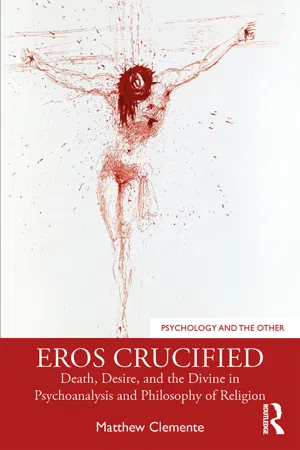
Table of contents

  1. Cover
  2. Half-Title
  3. Series
  4. Title
  5. Copyright
  6. Dedication
  7. Contents
  8. A brief disclaimer: Knowing that you know not, or how to read philosophy
  9. Preface
  10. Acknowledgments
  11. Introduction
  12. Part 1 Creation: A theological aesthetic
  13. Part II Incarnation A theological dramatic
  14. Afterword: Eschaton: A theopoetic
  15. Conclusion: Eternal recurrence of the new: A repetition forward
  16. Index