- 192 pages
- English
- ePUB (mobile friendly)
- Available on iOS & Android
eBook - ePub
Complications in Laser Cutaneous Surgery
About this book
The concept of selective photothermolysis revolutionized cutaneous therapy and continues to be the basis of low-risk laser treatment of photoaged skin, benign pigmented lesions and tattoos, unwanted hair, and cutaneous vascular lesions. However, all practitioners are aware that problems can arise, and with the increasing availability of more powerf
Information
1
LASER COMPLICATIONS: LASER-TISSUE INTERACTION
KEY POINTS
- An understanding of basic laser-tissue interaction will lead to a lessened incidence of laser complications
- Complications are more common after ablative laser resurfacing as compared to non-ablative techniques. However, no dermal remodeling technique will have a zero incidence of complications
- Complications from pigment-specific lasers are usually related to collateral tissue damage occurring during treatment. This will be more common from millisecond, as compared to nanosecond pigmented lesion and light sources
- Complications from laser hair removal systems occur because of either too much heat delivered into the dermis or alternatively not enough epidermal cooling
- Complications from vascular lasers are generally related to excess heat or insufficient cooling. This is more common with longer wavelength systems
INTRODUCTION
Lasers represent the most precise and selective surgical tools ever made. For years electromagnetic radiation (EMR) from lasers, lamps, and other EMR sources has been used to treat a variety of medical conditions in ophthalmology, dermatology, urology, otolaryngology, and other specialties.
Dermatologic EMR sources have been used to perform a wide variety of procedures including hair removal, treatment of pigmented lesions, removal of unwanted vascular lesions, tattoo removal, and skin resurfacing (Figure 1.1). For all these treatments, a natural or artificial chromophore present in the body is heated by absorption of either monochromatic or broadband EMR. Typical natural chromophores include water, melanin, and hemoglobin. Artificial chromophores include the various dyes and inks seen in tattoos.
The entire skin is accessible to light. At an optical wavelength of about 1200 nm, about one quarter of the incident light goes entirely through the dermis.1 In principle, then, every cell type and multicellular structure in the skin is a potential treatment target. However, according to the Grotthus-Draper law, selective photothermolysis and all associated light-activated mechanisms must begin with light absorption of a penetrating light.
Excellent progress has been seen when the EMR ‘target’ is the natural chromophores of hemoglobin or melanin. In tattoo removal, an exogenous pigment defines the target. There is no single laser (wavelength) that will perform every kind of laser surgery. While performing laser surgery, attention must be focused not only on the laser’s potential to perform precise treatments, but also on the destructive potential of that same EMR-emitting system. It is this destructive potential that forms the basis of potential complications that may be associated with cutaneous laser surgery.
In the ultimate analysis, current laser systems all heat an absorbing target. A laser surgeon wishes to avoid excess thermal injury to tissue. There is, generally, a transitional zone between death and survival of any biologic system heated above its normal temperature. Any combination of temperature and time, corresponding to a point lying beyond the transition zone, will lead to the potential for excess tissue injury and resultant complications.
BASIC LASER PRINCIPLES
The term LASER is an acronym for the words Light Amplification by the Stimulated Emission of Radiation (Figure 1.2). Radiation may be defined as the transmission of energy from one point in space to another, with or without an intervening material absorbing medium.
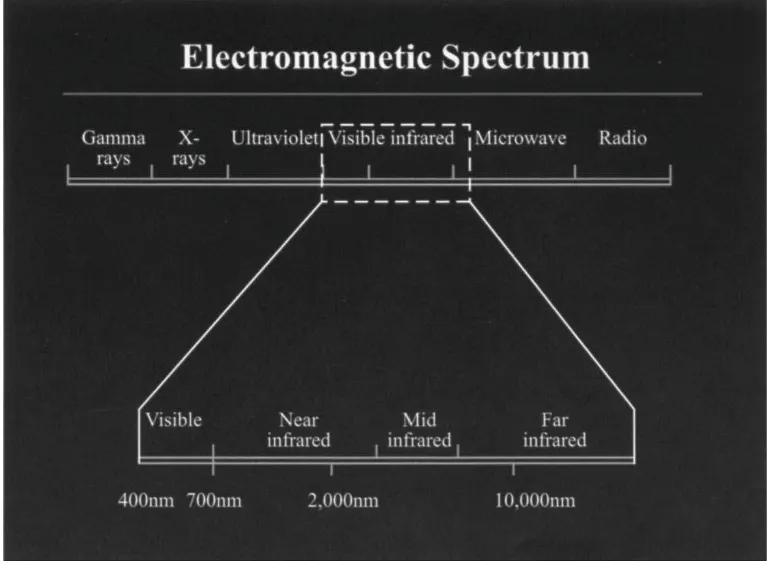
Figure 1.1. Electromagnetic spectrum (EMR) utilized in dermatologic laser treatments
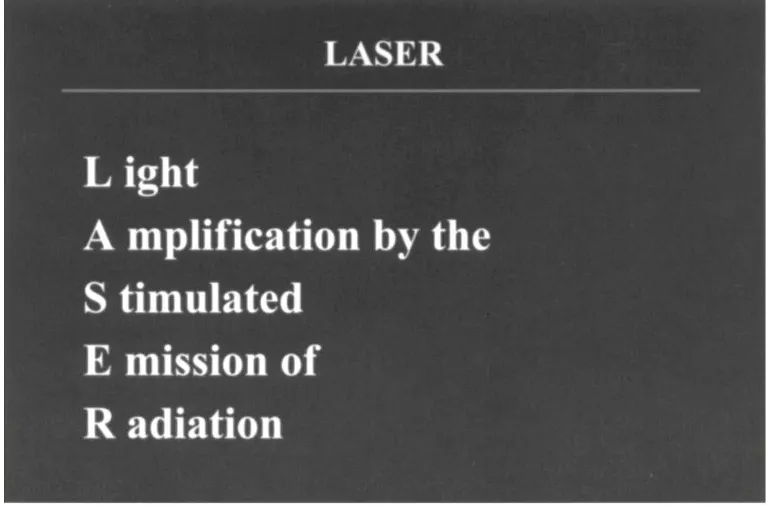
Figure 1.2. LASER (Light Amplification by the Stimulated Emission of Radiation)
Radiation can be:
- Particulate radiation. Particulate radiation is a stream of material particles, such as electrons, neutrons, or other atomic fragments. This kind of radiation needs no material medium for its transmission, but can pass through various mediums, usually with some attenuation and/or change of direction. Particulate radiation requires a transfer of mass, and the energy transmitted is the kinetic energy of the moving particles. Dermatologic lasers do not fit into this category.
- Mechanical radiation. Mechanical radiation is the transmission of vibrations through a material medium. Sound is an example. Mechanical radiation requires the presence of a material medium for its transmission. However, the medium need not move as a whole; its particles merely oscillate elastically about fixed positions, transmitting energy from one to the next. Current dermatologic lasers also do not fit into this category.
- Electromagnetic radiation (EMR). EMR is what current dermatologic lasers produce. Unlike mechanical radiation, electromagnetic radiation requires no medium for its transmission, as it can travel through free space devoid of any matter whatever. It can also propagate through space-containing matter in the form of gases, liquids, or solids. Upon entering such mediums electromagnetic radiation will, in general, be changed in direction and speed of propagation.
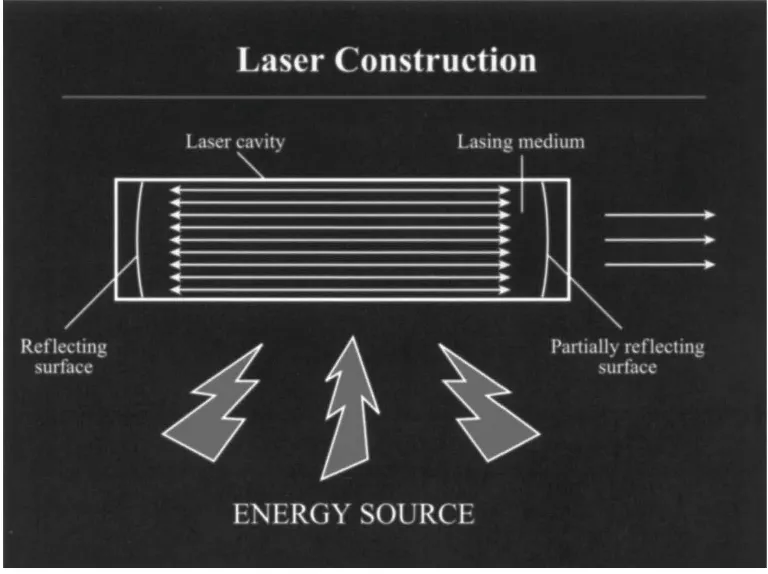
Figure 1.3. Laser structure
ELECTROMAGNETIC SPECTRUM
The range of values in terms of frequency, wavelength, and/or photonic energy encountered in the natural universe is known as the electromagnetic spectrum. In terms of any one of these parameters, there may be a span of some ×20 magnitude. At the very short end of the wavelength spectrum, there are cosmic rays, and at the very long end there are radio waves.
In general, lasers generate EMR ranging in wavelengths from 100 nm to 20000 nm (1 nm=1×10⁻⁹ m). Although for simplicity these wavelengths are all called ‘light’, by strict definition light is only the interval from 400 nm to 700 nm. This is the light which our eyes can perceive in daylight (the visible light spectrum).
The amount of laser energy delivered per area is fluence, sometimes called the dose, usually given in J/cm2 (joules). The rate at which energy is delivered is called power, measured in watts (W). Power delivered per unit area is therefore the rate of energy delivery per amount of skin surface. This is called the irradiance, usually given in W/cm2. Laser exposure duration (pulsewidth) for pulsed lasers, is an extremely important term because this parameter defines the time over which energy is delivered. Finally, the laser delivery system spot size may greatly affect intensity within the skin.
BASIC ELEMENTS OF LASERS
Every laser has certain common elements of structure and function (Figure 1.3). These common elements are:
- A material medium having the proper energy levels to produce the desired wavelengths of light. The mediums available today for lasers include hundreds of different materials grouped into three basic categories: gases, liquids, and solids.
- A resonant optical cavity shaped in the form of a cylinder whose length is much greater than its diameter, and having coaxial mirrors at opposite ends of it.
- An external source of energy to provide the excitation of the atoms or molecules of the medium by the process of pumping.
- The delivery system which may be composed of fiberoptics or articulating mirrors. Not all wavelengths of laser light can be transmitted efficiently through a slender quartz optical fiber, the most flexible and convenient device of all. In noninvasivecosmetic laser dermatology, where laser wavelengths lie in a range from 300 nm to 2100 nm, the most commonly used delivery system is the quartz optical fiber. Wavelengths in the mid-to-far infrared (2500–20000 nm ablative lasers) range of the spectrum must be transmitted via a series of articulating mirrors.
GENERATION OF LASER LIGHT
Laser light is generated when the laser medium is pumped by the introduction of energy from an external source. Some of the atoms or molecules in the medium will be excited into an upper level of energy. From there, one sees a possible downward radiative transition to a lower level that is above the ground level. The difference between this upper level and the original status of the laser medium determines the frequency and wavelength of the emitted laser radiation.
UNIQUE/SPECIAL PROPERTIES/ CHARACTERISTICS OF LASER LIGHT
It is now well established that laser light has three unique/special characteristics:
- Collimation
- Coherence
- Monochromaticity.
Collimation: Laser-emitted rays are collimated in that they emanate from a laser, and all rays are parallel to each other. Because of this property of laser light there is no divergence or convergence of laser-emitted radiation, unless a lens or mirror is placed in front of the beam path.
Coherence: Laser-emitted irradiation is coherent in that the rays are in phase with each other in both space and time. Spatial coherence means that the crests and troughs of all the waves coincide along lines perpendicular to the rays. Temporal coherence means that the frequency, wavelength, and speed of travel are all constant.
Monochromaticity: Laser light is said to be monochromatic in that it consists of just one wavelength. In reality, no light source produces just a single wavelength, but the bandwidth variation of dermatologic lasers is generally no more than 0.1 nm.
LASER-TISSUE INTERACTION
Laser-tissue interaction leads to four fundamental optical phenomena:
- Reflection and backscattering from the surface at impact
- Transmission into or through the tissue
- Absorption by the tissue
- Scattering within and perhaps out ...
Table of contents
- COVER PAGE
- TITLE PAGE
- COPYRIGHT PAGE
- PREFACE
- 1: LASER COMPLICATIONS: LASER-TISSUE INTERACTION
- 2: COMPLICATIONS IN LASER RESURFACING
- 3: COMPLICATIONS IN LASER TREATMENT OF TATTOOS AND PIGMENTED LESIONS
- 4: COMPLICATIONS IN LASER TREATMENT OF UNWANTED HAIR
- 5: COMPLICATIONS IN LASER TREATMENT OF VASCULAR LESIONS
Trusted by 375,005 students
Access to over 1.5 million titles for a fair monthly price.
Study more efficiently using our study tools.
Frequently asked questions
Yes, you can cancel anytime from the Subscription tab in your account settings on the Perlego website. Your subscription will stay active until the end of your current billing period. Learn how to cancel your subscription
No, books cannot be downloaded as external files, such as PDFs, for use outside of Perlego. However, you can download books within the Perlego app for offline reading on mobile or tablet. Learn how to download books offline
Perlego offers two plans: Essential and Complete
- Essential is ideal for learners and professionals who enjoy exploring a wide range of subjects. Access the Essential Library with 800,000+ trusted titles and best-sellers across business, personal growth, and the humanities. Includes unlimited reading time and Standard Read Aloud voice.
- Complete: Perfect for advanced learners and researchers needing full, unrestricted access. Unlock 1.5M+ books across hundreds of subjects, including academic and specialized titles. The Complete Plan also includes advanced features like Premium Read Aloud and Research Assistant.
We are an online textbook subscription service, where you can get access to an entire online library for less than the price of a single book per month. With over 1.5 million books across 990+ topics, we’ve got you covered! Learn about our mission
Look out for the read-aloud symbol on your next book to see if you can listen to it. The read-aloud tool reads text aloud for you, highlighting the text as it is being read. You can pause it, speed it up and slow it down. Learn more about Read Aloud
Yes! You can use the Perlego app on both iOS and Android devices to read anytime, anywhere — even offline. Perfect for commutes or when you’re on the go.
Please note we cannot support devices running on iOS 13 and Android 7 or earlier. Learn more about using the app
Please note we cannot support devices running on iOS 13 and Android 7 or earlier. Learn more about using the app
Yes, you can access Complications in Laser Cutaneous Surgery by David J. Goldberg in PDF and/or ePUB format, as well as other popular books in Medicine & Dermatology. We have over 1.5 million books available in our catalogue for you to explore.