Focusing on Barbados, Trinidad and Tobago, Jamaica, and Guyana, Professor Hope examines the determinants and socioeconomic consequences associated with urban population growth. He documents demographic trends in the region, examines government policies that inadvertently encourage urbanization, and discusses the effects of too-rapid growth on urban
- 144 pages
- English
- ePUB (mobile friendly)
- Available on iOS & Android
eBook - ePub
Urbanization In The Commonwealth Caribbean
About this book
Information
1
Urbanization and Economic Development in the Third World: An Overview
Urbanization is conventionally defined as the process of growth in the urban proportion of a country's entire population, rather than merely in the urban population per se. If urbanization is so defined then the appropriate measure of the rate of urbanization is the difference between the growth rates of the urban population and the national population.1 During the past two decades, there has been rapid urbanization in much of the Third World due primarily to development strategies that emphasized urban growth at the expense of agricultural and rural development. As a result, the rate of increase in the size of the nonagricultural population exceeds the rate of increase in meaningful nonagricultural employment opportunities, thus leading to what has now come to be known as "over-urbanization."
This chapter offers a broad overview of the urbanization dilemma in the Third World - within the context of elusive development - with particular attention to current trends, components, consequences, and policies designed to manage it.
Current Trends in Urbanization
Current urbanization rates in Third World cities are unique in the sense that these trends now result in some global concern. Today, a mere one percent shift of the world's population from rural to urban areas represents 44 million people.2 Estimates of the United Nations suggest that during the period 1980-2000 there will be a 1.4 billion increase in population in urban centers
Table 1.1
Total Urban Population and Proportion of Population Living in Urban Areas By Major Areas and Region, 1960-2000
(Millions and Percentages)
Total Urban Population and Proportion of Population Living in Urban Areas By Major Areas and Region, 1960-2000
(Millions and Percentages)
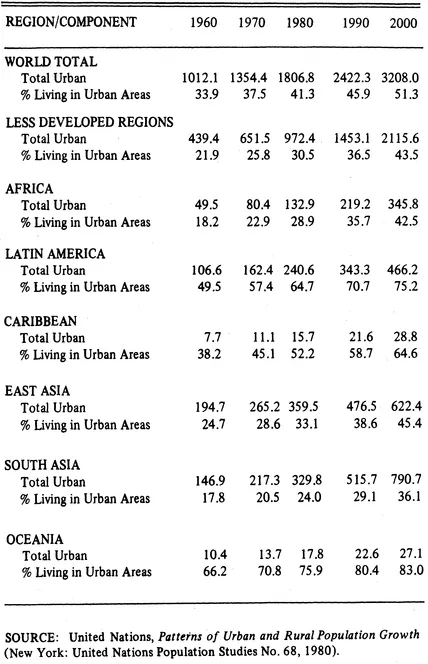
worldwide (as seen in Table 1.1), of which 1.2 billion will be in the Third World.
By the year 2000, the majority of the world's urban population (66 percent) will reside in the Third World. Between 1950 and 2000, it is anticipated that the urban population of the Third World will grow by a factor of 7.7, or factors of 10.9 in Africa, 6.9 in Latin America, 9.2 in East Asia (excluding Japan), and 7.5 in South Asia. In comparison, the urban population of the more developed regions is expected to grow by a factor of only 2.4 during the same period. Seventy-four percent of the anticipated growth in global urban population between 1950 and 2000 is expected to occur in the Third World with a breakdown of 13 percent in Africa, 16 percent in Latin America, 18 percent in East Asia, and 28 percent in South Asia.3
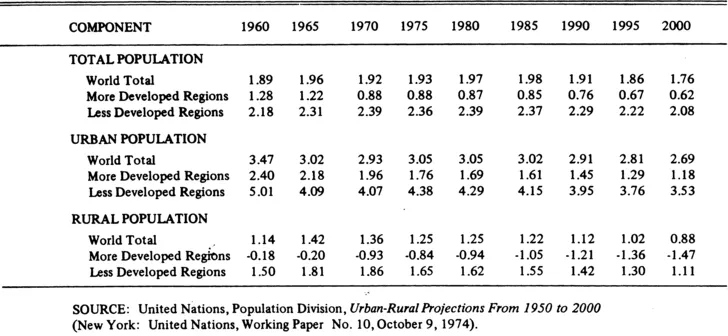
The average annual growth rates of total, rural, and urban population are depicted in Table 1.2. The urban growth rates of the Third World countries have been, and are projected to continue to be, twice as high as the urban growth rate of the more developed nations and three times as high by the last decade of the century. By the end of the century the world urban population is projected to be in the neighborhood of 3.3 billion, an increase of approximately 145 percent.4 During the period 1950-2000 world population is projected to grow by 160 percent and the urban population by 375 percent.5
In the 1950s Latin America and East Asia were the regions that experienced the most rapid urban growth. However, they have now been replaced by Africa. During the period 1975-80, urban areas in Africa were estimated to have grown at an annual rate of 5.1 percent. South Asia also experienced rising urban growth rates during the 1950-80 period, increasing steadily from an annual average of 3.37 percent during 1950-60 to 4.33 percent during 1975-80.6
Components of Urbanization
The significant growth of the urban population in the Third World today is the direct result of two major factors: natural increase of the urban population and rural-urban migration. Let us examine each component in detail, begining with the natural population increase.
TABLE 1.2
Average Annual Growth Rates of Total, Urban, and Rural Population By Region, 1960-2000
(Percentages)
Average Annual Growth Rates of Total, Urban, and Rural Population By Region, 1960-2000
(Percentages)
Natural Population Increase
Despite the much larger pool of potential rural-urban migrants in the Third World, the rate of urban in-migration, on the whole, differs very little from that of the more developed countries. It is therefore fair to conclude that the causes of rapid urban growth in the Third World are closely linked to the causes of rapid natural increase, particularly in Latin American and South Asian countries.
In Table 1.3 we see that in half of the countries natural population increase was responsible for more than 50 percent of urban growth. Conversely, in the other half of the countries the natural population increase accounted for less than 50 percent of the urban growth. Demographers have shown that the proximate cause for today's rapid urban population growth in those countries with large natural increases of the urban population has been the postwar decline in mortality rates which increased the gap between fertility and mortality.
TABLE 1.3
Share of Urban Growth Due to Natural Population Increase In Selected Third World Nations, 1970-75
(Percent)
Share of Urban Growth Due to Natural Population Increase In Selected Third World Nations, 1970-75
(Percent)
| COUNTRY | SHARE OF GROWTH DUE TO NATURAL INCREASE |
|---|---|
| PAPUA NEWGUINEA | 26 |
| TANZANIA | 36 |
| NIGERIA | 36 |
| COLOMBIA | 57 |
| MEXICO | 77 |
| THAILAND | 55 |
| SRI LANKA | 39 |
| INDIA | 55 |
SOURCE: Kathleen Newland, City Limits: Emerging Constraints on Urban Growth (Washington, D.C.: Worldwatch Institute, 1980), p.10.
The primary factors in the decline in mortality in the world have been well documented and are better understood than the factors in the decline of fertility. The decrease in mortality was in large part the unanticipated and unplanned by-product of social, technological, economic, and political change.7 The decrease in mortality was disproportionately achieved by lower infant and child mortality. Whereas, expectation of life at birth has greatly increased, doubling and more than doubling, that at age 60 has gone up relatively little. The reduced death rates in the Third World were also partly achieved exogenously as the result of technology and technical know-how imported from abroad. Thus, although it took the United States the first half of this century to cut its death rate in half, it took Sri Lanka, for example, less than a decade to do the same after World War II.8
Yet, despite the continued rapid decline in mortality in the Third World, there is alarming evidence that some causes of death believed to have been subjected to control have reappeared. For example, deaths attributed to malaria have increased as this disease has again become a health problem in a number of Third World nations in Asia and Africa.9
Mortality is the result of the interaction of three sets of factors affecting an individual's physical well-being. These are (1) public health services, such as immunization, which affect mortality regardless of individual behaviour; (2) health and environmental services (for example, clean water), which reduce the costs of health to individuals but require some individual response; and (3) an array of individual characteristics, including both income, which affects health through food consumption and housing, and education, which affects the speed and efficiency with which individuals respond to health and environmental services.10 It is now argued that of these three sets of factors affecting mortality, the benefits of the first have been more or less fully harvested.11 Further mortality declines depend therefore on changes in individual behaviour that are facilitated by increasing income and education and better access to health services.
However, mortality continued to decline in the Third World during the last decade, though not as quickly as it did during the previous twenty years. The Third World has now reached mortality rates of about 10 to 20 per 1,000 — rates which the developed countries did not attain until about 1900, and in some instances, even 1925.12
With the possible exception of Africa, the Third World has entered a phase of demographic transition. After significant reductions in mortality following World War II, many Third World countries are now experiencing a decline in fertility that may eventually lead to a new state of stationary population.13 However, since the developed world reached replacement fertility in 1975 and its population is expected to grow very little then almost all future population growth will be contributed by the Third World. The size of the future population depends therefore upon future fertility changes in the Third World.
Fertility declines in the Third World began ...
Table of contents
- Cover
- Half Title
- Dedication
- Title
- Copyright
- Contents
- List of Tables
- Preface
- 1 URBANIZATION AND ECONOMIC DEVELOPMENT IN THE THIRD WORLD: AN OVERVIEW
- 2 URBAN POPULATION GROWTH AND URBANIZATION IN THE CARIBBEAN
- 3 UNEMPLOYMENT, LABOUR FORCE PARTICIPATION, AND URBANIZATION IN THE CARIBBEAN
- 4 TOWARD POLICIES FOR MANAGING RAPID URBANIZATION IN THE CARIBBEAN
- 5 SUMMARY AND CONCLUSIONS
- Select Bibliography
- Index
Trusted by 375,005 students
Access to over 1.5 million titles for a fair monthly price.
Study more efficiently using our study tools.
Frequently asked questions
Yes, you can cancel anytime from the Subscription tab in your account settings on the Perlego website. Your subscription will stay active until the end of your current billing period. Learn how to cancel your subscription
No, books cannot be downloaded as external files, such as PDFs, for use outside of Perlego. However, you can download books within the Perlego app for offline reading on mobile or tablet. Learn how to download books offline
Perlego offers two plans: Essential and Complete
- Essential is ideal for learners and professionals who enjoy exploring a wide range of subjects. Access the Essential Library with 800,000+ trusted titles and best-sellers across business, personal growth, and the humanities. Includes unlimited reading time and Standard Read Aloud voice.
- Complete: Perfect for advanced learners and researchers needing full, unrestricted access. Unlock 1.5M+ books across hundreds of subjects, including academic and specialized titles. The Complete Plan also includes advanced features like Premium Read Aloud and Research Assistant.
We are an online textbook subscription service, where you can get access to an entire online library for less than the price of a single book per month. With over 1.5 million books across 990+ topics, we’ve got you covered! Learn about our mission
Look out for the read-aloud symbol on your next book to see if you can listen to it. The read-aloud tool reads text aloud for you, highlighting the text as it is being read. You can pause it, speed it up and slow it down. Learn more about Read Aloud
Yes! You can use the Perlego app on both iOS and Android devices to read anytime, anywhere — even offline. Perfect for commutes or when you’re on the go.
Please note we cannot support devices running on iOS 13 and Android 7 or earlier. Learn more about using the app
Please note we cannot support devices running on iOS 13 and Android 7 or earlier. Learn more about using the app
Yes, you can access Urbanization In The Commonwealth Caribbean by Kempe R Hope in PDF and/or ePUB format, as well as other popular books in Politics & International Relations & Politics. We have over 1.5 million books available in our catalogue for you to explore.