Examining the rise of Pudong and its role in re-creating Shanghai as a global city, Global Shanghai Remade utilises this important case study to shed light on contemporary globalisation and China's integration with the world since the late 20th century.
Unpacking the rise of Pudong in the context of Deng Xiaoping's nation-building agenda, this book explores the development of the district from its earliest planning into a global city centre through multiple perspectives. In doing so, it explores the role of key decision-makers and actors, the strategic planning process, the approaches to urban development, and some of the iconic projects that define the rise of Pudong, Shanghai, and China itself. A timely volume for the 30th anniversary of China's strategy of 'developing and opening Pudong,' it combines the analyses and findings from these perspectives into a framework for a broader understanding of city-making with Chinese characteristics.
The first study of its kind, providing a comprehensive and systematic examination of Pudong, this book will be useful for students and scholars of urban planning and design, as well as Chinese Studies and Development Studies more generally.
Hold fast to the development of Pudong and do not waver until it is built.
Deng Xiaoping, 18 February 1991
Introduction
Deng Xiaoping orchestrated the development and opening of Pudong, Shanghai, which formally commenced on 18 April 1990. Deng’s vision was more than building a new city area. Pudong was Deng’s ‘ace card’: politically it would help re-launch his national agenda of ‘reform and opening-up’, stalled after the Tian-anmen Square Incident in June 1989; economically it would regenerate Shanghai and drive both the regional economy of the Yangtze River delta and the national economy. As Pudong New Area (PNA), the formal administrative title of Pudong, moves towards its thirtieth anniversary, Deng’s vison has been fulfilled. PNA, with a land area of 1,200 km2 and a population in 2019 of five million, is a new city made from scratch within three decades. Pudong is a contemporary urban miracle, typifying China’s urbanisation – the largest scale of urbanisation in human history. Thirty years ago, not many people could have imagined a new city would grow out of a vast expanse of semi-urban and mostly rural land to the east of Shanghai across the Huangpu River. Today, Pudong is an urban centre of global importance; Shanghai has become a leading global city.
In this book, we write about the rise of Pudong, and its role in remaking Shanghai as a global city. We situate our investigation of Pudong within the broader contexts of contemporary globalisation and China’s integration with the world since the late 20th century. Within these contexts, Pudong has played a critical role in Shanghai’s re-emergence on the global stage, and China’s resurgence as a world power through Deng Xiaoping’s nation-building agenda. We unpack the rise of Pudong from its earliest planning into a global city centre, through multiple perspectives: we look at the role of key decision-makers and actors, the strategic plan making for Shanghai and Pudong, the approaches to urban development, and some of the iconic projects that define the rise of Pudong, Shanghai, and China. We integrate analyses and findings from these perspectives into forging a framework for understanding city making with Chinese characteristics. This book is the first study of its kind, providing a comprehensive and systematic examination of Pudong in order to gain new insights into global Shanghai and city making in China.
In China, Shanghai is often known as the ‘dragon’s head’ city; Pudong’s special role in Shanghai can be metaphorised as ‘the dragon’s eye’. Towards the end of this introductory chapter, we will explain the underlying meaning of these expressions, and show how the economic performance of both places justifies these names. First, however, we provide a brief history of modern Shanghai in three broad stages. The first of these is: ‘colonialism’ (1843–1949). This period incorporates Shanghai’s opening to the West as a trade city, and its growth into a world metropolis and an international financial and economic centre in the Far East in the 1920s and 1930s. The second historical stage we label ‘socialism’ (1949–78). In 1949, Shanghai was closed to the international community when the People’s Republic of China (PRC) was established, and it was re-opened in 1978 when the national agenda of ‘reform and opening-up’ was initiated by Deng Xiaoping. The final stage, which began in 1978, we refer to as ‘globalism’. This period has seen the rise of Shanghai, especially after the 1990s, so that by the second decade of the 21st century it has become a leading global city. Almost one century after its golden age in the 1920s and 1930s, Shanghai has reclaimed its glory as a city of global reputation. This book’s central focus on Pudong sits in the third stage of ‘globalism’. This chapter finishes setting the scene for the remainder of the book by describing how we have approached our topic, and giving a preview of the overall organisation of the book with a brief summary of each chapter.
Colonialism
Located at the estuary of the Yangtze River, and with China’s richest region in its hinterland, Shanghai has great endowments and through these could have been predestined to become a great city. However, the genesis of modern Shanghai was accidental. It started with a humiliating event in Chinese modern history. On 17 November 1843, Shanghai was declared open to foreign trade, according to the Treaty of Nanking signed after China’s Qing Dynasty (1644–1912) army was defeated by the United Kingdom in the First Opium War, which lasted from 1840 to 1842. The year 1843 thus marks a distinct line between Shanghai’s pre-modern history as a market and port town, and Shanghai’s modern history as it has developed into an international metropolis. Unlike many Chinese major cities that have long and grandiose histories, Shanghai’s history before 1843 was relatively short and not especially illustrious. An early form of urban settlement in what is now the Shanghai area took shape around 1,000 years ago, during the Northern Song Dynasty (960–1127). In 1291, during the Yuan Dynasty (1279–1368), Shanghai County was established. In 1553, in the time of the Ming Dynasty (1368–1644), a city wall was constructed to defend against Japanese pirates, thus formally establishing an ancient Chinese city form. In 1687, during the Qing Dynasty, customs arrangements for both river and sea trade were established in Shanghai County. These administrative arrangements reflected the growing economic activities and increasing population in the Shanghai area. During the 18th and early 19th centuries, Shanghai County gradually developed into a market and port town and became at that time one of the most prosperous counties in southeast China, attracting merchants from other parts of China doing business in cotton, tea, grain, shipping, trade, and auxiliary services (Johnson, 1995). In 1852, Shanghai County had a land area of 558 km2, and a population of around 540,000, of whom around 200,000 lived inside the walled city (SUPDRI, 2007).
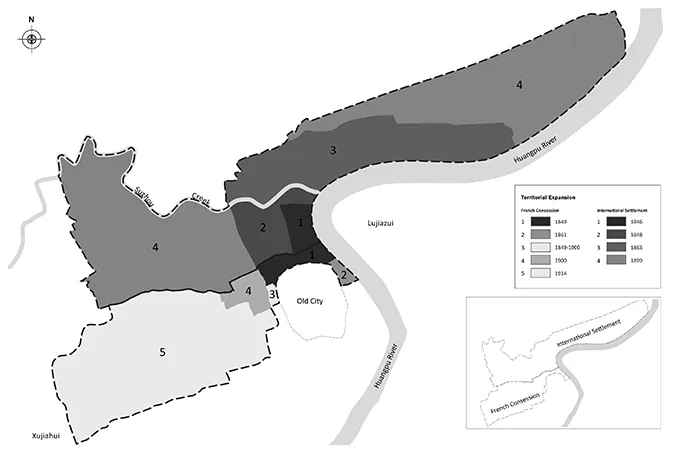
The year 1843, as noted earlier, represents an important dividing line in Shanghai’s history, and marks the commencement of what we are terming the ‘colonialism’ stage of Shanghai. Colonial Shanghai was based on the establishment and incremental expansion of foreign settlements. Land lots were leased for foreign residents with extraterritoriality – an exemption from local laws – according to arrangements in the Land Regulations, put into place in 1845 and 1854 and agreed between the Chinese local authorities and the foreign consuls (Pott, 1928). Figure 1.1 shows the territorial expansions of the International Settlement and the French Concession – the two major foreign settlements with extraterritorial authority in colonial Shanghai. In 1846, an area of 55.3 hectares in the Bund area was leased to the United Kingdom with extraterritoriality (Sun, 1999). This was the first foreign ‘concession’ in Chinese modern history. In 1848, the British Concession was expanded westward to increase the area to 188 hectares; and an American Concession was designated in Hongko but without boundary delimitation, and this was expanded into an area of 591 hectares in 1863 (Sun, 1999). Then in the same year, the British Concession and the American Concession were merged into the International Settlement. In 1899, the International Settlement was enlarged northeastward along the Huangpu River to a total area of 2,288.9 hectares (Sun, 1999). The French Concession started with an area of 65.7 hectares in 1849, which was expanded to an area of 74.9 hectares in 1861; major subsequent expansions occurred in 1900 and 1914 respectively, with the French Concession ending up with a total area of 1,010 hectares (Sun, 1999).
FIGURE 1.1 Indicative map of foreign settlements in colonial Shanghai
Source: The authors.
These foreign settlements existed in Shanghai for almost a full century. Their existence represented a ‘transnational colonialism’, since the governance of these areas, through the Shanghai Municipal Council for the International Settlement for example, was beyond the control of either the host Chinese authority or the foreign imperial government. They were subject to colonial influence, but enjoyed a high degree of autonomy in activities and were transnational in personnel (Jackson, 2018). Despite the vast area and profound influence of these foreign settlements, the foreign population in colonial Shanghai remained a small proportion of the total population. The number of foreigners living in Shanghai was less than 1,000 until 1860, and even by 1936, when Shanghai was already a metropolis of 4 million residents, the foreign population was only around 60,000 (Murphey, 1953). While comparatively small, this foreign population and the presence of the foreign settlements injected a cosmopolitan gene into Shanghai’s modern history, and reshaped the city’s economy, institutions, urban morphology, and social life.
In late 1937, the Japanese army invaded, and occupied Shanghai after the Chinese army lost the Battle of Shanghai between August and November. The Japanese army occupied Shanghai from 1937 until 1945, isolating the city from both domestic and international connections. Shanghai was called ‘a lonely island’ in this period. In the initial stages of the war, the foreign settlements largely remained neutral and were left unoccupied. However, after the Pearl Harbor attack on 7 December 1941, the Japanese army occupied the International Settlement, virtually terminating its history. On 23 February 1943, the puppet French Vichy Government renounced the French Concession. On 20 May 1943, both the United Kingdom and the United States formally relinquished their extraterritorial rights in China, which legally terminated the International Settlement although it was not under their control at the time. In August 1943, the Japanese-occupied International Settlement was also returned. These foreign settlements were then taken over by the Wang Jingwei Government, a Japanese-controlled puppet government then in place, thus formally eliminating the century of extraterritoriality in Shanghai. During that single century of 1843–1943, Shanghai had ‘twin cities’ – a foreign Shanghai and a Chinese Shanghai – which were different from each other, and were often in contrast across many dimensions: housing, streetscapes, spirituality, and law (Balfour & Zheng, 2002, p. 63). After the end of World War II (WWII) in 1945, Shanghai was taken over by the Nationalist Government of the Republic of China (RoC), until 1949 when the RoC was replaced by the PRC, following the Civil War between the Nationalists and the Communists in 1946–49.
The century of colonialism witnessed the kaleidoscope of Shanghai’s transformation into a modern city, and provides a key to China’s modernity and modernisation in microcosm (Bergere, 2009; Jackson, 2018; Murphey, 1953). Among the many features of this period of Shanghai’s history, two stand out. One is the co-existence of a foreign Shanghai, represented by the foreign settlements, and a Chinese Shanghai. The other is Shanghai’s growth into one of the top-tier world cities from the early 1920s until the 1930s. The binary of Sino-foreign Shanghai was a place where two civilisations met, clashed, and fused to create a unique Shanghainese local culture that has nurtured the modern Shanghai. The foreign settlements cracked the walls of an ancient enclosed society, and injected into that society Western systems that were ‘rational, legal-minded, scientific, industrialised, efficient, and expansionist’ (Murphey, 1953, p. 3). Before the formal termination of the foreign settlements, three governance and regulation systems operated in Shanghai: the Chinese area, the International Settlement, and the French Concession. In the beginning, the foreign settlements were not open to Chinese residents. Gradually, this restriction became unrealistic and was loosened, and it was not long until more Chinese than foreigners lived in the concessions. However, the duality of Sino-foreign Shanghai persisted, presenting a contrast in terms of ruling and policing, urban planning, civil services, housing, architecture, and lifestyle. The spillover of Western thinking, technology, business, and way of life impacted the Chinese community in Shanghai, and spread elsewhere in China. Colonial Shanghai experienced the most turbulent chapter in the city’s history: dome...
Table of contents
Cover
Half Title
Title Page
Copyright Page
Table of Contents
List of figures
List of tables
Foreword
Acknowledgements
Abbreviations
1. The dragon’s head
2. Makers and making
3. Planning Greater Shanghai
4. Planning Pudong New Area
5. The financial city
6. The science city
7. Urban icons
8. City making with Chinese characteristics
A timeline for Pudong New Area, 1990–2018
A glossary of Chinese names and expressions
Index
Trusted by 375,005 students
Access to over 1.5 million titles for a fair monthly price.
Study more efficiently using our study tools.
Frequently asked questions
Yes, you can cancel anytime from the Subscription tab in your account settings on the Perlego website. Your subscription will stay active until the end of your current billing period. Learn how to cancel your subscription
No, books cannot be downloaded as external files, such as PDFs, for use outside of Perlego. However, you can download books within the Perlego app for offline reading on mobile or tablet. Learn how to download books offline
Perlego offers two plans: Essential and Complete
Essential is ideal for learners and professionals who enjoy exploring a wide range of subjects. Access the Essential Library with 800,000+ trusted titles and best-sellers across business, personal growth, and the humanities. Includes unlimited reading time and Standard Read Aloud voice.
Complete: Perfect for advanced learners and researchers needing full, unrestricted access. Unlock 1.5M+ books across hundreds of subjects, including academic and specialized titles. The Complete Plan also includes advanced features like Premium Read Aloud and Research Assistant.
Both plans are available with monthly, semester, or annual billing cycles.
We are an online textbook subscription service, where you can get access to an entire online library for less than the price of a single book per month. With over 1.5 million books across 990+ topics, we’ve got you covered! Learn about our mission
Look out for the read-aloud symbol on your next book to see if you can listen to it. The read-aloud tool reads text aloud for you, highlighting the text as it is being read. You can pause it, speed it up and slow it down. Learn more about Read Aloud
Yes! You can use the Perlego app on both iOS and Android devices to read anytime, anywhere — even offline. Perfect for commutes or when you’re on the go. Please note we cannot support devices running on iOS 13 and Android 7 or earlier. Learn more about using the app
Yes, you can access Global Shanghai Remade by Richard Hu,Weijie Chen in PDF and/or ePUB format, as well as other popular books in Politics & International Relations & City Planning & Urban Development. We have over 1.5 million books available in our catalogue for you to explore.