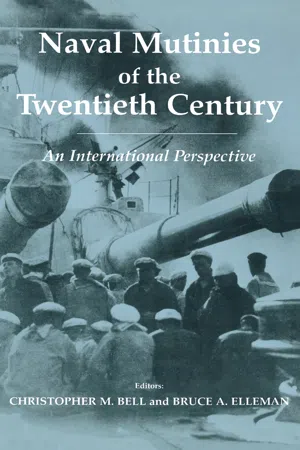
eBook - ePub
Naval Mutinies of the Twentieth Century
An International Perspective
- 288 pages
- English
- ePUB (mobile friendly)
- Available on iOS & Android
eBook - ePub
Naval Mutinies of the Twentieth Century
An International Perspective
About this book
This volume brings together a set of scholarly, readable and up-to-date essays covering the most significant naval mutinies of the 20th century, including Russia (1905), Brazil (1910), Austria (1918), Germany (1918), France (1918-19), Great Britain (1931), Chile (1931), the United States (1944), India (1946), China (1949), Australia, and Canada (1949)
1
The Battleship Potemkin and its Discontents, 1905
Robert Zebroski
The Potemkin mutiny of June 1905 had all of the makings of a sensationalized media event. Russian sailors captured the early twentieth-century imagination by doing the unthinkable: they commandeered the newest and most formidable battleship in the Black Sea, brandished it as a weapon for political reform, and for 11 days befuddled the Russian government’s attempts to suppress them. The Potemkin mutiny has been kept alive in modern memory by filmmakers, poets, artists, and composers. From Sergei Eisenstein’s film Battleship Potemkin to Boris Pasternak’s poem 1905 and Francis Bacon’s painting Battleship Potemkin, the mutiny has long inspired the imaginations of artists. Nearly a century later, it still resonates in our consciousness as one of the twentieth century’s most dramatic and enduring events.
Western historians have treated the Potemkin mutiny as an isolated incident that does not warrant closer examination.1 By contrast, the mutiny was widely documented and celebrated in Soviet historiography. In the 1920s, V.I.Nevskii conducted pioneering research by assembling all captured tsarist documents about the sailors, producing an account of the mutiny that was comprehensive and, by Soviet standards, reasonably balanced.2 Valuable narratives and documentary collections were produced by A.P.Platonov, I.P.Voronitsyn, and V.V.Maksakov.3 During the Stalinist era (1928–53), Soviet historians exaggerated the significance of the mutiny, a trend that persisted until the 1970s. Under glasnost, important works by B.I.Gavrilov and Iu. P.Kardashev reopened serious discussion and research on this subject.4 While making greater use of archival materials, Soviet historians tended to promote the revolutionary heroism of the sailors while often losing sight of the fact that many radical groups other than the Bolshevik Party influenced the sailors’ movement.
This chapter relies heavily on eyewitness participant accounts, especially those written soon after the mutiny and prior to 1917.5 Wherever possible, however, it employs primary sources. While Soviet historians often dismiss the court-martial records as tsarist propaganda, these investigations are in fact crucial to understanding the sailors’ motives. Naval prosecutors interviewed hundreds of eye-witnesses, and assembled the most detailed and informed documents available about the nature and course of the mutiny. There is certainly room for debate about tsarist motives in punishing the sailors, but this does not in the least diminish the historical significance of these documents.
Unlike the oversimplified view promoted by Eisenstein’s film, the Potemkin mutiny was the outgrowth of a complex interplay of general and specific factors that converged in 1905. The general conditions the sailors responded to included: a national climate of weariness with the Russo-Japanese War, economic depression, and the rapid erosion of political authority in Russia, which led to a sharp rise in social unrest in both the villages and cities.6 On the Potemkin itself, concern over the mismanagement of the war—over 20 ships and 10,000 sailors were lost at the Battle of Tsushima alone in May 19057— interacted with the sailors’ specific concerns, such as living conditions, officer elitism, radical propaganda, boredom, and home-sickness.
The Black Sea sailors who staged uprisings in the fleet during 1905 were ordinary men who managed to do extraordinary things. They were neither the ‘half-educated Godless traitors’8 their tsarist admirals claimed they were, nor the prototypes of ‘New Soviet Men’ as Soviet historians have portrayed them.9 They were simply young men who dreamed about living better lives.
The sailors’ movement, like the contemporary labor and peasant movements, arose from the problems of rapid industrialization. In the wake of its defeat in the Crimean War, the tsarist navy engaged in an unprecedented build-up of naval power that relied on Western technology to construct a modern steam-powered fleet. This build-up fostered the need for more technically proficient personnel to operate and maintain the increasingly sophisticated shipboard machinery. In its zeal to compete with its foreign counterparts, the Russian Navy departed from past practice, drafting not just peasants but also increasing numbers of better educated workers, many of whom had a radical past.10
Thus, the navy found itself in the precarious position of training working-class men to operate the latest technology, while subjecting them to traditional forms of discipline previously reserved for the peasantry. The navy’s demands were hampered by this traditional institutional structure. The mutinies staged by sailors in 1905 represented a rejection of the new identity that naval officialdom tried to impose on them. In particular, they endured four months of brutal basic training, originally designed to transform former peasants into sailors. This experience created a common identity as ‘sailors’. Over time their officers proved to be convenient symbols of tsarist authority, against whom the sailors would act out their frustrations.11
Life in the tsarist navy was nasty, brutish, and humiliating. Russian sailors were conscripted for ten-year terms of service, which included seven years of active-duty service and three years in the reserves.12 The technological revolution in ship design fundamentally altered shipboard conditions. Lower-deck space for living quarters, which had been cramped on sailing vessels, became even more confined on modern battleships. Housed in the battleship’s massive midsection were engines, boiler rooms, gun turrets, coal bins, and ammunition magazines, which consumed two-thirds of its overall length.13 The remaining third of the ship’s space contained 20 officers’ cabins in the front of the ship, while 600–700 sailors were crowded into open bays with multi-tiered hammocks in the aft section. Sailors were thus placed in living conditions worse than their forebears, while the navy demanded more from them in terms of skill and teamwork. To make matters worse, the design of Russian battleships physically segregated officers and sailors, which only exacerbated tensions between them.
One of the most serious problems for the ‘lower ranks’—and the one that most frequently became a lightning rod for sailor discontent—was the poor quality and quantity of food. ‘Spoiled meat’ has traditionally been cited in the historical literature as the proximate cause of the Potemkin mutiny.14 According to documents outlining the naval budget, in 1905 the Naval Ministry allocated only four rubles and 40 kopeks per month to feed each sailor. An additional two rubles and 40 kopeks was allotted for wine/vodka rations, but these figures were perhaps exaggerated.15 On paper, the sailors’ diets looked comparable or in many cases better than what they received at home, where, according to Abraham Ascher, ‘196.5 kopeks a month was the minimum needed to survive at a reasonable level’.16 Yet, in practice, sailors’ diets were often deficient, particularly in meat and vegetables.17
The sailors’ quality of life was also affected by decreasing naval budgets. Between 1898 and 1904, War Minister A.N.Kuropatkin received only one-third of the funds that he requested and these budget shortfalls created pressure to cut costs.18 As the navy had already committed large sums to upgrading its ships and equipment, commanders at all levels were under heavy and increasing pressure to cut expenses.19 An expedient way to accomplish this was to cut personnel costs, especially those associated with housing, equipping, and feeding sailors. As a result, while the navy as a whole experienced an unprecedented influx of new recruits and reservists, the Black Sea Fleet Command actually submitted budgets calling for reduced spending on rations.20 As crowded as conditions were in 1898, with 10,904 sailors in the fleet, they had become much worse by 1905, when there were 14,301. With the exception of the Sevastopol Naval Prison, which was expanded in late 1905, the navy built no new facilities for the sailors. Through costcutting measures, the navy reduced sailors’ food rations and compelled them to live in progressively more overcrowded conditions.21
In fact, the food issue, already a source of growing estrangement between officers and sailors, escalated into near mutiny in July 1903, when men on the Berezan stopped performing their duties to protest against tainted meat in the borscht. After several hours of tense negotiations, the sailors were served fresh borscht and went back to work. Since this incident had not been officially deemed a ‘mutiny’, it remained unreported.22 However, a weapons machinist aboard the Berezan wrote, ‘Relations between officers and the lower ranks were unbearably onerous, most of the officers viewed the sailors as two-legged farm animals who could be beaten or abused.’23
Class tensions were also a major problem in the Russian Navy. To meet the demands of advancing naval technology, the navy brought together Russia’s most disparate social groups—aristocratic officers, former peasants, and urban workers—and expected them to function in a traditional social environment. John Bushnell has described the relationship of aristocratic officers and their men in the army as marked by ‘exploitation, distance, and incomprehension’; much the same was true in the navy.24 Forty years after the serfs’ emancipation, sailors in the tsar’s navy found themselves in an institutional environment that still sanctioned and promoted pre-emancipation social relationships between officers and their men. Describing this reenserfment of servicemen in the context of the army in 1917, Allan Wildman wrote, ‘The legacy of serfdom, driven out the front door, filtered back in through all the side doors and windows.’25 Aboard ship, the sailors witnessed all of the foibles and faults of their superiors, which they endured with the prescribed affirmative responses: tak tochno (‘quite so’) or rad staratsa (‘glad to do my best’), accompanied by the crisp salutation of ‘your excellency’.26
Despite the liberal reforms of War Minister D.A.Miliutin, the tsarist navy, unlike the army, remained highly aristocratic in organization and outlook. The naval officers corps remained an impermeable elite controlled by the tsar, who continued to rely upon young noblemen, many of whom came from succeeding generations of naval officers. On the eve of the First World War, 93 per cent of the midshipmen attending the Naval Cadet School in St Petersburg were of noble origin.27 This compares with only 50.8 per cent for the army in 1895.28 During the waning years of Russian aristocratic power, the navy remained a respectable career for young middle- and lower-strata noblemen, and their numbers continued to grow.29
Contrary to the practice of the British, American, and French navies, Russian naval officers rarely dined with their men, and even in wartime demanded a separate officer mess. Daniel Horn’s analysis of the officer/sailor relations in the German Navy in 1918 aptly apply to the Black Sea fleet in 1905: ‘The officers’ aloofness and indifference for the mental and physical well-being of their men exacerbated the process of alienation their men endured.’30 Similarly, where British or American officers would assist their men in coaling a ship and often made a sporting contest out of it, Russian officers showed utter disdain for such morale-boosting activities and rarely, i...
Table of contents
- Cover Page
- Title Page
- Copyright Page
- Illustrations
- Maps
- Foreword
- Series Editor’s Preface
- Acknowledgements
- Abbreviations
- Introduction
- 1 The Battleship Potemkin and its Discontents, 1905
- 2 The Revolt of the Lash, 1910
- 3 The Cattaro Mutiny, 1918
- 4 ‘Red Sailors’ and the Demise of the German Empire, 1918
- 5 The French Naval Mutinies, 1919
- 6 The HMAS Australia Mutiny, 1919
- 7 Mutiny in the Chilean Navy, 1931
- 8 The Invergordon Mutiny, 1931
- 9 The Port Chicago Mutiny, 1944
- 10 The Royal Indian Navy Mutiny, 1946
- 11 The Chongqing Mutiny and the Chinese Civil War, 1949
- 12 The Post-war ‘Incidents’ in the Royal Canadian Navy, 1949
- 13 Naval Mutinies in the Twentieth Century and Beyond
- Notes on Contributors
Frequently asked questions
Yes, you can cancel anytime from the Subscription tab in your account settings on the Perlego website. Your subscription will stay active until the end of your current billing period. Learn how to cancel your subscription
No, books cannot be downloaded as external files, such as PDFs, for use outside of Perlego. However, you can download books within the Perlego app for offline reading on mobile or tablet. Learn how to download books offline
Perlego offers two plans: Essential and Complete
- Essential is ideal for learners and professionals who enjoy exploring a wide range of subjects. Access the Essential Library with 800,000+ trusted titles and best-sellers across business, personal growth, and the humanities. Includes unlimited reading time and Standard Read Aloud voice.
- Complete: Perfect for advanced learners and researchers needing full, unrestricted access. Unlock 1.5M+ books across hundreds of subjects, including academic and specialized titles. The Complete Plan also includes advanced features like Premium Read Aloud and Research Assistant.
We are an online textbook subscription service, where you can get access to an entire online library for less than the price of a single book per month. With over 1.5 million books across 990+ topics, we’ve got you covered! Learn about our mission
Look out for the read-aloud symbol on your next book to see if you can listen to it. The read-aloud tool reads text aloud for you, highlighting the text as it is being read. You can pause it, speed it up and slow it down. Learn more about Read Aloud
Yes! You can use the Perlego app on both iOS and Android devices to read anytime, anywhere — even offline. Perfect for commutes or when you’re on the go.
Please note we cannot support devices running on iOS 13 and Android 7 or earlier. Learn more about using the app
Please note we cannot support devices running on iOS 13 and Android 7 or earlier. Learn more about using the app
Yes, you can access Naval Mutinies of the Twentieth Century by Christopher Bell, Bruce Elleman, Christopher Bell,Bruce Elleman in PDF and/or ePUB format, as well as other popular books in History & 20th Century History. We have over 1.5 million books available in our catalogue for you to explore.