eBook - ePub
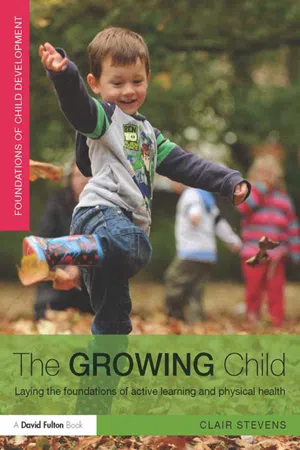
The Growing Child
Laying the foundations of active learning and physical health
- 112 pages
- English
- ePUB (mobile friendly)
- Available on iOS & Android
eBook - ePub
About this book
How do children's early physical experiences influence their future health and well-being? What are the future consequences of a sedentary childhood on life chances and health? What importance do we place in the UK on sleep, fresh air, good nutrition and movement?The Growing Child thoughtfully discusses the key principles of children's physical dev
Information
The foundations for virtually every aspect of human development are laid in early childhood. What happens during these early years (starting in the womb) has lifelong effects on many aspects of health and well-being, including mental health, educational achievement and economic status.1Sir Michael Marmot
It is difficult for us to comprehend that young children growing up in the twenty-first century in some of the richest, most advanced countries in the Western world are increasingly being denied the essential components necessary to set them up for a healthy and happy life. This statement may sound implausible but research worldwide indicates that children and families are increasingly leading hurried and pressured lifestyles. The results of these influences on a family's lifestyle have undoubtedly led to changes in the upbringing of children. It is important, therefore, that practitioners working in early years settings consider the significance of physical development and health to all-round learning and development. With my background in early years education, but also as a mother, I was recently appalled to see a catalogue selling gym equipment advertised for nursery schools. This equipment was marketed to settings wanting to improve the physical skills and health of their children; the list included exercise bikes, treadmills, rowing machines, a mini-stepper and weight bench. I found myself asking how we could have moved so far from the nature of the English nursery school where play was so highly valued. Few of us surely would think that this is the best way to set young children up for a healthy, rewarding life. Thus The Growing Child will explore, with reference to theory and practice, the importance of developing the aspect of physical development in the early years and its close ties in establishing healthy patterns for life.
Although many of us may have few memories from our earliest years, it is these early experiences that often shape and influence many aspects of our adult lives. My own early memories relate to days spent with my brothers on a local beach — freedom seldom given to children today. Brought up on the Kent coast, the beach, surrounding promenades, Victorian gardens and coastland became our playground. They offered rich opportunities throughout the year for physical challenge, sensory stimulation and adventure. Some forty years later my own children use many of the same outdoor spaces to play and explore, but somehow, as a society, it seems that we have lost sight of the importance of these tactile physical experiences.
As early years practitioners, we have a privileged part to play in supporting and enriching the lives of a new generation of young children and their families. These early experiences can set trajectories that affect cognition, relationships, health and well-being for individuals throughout their life. Furthermore, new concerns relating to health and well-being resound today; with physical play and activity seen as an important way of preventing and reducing childhood obesity. The level of obesity in the UK has been portrayed as an epidemic and its impact on children's health and well-being should be a concern for all in society. Many of these concerns focus on poor diets as a major cause but practitioners need to recognise the huge impact that physical activity can play in reversing this trend to obesity. More recently, a return of rickets in parts of England has resulted in a call for children to spend longer periods of time outdoors. The disease had all but died out some eighty years ago but is now returning. It is caused by low levels of vitamin D generated in the body from sunshine and particular types of foods. It is reported that children from all backgrounds are now being affected, a change from the Victorian times when only the poor seemed at risk.
Studying early childhood
The study of how young children grow up is not new; numerous educators and philosophers since the time of Plato have expressed an interest in human development. The past 300 years has seen a number of different approaches to teaching and learning influenced by the work of, among others, Rousseau, Pestalozzi, Froebel, Montessori and the McMillan sisters. In particular the interrelationship between education and health was central to Margaret McMillan's philosophy. She started an outdoor nursery school in Deptford in London, for children at risk of developing TB. The nursery promoted good health with fresh air, home-cooked food and daily physical activities.
At the other end of the social spectrum Chelsea Open Air Nursery School was formed in 1929 for over-indulged children, who were described by a benefactor as ‘crippled by not being allowed to take exercise’.2 The work of these important pioneers has been significant, influencing policy and practice across the world. Additionally, key figures such as Piaget, Bruner, Isaacs, Vygotsky and Malaguzzi have strengthened this debate and highlighted the importance of both adults and the environment in supporting children's healthy development.
However, early years practitioners, in daily contact with young children and families, will inevitably develop their own theories about early childhood development. These will probably evolve and grow from their own experiences as a child, and from the children they encounter. Over time these theories of development will change and will be influenced by their surroundings and by reading and research. Nowhere is this more evident than when early years students and practitioners come together in discussion. This valuable time spent reflecting and exchanging ideas helps to clarify and legitimise what one believes is important for young children in the setting. Drawing on my own experiences with young children, families, practitioners and students this book seeks to challenge the reader to deconstruct and identify key influences related to their beliefs and philosophies about young children's health, well-being and physical development, and how these are promoted in their settings.
Each of the book's chapters will reinforce the idea that the most effective early learning opportunities are those that offer children space, time and effective support, leading to the development of children as independent, self-directed learners. These are essential elements to support physical skills as children require repeated opportunities both to practise and strengthen their muscles, but also to develop the confidence in their ability to learn what their bodies can do for them. Physical development is vitally important for all children but should be viewed holistically, linked to all other areas of a child's development.
Pregnancy and the early years of life are formative years where the foundations of future health and well-being are established, and more importantly for practitioners across both health and education, it is a time when parents are often more open to learning and making changes, including the underpinning of good early years practice as a key aspect. This vitally important work of engaging and working with parents and families is fully discussed in Chapter 6, where the philosophy and practice of Forest School sessions, which run in partnership with children's centres, will be shared, particularly in relation to engaging fathers.
The importance of play
Within the early childhood context, play has long been recognized as the most valuable vehicle for children's learning and development. Play for young children is motivational and demanding, reflecting both social and cultural contexts. High-quality early years environments must be exciting and challenging, offering opportunities for physical risk that are essential for children's healthy growth and development. Yet factors related to health and safety and the threat of litigation seem to place implicit and explicit demands on staff to prevent or limit experiences involving physical risk.
Sadly, environments that offer no potential hazards will undoubtedly not offer children challenge. If a setting is too safe and restricting to children they are likely to become bored and in the long term grow up lacking self-confidence and belief in their own physical ability.3 Additionally, physical confidence has frequently been linked with more general feelings of competence. Duberry, interestingly, includes this definition: ‘To be broad and adventurous’ as a disposition of a good thinker, emphasising the links between a young child confronting physical fears and risks and transferring this to other learning situations.4 It is through these interactions during play that children experiment and test their bodies; developing dexterity, control and ultimately mastery.
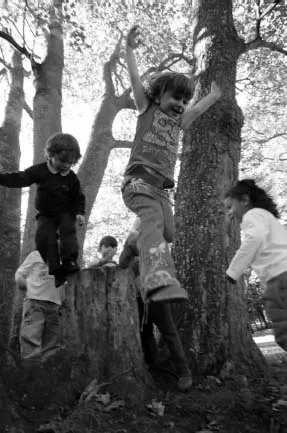
Figure 1.1 Confronting physical fears
Chapter 2, entitled ‘Play and exploration’, will discuss the central role that rich and stimulating play environments have in enabling children to learn, make connections and explore using their whole bodies. It will consider play both indoors and out and challenge practitioners to apply knowledge from key theorists in relation to children's active engagement and participation. Additionally Chapter 8 will draw further on the Forest School approach and its development in the UK, and present evidence from research that suggests children regularly attending these outdoor sessions develop a wealth of important attitudes and physical skills including improved confidence, self-esteem, determination, physical stamina and core strength. Conversely, children who do not develop their physical skills or test their capabilities in early childhood can feel isolated and remain physically inactive throughout life, drawn to the alternative excitement offered by screen technologies.
The contribution of science
The past decade has seen great advances in neuroscience, genomics, molecular biology and the social sciences, leading to a new deeper understanding of how healthy development occurs. Additionally, more recent contributions from brain research support the early years as a critical period for optimising learning. Shore maintains that it is these early play experiences and interactions that actually affect the way the brain develops. The physical environment and the experiences very young children have shape the brain by either creating new pathways or pruning neurons that have not been used or connected. Shore suggests that ‘meeting the developmental needs of young children is as much about building a strong foundation for lifelong physical and mental health as it is about enhancing readiness to succeed in school’.5
Movement and motor skills
Movement is now recognised as central to development and learning. Susan Greenfield suggests that if humans weren't designed to move we wouldn't require a brain.6 In early childhood movement plays a critical role in learning and connecting the two hemispheres of the brain. Repeated opportunities to practise and refine movements forms patterns in the child's brain and connects networks which link emotional thinking with logical thought. It is essential then that movement and play are emphasised as fundamental to learning in the early years as these experiences nourish the brain and trigger connections between the senses, muscular memory, perception and fluidity. New research and knowledge related specifically to early brain development and the importance of the environment have implications for all those working with young children, particularly the very youngest babies and toddlers. It is important therefore to understand that human development is based on the subtle interaction of both nature (biological factors) and nurture (environmental factors).
The book will include references to motor development, which is defined as the process by which a child acquires movement patterns and skills. Gross motor abilities are connected with other physical functions. For example, in order to write properly a child needs the gross motor skill to maintain upper body support as well as have the physical fine motor skills in the hand and wrist relating to dexterity. Practitioners should consider development as a whole but concentrate on opportunities that lend themselves to developing particular skills. Fine motor skills such as dexterity, associated with such tasks as cutting and pencil control, will follow on naturally from the development of gross motor skills such as body movement related to walking, running, maintaining balance, coordination, jumping and reaching. Those working with young babies will witness extraordinary motor development in the first year of life.
Complex developmental changes related to the organisation of movements are evident almost weekly; from a young infant just able to lift their head to a toddler, approximately fifteen months later, who can navigate numerous objects with great excitement to greet a parent or carer, and very soon afterwards feed themselves demonstrating a maturing pincer grip.
Health and equality
Concerns related to health and inequality have been linked to a number of growing anxieties including poorer outcomes in school, higher levels of stress, lack of engagement, behavioural problems and lower life expectancy. Numerous reviews and reports to the Government suggest that health inequalities often repeat themselves over a generation and that early intervention in the first few years is critical if changes are to be long term. Key points from the most important reports are included at the end of this chapter. Tickell's review of the Early Years Foundation Stage framework in 2008 has identified physical development as one of the three prime areas of development.7 Furthermore Frank Field's independent review on Poverty and Life Chances in 2010 recommended that the Foundation years need to be established in the public mind and given equal status to those of primary and secondary school years, making certain that child development and services during those years are clearly under-stood.8 Marmot has also stressed the urgency of closing this gap between the stages of education, suggesting that the Foundation years offer the best opportunity to make considerable improvements in life chances for many children.9 These sentiments were also echoed by the Oxford University research group who published data from the longitudinal study, the Effective Provision of Pres...
Table of contents
- Cover
- Half Title
- Title Page
- Copyright Page
- Dedication
- Table of Contents
- Acknowledgements
- Introduction to the series
- Introduction to The Growing Child
- 1 Setting the scene
- 2 Play and exploration
- 3 Active learning
- 4 Creating and thinking critically
- 5 Building developing competence
- 6 Engaging families
- 7 The different worlds of boys and girls
- 8 Forest School: The roots of life and learning
- 9 Ready for school or prepared for life?
- Epilogue
- Notes
- Author index
- Subject index
Trusted by 375,005 students
Access to over 1.5 million titles for a fair monthly price.
Study more efficiently using our study tools.
Frequently asked questions
Yes, you can cancel anytime from the Subscription tab in your account settings on the Perlego website. Your subscription will stay active until the end of your current billing period. Learn how to cancel your subscription
No, books cannot be downloaded as external files, such as PDFs, for use outside of Perlego. However, you can download books within the Perlego app for offline reading on mobile or tablet. Learn how to download books offline
Perlego offers two plans: Essential and Complete
- Essential is ideal for learners and professionals who enjoy exploring a wide range of subjects. Access the Essential Library with 800,000+ trusted titles and best-sellers across business, personal growth, and the humanities. Includes unlimited reading time and Standard Read Aloud voice.
- Complete: Perfect for advanced learners and researchers needing full, unrestricted access. Unlock 1.5M+ books across hundreds of subjects, including academic and specialized titles. The Complete Plan also includes advanced features like Premium Read Aloud and Research Assistant.
We are an online textbook subscription service, where you can get access to an entire online library for less than the price of a single book per month. With over 1.5 million books across 990+ topics, we’ve got you covered! Learn about our mission
Look out for the read-aloud symbol on your next book to see if you can listen to it. The read-aloud tool reads text aloud for you, highlighting the text as it is being read. You can pause it, speed it up and slow it down. Learn more about Read Aloud
Yes! You can use the Perlego app on both iOS and Android devices to read anytime, anywhere — even offline. Perfect for commutes or when you’re on the go.
Please note we cannot support devices running on iOS 13 and Android 7 or earlier. Learn more about using the app
Please note we cannot support devices running on iOS 13 and Android 7 or earlier. Learn more about using the app
Yes, you can access The Growing Child by Clair Stevens in PDF and/or ePUB format, as well as other popular books in Education & Early Childhood Education. We have over 1.5 million books available in our catalogue for you to explore.