The term ‘carcinoma’ is derived from the Greek word ‘karkinos,’ meaning crab. Hippocrates associated cancer with the shape of a crab, because of the way it spreads through the body and its persistent nature (Long, 1999).
Cancer is prevalent worldwide and impacts not only millions of people but also their families, carers, health systems, and even employers. Cancer impacts people’s physical, cognitive, and functional ability as well as their health-related quality of life (HRQoL) and economic well-being. The National Cancer Institute’s Dictionary of Cancer Terms (NCI, 2015) defines cancer as:
A term for diseases in which abnormal cells divide without control and can invade nearby tissues. Cancer cells can also spread to other parts of the body through the blood and lymph systems. There are several main types of cancer. Carcinoma is cancer that begins in the skin or in tissues that line or cover internal organs. Sarcoma is cancer that begins in bone, cartilage, fat, muscle, blood vessels, or other connective or supportive tissue. Leukaemia is cancer that starts in blood-forming tissue, such as the bone marrow and causes large numbers of abnormal blood cells to be produced and enter the blood. Lymphoma and multiple myelomas are cancers that begin in the cells of the immune system. Central nervous system cancers are cancers that begin in the tissues of the brain and spinal cord.
1.2 Epidemiology of Cancer
An estimated 14.1 million new cases of cancer occurred across the world in 2018. The four most common types of cancers are lung, female breast, colorectal, and prostate cancer (Bray et al., 2018). According to the Global Cancer Incidence, Mortality and Prevalence study (GLOBOCAN) (Bray et al., 2018), prostate cancer is the most commonly diagnosed cancer among males from 87 countries, especially in North and South America and northern, western, and southern Europe. Lung cancer is the most commonly diagnosed cancer among males in eastern Europe. Among females, breast cancer is the most common cancer in North America, Europe, and Oceania. Breast and cervical cancers are the most frequently diagnosed cancers in Latin America and the Caribbean, Africa, and most of Asia. However, the most common female cancers in Asia also include lung, liver, and thyroid.
Due to more screening, earlier detection, and improved treatment, cancer mortality rates are either plateauing or decreasing, particularly in the high-income regions.
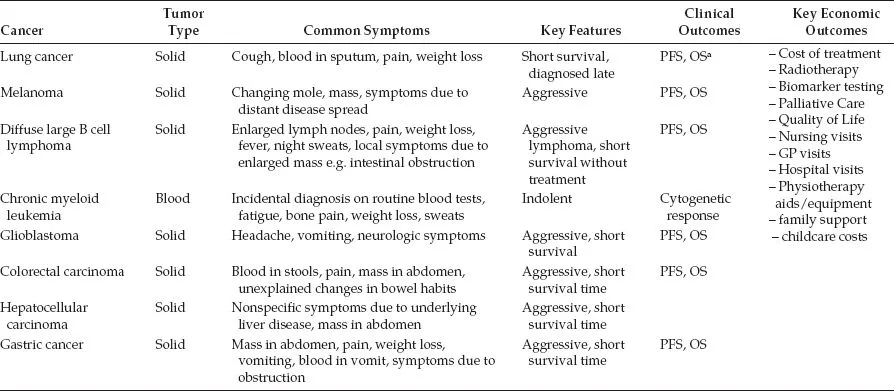
Table 1.1 summarizes the types of cancers and some key symptoms and features, along with the common clinical and economic outcomes collected in clinical cancer research.
TABLE 1.1
Examples of Some Common Cancers Regarding Clinical and Economic Outcomes
a Note: OS: overall survival; PFS: progression-free survival.
These endpoints will be discussed in more detail in Chapter 2. For indolent malignancies with long survival, other endpoints such as cytogenetic response and minimal residual disease are used to assess the effectiveness of new drugs, particularly in earlier lines of treatment. Surrogate endpoints are also discussed in more detail in Chapter 2. For a single cancer type, there are likely to be further subtypes (e.g. adenocarcinoma) for which some treatments might work better for patients belonging to this subpopulation.
1.2.1 Cancer Trends
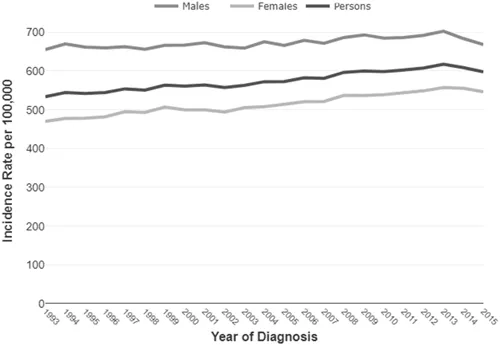
Mortality rates in several developing and low-income regions are increasing for some of these cancers due to increases in smoking, excess body weight, and physical inactivity. In 2011, there were nearly 8 million cancer-related deaths. All cancers, taken together, are now a leading cause of disease-related death worldwide, responsible for about 14% of the total of 55 million deaths from all causes in 2011. Cancer incidence in the UK is reported to have increased between 1993 and 2015 especially for females (Figure 1.1).
FIGURE 1.1
All cancers excluding non-melanoma skin cancer, European age-standardized incidence rates, UK, 1993–2015.
Source: CRUK Cancer Statistics.
On the other hand, cancer incidence appears to be decreasing globally for many cancers in the United States, Europe, and other high-income countries. In low- to middle-income countries, the trend for cancers is unclear. Liver cancer, however, is reported to be increasing globally. Table 1.2 provides a summary of mortality trends for different cancer types between the years 2000 and 2019 (Hashim, 2016).
TABLE 1.2
Summary of Countries by Cancer Type Showing Where Deaths from Each Type of Cancer are Increasing/Decreasing
| Cancer | Increasinga | Decreasing |
| All | Brazil, Cuba, Latvia, Moldova, Serbia, and Malaysia | Decreasing for other countries |
| Stomach cancer | Not increasing in any country | Decreasing for all countries |
| Colorectal cancer | Latin America, Asia, South Africa, Romania, Malaysia, Kuwait, and Latvia | Decreasing for other countries |
| Liver cancer | North America, Asia, and Latin America | Decreasing for other countries |
| Lung cancer | Women: most countries: North America, Spain, Belgium, and DenmarkMen: Venezuela, Moldova, Malaysia, Serbia, Bulgaria, Portugal, and Romania | Decreasing for: Ireland, Asian countries, Lithuania, and some Latin American countries |
| Breast cancer | Japan/Korea, Malaysia, Philippines, South Africa, and Latin America | Decreasing for other countries |
| Uterine cancer | Puerto Rico, Malaysia, and Philippines | Decreasing for other countries |
| Prostate cancer | Malaysia, Latvia, Serbia, Moldova, Ukraine, Belarus, USSR, and Korea | Decreasing for other countries |
aNote: See Hashim et al. (2016) for list of country studies.
Example 1.1: Lung Cancer
Lung cancer is one of the leading causes of cancer-related deaths in the world and accounts for nearly 1.4 million deaths per year worldwide, with a yearly incidence of over 41,000 in the UK alone (Cancer Research UK [CRUK] Statistics, 2012). More than 8 out of 10 lung cancer cases occur in people aged 60 and over. Rates of lung cancer in Scotland are among the highest in the world, owing to the high prevalence of smoking. Lung cancer incidence in a given country is directly linked with the level of tobacco smoking in that country. Lung cancer-related deaths occur approximately two to three decades after the widespread uptake of smoking in any given country, with mortality trends approximating the incidence trends. Among males, lung cancer mortality rates have peaked and are now decreasing in many developed countries, reflecting the uptake and subsequent decline in male smoking prevalence. Lung cancer incidence in women lagged behind that in males because women began smoking later.
In countries with the earliest uptake of smoking among women (e.g. US, UK, and Australia), lung cancer mortality rates have peaked, whereas they continue to climb in countries where women began smoking later. Lung cancer is often diagnosed later in life, frequently with aggressive disease progression leading to high mortality rates for this cancer. In the 1950s, for every 1 lung cancer case diagnosed in women in the UK, there were 6 in men. That ratio is now 3 cases in women for every 4 in men. The lowest lung cancer rates in the world for men and women are in Northern, Western, and Middle African countries and South-Central Asia; but this will also change if the current trends in the uptake of smoking persist (Jemal et al., 2011; Toms, 2004; CRUK Statistics, 2012).
1.3 Prognostic Factors Associated with Cancer Outcomes
Prognostic factors are known or unknown factors that may be related to either an increased or decreased chance (risk) of a (cancer-re...