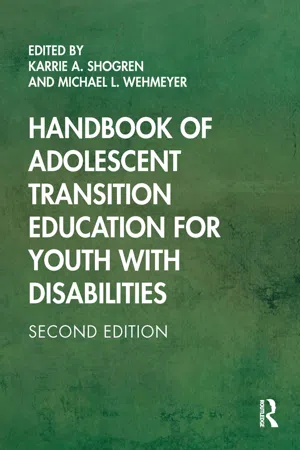
Now in a thoroughly revised and updated second edition, this handbook provides a comprehensive resource for those who facilitate the complex transitions to adulthood for adolescents with disabilities. Building on the previous edition, the text includes recent advances in the field of adolescent transition education, with a focus on innovation in assessment, intervention, and supports for the effective transition from school to adult life. The second edition reflects the changing nature of the demands of transition education and adopts a "life design" approach. This critical resource is appropriate for researchers and graduate-level instructors in special and vocational education, in-service administrators and policy makers, and transition service providers.
eBook - ePub
Handbook of Adolescent Transition Education for Youth with Disabilities
- 520 pages
- English
- ePUB (mobile friendly)
- Available on iOS & Android
eBook - ePub
Handbook of Adolescent Transition Education for Youth with Disabilities
About this book
Information
1
An Introduction to the Second Edition of the Handbook of Adolescent Transition Education for Youth with Disabilities
Since the publication of the first edition of the Handbook of Adolescent Transition Education for Youth with Disabilities, much has changed in the world and in the field of adolescent transition education. But the transition from secondary education to adulthood remains a period of major change during which adolescents face changing roles, responsibilities, and support systems. This creates a consistent and ongoing need for effective supports for students with disabilities as they transition from school to postsecondary education and begin to design their careers, to create new social networks, to make decisions about where and without whom to live, and to take more and more responsibility for their health and financial affairs. However, the conditions under which these transitions are occurring have changed and continue to change. With regard to higher education, there are both a growing number of opportunities for students with intellectual disability and autism spectrum disorders to attend college, but at the same time, there are ongoing challenges related to the increasing financial costs of higher education as well as ongoing issues related to disparities in access and completion for students from diverse backgrounds, who are first-generation college students, or who have disabilities. The same is true in employment. Whereas in the past, employment trajectories for many people were stable within an industry or role, in today’s economy there is significant volatility as career pathways have opened and closed because of technological innovation and the growing globalization of our economy. Planning for a job can no longer be the target; instead, designing a career (and life) characterized by the ability to adapt to changes that will continue to emerge both in the work sector as well as in the communities within which we live is a necessity.
Given these issues, the second edition of this handbook attempts to build on the foundation of the first edition by highlighting what we have learned in the field of transition since its inception, as well as introducing new areas of focus and directions that have emerged in the intervening years. The goal is that this handbook can serve as a comprehensive resource to students, communities of educators, related service and agency personnel, families, support providers, counselors, and really anyone who supports the complex process of transition to adulthood for adolescents with disabilities.
Chapters in this text provide an in-depth review of the historical foundations of transition (Chapter 2) as well as an overview of the history and current focus of transition policy (Chapter 3). However, as an introduction, the Individuals with Disabilities Education Act (IDEA), the federal law requiring all students with disabilities to receive a free, appropriate public education, has, since 1990, also required the educational programs of adolescents with disabilities receiving special education services to include a focus on services and instructional needs to enable the student to “transition” from secondary education to postsecondary education, employment, and community life. While there have been slight changes to the transition mandates in IDEA since their introduction in 1990 (e.g., changing the age at which transition planning is required to begin from 14 to 16), there has been remarkable consistency in the law and in research and practice that suggests this is a critical period that requires targeted and specific supports to lead to successful outcomes.
In fact, early definitions of transition that emerged after the introduction of the mandates in IDEA continue to have relevance today. The Division on Career Development and Transition developed one of the most comprehensive, early definitions (Halpern, 1994). This definition underscores that the transition period is a time of change and that being proactive is central to students achieving the adult outcomes that have meaning to them.
Transition refers to a change in status from behaving primarily as a student to assuming emergent adult roles in the community. These roles include employment, participating in postsecondary education, maintaining a home, becoming appropriately involved in the community, and experiencing satisfactory personal and social relationships. The process of enhancing transition involves the participation and coordination of school programs, adult agency services, and natural supports within the community. The foundations for transition should be laid during the elementary and middle school years, guided by the broad concept of career development. Transition planning should begin no later than age 14, and students should be encouraged, to the full extent of their capabilities, to assume a maximum amount of responsibility for such planning.
(p. 117)
These concepts of proactivity (Chapter 18 on planning for transition in middle school), community supports (Chapter 25), collaboration (Chapter 21), student involvement (Chapter 9), and self-determination (Chapter 14) continue to be emphasized in this text, and each chapter highlights where we have progressed through research and where we have to go in implementation to actualize the outcomes that are the goal of both IDEA and other laws that have more recently emphasized the criticality of the transition process, such as the Workforce Innovation and Opportunity Act (WIOA).
Other concepts that have been recognized as critical throughout the transition period, such as meaningful transition assessment (Chapter 8), individualized education program (IEP) development (Chapter 7), family involvement (Chapter 10), life skills (Chapter 12) and social skills (Chapter 13), and preparing transition professionals (Chapter 26) continue to be highlighted while new and emerging directions in the field that address the changes we are experiencing in transition education and our broader community and society are also introduced. For example, chapters on career design (Chapter 5), effective academic instruction to facilitate transition (Chapter 11), and college and career readiness (Chapter 19) highlight these new directions. Emerging directions related to technology (Chapter 17) and promoting school completion (Chapter 16) and job development (Chapter 24) and structured work experiences (Chapter 15) are also introduced. Ways to enhance our recognition of the complexities of diversity and to promote equity in transition processes and outcomes (Chapter 20) are also emphasized, as are ways to promote both access to (Chapter 22) and completion of postsecondary education (Chapter 23). Finally, specific considerations based on disability-related needs are highlighted (Chapters 27–33).
The emergence of evidence-based practices in each of these areas (Chapter 4) as well as the ongoing needs for additional research on implementation and scaling up are highlighted through the text. And these ongoing needs for research, implementation supports and scaling up of effective practices cannot be understated. Although progress has been made since the introduction of the transition mandates and the publication of the first edition of this text, we can only hope that by the time the third edition is being conceptualized, the disparities experienced by young people with disabilities in so many domains of their lives have been eliminated. There continues to be a pressing need that must drive all of us to recognize the need for complex, collaborative efforts that are driven by advocates with disabilities themselves to address the vexing problems that have limited our progress in addressing the disparate postschool outcomes of young adults with disabilities.
In the first edition of this text,1 findings from the emerging data quantifying these outcomes that highlighted the desperate need for attention to transition were summarized. A quote was used to characterize these findings emerging in the 1980s and 1990s:
The outcomes experienced by youth with disabilities for employment, residential status, and social and interpersonal relationships are disappointing. Although rates vary from state to state, most youths with disabilities are either not employed or underemployed. Few youths live independently, many are not well integrated into their communities, and some appear to be lonely. Overall, youths with disabilities face a very uncertain future that holds little promise of improving as they age.
(Chadsey-Rusch, Rusch, & O’Reilly, 1991, p. 28)
Unfortunately, all too similar conclusions can be drawn today about the postschool outcomes of young adults with disabilities. While some improvements, particularly in access to postsecondary education and employment, have been seen in certain disability groups, there remain persistent disparities, some of which continue to grow. As highlighted in chapters throughout this text, the National Longitudinal Transition Study-2 (NLTS-2) as well as the more recent National Longitudinal Transition Study 2012 (NLTS 2012) continue to suggest that students with disabilities experience highly disparate outcomes and that these outcomes are influenced by disability label, race/ethnicity, gender, and socioeconomic status.
For example, recent cross-sectional data collected by NLTS 2012 (in 2012 or 2013) while youth were still in school suggest:
- Youth with disabilities are more socioeconomically disadvantaged than their peers without disabilities.
- Youth with disabilities are more likely to struggle academically and less likely to take necessary steps during school toward postsecondary education and employment.
- Youth with intellectual disability, autism, deaf-blindness, multiple disabilities, and orthopedic impairments experience the most risk in their transition planning and outcomes (National Center for Education Evaluation, 2018).
Perhaps the most troubling finding from NLTS 2012, particularly for readers of this text, was that while youth with disabilities are more likely to be engaged and use some supports while in school (compared to previous NLTS data) youth were less likely to participate in transition activities than in the past. This suggests that there have actually been decreases in engagement in transition planning, which we know has the potential to reduce the disparate postschool outcomes. This suggests an ongoing need to promote both implementation and scaling up of the practices described in this text.
This is particularly important as the longitudinal data from the NLTS-2, collected between 2001 and 2009 by following youth with disabilities as they completed secondary school and transitioned into adult life, suggested that up to eight years after youth exited high school, youth with disabilities were:
- Less likely than peers to have enrolled in any postsecondary education and significantly less likely to have completed postsecondary education.
- When working, earning significantly less than their peers without disabilities.
- Less likely to be establishing financial accounts, such as checking accounts or credit cards than their peers without disabilities (Newman et al., 2011).
These differences were even more disparate for those with specific disability labels; for example, those with intellectual disability were significantly less likely to be enrolled in postsecondary education as well as be employed at any level than those with other disability labels. There are also differences based on gender, with males working significantly more hours when employed than females, African American youth being less likely to establish financial accounts, and those living in lower socioeconomic strata being less likely to be employed (Newman et al., 2011).
These data suggest the compelling need to continue to advocate for the implementation of effective transition supports, using the core values that have driven the field of transition since its inception, and integrating emerging directions, particularly related to student self-determination, promoting college and career readiness, merging academic and transition instruction, considering how to leverage emerging supports for collaboration such as WIOA, and promoting access to and completion of postsecondary education and meaningful career design and community participation.
Overall, we must be driven by key values as we support young people to create meaningful adult lives.
- Transition efforts should start early.
- Planning must be comprehensive.
- The planning process must consider a student’s preferences and interests.
- The transition planning process should be considered a capacity-building activity (i.e., consider a student’s strengths).
- Student participation throughout the process is essential.
- Family involvement is desired, needed, and crucial.
- The transition planning process must be sensitive to diversity.
- Supports and services are useful, and we all use them.
- Interagency commitment and coordination are essential.
- Timing is crucial if certain linkages are to be made and a seamless transition to life after high school is to be achieved.
- Transition continues, and the focus must be on career and life design, enabling self-determination across the life course.
Ways to support these outcomes will be t...
Table of contents
- Cover
- Half Title
- Title
- Copyright
- Contents
- List of Contributor Biographies
- List of Tables and Figures
- Foreword
- 1 An Introduction to the Second Edition of the Handbook of Adolescent Transition Education for Youth with Disabilities
- 2 A History of Adolescent Transition Education
- 3 Policy and Adolescent Transition
- 4 Evidence- and Research-Based Transition Predictors and Practices: Identification and Implications
- 5 Career Design
- 6 Adolescent Transition Planning Strategies
- 7 IEP Development That Supports the Transition to Adult Life for Youth with Disabilities
- 8 Transition Assessment
- 9 Student Involvement in the Transition Process
- 10 Family Involvement in Adolescent Transition Planning
- 11 Academic Skill Instruction in Adolescent Transition Education
- 12 Life Skills and Community-Based Instruction
- 13 New Social Relationships: Social Skills, Supports, and Networks in Adolescent Transition Education
- 14 Self-Determination and Transition
- 15 Work-Based Learning for Students With Disabilities
- 16 School Completion and Adolescent Transition Education
- 17 Assistive Technology in the Transition Education Process
- 18 Middle School Transition Education Planning and Services
- 19 Integrating College and Career Readiness into Transition Education
- 20 Addressing Equity and Providing Transition Education to a Diverse Student Population
- 21 Effective Strategies for Interagency Collaboration
- 22 Supporting the Transition to Postsecondary Education for Students With Disabilities
- 23 Promoting Access to Supports and Accommodations in Postsecondary Education
- 24 Job Placement and Job Development for Young Adults With Disabilities
- 25 Enabling Community Participation During and After Transition
- 26 Trends in Transition Educator Personnel Preparation
- 27 Adolescent Transition Education for Students With Autism
- 28 Transition and Adolescents With Learning Disabilities
- 29 Adolescent Transition Education for Students With Intellectual Disability
- 30 Adolescent Transition Education for Deaf Students
- 31 Transition Education for Adolescents Who Are Blind or Have Low Vision
- 32 Transition Planning and Services for Youth With Emotional and Behavioral Disorders
- 33 Improving Transition Outcomes for Youth With Mental Health Conditions
- Index
Trusted by 375,005 students
Access to over 1.5 million titles for a fair monthly price.
Study more efficiently using our study tools.
Frequently asked questions
Yes, you can cancel anytime from the Subscription tab in your account settings on the Perlego website. Your subscription will stay active until the end of your current billing period. Learn how to cancel your subscription
No, books cannot be downloaded as external files, such as PDFs, for use outside of Perlego. However, you can download books within the Perlego app for offline reading on mobile or tablet. Learn how to download books offline
Perlego offers two plans: Essential and Complete
- Essential is ideal for learners and professionals who enjoy exploring a wide range of subjects. Access the Essential Library with 800,000+ trusted titles and best-sellers across business, personal growth, and the humanities. Includes unlimited reading time and Standard Read Aloud voice.
- Complete: Perfect for advanced learners and researchers needing full, unrestricted access. Unlock 1.5M+ books across hundreds of subjects, including academic and specialized titles. The Complete Plan also includes advanced features like Premium Read Aloud and Research Assistant.
We are an online textbook subscription service, where you can get access to an entire online library for less than the price of a single book per month. With over 1.5 million books across 990+ topics, we’ve got you covered! Learn about our mission
Look out for the read-aloud symbol on your next book to see if you can listen to it. The read-aloud tool reads text aloud for you, highlighting the text as it is being read. You can pause it, speed it up and slow it down. Learn more about Read Aloud
Yes! You can use the Perlego app on both iOS and Android devices to read anytime, anywhere — even offline. Perfect for commutes or when you’re on the go.
Please note we cannot support devices running on iOS 13 and Android 7 or earlier. Learn more about using the app
Please note we cannot support devices running on iOS 13 and Android 7 or earlier. Learn more about using the app
Yes, you can access Handbook of Adolescent Transition Education for Youth with Disabilities by Karrie A. Shogren, Michael L. Wehmeyer, Karrie A. Shogren,Michael L. Wehmeyer in PDF and/or ePUB format, as well as other popular books in Education & Education General. We have over 1.5 million books available in our catalogue for you to explore.