- 408 pages
- English
- ePUB (mobile friendly)
- Available on iOS & Android
eBook - ePub
An Essential Introduction to Maya Character Rigging with DVD
About this book
Discover the concepts and techniques required to rig engaging CG character models with Maya in this unique book and DVD package. The stunning color images show just what you can achieve, and the detailed step-by-step tutorials show exactly how to achieve them. Every technique and tip is backed up with practical tutorials, using the models, student
Information
Subtopic
Digital MediaIndex
Computer Science1
Designing Your First Biped Character

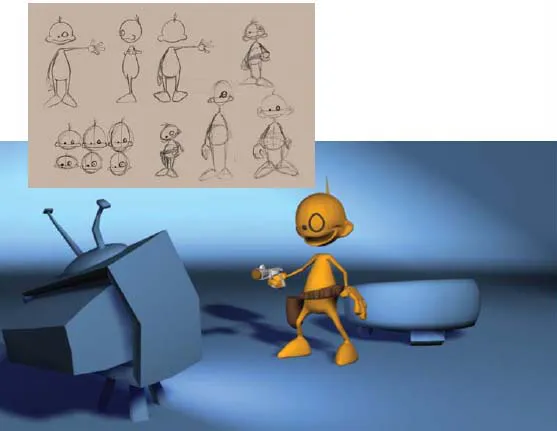
Little Billy by Sean Danyi (2004).
Former Student Spotlight: Zach Parrish
Rigging is the big step in creating a short film that most beginners completely underestimate. Many blossoming students or beginners are anxious to start making things move and do not give as much thought and foresight to the end result. The final outcome really begins with the first time the character is sketched out. The concept for a character dictates its personality, which dictates how it moves, which dictates how it can be modeled and rigged. Give some thought to the whole picture as you work through your film and it will enhance the end result that much more.
The few problems I had on my short film were a direct result of not thinking ahead. I was too anxious to make things move that I didn’t fully plan each step. My models feet were big, almost as long as his leg; consequently, I had to sort of swing his feet out to the side to make him walk semi-naturally. The problem was, that I didn’t think about this when I was modeling or rigging. So the rig was not as flexible as it could have been, which slowed and limited the animation process. The creation of that short film taught me more than I had anticipated. I think it’s a big stepping stone in the maturation of a student film maker to do the whole process, even if it isn’t for a whole film. It can be used to simply do a basic animation exercise. That way, you learn the pitfalls, the easier areas, and also the areas you prefer to focus on. And finding your area of interest is the most important part.
Zach graduated with his Bachelor of Fine Arts degree in 3D animation from the Savannah College of Art and Design (SCAD). During his final quarter at SCAD, he began online courses through Animation Mentor. He was hired directly out of SCAD by Rhythm & Hues Studios in Marina Del Rey, CA. He is currently working at Rhythm & Hues, continuing his education with Animation Mentor and looking forward to his future endeavors in the world of Character Animation. You can see more of his work and what he is up to at his website: www.zapmyshorts.com
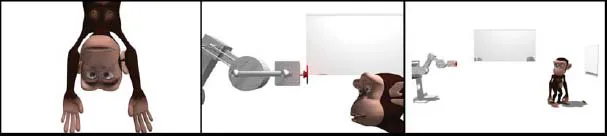
Bananas by Zach Parrish (2006).
Workflow
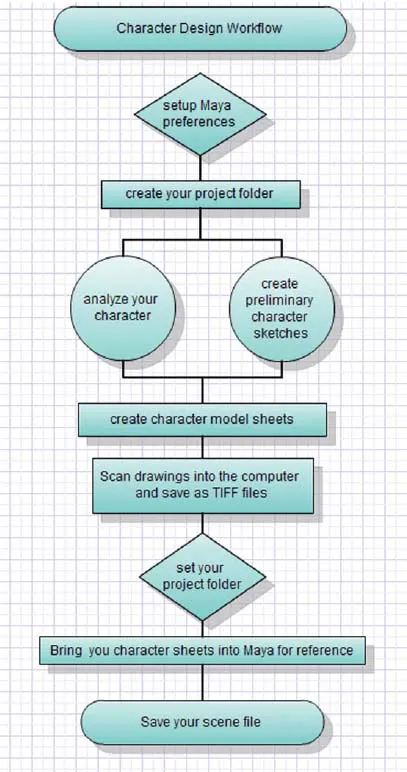
Character Design Workflow.
Introduction
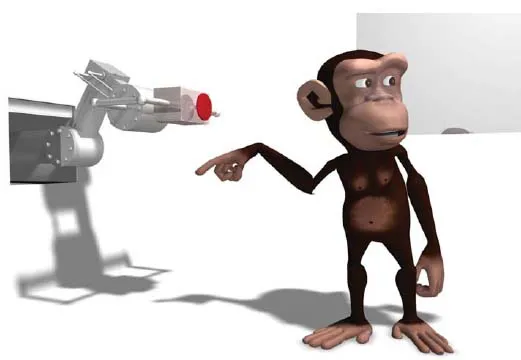
Bananas by Zach Parrish (2006).
Creating a character can be an enormous task. Production studios invest months (and sometimes even years) to simply get the design of a character just right. Sometimes, there is an entire team of artists with varied backgrounds (such as painters, sculptors, and concept artists) who work together to develop a single character.
When designing your first character to model, rig, and animate, it is important to remember the most important rule of all: KEEP IT SIMPLE. Complexity will come later. A biped is a great character for beginners to start with because of the varied problems that will be addressed during the process. It is also one of the easiest of which to gather research since you, in fact, are bipedal. When you have a question about how something moves, you simply have to study your own mechanics. Many of the rigging solutions that are used for a biped can be reused with other types of creatures and props. However, it is important to stick to simple and stylized design ideas. The more realistic and detailed the character becomes, the more difficult it is to set up for animation.
Character Design
Analyzing Your Character
The first character you design should be simple. Remember this general rule: the easier and the simpler you make the design, the easier and the simpler the entire process will be. This rule really applies to anything in life. You will encounter obstacles, so why complicate the situation – unless, of course, you thrive on challenges and have no problem tackling these obstacles on your own.
In addition to thinking about what your character looks like, you should consider other aspects that will help define their design. For a well-rounded character, you should base your design on a realistic character or story. Even though you may not be pursuing an animated story with the character for your first animation, in order to get a plausible character, there needs to be some type of background developed for personality, motivation, and purpose. If you do not have a concrete story idea, you can still answer questions that help create this background. This process is called character analysis and has been used by writers and actors for many years.
You should ask not only questions like color, gender, and height, but also questions that answer background information, such as whether the character has brothers, sisters, or is an only child. How old is the character? Is he a child? Is she a teenager? Is he a parent? Are they androgynous? Schizophrenic? All of these answers have a huge impact on how the character behaves and will actually help you come up with ideas for how they look. It is really not important that your audience knows the answer to these questions. As an animator, however, the more you understand your character, the more believable your character will become. As you answer these questions (Assignment 1.1), try to visualize your character. Keep a sketchbook handy and begin preliminary sketches. As you sketch, think about design considerations discussed in this chapter.
Design Considerations
For your first character design, there should be requirements as well as limitations. The first requirement is to make sure that your character is bipedal. You can design animal characters as long as they move like a human....
Table of contents
- Cover
- Halftitle
- Title
- Copyright
- Dedication
- Contents
- Forword
- Preface
- Acknowledgements
- Introduction
- 1 Designing Your First Biped Character
- 2 Creating Your First Biped Character: Modeling Basics
- 3 Creating Your First Biped Character: Facial Expressions
- 4 Creating Your First Biped Character: Shading and Texturing Basics
- 5 Skeleton Setup for a Biped Character: Joint Placement
- 6 Control Rig Setup for a Biped Character: IK and FK
- 7 Wrapping Up the Setup
- 8 Skinning Your Character
- Glossory
- Index
Trusted by 375,005 students
Access to over 1.5 million titles for a fair monthly price.
Study more efficiently using our study tools.
Frequently asked questions
Yes, you can cancel anytime from the Subscription tab in your account settings on the Perlego website. Your subscription will stay active until the end of your current billing period. Learn how to cancel your subscription
No, books cannot be downloaded as external files, such as PDFs, for use outside of Perlego. However, you can download books within the Perlego app for offline reading on mobile or tablet. Learn how to download books offline
Perlego offers two plans: Essential and Complete
- Essential is ideal for learners and professionals who enjoy exploring a wide range of subjects. Access the Essential Library with 800,000+ trusted titles and best-sellers across business, personal growth, and the humanities. Includes unlimited reading time and Standard Read Aloud voice.
- Complete: Perfect for advanced learners and researchers needing full, unrestricted access. Unlock 1.5M+ books across hundreds of subjects, including academic and specialized titles. The Complete Plan also includes advanced features like Premium Read Aloud and Research Assistant.
We are an online textbook subscription service, where you can get access to an entire online library for less than the price of a single book per month. With over 1.5 million books across 990+ topics, we’ve got you covered! Learn about our mission
Look out for the read-aloud symbol on your next book to see if you can listen to it. The read-aloud tool reads text aloud for you, highlighting the text as it is being read. You can pause it, speed it up and slow it down. Learn more about Read Aloud
Yes! You can use the Perlego app on both iOS and Android devices to read anytime, anywhere — even offline. Perfect for commutes or when you’re on the go.
Please note we cannot support devices running on iOS 13 and Android 7 or earlier. Learn more about using the app
Please note we cannot support devices running on iOS 13 and Android 7 or earlier. Learn more about using the app
Yes, you can access An Essential Introduction to Maya Character Rigging with DVD by Cheryl Cabrera in PDF and/or ePUB format, as well as other popular books in Computer Science & Digital Media. We have over 1.5 million books available in our catalogue for you to explore.