eBook - ePub
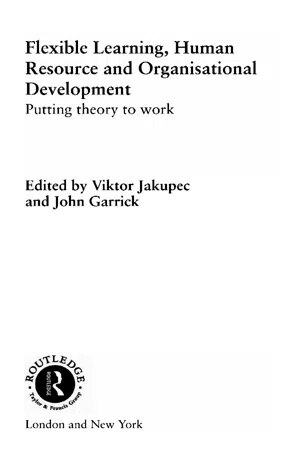
Flexible Learning, Human Resource and Organisational Development
Putting Theory to Work
- 304 pages
- English
- ePUB (mobile friendly)
- Available on iOS & Android
eBook - ePub
Flexible Learning, Human Resource and Organisational Development
Putting Theory to Work
About this book
Recent challenges facing higher and tertiary education such as the impact of globalisation and the emergence of new technologies, have called for a radical reconceptualisation of the teaching-learning nexus.This book addresses contemporary contexts of flexible learning and its practices, and provides insights about directions in which education and
Information
1 Flexible learning, work and human resource development
John Garrick and Viktor Jakupec
In the information age, flexible learning has become a central feature of national education policies around the globe. In the era of ‘knowledge workers’ and workplace reforms, the importance of flexible approaches to learning cannot be overestimated. The adjustments to the workplace, working in teams, developing flexibility and mobility are all part of the melange of skills, knowledge and attitudes now required at work. Workplace reforms and subsequent demands on the labour force are aspects of powerful discourses that are fuelling the demand for flexible approaches to learning. Flexible learning is itself therefore connected to workplace and economic discourses. From the perspective of many employers, the ultimate value to the organisation of an employee is their ability to apply their knowledge. Productivity in firms depends not only on the aggregate capabilities of individuals, but on the development of effective interaction patterns and team work (Bowman 1995: 69). Hopes that flexible learning will service the new interaction patterns and work teams are held not only at enterprise level, but are increasingly reflected at national and transnational policy levels.
The then European Commissioner for Science, Research, Human Resources, Education, Training and Youth, Edith Cresson, recently stated that due to changes in the socio-economic, demographic and technological environment, and the ever increasing rate at which skills become obsolete in this process, the improvement of lifelong learning is of growing concern. Related policies aim at reducing the negative impacts of unemployment by strengthening open distance learning and at promoting continuing vocational training in order to maintain both personal self-fulfilment and economic competitiveness (Tessaring 1998: 4).
This book is one of the first to examine critically flexible learning at work and to expand on its implications for human resource development. It brings together ideas about flexible learning and the realities of workplace demands. Our objective is to generate discussion and an access point to the ideas of flexible learning by presenting chapters from leading researchers and practitioners who have directly engaged with the various approaches to flexible learning – including work-based learning. The insights provided in this book show that there are many ways of viewing flexible learning and the practical implications for what can be done in workplaces are immense. The idea that employees are able to learn everything that is required in contemporary work through mechanistic ‘training’ or picked up from experienced ‘mentors’ or peers is no longer tenable. Both workplace managers and educators increasingly have to find new ways of communicating about and implementing a range of learning strategies. The aim of this book is to provide a starting point for examining what some of these new ways might be. Indeed, ‘learning’ and ‘work’ are merging in unprecedented ways.
Flexible learning in work contexts
This book focuses on what we know about flexible learning and how various approaches might be used in work contexts. It is also about comprehending the multifaceted dimensions of flexible learning including the culture changes it can require at work. It explores these features in ways that are practical and of immediate relevance to human resource development (HRD) practitioners, flexible researchers and education and training policy-makers alike. Indeed, our aim is to generate discussion and critique directions for developing flexible approaches to learning in and through work, but we do not want to offer prescriptions as to where flexible learning ‘ought to go’. We do not promote a how-to-do-it approach because flexible learning is too important and complex an activity to do this. Rather, this book delivers an access point for those who want to engage with flexible learning in work contexts. It is directed towards practitioners, researchers and scholars who want to know about what flexible learning is and what it might offer organisations that want to transform themselves through emphasising a learning dimension. As such it is not a survey of flexible learning methods or techniques. It is a set of essays which can be read as a linear narrative. The book has a structure and pattern that moves towards some conclusions, but it also encompasses contradictions and its own subversions. Each contributor has her or his way of seeing things. We all operate from certain philosophical perspectives and these are intended to inform rather than confirm particular standpoints.
So, what is flexible learning?
Flexible learning is a complex concept and is difficult to define. Neither individuals nor organisations have yet been able to define this term from any one specific vantage point. There is no unifying and generally accepted definition. Any attempt at a definition of flexible learning would use the language and notion of ‘possibility’ in learning. It is therefore not surprising that flexible learning has been defined with many different political, theoretical, practical, technical and pedagogical agendas in mind (Jakupec 1997: 95). Whether in the field of higher education, tertiary training and HRD, or workplace learning, ‘flexible learning’ has created some ambiguity amongst senior managers, administrators, academics, teachers, trainers and HRD practitioners. However, if one surveys the practices of flexible learning, there is one aspect that recurs in the many definitions: flexible learning is a purposeful action undertaken by higher education, tertiary training and HRD organisations in order to meet new, and often economic, challenges. Flexible learning is seen by education and training institutions and HRD organisations as a vehicle for addressing current economic, social, political, technological and cultural issues caused by the forces of globalisation. That is, globalisation has made it imperative for education and training organisations, and private and public enterprise, to develop more flexible approaches to learning. This includes new approaches to course planning, structures, delivery methods and access to education, training and staff development.
The challenges that have brought about the need for change in the operating contexts of organisations are manifold. The most obvious and general ones are as follows: first, the education and training sectors and companies are increasingly operating in competitive market-driven environments. Second, there is a greater expectation held by individuals and organisations of access to new developments in information and computer technologies (ICTs). Such developments are often held as offering (whether correctly or not) enhanced learning, education, training and staff development in more accessible, compressed time and space. Third, there is a need for individuals to adjust to changes in the workplace and in learning practices. Four, workplace reforms are occurring constantly with the aims of capitalising on improvements in work organisation and new technologies. Fifth, education and industry are increasingly globalised, and overseas institutions and industries are aggressively entering national markets.
This interwoven set of challenges leads to demands for access to and participation in continuous and lifelong – professionally/occupationally relevant – learning. Taking each of the above aspects into consideration, flexible learning will be interpreted differently according to different and changing needs. Individual education and training institutions (both private and public), and business organisations and enterprises, will position themselves differently at different times. Our point here is that any definitions of ‘flexible learning’ can be expected to build on the distinct identity of individual institutions, organisations or companies.
Putting flexible learning theory to work – why now?
Arguably the most powerful discourse on learning at this point in our history is one that holds that ‘a well educated and well trained population is important for the social and economic well-being of countries’ (OECD 1997: 33). Within this discourse educational attainment – and by extension, labour-force qualifications – are seen as important factors in determining economic outcomes and the quality of life for individuals and society as a whole. As the OECD points out, with the increasing skill requirements of jobs in today’s economies:
persons with low levels of educational attainment may find themselves at a distinct disadvantage in the labour market … and of key interest is the flexibility with which education and training systems have adapted to changes in labour market and socio-economic conditions.
(OECD 1997: 34)
Underlying this discourse is an emphasis on human resource development which, in turn, is indebted to human capital theory. This theory rests on two key assumptions: the first is that there is a direct relationship between the formation of the type of human capital needed in the economy and the learning that can be provided through education and training systems; the second assumption is that firms and enterprises are capable of taking advantage of the greater productive capacities of highly trained and educated employees. Querying the degree to which either of these assumptions is valid is not the point here. Rather it is our intention to examine the learning possibilities for HRD found in flexible approaches to education and training – within and against work contexts shaped by influential, economically driven discourses of learning.
It is clear to us that many nations are now actively supporting ‘flexible’ solutions to the requirements of capitalist enterprise. For instance, OECD countries have initiated major change at a systems level in their vocational education and training sectors as a strategy for increasing international competitiveness (Tessaring 1998). The 1998 CEDEFOP report on ‘training for a changing society’ makes the point that ‘due to the rapid changes in job requirements and to occupational mobility, initial training is expected to prepare people less and less for their entire working lives’ (Tessaring 1998: 18). Against this backdrop, the growing importance of flexible approaches to learning, particularly for continuing vocational training, is undeniable. Increasingly we find demands for flexible specialists who possess high level communication skills and can cross a range of professional and disciplinary boundaries. Put simply, as society becomes more complex so too do the requirements of professional labour and thus the growing demands for flexible learning.
Work has become more fragmented and more subject to processes of unpredictable change. A part of this process is the breaking-down and blurring of boundaries, sometimes referred to as ‘de-differentiation’. Distinctions between life and work, learning and production, community and enterprise are becoming less firm. Shifting boundaries, changing values and purposes of work and learning affect the physical, emotional and cognitive demands on workers at all levels. What is now required are abilities to put knowledge and expertise to use in unfamiliar circumstances and flexible learning offers rich and varied possibilities in this terrain. Indeed, increased flexibility is required not only in relation to learning but also of labour and capital. We argue that in part these changes are tied to globalisation, particularly as market mechanisms become more integrated. In this integration, flexibility of labour and capital is, of course, closely interconnected, but it would be unfair to see flexible learning as simply an off-shoot of this connection. One thing that the contributors make clear in this book is that flexible learning is far more than simply a child of high capital. It has important social and cultural dimensions in addition to its economic underpinnings.
In the climate of spiralling economic competitiveness, flexible learning can, of course, be viewed as being intimately connected with productivity and the operation of contemporary enterprises. However, as we have pointed out previously, flexible learning operates at many levels and in more diverse ways than we have known. Universities have been slow to respond to the connections between flexible learning and work-based learning but are now placing the needs of learning in organisations as a priority. Courses are increasingly required to have well-developed employment components with ensuing implications for what is regarded as ‘legitimate’ or valid knowledge. As flexible learning approaches and technologies become more connected to workplaces, it becomes even more important to examine what flexible learning encompasses and what it is actually doing.
Flexible learning/work-based learning: crossing the borders
Much of what has been written to date has focused either on proposals for new types of ‘learning organisations’ or how-to-do-it books that focus on distance learning and delivery methods. We are concerned about the striking absence of critical literature about learning in the context of contemporary approaches to flexible learning. For the most part, the shaping of our understandings of the topic has been left to literature which glosses over key issues. In the contexts of HRD and HRM literature, this book is a breakthrough in that it offers an in-depth examination of key issues. We see an opportunity to address the ways in which flexible learning has been conceptualised, the processes of contemporary society that shape this form of learning, and what flexible delivery can mean for HRD managers, practitioners and academics interested in work-based learning. We have thus sought contributions that address the connections between the social and institutional processes of flexible learning, and how one can learn in contemporary organisations.
There is a substantial amount of literature on flexible learning within information and communication technologies, business management, higher education, vocational training, policy studies, psychology and work sociology. Each discipline has its own interests and concerns, and it is outside the scope of this book to address them all. We do, however, recognise that flexible learning is multidisciplinary and multilayered. The decision we have made is to foreground the learning and to view the workplace (and the many dimensions that come with workplaces) as important contextual features that shape what flexible learning is and does. Having made this decision we sought contributions from practising educators who have practical experience in working with the approaches they write about. Each draws on ideas about flexible learning that extend what is already known about the topic.
The choice of what material to include was not always easy. The changing contexts of work, the dazzling array of new technologies and the changing purposes of learning needed to be included. But a key decision was to give the book a strong focus on the practical and contextual influences on flexible learning. The significance of organisational cultures including the influences of management, power and politics cannot be underestimated when one considers flexible learning systems. Consequently, we have emphasised these influences, including the technological aspects of flexible learning. The emphasis of this book is more on the implications of flexible learning in the context of work and what these might mean for managers and human resource developers. Perspectives on flexible learning that focus on ‘supporting the learning’ from a pedagogical perspective of openness and distance however have been recast within a framework of flexibility.
The main themes that emerge from the contributions to this book focus on the political and economic influences that lead to the rapid development of flexible learning and flexible delivery in universities and workplaces. Discussion of globalisation, information and computer technologies, and the management of ‘intellectual’ capital, indicates that these are very powerful underpinning influences on the development of flexible learning. All these concepts are as problematic as the concept of flexible learning itself. It was thus necessary to position flexible learning in relation to higher education, tertiary training, HRD (and the work-based learning connections between these) within local and specific contexts. These contexts range from conceptualising flexible learning itself, to discussions from a variety of perspectives of the ‘hidden curriculum’ of flexible learning in the workplace, to a postmodern examination of what it might mean for employees to be ‘learning flexibility’.
The implementation of flexible learning is canvassed by a number of contributors. They discuss their first-hand experiences in both the management of organisational change and the pedagogical changes required to develop flexible learning. This includes the important issue of gender and how to make flexible learning ‘genuinely’ more flexible and human resource development more humane in the workplace.
In this book we try to address a number of questions. In Part I we ask, what does flexible learning mean? With this question, Haughey (Chapter Two), Paul (Chapter Three), Nunan (Chapter Four) and Jakupec (Chapter Five) set the scene, pointing out the main features of flexible learning in the current global economic, industrial, social and political contexts. The next question is, how is flexible learning being implemented? In Part II, Bottomley (Chapter Six), King (Chapter Seven), Edwards and Tait (Chapter Eight) and Rowan (Chapter Nine) explore institutional strategies, cultural changes in organisations as they relate to examples of flexible learning and policy changes. Rowan in particular examines how the policy changes relate to equity, access and participation in flexible learning.
Our last set of questions relate to practices of flexible learning. Part III, which includes Thorpe (Chapter Ten), Hawkridge (Chapter Eleven), Evans (Chapter Twelve), Usher (Chapter Thirteen) and Garrick (Chapter Fourteen), focuses on some of the most critical pedagogical implications of putting flexible learning to work. These authors make it clear that the uses of media and technologies, the promotion of flexible learners and work as ‘learning environments’ present an array of challenges, dilemmas and tensions for the future. We conclude our discussion in Chapter Fifteen by briefly examining the contested nature of computerised work, ‘working knowledge’, the demands for ‘knowledge workers’ and where these forces seem to be heading. It appears to us that Lyotard (1984) was quite accurate when he foresaw that the old notion – that knowledge and pedagogy are inextricably linked – was being replaced by a new view of knowledge as a commodity. We wonder whether flexible and work-based learning can offer more than this. We therefore speculate on what directions flexible learning, and human resource and organisational development might take in the future, without, of course, concluding the discussion on how we might put the theories of flexible learning to work.
References
Bowman, M. (1995) ‘On-the-job training’, in M. Carnoy (ed.) International Encyclopedia of Ec...
Table of contents
- Cover Page
- Title Page
- Copyright Page
- Contributors
- Preface
- 1 Flexible learning, work and human resource development
- Part I Setting the scene for flexible learning
- Part II Putting the theory to work
- Part III The implications of flexible learning for practice
- Part IV Conclusion
Trusted by 375,005 students
Access to over 1.5 million titles for a fair monthly price.
Study more efficiently using our study tools.
Frequently asked questions
Yes, you can cancel anytime from the Subscription tab in your account settings on the Perlego website. Your subscription will stay active until the end of your current billing period. Learn how to cancel your subscription
No, books cannot be downloaded as external files, such as PDFs, for use outside of Perlego. However, you can download books within the Perlego app for offline reading on mobile or tablet. Learn how to download books offline
Perlego offers two plans: Essential and Complete
- Essential is ideal for learners and professionals who enjoy exploring a wide range of subjects. Access the Essential Library with 800,000+ trusted titles and best-sellers across business, personal growth, and the humanities. Includes unlimited reading time and Standard Read Aloud voice.
- Complete: Perfect for advanced learners and researchers needing full, unrestricted access. Unlock 1.5M+ books across hundreds of subjects, including academic and specialized titles. The Complete Plan also includes advanced features like Premium Read Aloud and Research Assistant.
We are an online textbook subscription service, where you can get access to an entire online library for less than the price of a single book per month. With over 1.5 million books across 990+ topics, we’ve got you covered! Learn about our mission
Look out for the read-aloud symbol on your next book to see if you can listen to it. The read-aloud tool reads text aloud for you, highlighting the text as it is being read. You can pause it, speed it up and slow it down. Learn more about Read Aloud
Yes! You can use the Perlego app on both iOS and Android devices to read anytime, anywhere — even offline. Perfect for commutes or when you’re on the go.
Please note we cannot support devices running on iOS 13 and Android 7 or earlier. Learn more about using the app
Please note we cannot support devices running on iOS 13 and Android 7 or earlier. Learn more about using the app
Yes, you can access Flexible Learning, Human Resource and Organisational Development by John Garrick,Viktor Jakupec in PDF and/or ePUB format, as well as other popular books in Education & Business General. We have over 1.5 million books available in our catalogue for you to explore.